Whatsapp 88106-52225 For Details
Get Free IAS Booklet
Get Free IAS Booklet
INDIA-THAILAND RELATIONS
INTRODUCTION
India and Thailand, located in each other’s extended neighborhood, share a maritime boundary in the Andaman Sea. India’s bilateral relations with Thailand are rooted in history, age-old social and cultural interactions and extensive people to people contacts. The shared link of Buddhism is reflected in regular pilgrimages to places of Buddhist interest in India by a large number of Thai people. Hindu elements can be found among those reflected in Thai architecture, arts, sculpture, dance, drama and literature. Thai language incorporates Pali and Sanskrit influences. A large Indian Diaspora living and working in Thailand is another important bond.
In the past two decades, with regular political exchanges, growing trade and investment, India’s ties with Thailand have now evolved into a comprehensive partnership. India’s 'Act East Policy' has been complemented by Thailand’s 'Act West Policy' in bringing the two countries closer. Both countries are important regional partners linking South and Southeast Asia.
Both countries cooperate closely in the ASEAN, East Asia Summit (EAS) and Bay of Bengal Initiative for Multi-Sectoral Technical and Economic Cooperation (BIMSTEC) groupings as also in Mekong Ganga Cooperation (MGC), Asia Cooperation Dialogue (ACD), Indian Ocean Rim Association (IORA) and Ayeyawady-Chao Phraya-Mekong Economic Cooperation Strategy (ACMECS).
The India-ASEAN Agreement on Trade in Goods was implemented in January 2010 and the India-ASEAN FTA in Services and Investment was signed in September 2014 and came into force in July 2015.
On the occasion of 25th anniversary of ASEAN- India relations, the leaders of the 10 ASEAN member states are invited to visit India for the Republic Day celebration on 26th January 2018.
India and Thailand signed an MoU for collaboration for Research and Development in the field of medical sciences and vaccine development in August 2022.
India Thai Political Relations
• The political relations between two countries are friendly.
• Both the Prime Ministers exchanged the visits of each other’s countries.
• Thailand and India openly took the challenge against terrorism, narcotics and transnational organised crime.
Military and Security Relations
Military and security relations of both the countries are constructive and mutually beneficial, covering the land, sea and air dimensions.
• India and Thailand jointly exercise patrols near the international boundary to counter terrorism, piracy and smuggling.
• Since 2015, India is participating in Ex-Cobra Gold, the largest Asia Pacific Military exercise as ‘Observer Plus’ category.
• India fields its Engineers, Observers and Medical Delegations in the exercises in Thailand. Bilateral exercises are held annually between the armed forces of both countries.
• The other ongoing defence cooperation initiatives comprises of bi-annual joint maritime patrolling by the navies of both countries, annual staff talks, subject matter expert exchange visits and training of officers at each other’s institutions.
Economic and Commercial Relations
• As per the Department of Commerce of India, during the period April-November 2024, Thailand was the 19th largest trading partner of India with total bilateral trade of around USD 11 billion.
• As per Ministry of Commerce of Thailand, in 2024 (January-December), India was the 11th largest trading partner of Thailand, and the total bilateral trade in 2024 was around USD 17.5 billion
• The major Indian groups doing business in Thailand Tata Group, Aditya Birla Group, Indo Rama Group, Ranbaxy, Dabur, Lupin, Bharti Airtel, NIIT, Punj-Lloyd, Kirloskar, Mahindra-Satyam, etc. These groups are
reflecting the diverse sectors of interest. Among public
sectors, Indian Overseas Bank, Bank of Baroda, Air India, New India Assurance etc. are there.
Cultural Relations
• The two governments exchange their cultures under the
framework of Cultural Exchange Programme (CEP).
• An Indian Cultural centre was opened in Bangkok in September 2009.
• A number of India Studies centre are operational in Thai Universities.
• Booming tourism and exchanges of high-profile visits are helping to transform the modern Thai person’s perspective on new India and vice versa.
• People to people contacts are great, with 1.2 Indians visiting Thailand every year.
This healthy people-to-people contact adds to the reserve of goodwill that Indians have for Thais.
Connections by tourism
Air connectivity between the two countries is growing around 140 flights per week.
Bangkok is connected by air with 9 Indian destinations.
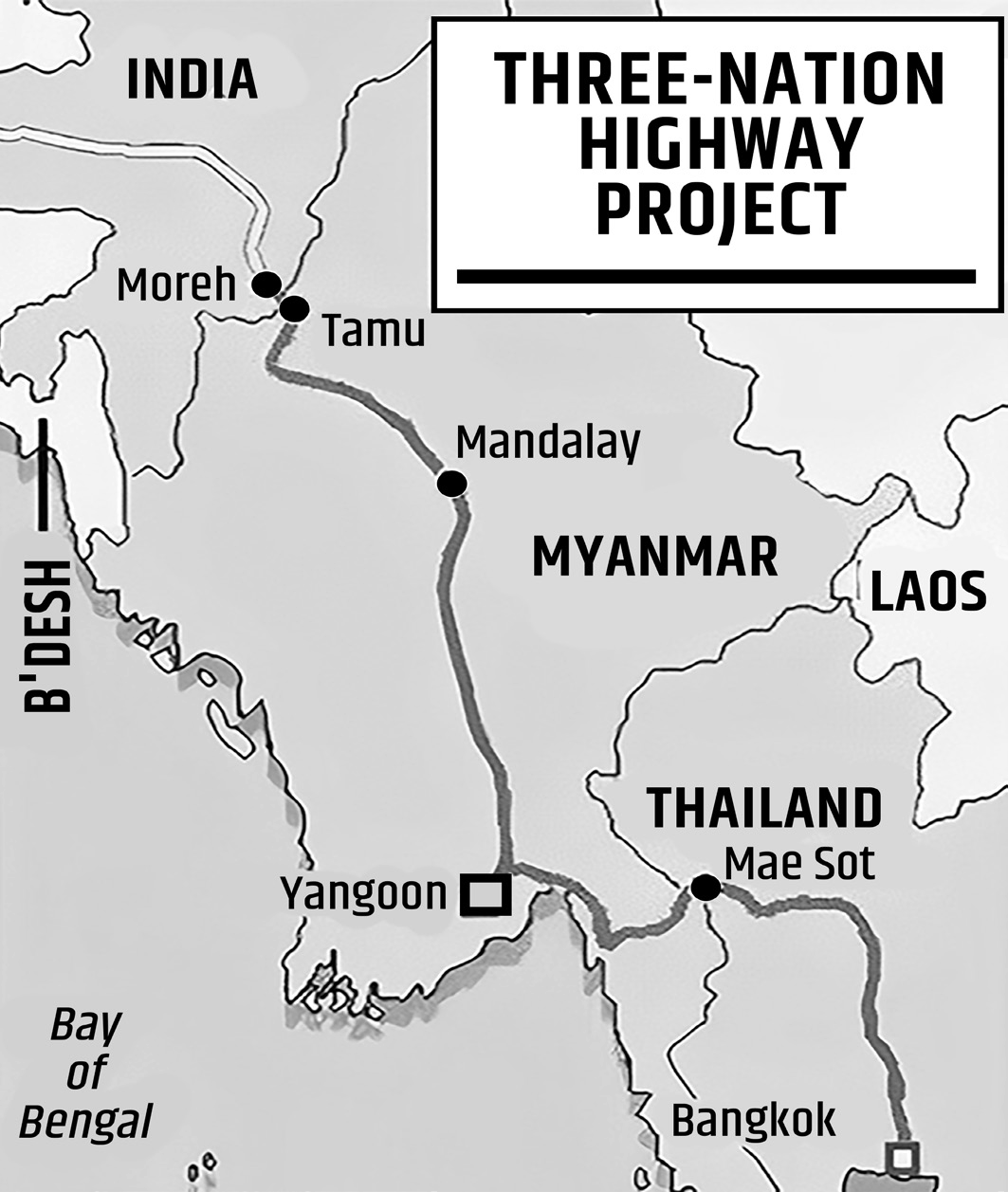
India-Thailand are cooperating closely on improving regional connectivity through initiatives like India- Myanmar-Thailand trilateral highway.
About 1.6 million Indians visiting Thailand every year.
As per Ministry of Tourism and Sports of Thailand, during 2024, around 2.1 million Indian tourists visited Thailand, which is around 6% of the total tourist inflow into Thailand and Indians were the third largest group of tourists visiting Thailand during this period.
Connectivity
The two countries are working to improve regional connectivity, including through the Bay of Bengal Initiative for Multi-Sectoral Technical and Economic Cooperation (BIMSTEC).
The India-Myanmar-Thailand Trilateral is a highly anticipated project. It will expand land connectivity through Northeast India and Southeast Asia. It will become the first-ever cross-border facilitation agreement between the two regions.
Education
In the field of education, an MoU on Cooperation was signed in 2005. Between 2018 and 2019, the government of India offered 72 scholarships to Thai students under its various schemes.At present, there are 5 Indian Study Centre in Thailand - Chulalongkorn University, Silpakorn University, Mahidol University, Thammasat University and Chiang Mai University.
Indian Diaspora in Thailand
• As per estimation around 2.5 lakh people of origin are residing in Thailand, majority of them have Thai nationality.
Result of Relations
• The ASEAN community of 625 million people is on the rise and is a worthy counterpart for the Indian market of 1.3 billion people. Thailand is working hard to link these two markets through India’s North eastern region
and Cambodia, Lao PDR and Myanmar.
• Thailand, set in the context of ASEAN, APEC, BIMSTEC, IORA, ACD and being well-established on global value chains, holds the great opportunities for India especially in manufacturing and services.
• New initiatives like Eastern Economic Corridor offer opportunities in the areas of next generation automotive, aviation, smart electronics, robotics, digital economy, health care, biotech, bio fuel and bio chemicals.
WAY FORWARD
In order to increase trade and investment, both parties should address concerns about lowering import tax rates and trade obstacles through bilateral discussions.
Opportunities for cooperation between startup ecosystem and India’s should also be investigated.
Through mutual investments in each other’s markets, the two nations can cooperate to close gaps in their supply chains.
Additionally, it is crucial to keep advancing defence engagements, military-to-military exchanges, and joint exercises as ways to deepen strategic and security cooperation.
CONCLUSION
The Indo-Thai relationship is being viewed from more perspectives than only sociocultural ones. Since the relationship’s scope has expanded to become extremely broad in the current setting. This bilateral relationship has the ability to promote growth for the entire region as well as for the two countries.
This is especially clear in light of the fact that collaboration in the interconnected domains of connectivity, economics, and security would likewise have an equivalent degree of influence on the neighboring countries and the region.