Whatsapp 88106-52225 For Details
Get Free IAS Booklet
Get Free IAS Booklet
INDIA- UAE RELATIONS
INTRODUCTION
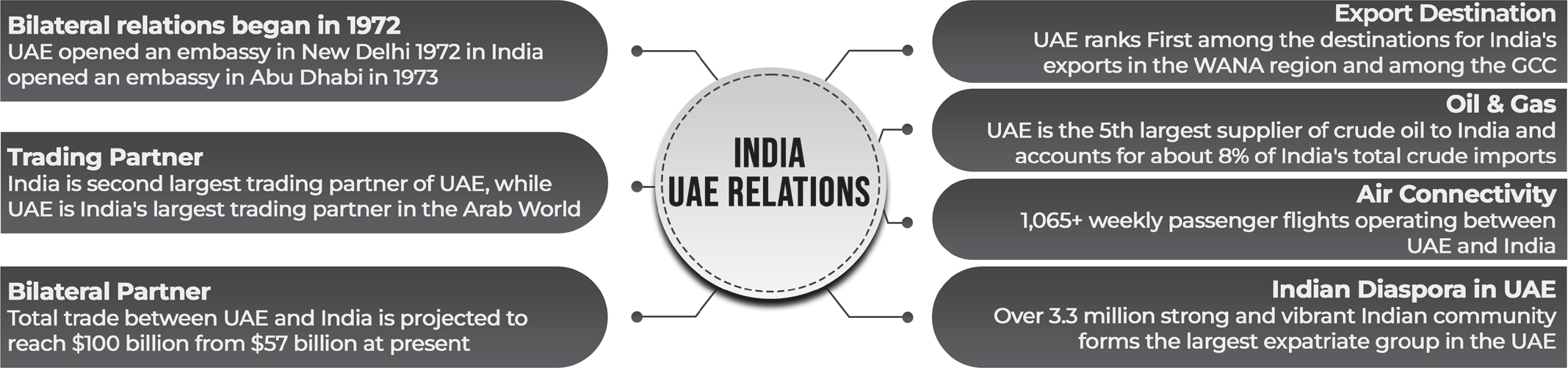
India and the United Arab Emirates (UAE) established diplomatic relations in 1972 and opened its embassy in Delhi in 1972 & India reciprocated by opening its Embassy in Abu Dhabi in 1973. The traditionally strong bilateral relations enjoyed by India & UAE received impetus with the visit of PM Modi to UAE on 16-17 August 2015 that marked the beginning of a new strategic partnership between the two countries.
• Sheikh Mohamed bin Zayed Al Nahyan, (MBZ) Crown Prince of Abu Dhabi and Deputy Supreme Commander of UAE Armed Forces, visited India in from February 2016. MBZ visited India again in January, 2017 as the Chief Guest at India’s Republic Day celebrations. It was during this visit that the bilateral relations were upgraded to a ‘Comprehensive Strategic Partnership’.
Economic & Commercial Relations
• Growing India-UAE economic and commercial relations contribute to the stability and strength of a rapidly diversifying and deepening bilateral relationship between the two countries.
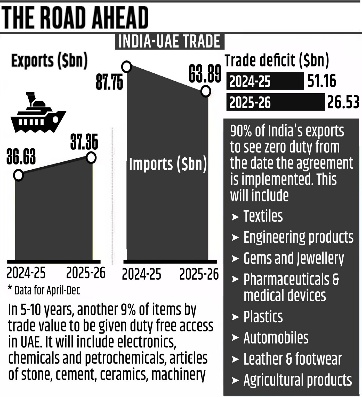
• Bilateral merchandise trade between the two countries crossed US$100 billion for the first time, reaching US$101.25 billion in FY 2025-26. Both sides have committed to doubling bilateral trade to US$200 billion by 2032.
• From April 2000 to March 2025, the cumulative FDI from the UAE into India amounted to US$25.19 billion, making UAE the seventh-largest overseas investor in India
• Indian companies have set up manufacturing units in the UAE for various sectors, including cement, building materials, textiles, engineering products, and consumer electronics.
• The Indian government has prioritized six countries/ regions for deals, with the UAE at the top of the list for an early harvest deal (the others are the UK, the
EU, Australia, Canada, Israel and a group of countries in the Gulf Cooperation Council (GCC). The UAE also plans to pursue bilateral economic agreements with India and seven other countries (U.K., Turkey, South Korea, Ethiopia, Indonesia, Israel, and Kenya).
• The Local Currency Settlement System (LCSS) aims to enable exporters and importers to invoice and pay in their respective domestic currencies, thereby developing an INR-AED foreign exchange market, according to the Reserve Bank of India (RBI).
• An agreement is in place for interlinking of instant payment platforms – UPI (India) and AANI (UAE) and domestic debit/credit cards – RuPay (India) with JAYWAN (UAE). This will facilitate seamless cross- border transactions and enhance universal acceptance of RuPay across the UAE.
• ONGC Videsh, Indian Oil Corp. Ltd (IOC), and a unit of Bharat Petro Resources Ltd (BPCL) have paid $600 million for a 10% stake in the UAE's offshore oil and gas field Zakum, marking the first Indian investment in the upstream oil sector of the UAE. The deal aims to transform the traditional buyer-sell relationship into a long-term investor relationship.
• Indian and UAE governments have signed a Memorandum of Understanding (MoU) to establish collaborative administration of contractual employment for Indian workers in the Gulf country. The MoU aims to
combat malpractices, trafficking, and education programs
for workers. It also includes a MoU for technical cooperation in railways, facilitating joint projects, knowledge sharing, research, and technology transfer. The MoU also aims to enhance cooperation in the financial services industry, facilitating investment in financial markets.
• Additionally, a MoU was signed to establish a multi-modal logistics park and hub in Jammu & Kashmir.
• The Inter-governmental Framework Agreement aims to empower India-Middle East-Europe (IMEC) Economic Corridor, a sea-land connectivity project linking India with West Asia and Europe.
• The UAE and India’s airlines are permitted to fly a total of 66,000 seats per week between Dubai and 15 Indian destinations under the bilateral air service agreement (ASA) that was signed in January 2014 between the two countries.
• India and UAE are active in various plurilateral platforms, including BRICS, I2U2, and UFI Trilaterals, and were invited as a Guest Country to the 2023 G-20 Summit.
• NRI Remittance: India remains the world's largest recipient of inward remittances, with total inflows reaching a record $110.47 billion for the full fiscal year 2025-26. The United Arab Emirates (UAE) serves as the second-largest remittance source for India globally. The UAE contributes roughly 18% to 19.2% of India's total inward remittances
Cultural and Educational Relations
UAE has over 3.3 million Indians and Emiratis are quite familiar and receptive to Indian culture. The importance given to Indian culture by the UAE was further highlighted in April, 2019 when India participated as the Guest of Honour Country in Abu Dhabi International Book Fair 2019.
Indian cinema/ TV / radio channels are easily available and have good viewership; major theatres/cinema halls in the UAE screen commercial Hindi, Malayalam and Tamil films.
The Emirati community also participate in our annual International Day of Yoga events and various schools of yoga & meditation centres are running successfully in the UAE.
Indian Prime Minister inaugurated the historic BAPS Swaminarayan Mandir in Abu Dhabi, marking India's international relations milestone. The seven-spired temple symbolizes the harmonious relationship between India
and the UAE, built by the Emirati government.
A Memorandum of Understanding (MoU) is in place for the development of the National Maritime Heritage Complex in Lothal, Gujarat.
Cooperation Protocol between the National Library and Archives of UAE and National Archives of India for restoration and preservation of archival material.
In 2019, India's Prime Minister was awarded the UAE's Order of Zayed, and the Louvre Museum in Abu Dhabi houses Indian artefacts, including a Mughal painting.
The IIT Delhi-Abu Dhabi Campus will offer its first program from 2024. Manipal, BITS Pilani and Amity University also have set up their campuses in the UAE. IIT Delhi is part of the "IITs go Global" campaign,
which includes plans to establish a campus in Abu Dhabi. This will be the second global campus for an IIT, after IIT Madras' Zanzibar campus.
Indian Community
Indian expatriate community of approx. 3.3 million is the largest ethnic community in UAE constituting roughly about 30 per cent of the country’s population. Among the Indian States, Kerala is the most represented
followed by Tamil Nadu and Andhra Pradesh.
However, Indians from the Northern States, all put together, also form a significant portion of the UAE Indian population. The profile of the community has changed from the 1970s and 1980s, when majority of the Indian community was blue-collared to the extent of 85% - 90%. Today, around 35% of the Indian community is made up of professionally qualified personnel, businessmen & other white-collar non-professionals.
Defence and Security Cooperation
Bilateral Defence Interaction between India and UAE has been steadily growing in accordance with other aspects of the bilateral relationship. There have been regular high level & functional level exchanges between the two countries. The ships of the Navies of both countries have regularly made port calls enhancing bilateral defence co-operation.
EXPANDINGSECURITYAND DEFENCE ENGAGEMENT: NEW DIMENSION OF STRATEGIC PARTNERSHIP
Another significant pillar of India-UAE ties is reflected in their growing cooperation in security and defense sector.
Given the current state of flux in West Asia, India sees the UAE as an important partner to maintain peace and stability in the region.
With the rise of global terrorist organizations and spread of radicalism in Gulf and South Asia, India looks to enhance security cooperation with the Gulf countries including the UAE to counter terrorist threats and combat online radicalization.
Similarly, UAE and India are looking to enhance defense cooperation to ensure peaceful maritime trade, prevent organized crime and deny opportunities for global terrorist organizations to set up their networks in South Asia and the Gulf.
Combating Extremism and Terrorism
India and UAE see each other as important players in maintaining peace and stability in their respective regions and have reinforced their partnership in countering terrorism, combating radicalization and preventing terror finance through intelligence sharing and close contacts between their National Security Councils.
The most significant support from the UAE came to
India after the Uri attack when Abu Dhabi sent out a very clear public statement suggesting India to take decisive action against perpetrators of the attack. Even on Pathankot attack, the UAE supported India.
WAY FORWARD
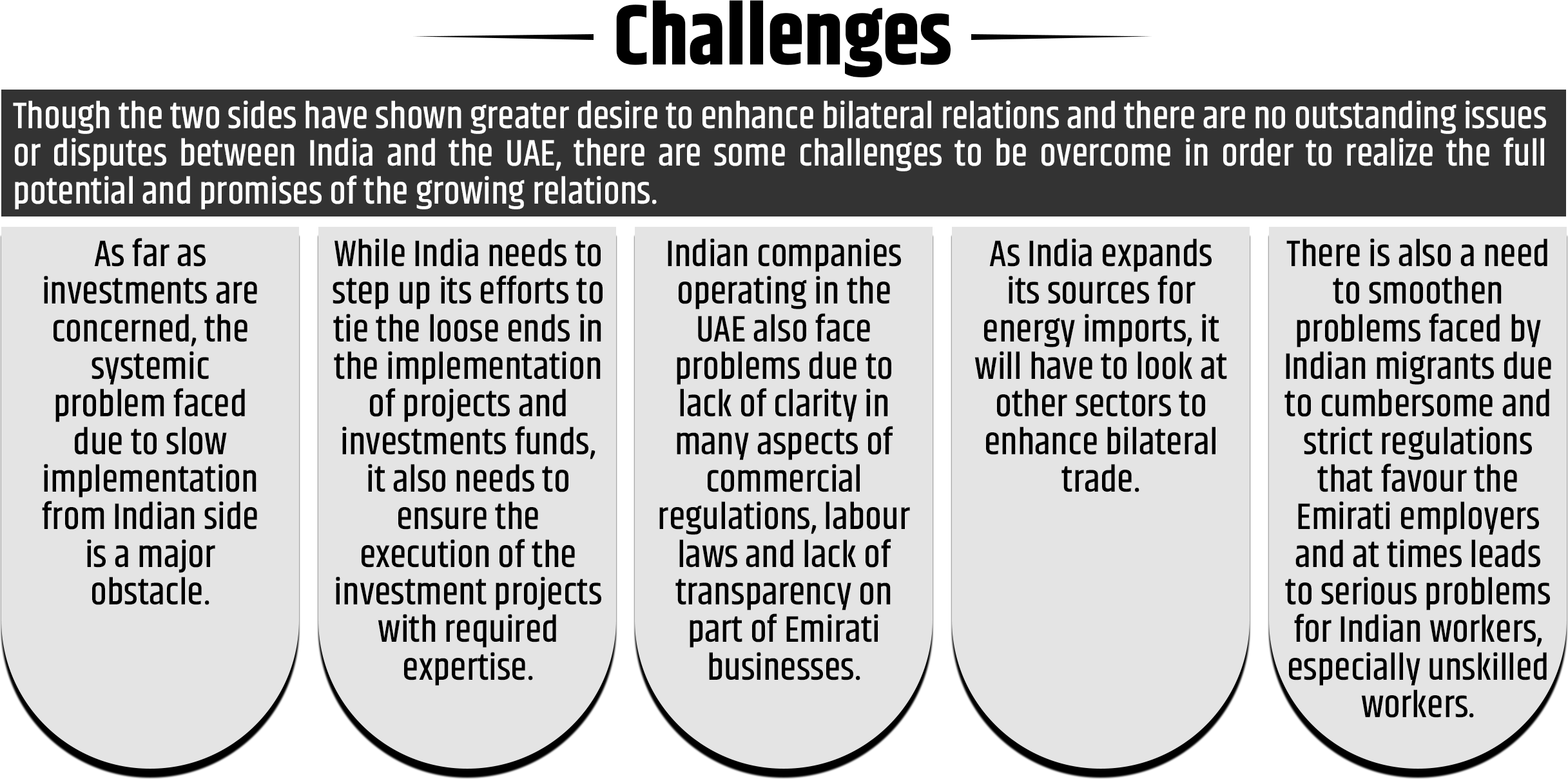
As India and UAE look forward to enhance their bilateral relations, there are areas that provide further opportunities and should be tapped to further the ties. There are untapped potentials as far as Indian health industry and medical
sector is concerned.
India is home to one of the finest human resources as far as the medical profession is concerned and its private hospitals have the necessary infrastructure, facilities and expertise to provide world class medical care within a fraction of the cost spent in developed countries. Hence, medical tourism can be an important area where India
can attract Emiratis.
There are further untapped potentials in the arena of renewable energy. The cost for production and transmission of solar energy in the UAE are a fraction
to that of India and this is a priority area for the UAE government. Indian companies with expertise in this area can invest in the renewable energy sector in UAE. India can also learn from UAE’s experience as it has been able to create a significant infrastructure in this area within a short span of time and with lesser cost.
There is a scope for improving the investment climate in India to attract UAE businesses. India has a huge market and there is a significant scope for growth in automobile industry, services sector, agriculture and allied industries.
India has some of the finest higher education institutions in engineering and management fields and given their cost-effective and world-class education, they can be a major attraction for Gulf and Emirati students who are looking for acquiring higher education and better skills.
Further, there is a need for enhancing the people-to- people contacts for familiarisation and increasing interactions between think tanks, researchers and through academic exchanges.
In defense sector, there is a need to further enhance cooperation through joint training programs for Indian and UAE officers.
India can also increase the number of Emirati officers who can avail training in its defense schools. This will lead to greater familiarisation within the defense establishment as both the countries move towards enhancing greater defence engagement.