India-uk Relations
INDIA-UK RELATIONS
INTRODUCTION
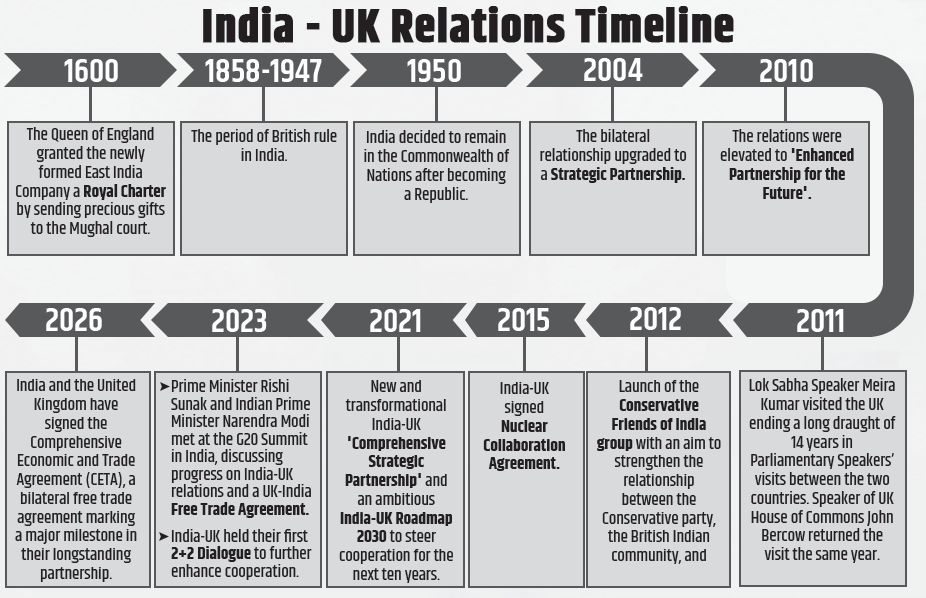
• East India Company (1600–1857): Trade was established between Tudor England and Mughal India in 1600 when Elizabeth I granted the newly formed East India
Company a royal charter.
• Following the Indian Mutiny of 1857, where Indian sepoys rebelled against their British officers, the East India Company was dissolved the following year.
• British Raj (1858–1947): In 1858, the British Governmentassumed direct control of the territories and treaty arrangements of the former East India Company.
• Opposition to British rule increased,both through violent revolutions and through nonviolent resistance which eventually led to Indian independence in 1947.
• In 1950 India became a Republic and the link with the British crown was severed.
• India decided to remain in the Commonwealth of Nations after becoming a Republic. Both Britain and India have since pursued quite divergent diplomatic paths.
India- UK Relation in the Present-day Context
• The bilateral relationship that was upgraded to a strategic partnership in 2004.
Indian mission in the UK: The Indian mission in the UK on May 22, 2017 organized the first community-wide anti- terrorism pledge.
The pledge is taken by Indian embassies and missions around the world to coincide with former Prime Minister Rajiv Gandhi’s death anniversary on May 21, marked as Anti-Terrorism Day in India.
The Indian High Commissioner to UK was of the opinion that the scourge of terrorism affects innocent lives not just in one country but across the globe.
KEY AREAS OF COOPERATION
Economic Cooperation
Bilateral trade between India and the UK reached approximately £47.9 billion / $56 billion in which India’s exports to UK was £19.3 billion (31% goods, 69% services) and India’s imports from UK was £28.7 billion (39% goods, 61% services).
The UK is India's 4th-largest export destination, while India is the UK's 11th-largest trading partner globally
Investments
There are 971 Indian companies operating in the UK, with combined revenues of almost £68 billion. UK is the 6th largest inward investor in India and has invested US$ 35.28 billion in FDI inflows between April 2000 - September 2024.
There are 667 British companies in India with a combined turnover of approximately INR 5082 billion. Total outward FDI to UK is $19 billion till March 2024. Indian companies in UK are employing over 1.7 lakh people in UK and the UK companies in India are employing over 5 lakh people
India-UK Joint Economic Trade Committee (JETCO) and Collaboration
JETCO provides a forum to United Kingdom companies to enhance their links and develop new partnerships with India business and decision-makers.
Government to Government negotiations, which address issues of market liberalization and market access, are conducted through the JETCO process.
The UK India Business Council plays a key role in feeding the views of the UK business community into the JETCO process with a view to achieving favourable outcomes for UK companies.
One of the key objectives of the JETCO process is to unveil opportunities for UK’s most prominent institutional investors to invest in India.
Defence
India and the UK signed the Defence and International Security partnership (DISP) in November 2015 to provide a strategic roadmap and direction to the evolving India- UK Defence Relations.
Around 70 defence related companies across the UK supply various goods for aircraft/helicopter manufacturing/overhaul at HAL like ejection seats, fuel tank kits, hydraulic pumps, engine spares etc. and support legacy platforms like Jaguar, Mirage & Kiran.
Maritime cooperation is another area where engagement is increasing. UK is deploying Carrier Strike Group in Indian Ocean region this year in line with its strategic tilt to Indo-Pacific.
• Joint military exercises - Ajeya Warrior-Army; Konkan- Naval; Indradhanush, Air Force.
Maritime cooperation is another area where engagement is increasing. UK is deploying Carrier Strike Group in Indian Ocean region this year in line with its strategic tilt to Indo-Pacific.
Education, Research and Innovation
UK is among the favoured destinations for Indian students to pursue higher education. India was one of the biggest beneficiaries of UK’s new liberalised point-based immigration system. Around 50000 Indian students are currently studying in UK.
UK is India’s second largest partner in Science and Technology collaborations. The two sides are collaborating under institutionalized mechanisms like UK-India Education and Research Initiative (UKIERI) and through UK Research and Innovation (UKRI) programmes.
UK identifies India as a key development partner. Further, the two sides are discussing Global Innovation Programme, which will support Indian sustainable innovations to be scaled up and transferred to select developing countries. GIP builds on the success of Invest Global, a pilot project that was supported by DST and ex- DFID as part of the Millennium Development Alliance.
Climate and Environment
India and UK closely engage on climate related issues through various mechanisms including the Ministerial Energy Dialogue (Sep, 2018), and Joint Working Groups on Climate, Power and Renewables.
India-UK Green Growth Equity Fund is mobilising institutional investments in the renewable energy, waste management, electric mobility and environment sub- sectors in India.
Health
Health sector collaboration is a key element of India- UK Strategic Partnership. The Joint Working Group on Health and Life Sciences regularly meets to prioritise and coordinate bilateral cooperation in the health sector.
The two sides are also working on pandemic preparedness, Antimicrobial Resistance (AMR), Zoonotic research, non- communicable diseases, digital health, ayurveda and alternate medicines, as well as health worker mobility.
Ayurveda: An MOU was signed in April 2018 during the visit of PM Modi to the UK. Under which £110,000 was sanctioned to the Prince’s Foundation, UK/College of Medicine, for developing an AYUSH Centre at St. Charles Hospital, London.
IPR and Medicines
The leaked intellectual property rights (IPR) chapter of the FTA calls for the harmonization of intellectual property (IP) regulations, especially patent laws in the UK and India.
Such relatively strict laws could affect the provision of affordable and life-saving generic medicines in India.
Agriculture
Agriculture is a sensitive sector in both countries. The UK is a net agricultural importer and an FTA could boost India’s agricultural export share from just 1.1% in the UK’s import basket for goods like rice, marine products, spices and bovine meat.
India could revisit its apprehensions about allowing British food imports, especially with its expanding middle class that is willing to spend on higher-value added agri- based food products.
To compensate farmers for losses from increased British imports, India could establish a structural fund like those of the EU, and the UK could contribute aid-for-trade.
Multilateral Collaboration
UK has been supportive of India’s permanent membership of UNSC since 2004 and voted favourably in the roll-over decision on UNSC reforms to the 70th
session of UNGA. UK is also a strong supporter of India’s membership of the NSG, MTCR, Australia Group and Wassenar Arrangement.
UK and India are the current co-chairs of CDRI. UK is also a member of ISA and supports its activities.
Data Policies
Data protection is a major concern for UK firms that may operate in India under the FTA due to the absence of GDPR like protection in India.
India should implement the Digital Personal Data Protection Bill 2023 that is pending in the Indian parliament. Recently, the Lok Sabha passed the Bill.
This will be an important step towards better data protection and meeting the UK business standards.India’s concerns
Perception in India that Britain was too supportive of Pakistan.
Recent efforts of the Indian government to extradite high net worth individuals such as Vijay Mallya back to the country.
Recent row over student visas.
British concerns
Demands around opening up of financial and legal services in India, and its opposition to India’s visa and mobility demands as part of any agreement.
migration and Visa issue
In the whole Brexit debate one of the most critical issues is the immigration issue. They need to control the flow of immigrants into their country. There are people of Indian community in UK who voted for Brexit. India would not react so long as the rules are made in a non-discriminatory fashion, without discriminating any country. There must be enough flexibility in the immigration rules for dealing with genuine cases, like people married to someone in UK or when there are medical reasons and people want to stay in UK for long periods of time. The immigration rules should not be dampener for genuine travellers,
students, research workers etc..
Tourism is another factor, a lot of Indian’s visit UK and spend lot of money. For Chinese tourists, UK has reduced the tourist visa fee. It is unlikely that India will get the similar generosity. The number of Indian tourists is huge and there is a need for some kind of generosity. India has opened up electronic visa for people who want to travel to India and is willing to reduce the visa fee. There is need for generosity and pragmatism in the tourist visa fee issue.
In: the last 5 years the number of Indian students going to UK has fallen by 50%. This is because of the tightened rules. Indian students find opportunities that are as good as Britain in Australia and Canada apart from USA. It’s time to negotiate with UK for visas and making easy mobility between both the countries.
Indian Diaspora
Indians make up around 2.86% of the United Kingdom's population.
As per the UK Census 2021, total Indian Population in the United Kingdom is around 19 Lakh or 1.9 million.
The UK is the largest source of European remittances to India.
KEY ISSUES
When it came to India, the British government doesn’t have a strategy and rather than involving a joined- up approach, random interventions were made by individuals within the British government that were inevitably ineffective.
Brexit
‘Brexit’ is the name given to the United Kingdom’s departure from the European Union. It is a combination of ‘Britain’ and ‘exit’.
Britain’s post-Brexit opportunities in which India and the UK business relations can develop:
Getting rid of EU (European Union) regulations, Britain will be more flexible and increase trade between the two nations as a result.
As one of the fastest growing economies with a GDP growth projection of 42.9% (period growth at constant prices) between 2016 and 2021, there are ample investment opportunities in India.
Globally, India ranked number 3 in 2016 in terms of investment in telecommunications at US$13.1 bn (constant prices), making India one of the best suitors to invest in the UK’s telecommunication sector.
In the absence of the EU-India free trade agreement, the UK expects to benefit from tariff free trade with India.
Britain will be able to increase its exports to India by more than £2 billion per year after Brexit by cutting EU red tape.
There is significant potential for the growth in the export of pearls and precious stones from the UK to India, cars and car parts and alcohol.
Imports from India to the UK will rise by around £1 billion, meaning the UK’s balance of trade will be improved. Britain and India leading the potential to expand post- Brexit trade in the auto sector
Import – Exports of cars
Exports of U.K.-made cars to India rose 8.3% in the first half of 2017, while those of Indian-made cars to the U.K. almost doubled.
The 8.3% rise in sales of U.K. cars was driven by increased demand for British-made luxury cars, while the number of India-built cars rose by 48.6%.
Both India and the U.K. are serious about overcoming legacy issues and engaging in robust dialogue to promote cooperation on strategic and defense issues, both in the Indo- Pacific as well as at the global level. They both trying to carve out their new identities on the global stage and their strategic convergence has allowed for the possibility of reimagining the future of their partnership.
Extradition Treaty
Cabinet approved the ratification of ‘Extradition Treaty’ between Indian and Belgium It is aimed at providing a legal framework for seeking extradition of terrorists, economic offenders, and other criminals from and to Belgium.
It will replace the pre - independence Extradition Treaty between Great Britain and Belgium of 1901 that was made applicable to India through the exchange of letters in 1958.
Each Party agrees to extradite to the other any person found in its territory, who is accused or convicted of an extraditable offence in the territory of the other Party.
An extraditable offence is an offence punishable under the laws of both the Parties with imprisonment for one year and more severe punishment.
Offences relating to taxation, or revenue or is one of a fiscal character also fall within the scope of this Treaty.
The extradition can be refused under the pre mentioned conditions such as offence involved is a political offence; offence for which extradition is requested is a military offence; prosecution of enforcement of sentence has become time barred etc.