India-west Asia Relations
INDIA-WEST ASIA RELATIONS
INDIA’S WEST ASIA POLICY
For many years, India remained a passive participant in West India has ties to West Asia since millennia. The Indus Valley civilization had trade links with Dilmun (Bahrain). In the 6th century BCE, Punjab was part of the Persian Empire. In the 3rd century BCE, Egypt’s II and the Mauryan emperors Chandragupta Maurya and Asoka exchanged ambassadors. Farsi was the language of the Mughal court and India’s official language until 1835. This connection continues. India has interests in economic, political, security and strategic fields with the West Asian nations. Asia, benefiting from positive relationships with various regional actors. Traditionally, India’s policy towards West Asia has been multi-faceted.
• During the Cold War, India fostered strong economic ties with both Saudi Arabia and Iran, despite these nations being at opposite ends of the regional geopolitical spectrum.
• In the post-Soviet era, India expanded its approach from a bi-directional to a tri-directional foreign policy, incorporating the three key pillars of West Asia: Saudi Arabia, Iran, and Israel.
AREAS OF COOPERATION
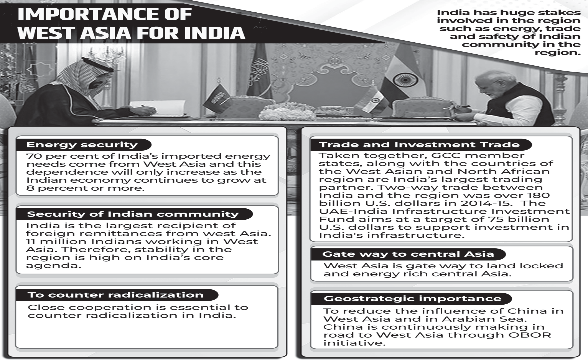
Strategic alliances: To further its political and security objectives in the region, India has established alliances with several West Asian nations. For instance, India has close defense relations with Israel (purchasing Barak missiles) and a CEPA with the United Arab Emirates.
Migration and labour: India is a major source of migrant labour in West Asia, with many Indians seeking work in countries like the UAE and Saudi Arabia, making it a significant migration and labour movement.
Humanitarian assistance: India has provided humanitarian aid to countries in the region during crises, such as natural disasters or conflicts, such as Syria's civil war.
Connectivity: The International North-South Transport Corridor (INSTC) is a multi-mode networkof ship, rail, and road routes aimed at reducing freight transport costs between India and West Asia to Europe, initially decided between India, Iran, and Russia in 2000, and later including 10 other central and West Asian countries.
Ashgabat Agreement: Signed in 2011, it aims to improve the transit and transportation of goods between Central Asia and the Persian Gulf, with India joining in 2018.
Counter Terrorism and Radicalization: Cooperation with West Asia is crucial to counter terrorism and radicalization, as the geographical proximity of the region helps prevent the spread of terror outfits like Islamic State and associated ideologies into India.
Defence Cooperation: India is strengthening its defence cooperation with the United Arab Emirates and Oman, conducting regular exercises and providing refuelling facilities. The strategic Port of Duqm in Oman will expand India's footprint in the Indian Ocean region, strengthening its maritime strategy against Chinese influence.
Gateway to Central Asia: West Asia serves as a gateway to Central Asia, with Chabahar port in Oman facilitating direct sea access for India, boosting trade and connectivity bypassing Pakistan.
Remittance: Non-resident Indians (NRIs) contribute over 55% of India's total remittance inflows, with 82% of total remittances originating from seven West Asia countries, according to the Reserve Bank of India.
CHALLENGES IN WEST ASIA
• Limited economic ties: India's trade with West Asian countries is limited compared to other regions, accounting for only 7.5% of global trade in 2019.
• Balancing between Palestine and Israel: The region is politically tense, and India must navigate complex geopolitical dynamics, such as balancing relations with Israel and Palestine.
• China's rising influence: India's relations with West Asian countries are also influenced by competing interestsof major powers like China, which India has sought to counter through economic and security cooperation with countries like the UAE and Saudi Arabia.
Political instability: Political instability in West Asia, such as the instability in Syria, Iraq, and Yemen, has negatively impacted India's interests in the region.
Terrorism threat: The rise of the Islamic State and other terror groups has created threats to the Indian diaspora in West Asia, and the radicalization of Indian youth has also been a major problem.
Shia-Sunni Conflict: Sectarian tensions between Shia and Sunni Muslims in the region have also impacted India's relations with West Asian countries.
Energy dilemma: India continues to buy oil from Russia despite US and Western sanctions, prompting Iran to consider importing oil and gas from them. This presents a complex dilemma in the wake of US-imposed CAATSA sanctions.
Weak labour Laws & Indian diaspora: Some West Asia countries, particularly Gulf States, have not ratified core international Labour Organisation conventions protecting freedom of association, right to organize, strike, and collective bargaining. For example, UAE's labour laws favour employers and law enforcement are poor.
INDIA’S “LOOK WEST” POLICY
India adopted look west policy in 2005. However, the policy did not get much attention since 2005. Recent visit of Prime Minister Narendra Modi to number of west Asia countries has the potential to transform our engagement with West Asia.
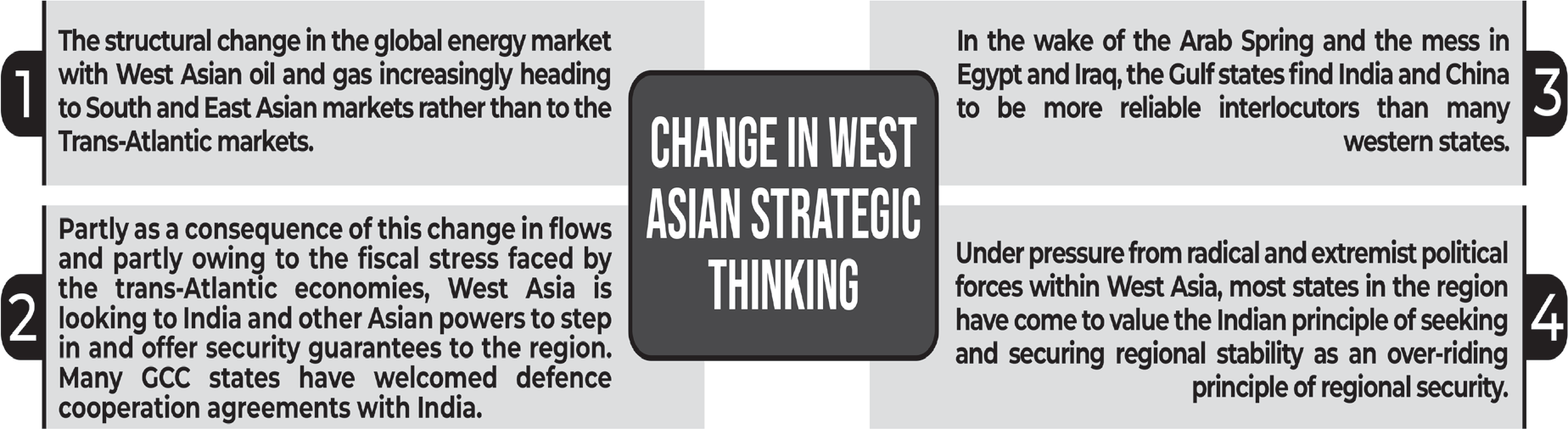
Several factors have contributed to this fundamental shift in West Asian strategic thinking.
Analysis
The success of the "Look East" Policy was due to Southeast Asia turning to India as a counterbalance to China.
The "Look West" Policy is poised for success because West Asia is increasingly looking to the East, concerned about rising strategic instability in its own neighborhood and the shifting dynamics in the global energy market.
The India-West Asia relationship reflects not only a shared history but also mutual challenges in the present and a common vision for the future.
THE 6TH INDIA-ARAB PARTNERSHIP CONFERENCE
The 6th India-Arab Partnership Conference, organized by the Arab-Indian Cooperation Forum, took place from 11- 12 July 2023 in New Delhi.
The conference aimed to provide an institutional platform for robust engagement between the business communities of India and the League of Arab States (LAS) countries.
The conference focused on investment climates, opportunities, and the role of the private sector in promoting trade and investment relations.
CONCLUSION
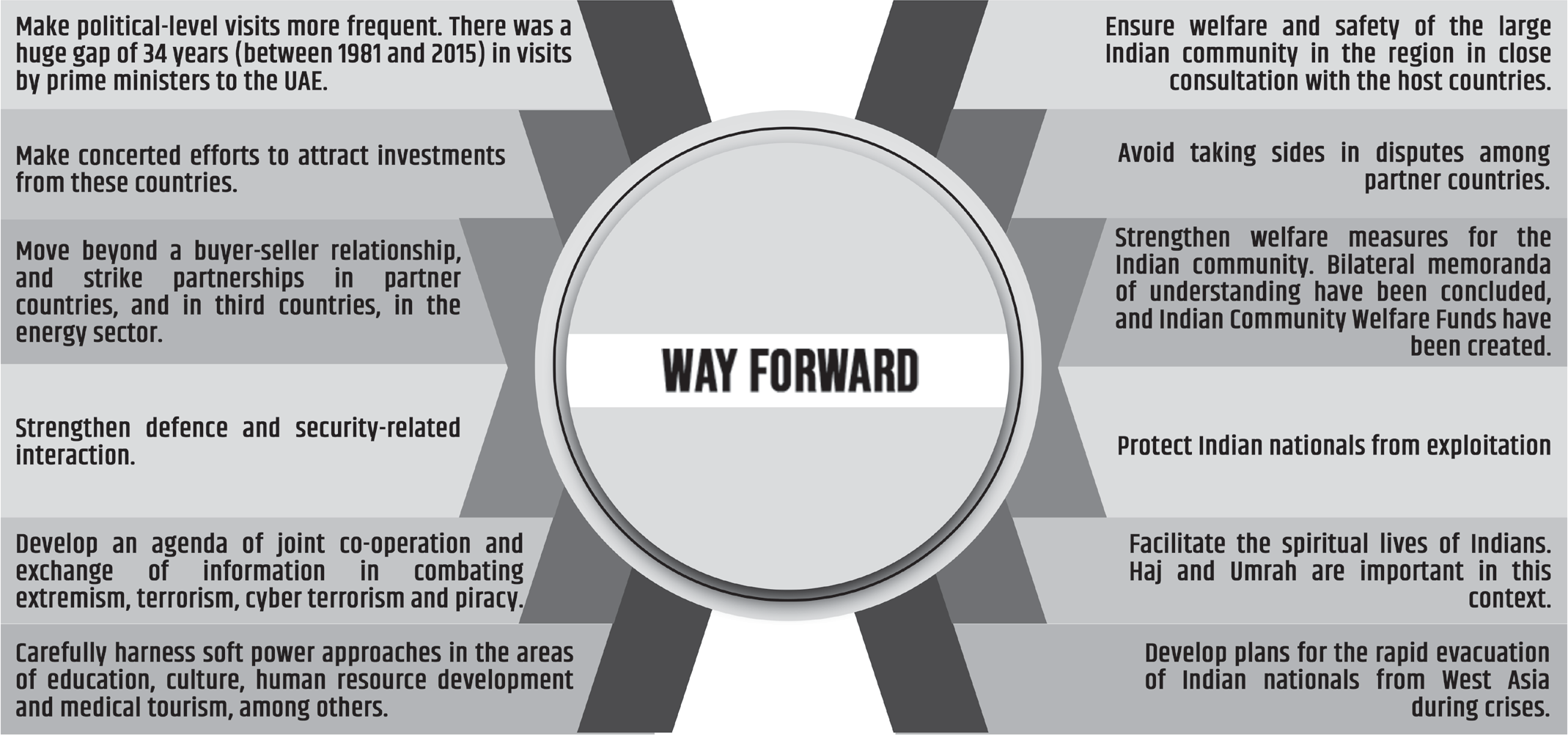
We share political and security concerns, and need to pool in efforts for peace and stability in the Gulf, as well as the security of the maritime routes passing through the region. Common threats from terrorism and fundamentalism require joint action. Given the conflicts and volatility of the region, Indian diplomacy needs to approach West Asia with pragmatism, delicacy and sophistication. This is indeed happening.