Whatsapp 88106-52225 For Details
Get Free IAS Booklet
Get Free IAS Booklet
INTRODUCTION
The story of the evolution of India’s foreign policy begins with the pre-independence period when Indian National Congress decided in 1932 to have a foreign policy department under the chairmanship of Jawaharlal Nehru with Ram Manohar Lohia as its secretary. As a matter of fact, no country in the world can afford to have an isolationist policy preference in its dealings with rest of the world given the complex nature and working of international relations. Such a situation holds truer in the case of countries like India that have always looked upon themselves as active participants in the global affairs with the objective of not only serving their national interest but also as conscience-keepers of collective wisdom and the pursuits towards the well-being of humankind. Moreover, in the case of India, there have been a number of factors that seems to have persuaded the country to evolve a definite and comprehensive foreign policy. For instance, sheer size of the country, its rich diversity, historical and cultural relations, existence of a large number of countries in the near and not-so-distant neighbourhood as well as expectations of a majority, if not all, of the countries from Asia and Africa to provide a formidable voice to their concerns along with the global vision and outlook of its leaders – have all tended to make the country an important player in the international politics. In analysing the evolution and working of India’s foreign policy at different periods of time, two inter-related tendencies could be identified that acted as its signposts. One, in providing for the evolutionary framework of India’s foreign policy especially during its formative years in the post-independence period, moralistic overtones and global concerns seemed to have taken precedence over the sheer imperatives of national interests. In other words, the idealist rather than the Realist perspective of international politics has been at the core of India’s foreign policy during its early phase. In its urge to provide leadership to the mass of newly-independent countries of Asia and Africa, India tended to mould its foreign policy in quite ambivalent mode than having a sharply focused perspective aimed at serving national interests at any cost. The disastrous impact of such a foreign policy in terms of both losing a decisive war as well as other compromises on national interests is apparent to see. Two, in the post-Nehru years, the conduct of India’s foreign policy has been underpinned by harsh realities of national and global politics, apart from the personal preferences of the leaders at the helm of country’s foreign policy at a particular period of time. For instance, though non-alignment has been the core of India’s foreign policy ever since the country gained independence, it was compromised to a large extent, if not shelved altogether, by signing of the Indo-Soviet Treaty of Peace and Friendship in 1971. Thus, despite the permanence of national interests of the country, the foundational principles and operational dynamics of India’s foreign policy of India has not showed that degree of permanence and consistency
FORMATION OF INDIA’S FOREIGN POLICY
The genesis of India’s foreign policy can be traced back to the period of British rule in India. During this time, the colonial government often involved India in global politics to serve the interests of Great Britain. Despite not having a direct stake in international affairs, India was made a party in global relations to strengthen the British position on crucial issues. The British rulers’ articulated positions on behalf of India sometimes contradicted India’s conventional wisdom and philosophical foundations.
The initial response of the Indian National Congress, the leading political party in the Indian independence movement, was hesitant. However, as the national movement gained strength and the Congress became more involved in the country’s governance, there was a growing realization of the need for a structured approach to foreign affairs. Consequently, the Congress created a department of foreign affairs within its organizational structure, marking the first step towards the evolution of India’s foreign policy. Jawaharlal Nehru, a prominent leader of the Congress, played a pivotal role in articulating India’s stance on international issues independently of the colonial government.
As India moved towards the end of colonial rule, Nehru, who became the interim Prime Minister, developed sharper and more categorical perspectives on foreign policy. In a broadcast on September 7, 1946, Nehru outlined the guiding principles of India’s foreign policy. His vision was idealistic, aligning national interests with broader international challenges such as the end of colonialism, imperialism, racism, nonalignment with power blocs, and fostering friendship and solidarity among newly emerging nations in Asia and Africa.
The values of India’s freedom movement significantly influenced its foreign policy. Leaders of the movement saw India’s freedom as interconnected with the liberation of all colonized people in Africa and Asia. The movement was rooted in principles of ahimsa (non-violence), satyagraha (truth-force), and swadeshi (self-reliance). It was a popular movement that unified people across castes, linguistic groups, and communities. The values emerging from this struggle, including equality, non-discrimination, freedom, social justice, and development, became guiding principles of Indian foreign policy.
The world-view developed during the freedom movement emphasized active engagement with other nations on the basis of equality, freedom, and sovereignty. Nehru also highlighted India’s interest in the emancipation of colonial and dependent countries and rejected racialism. Despite India’s independence, Nehru recognized the economic and defence ties with the British Commonwealth, acknowledging the need for continued engagement for India’s economic development and military preparedness.
Nehruvian Era
During the Nehruvian era, Jawaharlal Nehru played a crucial role in shaping India’s foreign policy. As both the Prime Minister and the first foreign minister of the country for an extended period, Nehru formulated a foreign policy that left a lasting impact even after seventy years of independence. Nehru’s foreign policy was characterized by a mix of idealism and pragmatism.
Idealism and Non-Alignment
N ehru was considered an idealist at heart, and his foreign policy seemed to align more with his moralistic worldview than the immediate national interests of the country.
The onset of the Cold War presented challenges, but Nehru, along with nations like Egypt, Indonesia, and Yugoslavia, embraced the policy of non-alignment. Non-alignment stood for the independence of developing countries in making autonomous decisions irrespective of the positions taken by the two power blocs.
Nehru’s commitment to Afro-Asian solidarity influenced his stance against imperialism and colonialism.
Panchsheel and Neighbour Relations
The doctrine of 'Panchsheel' consisting of principles like respect for sovereignty, non-aggression, noninterference, mutual benefit, and peaceful co-existence, guided India’s relations with its neighbours.
Nehru believed in the principles of 'Panchsheel' and assumed that countries, particularly China, would adhere to them. However, this idealism led to consequences, such as the Chinese Invasion in 1962.
Nehruvian Consensus
The concept of ‘Nehruvian Consensus’ emerged around the ideals and principles developed during India’s struggle for freedom. It included anti-racism, anti-apartheid, and anti-imperialism.
Nehru combined Gandhian values with the vision of a modern, sovereign India on the path to rapid economic development.
The consensus supported multilateral institutions, international law, collective security, diplomacy, and peaceful dispute resolution.
Changes in the 1970s:
By the 1970s, the international landscape had changed. The space for non-alignment had shrunk, and the Cold War had intensified.
Prime Minister Indira Gandhi, more of a pragmatist, shifted towards ‘realpolitik,’ and India’s capabilities had grown both militarily and economically.
The signing of the Indo-Soviet defence treaty in 1971, the liberation of Bangladesh, and the Pokhran nuclear tests marked a departure from the Nehruvian Consensus
Post Nehruvian Era or During the Cold War
During the major period of the Cold War in the post-
Nehruvian era, India’s foreign policy underwent significant evolution and development under the guidance of five Prime Ministers: Lal Bahadur Shastri, Indira Gandhi, Morarji Desai, Charan Singh, and Rajiv Gandhi.
Lal Bahadur Shastri:
Shastri’s term as Prime Minister, though short, was eventful, marked by the Indo-Pakistan War of 1965.
Shastri showed exemplary courage during the war, boosting the morale of the Indian army, leading to a decisive victory for India.
Shastri’s leadership during a crisis made him a heroic figure in both domestic and foreign affairs.
Indira Gandhi and Paradigm Shift:
I ndira Gandhi succeeded Shastri and initially continued with traditional formats of foreign relations.
The limitations of Nehruvian mores became apparent during the disturbances in East Pakistan, leading to a paradigm shift in India’s foreign policy.
India signed a Treaty of Peace and Friendship with the Soviet Union in 1971, aligning with the Soviet Union during the Indo-Pakistan War.
Shimla Agreement and Nuclear Tests:
A fter the war, Indira Gandhi signed the Shimla Agreement with Pakistani counterpart Zulfiqar Ali Bhutto, attempting to bring the Kashmir issue back to bilateral negotiations.
India conducted its first nuclear tests at Pokhran in 1974, signalling a departure from the perceived Nehruvian stance of remaining a non-nuclear nation.
Janata Party Rule:
The Janata Party rule under Morarji Desai and Charan Singh saw relatively uneventful years in terms of foreign policy.
Despite opposition to the pro-Soviet tilt in non-alignment, no major modifications were made to Indian foreign policy.
Rajiv Gandhi and Interventionist Policy:
Rajiv Gandhi, after assuming office in 1984, displayed an inclination towards resolving long-standing ethnic conflicts.
Internally, his tenure witnessed peace agreements in Assam, Mizoram, and Punjab, while externally, he introduced an overtly interventionist twist with the Sri Lankan Peace Accord.
The accord led to the deployment of Indian Peace Keeping Forces (IPKF) in Sri Lanka, marking a departure from India’s non-interventionist stance.
Rajiv Gandhi’s Legacy:
Rajiv Gandhi’s foreign policy, particularly the Sri Lankan intervention, was distressing and harmful to national interests.
The IPKF operations in Sri Lanka incurred a significant human cost and raised concerns about India’s role in the liberation movement of Tamils.
Foreign Policy during the 1990s
In the 1990s, India’s foreign policy witnessed substantial changes and challenges, marked by the disintegration of the Soviet Union and the shift from a bipolar to a unipolar international political scenario.
The P V Narasimha Rao government faced pressure from the United States to dismantle India’s nuclear and missile programs after the Soviet Union’s collapse. India, grappling with a severe domestic economic crisis, initiated economic liberalization, moving away from its state-centric strategy of development.
Under Rao’s leadership, India adopted the Look East Policy in foreign economic affairs, recognizing the need to integrate with dynamic economies in Southeast Asia and East Asia during the era of economic globalization. Diplomatic relations with Israel were established, and India began formulating policies to combat cross-border terrorism, raising it as a security threat in international forums.
Facing external pressures, India aligned itself with the U.S. and co-sponsored the Comprehensive Test Ban Treaty (CTBT) and Fissile Material Control Treaty (FMCT). For the first time, defence cooperation between India and the U.S. began to take shape.
The latter half of the 1990s was marked by coalition governments in India, resulting in political instability. Prime Ministers Atal Bihari Vajpayee, Deve Gowda, and I. K. Gujral led short-lived governments, characterized by a lack of majority to bring about radical changes in foreign policy. Despite the political challenges, Inder Kumar Gujral introduced the ‘Gujral Doctrine.’ This doctrine aimed at extending benefits to India’s neighbours (excluding Pakistan) on a non-reciprocal basis, emphasizing principles like noninterference, territorial integrity, and peaceful dispute resolution through bilateral negotiations
Foreign Policy under NDA 1
India’s foreign policy under the leadership of the Bhartiya Janata Party (BJP)-led National Democratic Alliance (NDA) government, headed by Atal Behari Vajpayee, saw significant shifts and initiatives.
Vajpayee’s Terms:
Vajpayee became Prime Minister in 1998 and led the NDA government in three distinct phases (1996, 1998-99, and 19992004). The NDA government pursued a closer cooperation with the United States from the beginning, emphasizing maintaining good ties with Russia and fostering good neighbourly relations in South Asia.
Nuclear Test:
One of the major initiatives was the nuclear test conducted at Pokhran in May 1998, declaring India a nuclear weapon state. India’s nuclear doctrine included principles such as a voluntary moratorium on further tests, ‘no first use,’ and ‘minimum credible’ deterrence.
Indo-US Relations:
The NDA government engaged in a dialogue with the United States, seeking improved relations. There was a better understanding of India’s growing strategic importance, with US President Bill Clinton visiting India in March 2000. The 9/11 attacks and subsequent developments led to increased cooperation, positioning India as a strategic partner for regional peace and stability. The US recognized India’s security concerns, especially in the context of cross-border terrorism emanating from Pakistan.
India-Pakistan Relations:
Despite setbacks like the Kargil war in 1999, Vajpayee took unprecedented initiatives to improve relations with Pakistan. The bus trip to Lahore and an invitation to Pakistani counterpart Nawaz Sharif were notable efforts. However, the Kargil conflict and subsequent events strained relations. Vajpayee later invited Pervez Musharraf to Agra in 2001, but normalization efforts faced challenges, and the attack on the Indian Parliament in December 2001 further escalated tensions.
These foreign policy initiatives during Vajpayee’s terms showcased a nuanced approach, including nuclear capabilities, improved relations with the United States, and attempts at normalizing ties with Pakistan, while maintaining regional stability and economic growth.
India’s Foreign Policy during the UPA Governments
The United Progressive Alliance (UPA) government, led by Prime Minister Manmohan Singh, governed India’s foreign policy for a decade (2004-2014). Despite the continuity in certain foreign policy aspects, the UPA government introduced new elements to align with changing global dynamics.
Economic Focus:
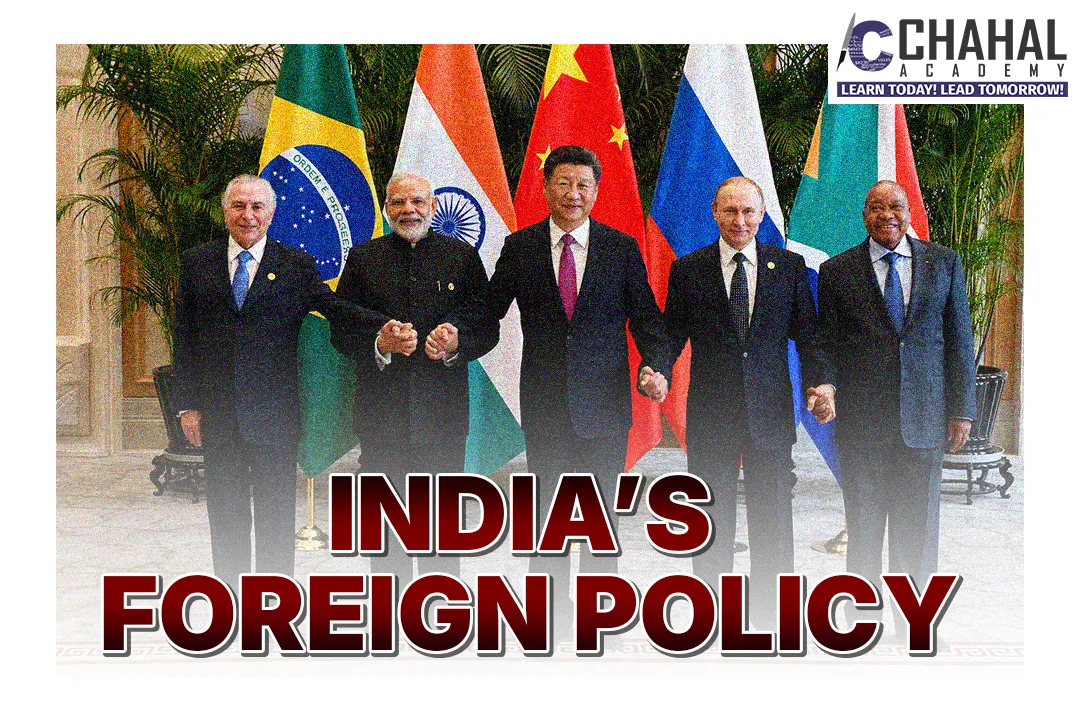
A significant reorientation under UPA was the shift from geostrategic to economic goals. Recognizing the importance of economic relations in a globalized world, the government used foreign policy to enhance India’s economic interests globally. Initiatives like the 'Look East policy' aimed to partner with East Asian economic tigers, while joining forums like BRICS sought to reform global governance collectively.
Technology Regimes Access:
The UPA government made notable forays into restrictive technology regimes to secure access, showcasing India’s commitment to technological advancements. This demonstrated a proactive approach in enhancing the country’s capabilities and ensuring a position in global technological developments.
Institutionalization of Foreign Policy:
Foreign policy under the UPA continued the trend of institutionalization that began in the 1990s. Mechanisms and departments facilitated long-term policy formulation, emphasizing the need for agile statecraft to respond to international developments and secure national interests effectively.
India-Pakistan Relations:
In terms of India-Pakistan relations, Prime Minister Manmohan Singh’s meeting with President General Pervez Musharraf in 2004 emphasized a commitment to peaceful solutions. Confidence-building measures (CBMs) were implemented to reduce tensions, leading to troop reductions in Kashmir. The Samjhauta Express and other diplomatic initiatives aimed at normalizing relations faced challenges due to terrorist incidents, but public support for normalization remained strong.
India-China Relations:
UPA continued the momentum in bilateral ties with China, focusing on economic and trade relations. The visit of Prime Minister Wen Jiabao and President Hu Jintao strengthened economic cooperation, and trade became a significant driver of relations. Energy security also emerged as an area of mutual cooperation.
India-Russia Relations:
India’s relations with Russia evolved, culminating in a strategic convergence with China. This convergence eventually led to the formation of the BRICS grouping, reflecting changing global power equations.
India-US Relations:
India-US relations gained momentum during the UPA era, marked by the Next Step in Strategic Partnership (NSSP) and the ground-breaking India-US Civil Nuclear Deal of 2005. The deal, a path-breaking initiative, recognized India as a nuclear weapons state, leading to closer cooperation between the two countries in various areas.