Whatsapp 88106-52225 For Details
Get Free IAS Booklet
Get Free IAS Booklet
Food and Agriculture Organisation (FAO)
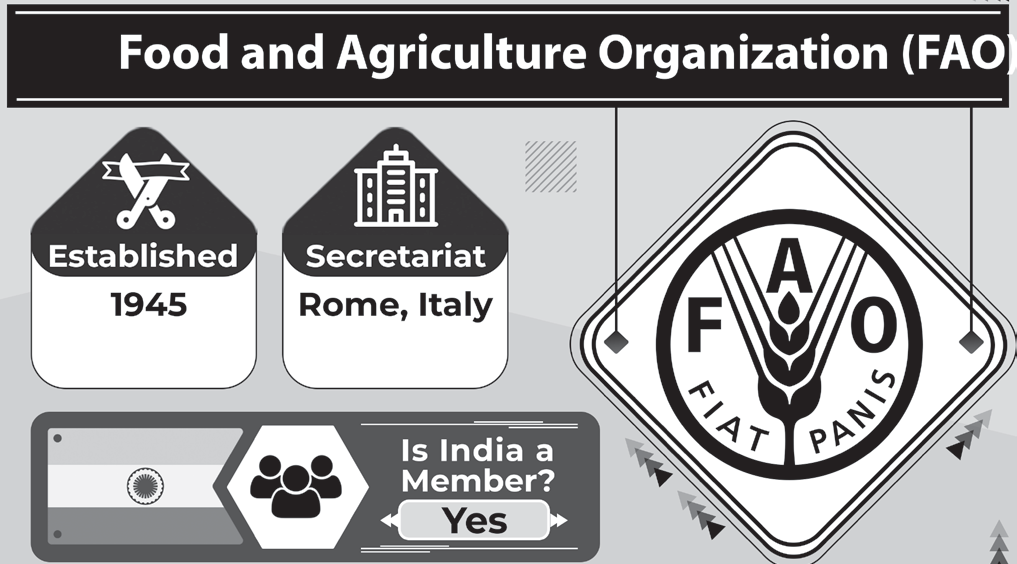
The FAO was established with the goal of eliminating hunger, improving nutrition, and raising living standards by boosting agricultural productivity.
Key programs of the FAO include Food Security Programs, Codex Alimentarius, and the International Plant Protection Convention (IPPC), among others.
Codex Alimentarius – International Food Standards
The Codex Alimentarius Commission, created by FAO and WHO, develops globally recognized food standards, guidelines, and codes of practice to safeguard consumer health and ensure fair trade in the food sector.
International Plant Protection Convention (IPPC) – This initiative seeks to protect both cultivated and wild plants by preventing the introduction and spread of harmful pests.
International Civil Aviation Organisation (ICAO)
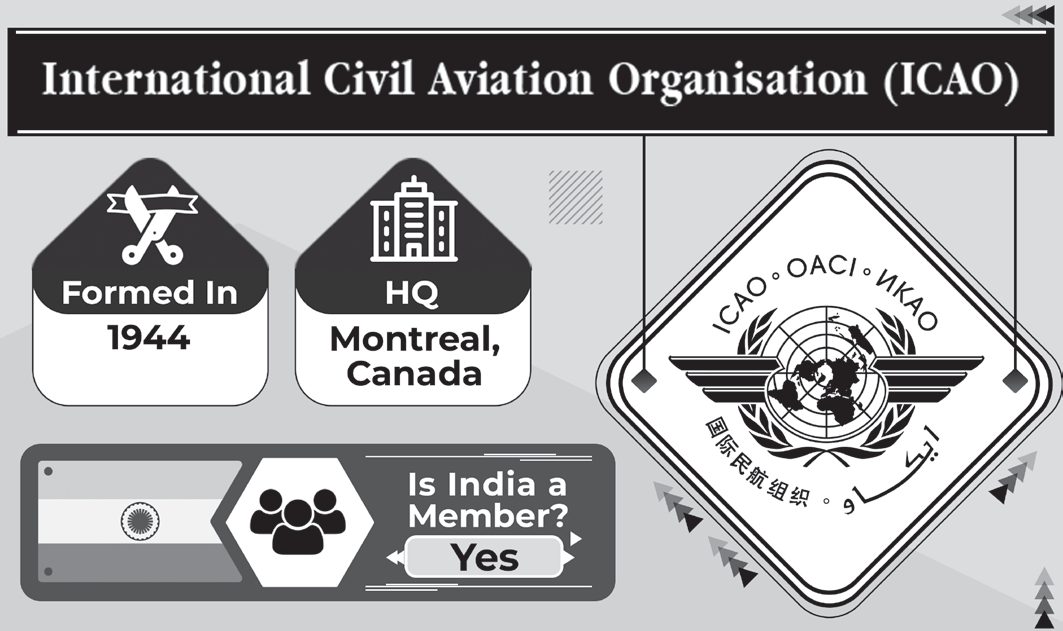
• ICAO was established following the Chicago Convention
on International Civil Aviation.
• It became a specialized agency of the United Nations, linked to the Economic and Social Council (ECOSOC).
• ICAO sets the standards and regulations needed to ensure aviation safety, security, efficiency, and environmental protection.
• Recently, ICAO introduced CORSIA (Carbon Offsetting and Reporting Scheme for International Aviation), a market-based measure to track and reduce carbon
emissions in international aviation.
International Fund for Agricultural Development
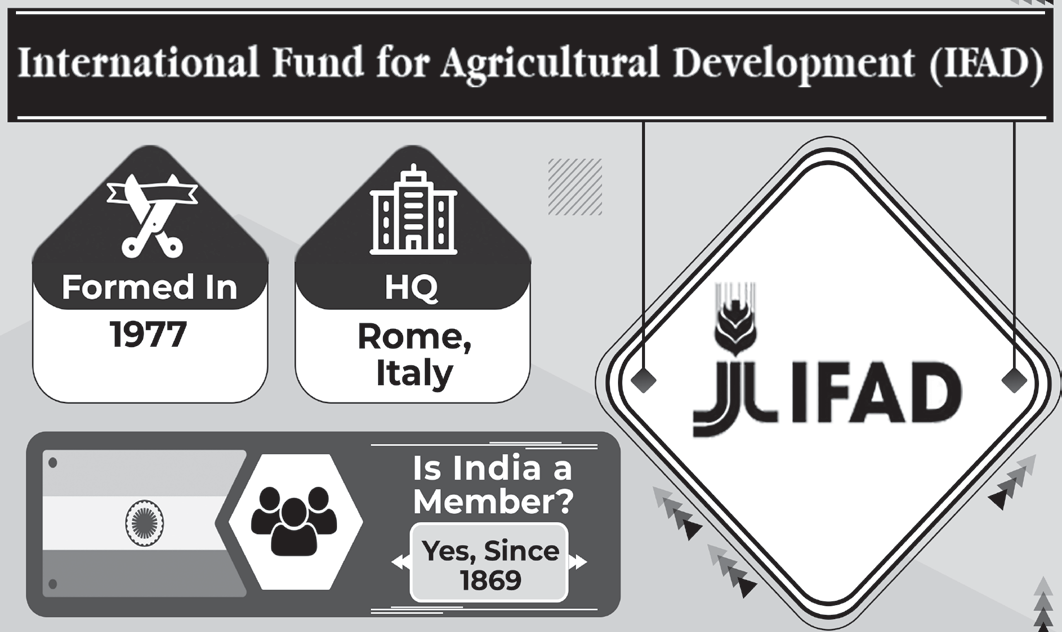
It is a specialized UN agency focused on eliminating poverty and hunger in rural areas of developing countries.
It offers low-interest loans and grants to fund innovative agricultural and rural development programs and projects.
The agency was established following the World Conference of 1974, which was convened in response to the food crises in the Sahelian countries of Africa during the 1970s.
Its headquarters is located in Rome, Italy.
International Labour Organisation
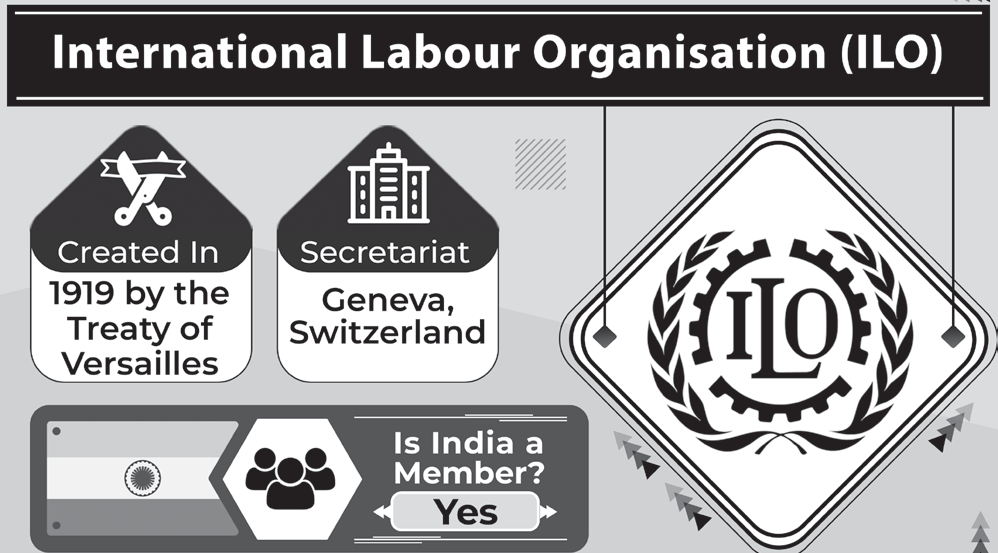
After the demise of the League of Nations, the ILO became the first specialized agency associated with the UN.
The organization has 186 of the 193 UN member states plus the Cook Islands are members of the ILO and its secretariat is located in Geneva, Switzerland.
It is responsible for drawing up and overseeing international labour standards.
Unlike other United Nations specialized agencies, the International Labour Organization has a tripartite governing structure – representing governments, employers, and workers.
ILO designates some member countries as ―Chief Industrial Importance.
The designated nations are Brazil, China, France, Germany, India, Italy, Japan, the Russian Federation, the United Kingdom and the United States.
In 1988, the international labour conference adopted the
―Declaration on Fundamental Principles and Rights at Work. It aims to eliminate all forms of forced or compulsory labour, abolition of child labour and the elimination of discrimination in employment and occupation.
The five flagship programs of ILO are Better work, Social Protection Floors for All (SPF’s), IPEC+, Global Action for Prevention on Occupational Safety and Health (GAP- OSH programme), Jobs for Peace and Resilience
International Maritime Organisation
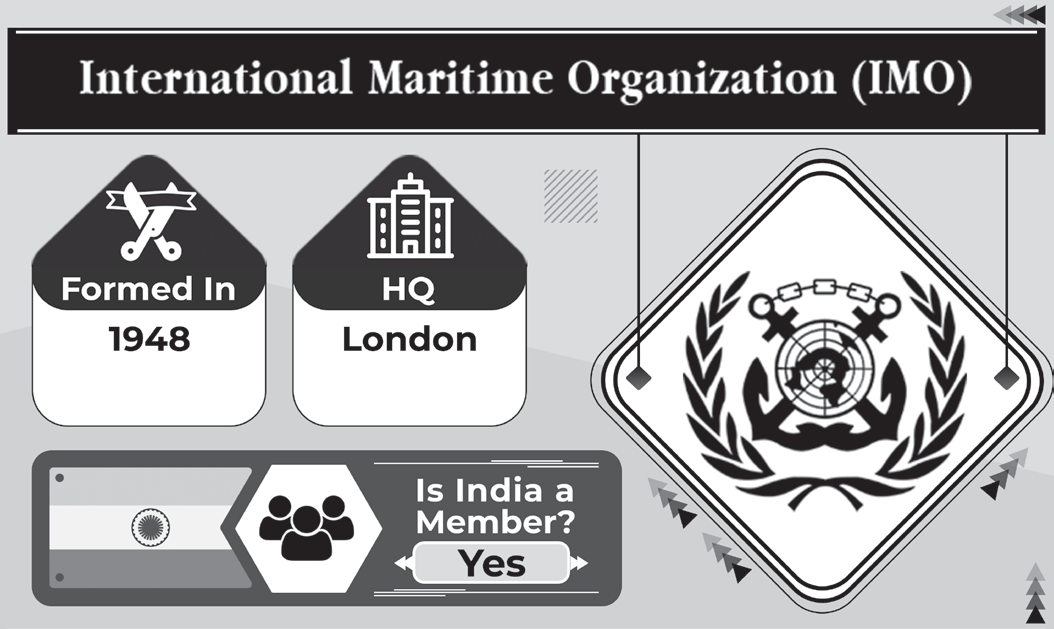
• IMO is the only UN specialized agency with its headquarters in the United Kingdom.
• It is the first international organization dedicated solely to maritime affairs.
• The IMO's primary goal is to enhance maritime safety and prevent marine pollution.
• One of its key committees, the Maritime Environment Protection Committee, oversees the organization's efforts to prevent and control marine pollution caused by ships.
International Telecommunication Union (ITU)
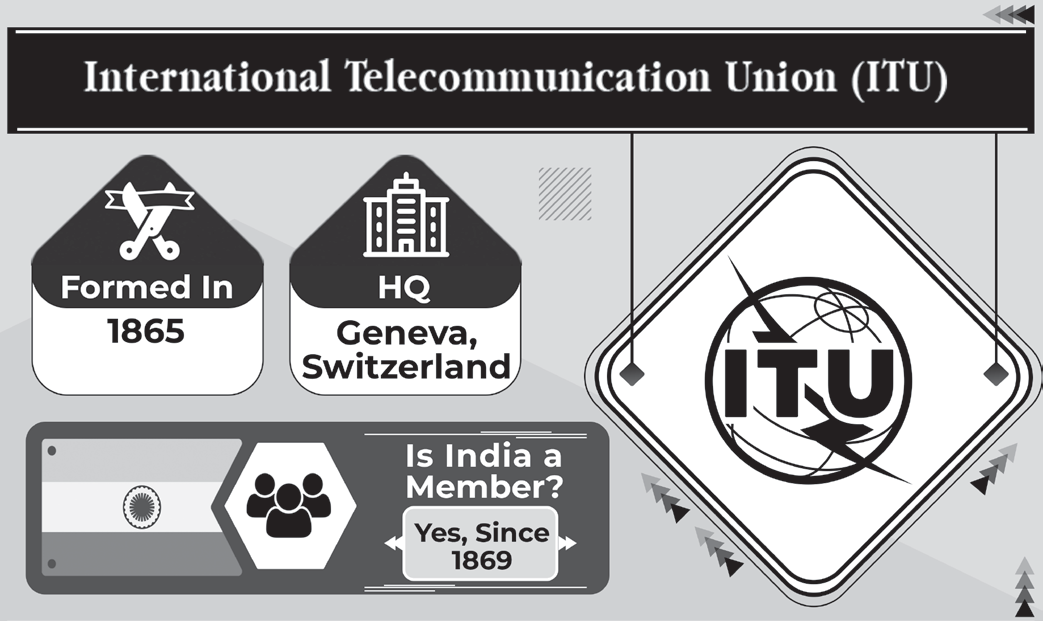
ITU is the specialized UN agency for information and communication technologies (ICTs).
It is responsible for allocating radio spectrum satellite orbits, as well as for the standardization and development of ICTs globally.
• ITU’s work spans the entire ICT sector, from broadcasting and the Internet to mobile technologies and 3D TV.
• Unique among UN agencies, ITU has both public and private sector membership, currently including 192 countries and 700 private-sector entities.
• Its secretariat is based in Geneva, Switzerland.
UNESCO – UN Educational Scientific and Cultural Organization
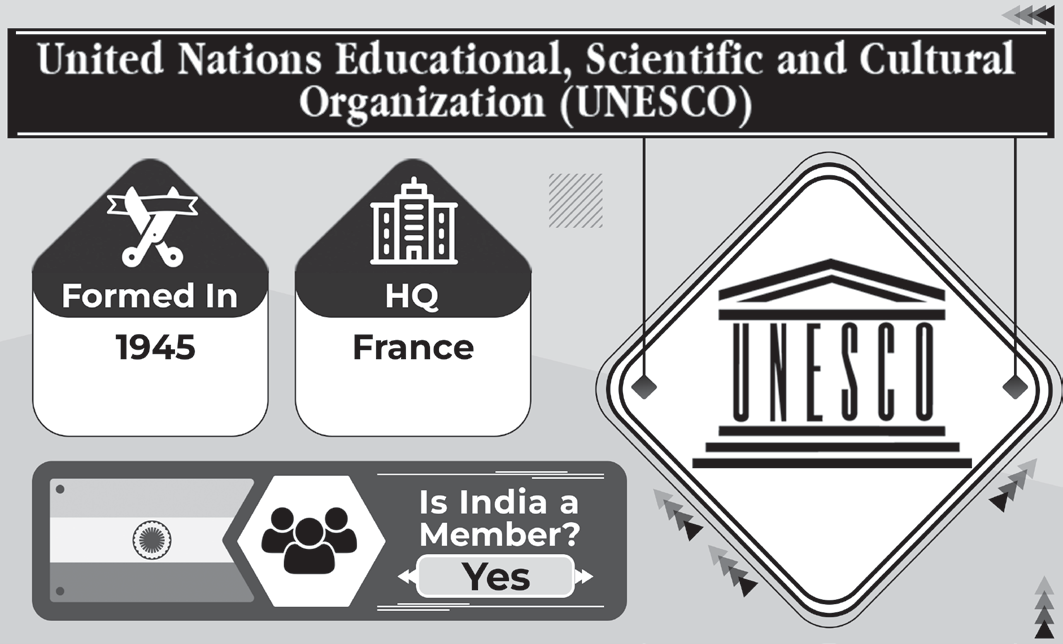
UNESCO works to promote peace, social justice, human rights, and international security by fostering global cooperation in education, science, and cultural initiatives.
It has 195 member states.
Major themes under UNESCO
Education–UNESCO leads the global efforts in improving all aspects of education policy, increasing access to learning, expanding early childhood care and ensure that all children are able to access and complete free and compulsory primary education of good quality.
Natural Science - UNESCO promotes member countries to formulate policies for protecting water and water quality, ocean and promoting technologies for resource management and disaster management.
Social and Human science – It promotes basic human rights and focused on global issues like fighting discrimination and racism.
Culture - To foster Cultural diversity and protection cultural heritage. UNESCO leads international efforts to safeguard tangible and intangible heritages.
Communication and information - To promote Inclusive knowledge.
UNESCO’s World Heritage Mission – Encourage world countries to protect Natural and Cultural Heritage sites. It publishes Global Education Monitoring report and Gender Parity Index.
It also leads the initiative of Man and Biosphere Programme for protecting Biosphere reserves across the world.
UNITED NATION AND ITS ORGANS
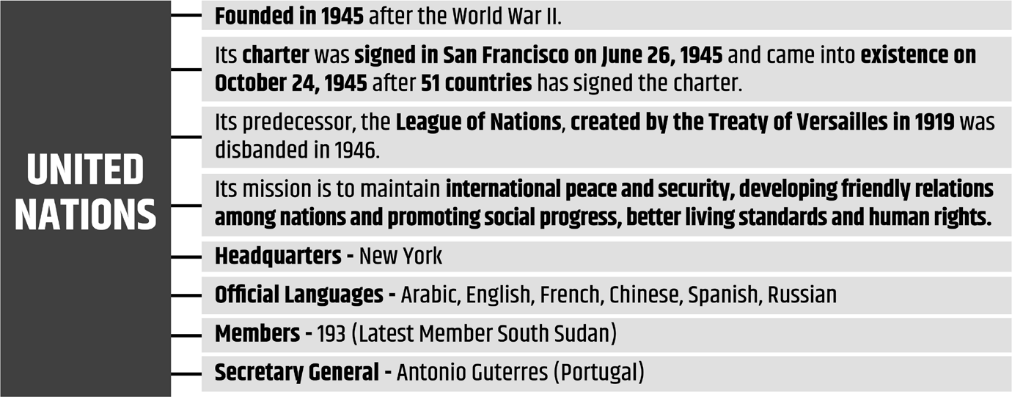
UN ORGANS
UN-General Assembly
• It is the main deliberative organ and composed of all member states, each of which has one vote.
• General Assembly appoints Secretary General of UN based on the recommendations given by Security Council.
• General Assembly elects Non-Permanent members in Security Council and elects Members for Social and Economic Council.
• Along with Security Council, General Assemble elects Judges to International Court of Justice.
• Decision on important questions such as those on peace and security, UN budget, admission, suspension and expulsion of members to various organs of UN requires special majority.
• Make recommendations on any matters within the scope of the UN, except matters of peace and security that are under consideration by the Security Council.
UN budget – United Nation is funded by its member states through compulsory and voluntary contributions.
• The size of each state’s compulsory contribution depends mainly on its economic strength, though its state of development and debt situation are also taken into account and member countries can make voluntary contribution to UNESCO, WHO, UN Programmes and Funds such as Office of the UN High Commissioner for Refugees (UNHCR) and the UN Children’s Fund (UNICEF).
United Nation Security Council (UNSC)
• The Security Council has primary responsibility for the maintenance of International peace and security.The council has 15 members: 5 Permanent – US, UK, Russia, France and China and 10 members elected by the General Assembly for 2-year terms.
• While other organs of the UN can only make ― recommendations to member states, the Security Council has the power to make binding decisions on member states.
• All the members have one vote and permanent members have veto power.
• Decisions on procedural matters should have vote of at least 9 of the 15 members and decision on substantive matters require nine votes and the absence of negative vote by any of the 5 permanent members.
• The presidency of the Security Council rotates alphabetically each month.
• G4 Nations – 4 countries bids for permanent seats in UNSC which are Brazil, Germany, India, and Japan.
• Uniting for Consensus (Coffee Club) – These are group of countries who are opposing the expansion of permanent seats in the United Nations Security Council under the leadership of Italy. Other Members in Coffee Club - Spain, Malto, San Marino, Pakistan, South Korea, Canada, Mexico, Argentina, Colombia and Turkey.
Economic and Social Council
• The Council is the main body responsible for coordinating the economic, social, and related activities of the United Nations, along with its specialized agencies and institutions.
• It consists of 54 members, elected by the General Assembly for a three-year term. Seats are allocated based on geographical representation.
• The president is elected for a one-year term, and decisions in the Council are made by a simple majority, with each member having one vote.
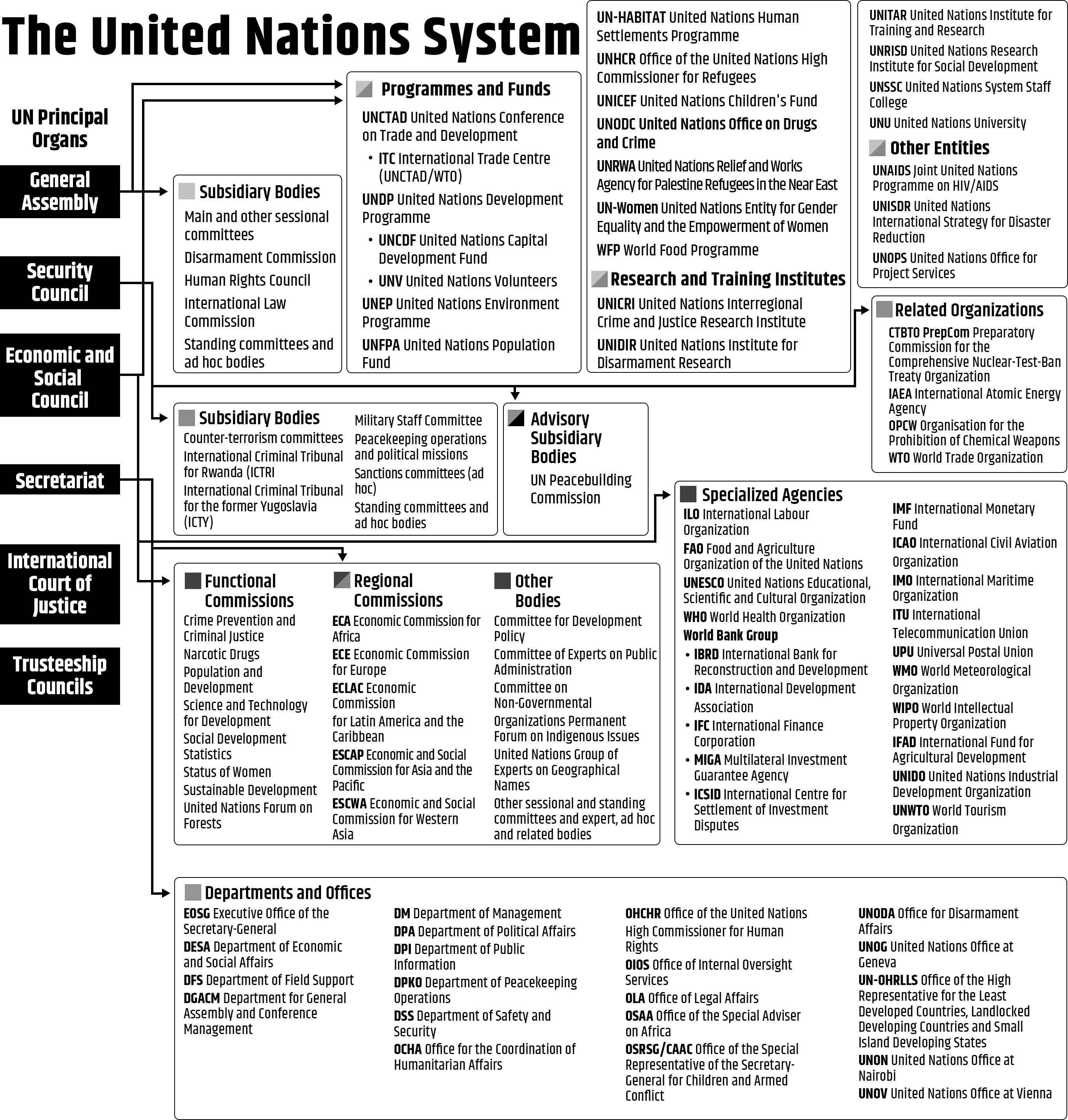
Secretariat
• It carries out the daily operations of the UN, overseeing the implementation of its programs and policies.
• The organization is led by the Secretary-General, who is supported by a team of international civil servants across the globe.
International Court of Justice
• The International Court of Justice (ICJ) is the principal judicial body of the United Nations, based in The Hague, Netherlands.It resolves legal disputes between states and provides advisory opinions to the UN and its specialized agencies.
• The Court consists of 15 judges, each appointed by the General Assembly for a 9-year term, with one judge from each nation.
• It hears cases related to war crimes, unlawful state interference, ethnic cleansing, and other international issues.
• The ICJ settles legal disputes between nations, not individuals, based on international law. A country may choose not to participate in proceedings unless mandated by a specific treaty. Once a state agrees to the Court's jurisdiction, it must comply with the ruling.
• The Court can only hear a dispute when requested to do so by one or more States. It cannot deal with a dispute of its own motion.
India was elected as a non-permanent member of the United Nations Security Council (UNSC) for a two-year term recently with an overwhelming majority.
• India garnered 184 votes in the General Assembly that consists of 193 members.
• The two-year term will begin on 1 January 2021, and along with India — Ireland, Mexico and Norway were also elected to the council.
• India was the sole candidate from the Asia-Pacific region vying for a non-permanent membership. Its candidature was unanimously endorsed by the 55-member Asia- Pacific Group in June last year.
• This is the eighth time India has been elected a non- permanent member of the UNSC.
• Previously, it has been elected as a member for the period of 1950-1951, 1967-1968, 1972-1973, 1977-1978, 1984-1985, 1991-1992 and 2011-2012.
How non-permanent member of the United Nations are elected?
• The General Assembly elects each year five non- permanent members of the Security Council.
• At its eighteenth session, in 1963, the Assembly decided that the non-permanent members of the Council should be elected according to the following pattern (resolution 1991 A (XVIII)):
• Five from African and Asian States;
• One from Eastern European States;
• Two from Latin American States;
• Two from Western European and other States.
• A retiring member is not eligible for immediate re- election. I
• The election is held by secret ballot
• The non-permanent members of the Security Council are elected by a two-thirds majority.
• The current non-permanent members are Algeria (2025)
• Denmark (2026)
• Greece (2026)
• Guyana (2025)
• Pakistan (2026)
• Panama (2026)
• Republic of Korea (2025)
• Sierra Leone (2025)
• Slovenia (2025)
• Somalia (2026)
United Nations Development Programme (UNDP)
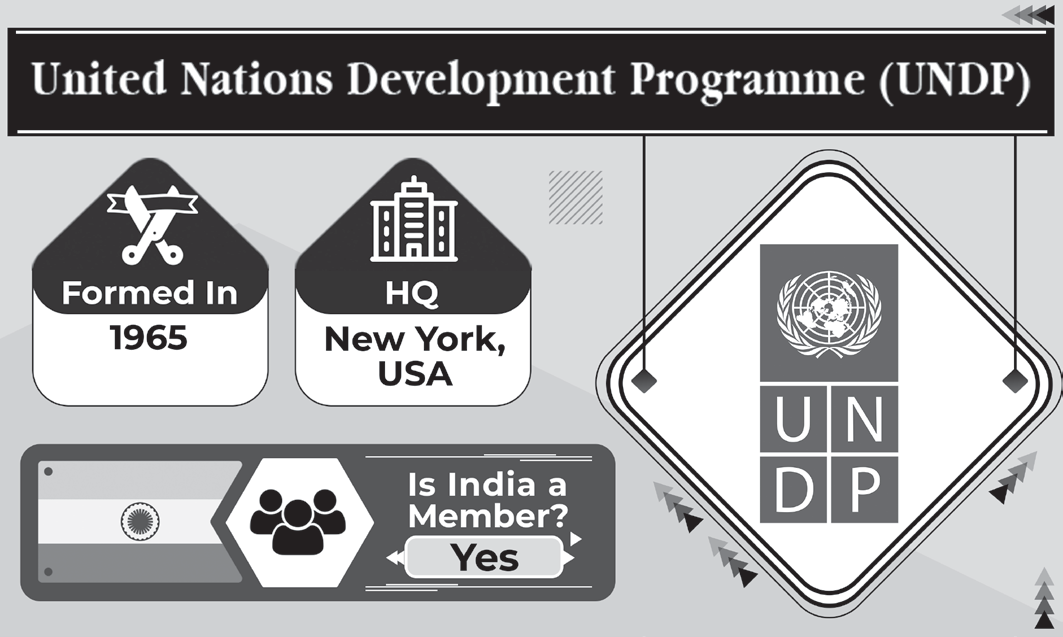
Established in 1965, UNDP is a UN organization aimed at helping countries eradicate poverty and achieve sustainable human development, which focuses on improving the quality of life for all citizens while preserving the environment and natural resources for future generations.
UNDP operates under the executive board of the UN General Assembly (UNGA).
The organization works to strengthen new frameworks for development, disaster risk reduction, and climate change.
UNDP also promotes the protection of human rights and the empowerment of women across all its programs.
The UNDP Human Development Report Office has been publishing the annual Human Development Report since 1990 to assess and analyze development progress. In addition to the global report, UNDP also produces regional, national, and local Human Development Reports.
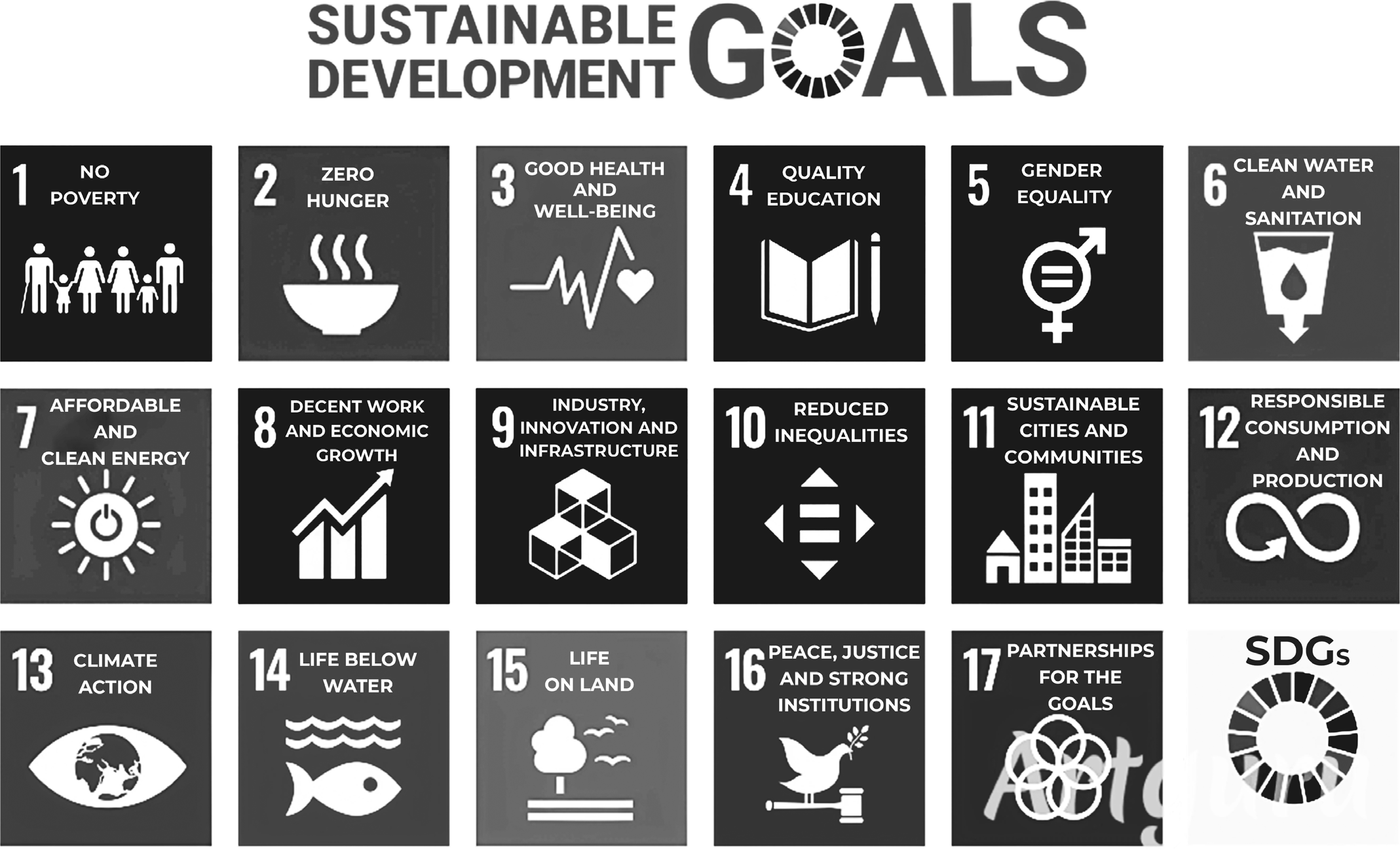
UNDP is a key UN agency involved in shaping the Post-2015 Development Agenda, widely known as the Sustainable Development Goals (SDGs).
The SDGs, also referred to as the Global Goals, represent a universal call to action aimed at ending poverty, protecting the planet, and ensuring that all people enjoy peace and prosperity.
United Nations Human Rights Council (UNHRC)
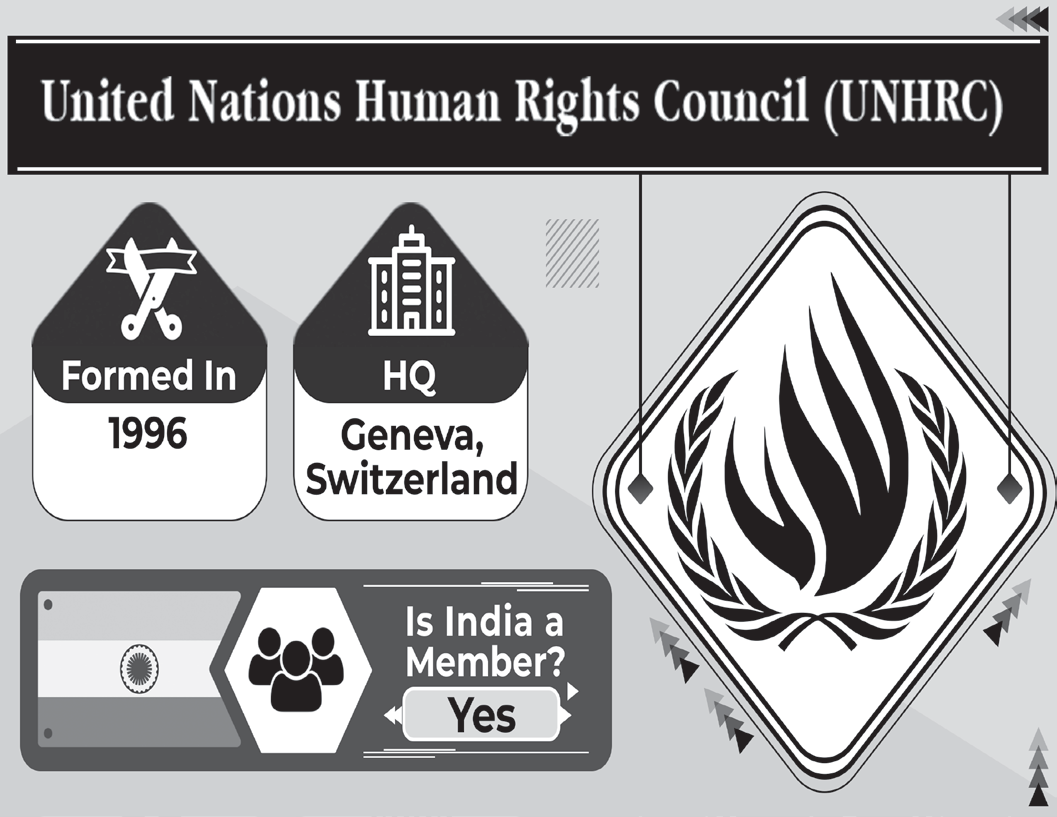
The UNHRC is an intergovernmental body within the UN system dedicated to promoting and protecting human rights worldwide.
The UN General Assembly elects members to the UNHRC, with 47 seats for a three-year term. No member can serve more than two consecutive terms.
The UNHRC succeeds the UN Commission on Human Rights and functions as a subsidiary body of the UN General Assembly.
The council works closely with the Office of the High Commissioner for Human Rights (OHCHR) and collaborates with the UN’s special procedures.
The UNGA, by a two-thirds majority, can suspend the rights and privileges of any council member found to have persistently committed gross and systematic human rights violations during their term.
Through the Universal Periodic Review, the UNHRC evaluates the human rights situations in all 193 UN member states.
Key aspects of the UPR process include:
• Comprehensive Assessment:
• It covers a broad spectrum of human rights issues, examining the country’s compliance with international human rights obligations and commitments.Inclusive Participation:
• The process involves active participation from the country under review, as well as contributions from other UN Member States, civil society organizations, and other stakeholders.
• Dialogue and Recommendations:
• The country under review presents its human rights achievements and challenges.
• Other states provide recommendations, and the country being reviewed can accept or note these suggestions.
• National Report:
• The country in question submits a national report outlining its human rights situation, policies, and initiatives.
• Interactive Session:
• An interactive dialogue takes place during the review session, allowing for clarification and additional information.
• Outcome Report:
• The process concludes with the adoption of an Outcome Report, summarizing the discussions, recommendations, and commitments made by the country under review.
The UPR process aims to promotetransparency, accountability, and the improvement of human rights situations globally by fostering constructive dialogue and collaboration among UN Member States.
United Nations Industrial Development Organisation
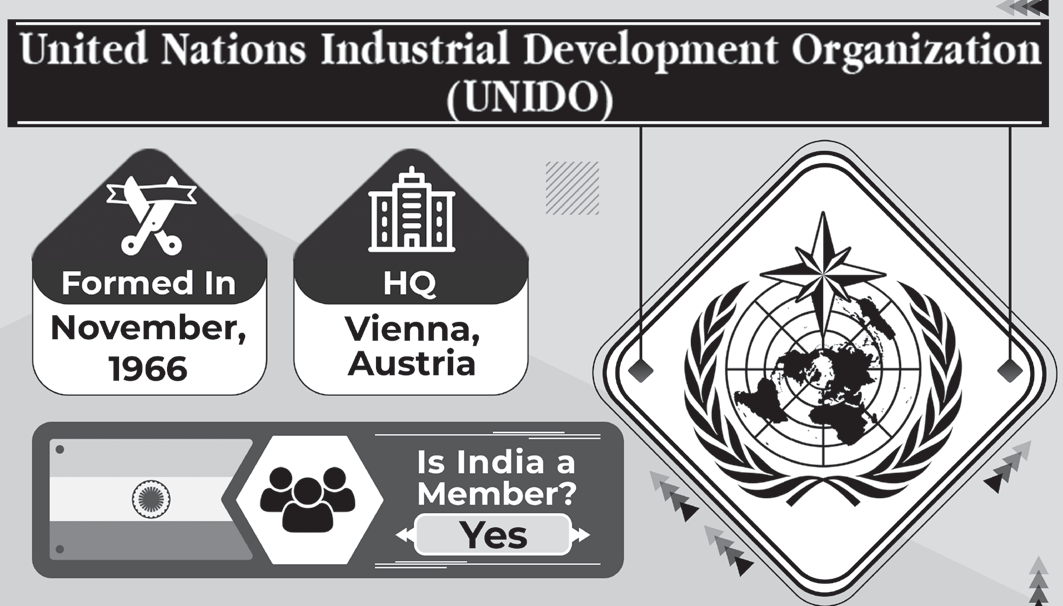
UNIDO is mandated to promote Industrial development and global industrial cooperation.
Its mission is to promote and accelerate the industrialization of developing countries.
United Nations World Tourism Organisation
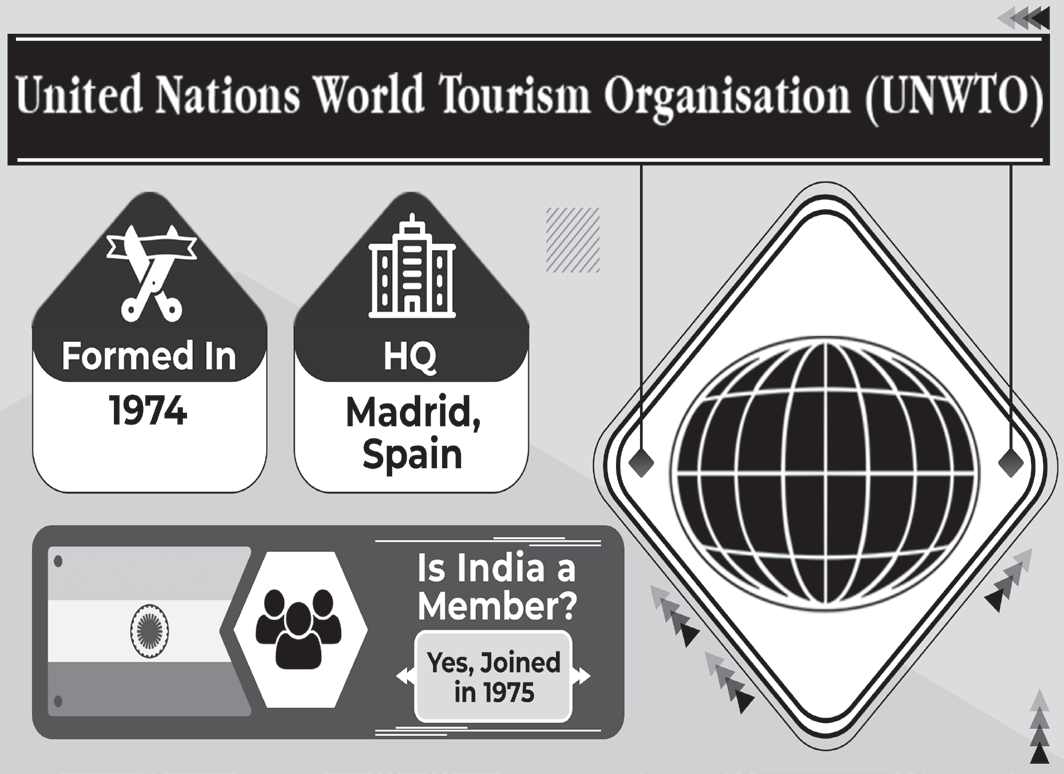
• It is responsible for the promotion of responsible sustainable and universally accessible tourism.
Samarkand Declaration – It is the joint initiative of UNWTO and UNESCO and the declaration are made on Silk Road Tourism to enhance sustainable tourism development along the historic Silk Road route.
WHO
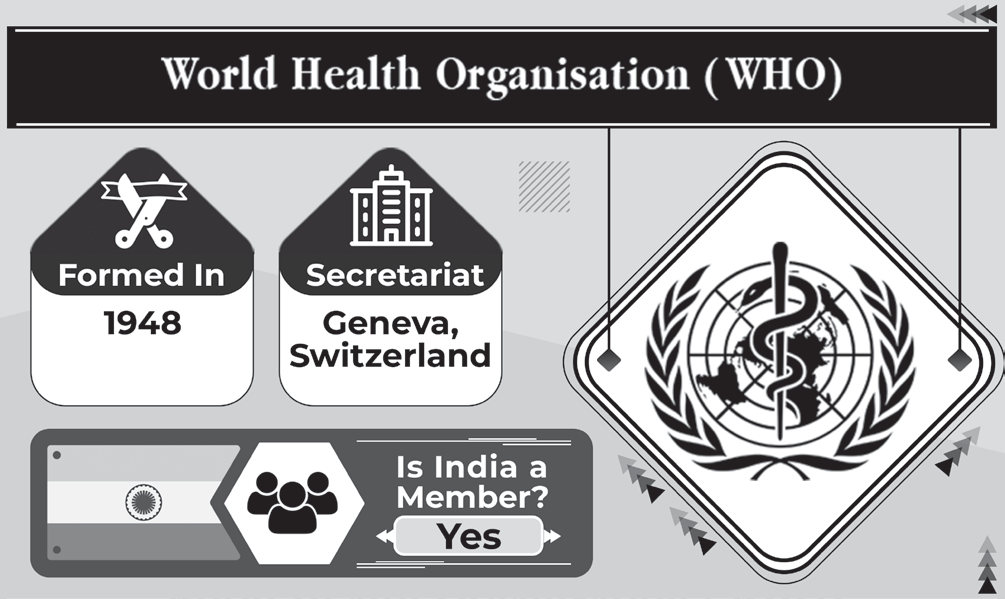
WHO is the first global health organization absorbing many regional and national health bodies
It has 194 member countries.
It has the authority of directing and coordinating matters related to International health.
• World Health Assembly – It is the supreme decision- making body of WHO, attending by delegations from all member states. It meets in Geneva in May each year. The Seventy-seventh World Health Assembly is being held
in Geneva, Switzerland, on 27 May – 1 June 2024. The theme of this year’s Health Assembly is: All for Health, Health for All.
• Executive Board – It is to implement the decision and policies of the World Health Assembly.
World Food Programme (WFP)
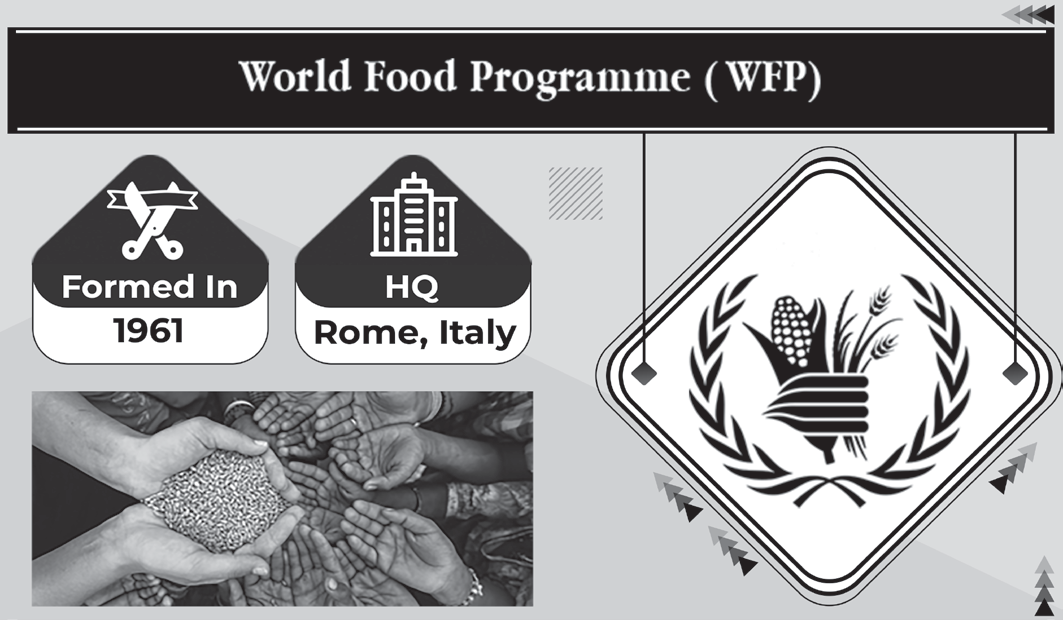
WFP is the food-assistance branch of the United Nations and the world’s largest humanitarian organization addressing hunger and promoting food security.
WFP works from its headquarters at Rome to help people who cannot produce or obtain enough food for themselves and their families.
It is a member of the United Nations Development Group and part of its Executive Committee.
The WFP was formally established in 1963 by the FAO and the United Nations General Assembly.
The WFP strives to eradicate hunger and malnutrition, with the ultimate goal in mind of eliminating the need for food aid itself.
• WFP’s efforts focus on emergency assistance, relief and rehabilitation, development aid and special operations.
• WFP food aid is also directed to fight micronutrient deficiencies, reduce child mortality, improve maternal health, and combat disease, including HIV and AIDS.
• Food-for-work programmes help promote environmental and economic stability and agricultural production.
• WFP has coordinated the five-year Purchase for Progress (P4P) pilot project which assists smallholder farmers by offering them opportunities to access agricultural markets and to become competitive players in the market place.
The WFP operations are funded by voluntary donations from world governments, corporations and private donors.
World Intellectual Property Organisation
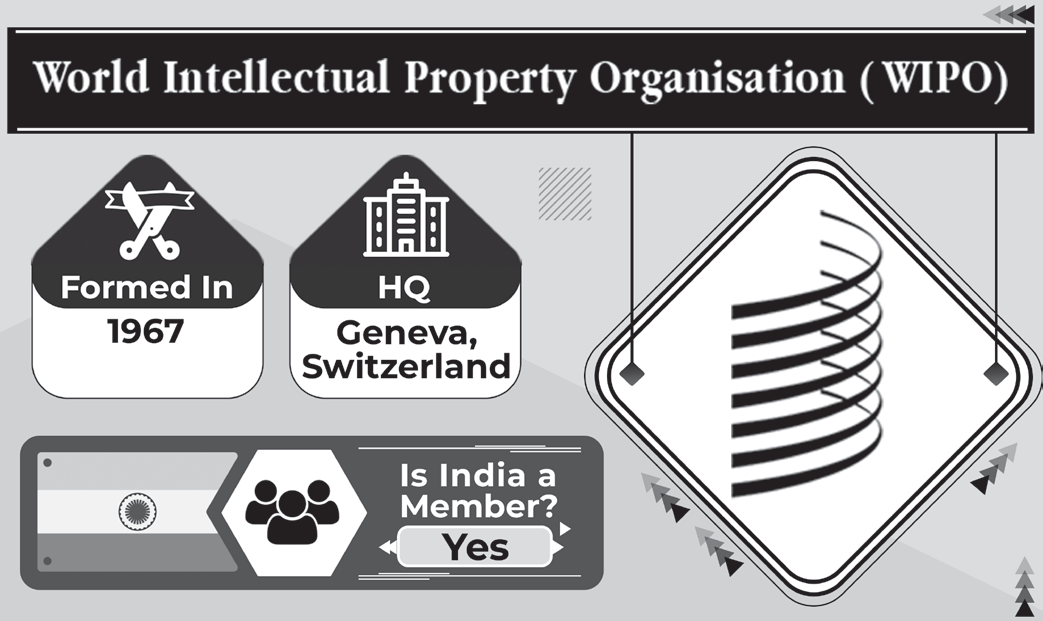
WIPO’s mission is to promote innovation and creativity for the economic, social, and cultural development of all countries.
• It is headquartered in Geneva, Switzerland.
• WIPO’s predecessor was the United International Bureaux for the Protection of Intellectual Property (BIPRI), which managed the Paris and Berne Conventions for the protection of industrial property and literary and artistic works, respectively.
• The Marrakesh Treaty of WIPO, aims to improve access to published works for people who are blind, visually impaired, or print disabled. India was the first country to sign this treaty.
World Meteorological Organisation
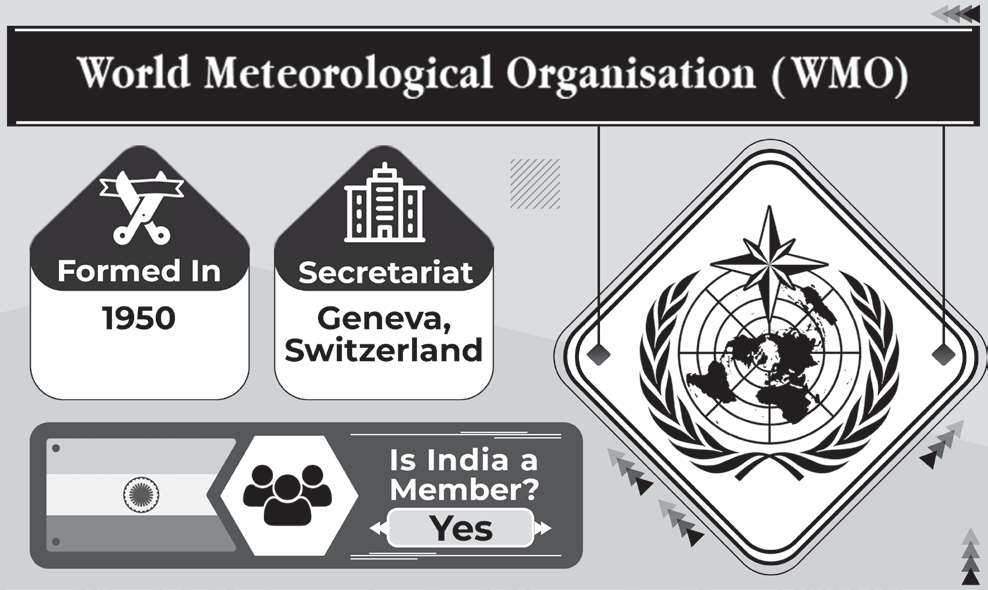
The WMO was established in 1950 as an intergovernmental organization and became a specialized UN agency in 1951.
• Its secretariat is based in Geneva, Switzerland.WMO is the UN's leading authority on weather, climate, and water issues.
• Through its member countries, WMO provides forecasts and early warnings that help prevent and mitigate natural disasters.
• WMO monitors and forecasts the movement of chemical and oil spills, forest fires, volcanic ash, haze, and nuclear isotopes. It also raises global awareness about the depletion of the ozone layer.
• The Indian Meteorological Department in Pune serves as the WMO's regional center for the Asian region.