Whatsapp 88106-52225 For Details
Get Free IAS Booklet
Get Free IAS Booklet
BEGINNING OF NATIONALISM IN INDIA
PRECURSORS TO INDIAN NATIONAL CONGRESS
The Indian National Congress was not the earliest political organization formed in India; several political groups had emerged before its establishment.
However, during the early part of the nineteenth century, most of these associations were led by wealthy and aristocratic individuals and were primarily confined to local or regional concerns. Their main method of communication was sending lengthy petitions to the British Parliament, in which they typically requested: ➤ Reforms in administration, ➤ Inclusion of Indians in governance, and ➤ Promotion of education.
In contrast, political organizations that arose in the latter half of the nineteenth century were increasingly led by the educated middle class, including professionals such as lawyers, journalists, doctors, and teachers. These groups had broader visions and more comprehensive objectives.
POLITICAL ASSOCIATIONS IN BENGAL The Bangabhasha Prakasika Sabha:
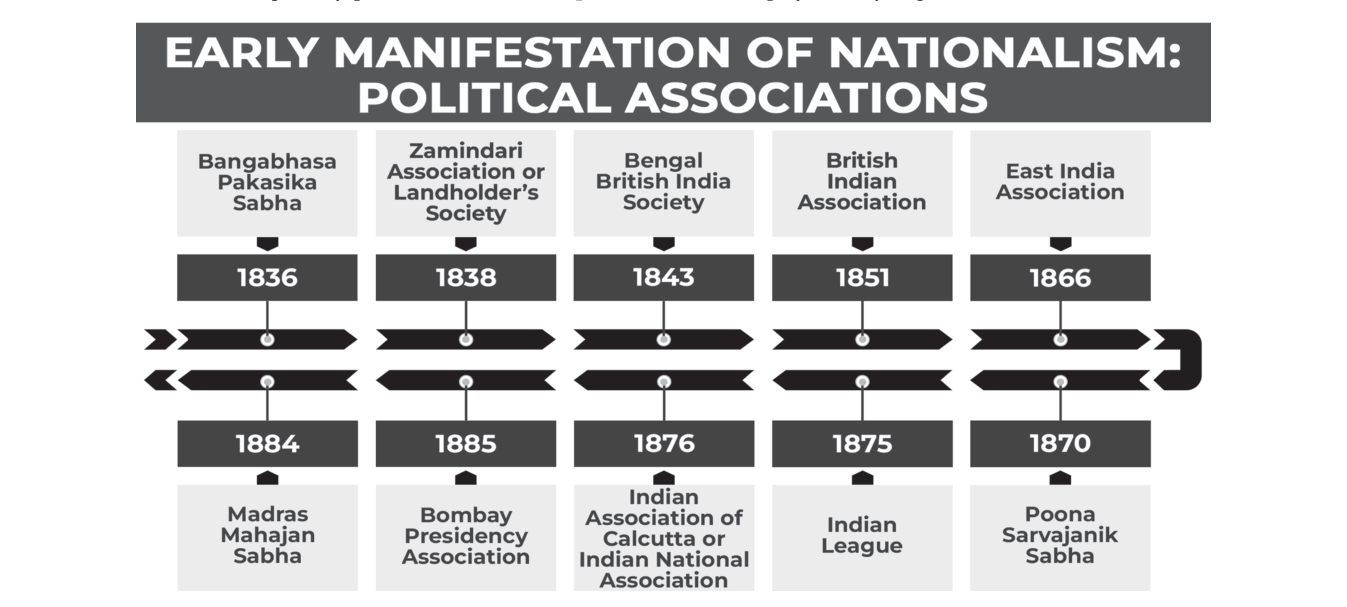
It was formed in 1836 by associates of Raja Rammohan Roy.
The Zamindari Association or Landholders Society:
Established in 1837, this organization comprised landowners from Bengal, Bihar and Orissa, with its main goal being the protection of their class interests.
It was created to defend the rights and privileges of landlords. While its aims were narrow, the Landholders’ Society signified the beginning of organized political engagement and the adoption of constitutional methods to seek redress for grievances.
The society primarily reflected the interests of the wealthy aristocratic class.
The Bengal British India Society:
Established in 1843, the Bengal British India Society aimed to gather and share information about the real conditions of the people in British India. It sought to use peaceful and lawful methods to promote the welfare, protect the rights and advance the interests of all sections of society.
The society symbolized the intellectual elite, representing the aristocracy of knowledge and thought.
British Indian Association:
In 1851, the Landholders’ Society and the Bengal British India Society merged to form the British Indian Association, marking a significant step in organized political advocacy in India.
The association submitted a petition to the British Parliament with recommendations for the renewed Charter of the East India Company, which included: ➤ Creation of a distinct legislature with a representative character. ➤ Separation of executive and judicial powers. ➤ Reduction in the salaries of senior officials. ➤ Elimination of taxes on salt, alcohol (abkari), and stamps. ➤ Partial acceptance of these suggestions led to the Charter Act of 1853, which added six legislative members to the governor-general’s council.
The East India Association
➤ Dadabhai Naoroji established an organization in London in 1866 to address Indian issues and influence prominent figures in England to support Indian welfare. ➤ Other prominent leaders involved included Pherozeshah Mehta, Badruddin Tyabji and Manmohan Ghose, with branches of the association later set up in major Indian cities.
The Indian League
Founded by Sisir Kumar Ghosh in 1875, its primary objective was to cultivate a strong sense of nationalism among the people while actively promoting political awareness and education to empower them in shaping their future.
The Indian Association of Calcutta
Known as the Indian National Association, it was established in 1876, succeeding the Indian League.
It was founded by young nationalists from Bengal, including Surendranath Banerjee and Ananda Mohan Bose, who opposed the conservative and pro-landlord stance of the British Indian Association.
Recognized as the most prominent pre-Congress association, its primary goal was to advance the political, intellectual, and material development of the people through legitimate means. ➤ It aimed to foster a strong public opinion on political matters. ➤ It sought to unify Indians under a common political agenda.
The association opposed the 1877 reduction in the age limit for Indian Civil Service examination candidates.
It advocated for simultaneous civil service examinations in India and England and demanded Indian representation in higher administrative roles.
Campaigns were organized against repressive laws, including the Arms Act and the Vernacular Press Act.
To expand its reach, branches were set up in various towns and cities across Bengal and beyond, with low membership fees to include the economically weaker sections.
The association hosted an all-India conference in Calcutta from December 28 to 30, 1883, with over a hundred delegates participating from across the country.
Acting as a precursor to the Indian National Congress, the association eventually merged with it in 1886, establishing its legacy as a key step in the nationalist movement..
POLITICAL ASSOCIATIONS IN BOMBAY The Poona Sarvajanik Sabha
1867 by M.G. Ranade, G.V. Joshi, S.H. Chiplankar, ➤ Founded in of its time. ➤ and their associates, it became a significant organization
Its primary purpose was to act as a link between the government and the people, fostering communication and understanding.
The Bombay Presidency Association
It was started by Badruddin Tyabji, Pherozshah Mehta and K.T. Telang in 1885.
POLITICAL ASSOCIATIONS IN MADRAS The Madras Mahajan Sabha
It was founded in 1884 by M. Viraraghavachari, B.Subramaniya Aiyer and P.Ananda- charlu.
FOUNDATION OF THE INC
An Englishman, Allan Octavian Hume, a retired member of the Indian Civil Service was a major motivating force to bring the educated Indians who were active in provincial associations together to form one national political association.
Hume wanted to have an all-India representative body of educated Indians to voice their concerns on issues affecting them.
Surendranath Banerjea also tried to make his Indian Association a broader platform by convening an all-India conference of the association.
But the initiative taken by Hume gave birth to the formation of the Indian National Congress and later on Surendranath joined the National Congress.
In December 1885, seventy- two delegates all belonging to the educated class living in the big cities of Calcutta, Bombay, Poona and Madras met in Bombay under the presidentship of W.C. Bonnerji, a noted Bengali lawyer.
The foundation of Indian National Congress is generally considered as the first manifestation of organised nationalism in India and the beginning of a national political community in India.
Safety Valve Theory
There is a theory that Hume formed the Congress with the idea that it would prove to be a ‘safety valve’ for releasing the growing discontent of the Indians.
The extremist leaders like Lala Lajpat Rai believed in the ‘safety valve’ theory.
Modern Indian historians, however, dispute the idea of ‘safety valve’. In their opinion the Indian National Congress represented the urge of the politically conscious Indians to set up a national body to express the political and economic demands of the Indians.
In the circumstances, as Bipan Chandra observes, the early Congress leaders used Hume as a ‘lightning conductor’ i.e., as a catalyst to bring together the nationalistic forces even if under the guise of a ‘safety valve’.
Composition of Indian National Congress
As a matter of fact, there was a great disparity in the representation of various castes, creeds, races, professions, trades and provinces.
Among the classes, the educated middle class had the largest share.
The legal profession was most heavily represented among the professions.
The Brahmins among the castes were comparatively larger in number.
The Methods of Work
Early Congressmen had an implicit faith in the efficacy of peaceful and constitutional agitation.
The press and the platform at the annual sessions were their agencies.
The Congressmens’ belief in the essential sense of justice and goodness of the British nation was strong. They worked under the illusion that all would be well if the British could be acquainted with the true state of affairs in India.
It also intends to inform the British public about the problems faced by the Indians and remind it of its duty towards India.
To fulfil the latter aim, deputations of leading Indians were sent to Britain to present the Indian viewpoint.
In 1889, a British Committee of Indian National Congress was founded. To carry on its propaganda the Committee started its organ India, in 1890.
BEGINNING OF MODERN NATIONALISM IN INDIA [1885-1905]
The Moderates The Congress programme during the first phase (1885-1905) was very modest. Between 1885 and 1905, the Congress leaders were moderates. They were called moderates because they adopted peaceful and constitutional means to achieve their demands.
Important Leaders
The leading figures during the first phase of the National Movement were A.O. Hume, W.C. Banerjee, Surendra Nath Banerjee, Dadabhai Naoroji, Feroze Shah Mehta, Gopalakrishna Gokhale, Pandit Madan Mohan Malaviya, Badruddin Tyabji, Justice Ranade and G. Subramanya Aiyar.
Surendranath Banerjee was called the Indian Burke. He firmly opposed the Partition of Bengal. He founded the Indian Association (1876) to agitate for political reforms. He had convened the Indian National Conference (1883) which merged with the Indian National Congress in l886.
G. Subramanya Aiyar preached nationalism through the Madras Mahajana Sabha. He also founded The Hindu and Swadesamitran.
Dadabhai Naoroji was known as the Grand Old Man of India. He is regarded as India’s unofficial Ambassador in England. He was the first Indian to become a Member of the British House of Commons.
Gopal Krishna Gokhale Servants of India Society was regarded as the political guru of Gandhiji. In 1905, he founded the to train Indians to dedicate their lives to the cause of the country.
The Demands and Programme
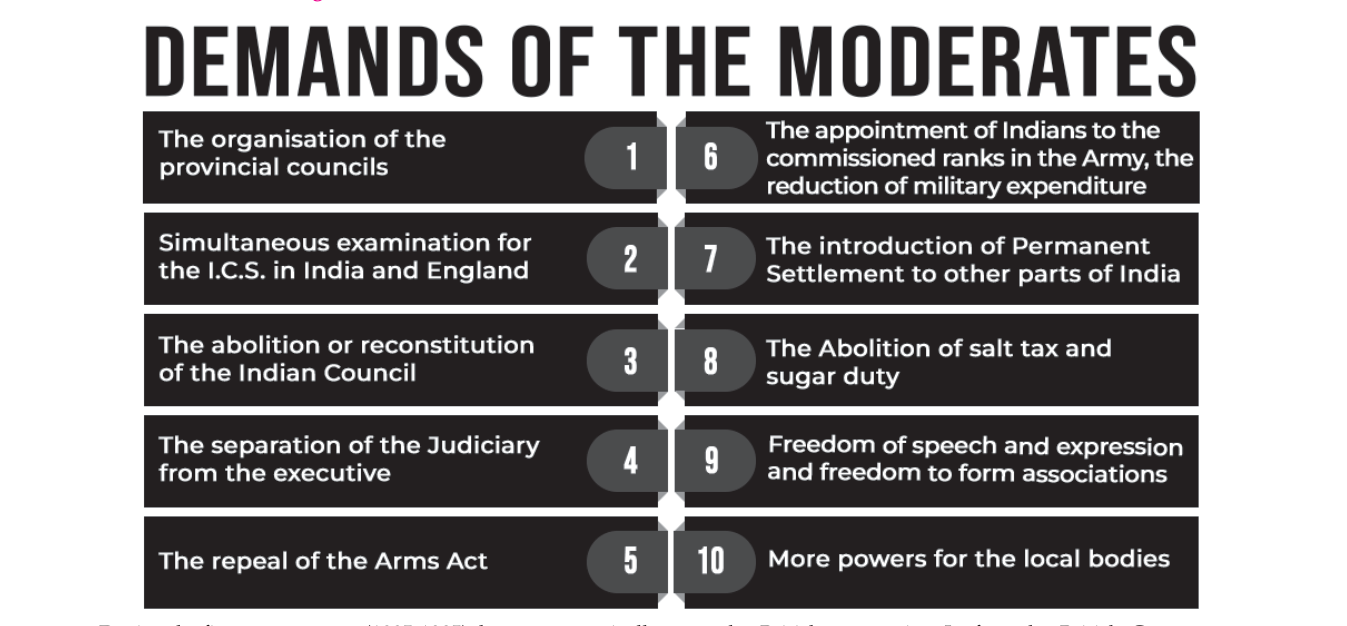
During the first twenty years (1885-1905) there was practically no change in the Congress programme. The major demands were practically the same as those formulated at the first three or four sessions. This phase of the Congress is known as the Moderate phase.
Methods of Moderates
The Moderates had total faith in the British sense of justice and fair play. They were loyal to the British. They looked to England for inspiration and guidance.
The Moderates used petitions, resolutions, meetings, leaflets and pamphlets, memorandum and delegations to present their demands.
They confined their political activities to the educated classes only. Their aim was to attain political rights and self-government stage by stage.
Achievements of Moderates
The Moderates were able to create a wide national awakening among the people.
They popularized the ideas of democracy, civil liberties and representative institutions.
They explained how the British were exploiting Indians. Particularly, Dadabhai Naoroji in his famous book Poverty and UnBritish Rule in India wrote his Drain Theory. He showed how India’s wealth was going away to England in the form of: (a) salaries,(b) savings, (c) pensions, (d) payments to British troops in India and (e) profits of the British companies. In fact, the British Government was forced to appoint the Welby Commission, with Dadabhai as the first Indian as its member, to enquire into the matter.
Some Moderates like Ranade and Gokhale favoured social reforms. They protested against child marriage and widowhood.
The Moderates had succeeded in getting the expansion of the legislative councils by the Indian Councils Act of 1892.
The Moderates campaigned for General Administrative Reforms like Indianisation of government service, call for increase in expenditure on welfare and demand for better treatment for Indian labour abroad in other British colonies etc.
Evaluation of Work
It must be said to the credit of the nationalist leaders that though they belonged to the urban educated middle class, they were too broad-minded and free from narrow and sectional class interests.
This challenging critique of the financial foundations of the Raj was a unique service that the early Congress leadership rendered to the nation.
Moderates had played an important role at a critical period in the history of Indian nationalism. In fact, the flowering of the Moderate thought was the culmination of a tradition which can be traced back to Raja Rammohun
Roy, who stood for the rational, liberal tradition of contemporary Europe.
With changing times, the Moderates also began to alter their position. By 1905 Gokhale had started speaking of self-rule as the goal and in 1906 it was Dadabhai Naoroji who mentioned the word Swaraj as the goal of the Congress.
However, the moderate phase of the national movement had a narrow social base and the masses played a Congress SessionYear President Bombay1885WC Bonnerjee Calcutta1886Dadabhai Naoroji Madras 1887Badruddin Tyabji Allahabad1888George Yule Bombay1889 William Wedderburn Calcutta1890Pherozeshah Mehta Nagpur 1891P. Anand Charlu Allahabad1892WC Bonnerjee – 2 Lahore1893 Dadabhai Naoroji – 2 Madras1894Alfred Webb Pune 1895 passive role. This was because the early nationalists lacked political faith in the masses; they felt that there were numerous divisions and sub- divisions in Indian society, and the masses were generally ignorant and had conservative ideas and thoughts.
They created a solid base for a more vigorous, militant, mass-based national movement in the years that followed. Remarks 1st session attended by 72 delegates National Congress and National Conference Appeal made to Muslims to join the Congress First European President
Mehta had been knighted by the British
Surendranath Banerjee Calcutta 1896 Rahimtullah Sayani Amraoti 1897C. Shankaran Nair Madras1898 Anand Mohan Bose
Lucknow 1899 2nd Muslim; Vande Mataram was sung for the first time
RC Dutt was a civil servant, historian, economist, writer and translated Mahabharata Romesh Chandra Dutt
Lahore1900N.G. Chandavarkar Calcutta1901 and Ramayana.
Dinshaw Eduljee Wacha Ahemdabad1902 Surendranath Banerjee – 2 Madras1903Lal Mohan Ghosh Bombay 1904Henry Cotton Banaras1905 Expressed resentment against the partition of Gopal Krishna Gokhale Bengal