Whatsapp 88106-52225 For Details
Get Free IAS Booklet
Get Free IAS Booklet
BENGAL BEFORE THE BRITISH CONQUEST
In the process of imperialist expansion, Bengal became since the 17th century, the hunting ground of the Dutch, the French and the English companies.
It was mainly the rich resources and good prospects of trade in Bengal which attracted the various foreign companies.
In the 18th century exports from Bengal to Europe consisted of raw products, such as, saltpetre, rice, indigo, pepper, sugar, etc. and silk, cotton textiles, handicrafts etc.
Bengal goods comprised nearly 60 per cent of British imports from Asia in the early 18th century. Commercial potential of Bengal was naturally the chief cause of the interest of the English in this province.
Regular contact of the English with Bengal started in the 1630s. First English company in the east was set up at Balasore in Orissa in 1633, then at Hugli, Qasimbazar, Patna and Dacca.
By 1690s the acquisition of the Zamindari rights of the three villages of Sutanuti, Calcutta and Govindpur and the foundation of Calcutta by the Company, completed this process of English commercial settlement in Bengal.
Since the 17th century the English East India Company was allowed to trade freely in Bengal, in return the Company had to pay annually Rs.3,000 (£350) to the Mughal emperor.
In 1700, Murshid Quli Khan became the Dewan of Bengal and ruled till his death in 1727. He was not in favour of the special privileges enjoyed by the Company because of the loss that resulted to the treasury. So, the tussle between the English commercial interest and the local government in Bengal was already marked before the mid-18th century.
Almost all the governors of Bengal strongly resented the special privileges enjoyed by the English company as it meant a huge loss to the provincial exchequer. So, the friction between the English commercial interests and the Bengal government became the chief cause for conflict between the two.
During a short period between 1757 and 1765, the power gradually got transferred from the Nawabs of Bengal to the British with the latter defeating the former.
Alivardi Khan and the English
In 1741, Alivardi Khan, the Deputy Governor of Bihar, killed the Nawab of Bengal Sarfaraz Khan in a battle and certified his own position as the new Subahdar of Bengal by paying a large sum of money to the Mughal Emperor, Muhammad Shah.
Alivardi Khan ruled for 15 years, during which he fought off the Marathas. The English, too, took the advantage of the Maratha incursions in Bengal, by obtaining a permission from the nawab to dig a ditch and throw up an entrenchment around their settlement of Fort William.
Later, Alivardi Khan’s apprehensions were drawn to the Carnatic region, where the European companies had usurped all power; on realising this, he was urged to expel the Europeans from Bengal. But he died in April 1756 and was succeeded by his grandson, Siraj-ud-daula, the son of Alivardi’s youngest daughter.
THE BRITISH CONQUEST OF BENGAL, 1757-65
The history of Bengal from 1757 to 1765 is the history of gradual transfer of power from the Nawabs to the British. During this short period of eight years three nawabs, Siraj-ud-daula, Mir Jafar and Mir Qasim ruled over Bengal. But they failed to uphold the sovereignty of the Nawab and ultimately the reign of control passed into the hands of the British.
Siraj-ud-daula and the British
Siraj-ud-daula succeeded Alivardi Khan as Nawab of Bengal in 1756. The succession of Siraj was opposed by his aunt Ghasiti Begum and his cousin Shaukat Jang who was the governor of Purnea.
There was a dominant group in the Nawab’s court comprising Jagat Seth, Omichand, Raj Ballabh, Rai Durlabh, Mir Jafar and others who were also opposed to Siraj.
Besides this internal dissension within the Nawab’s court, another serious threat to Nawab’s position was the growing commercial activity of the English Company.
THE BATTLE OF PLASSEY
Prelude to the Battle
The conflict between the Nawab and the English Company over trade privileges was nothing new. But during Siraj-ud daula’s reign certain other factors further strained the relations between the two. They are:
The fortification around Calcutta by the English Company without the permission of the Nawab, challenging the sovereignty of the Nawab.
The misuse of the Company’s trade privilege by its officials for their private trade that adversely affected the nawab’s finances.
The English Company at Calcutta had given shelter to Krishna Das, son of Raj Ballabh, who had fled with immense treasures against the Nawab’s will.
The Company, on its part, suspected that Siraj would drastically reduce its trade privileges in collusion with the French in Bengal. Thus, when Siraj attacked and seized the English fort at Calcutta, it brought their hostility into the open.
The much propagated “Black Hole Tragedy” in which Siraj-ud-daula is believed to have imprisoned 146 English persons who were lodged in a very tiny room due to which 123 of them died of suffocation.
The Battle
The arrival of a strong force under the command of Robert Clive at Calcutta from Madras strengthened the English position in Bengal.
Clive forged a secret alliance with the traitors of the nawab—Mir Jafar, Rai Durlabh, Jagat Seth (an influential banker of Bengal) and Omichand.
Under the deal, Mir Jafar was to be made the nawab who in turn would reward the Company for its services. The secret alliance of the Company with the conspirators further strengthened the English position.
English victory in the Battle of Plassey, (June 23, 1757) was decided before the battle was fought. It was not the superiority of the military power but the conspiracy of the Nawab’s officials that helped the English in winning the battle.
Due to the conspiracy of the nawab’s officials, the 50,000-strong force of Siraj was defeated by a handful of Clive’s forces. Siraj-ud-daula was captured and murdered by the order of Mir Jafar’s son, Miran.
The Battle of Plassey was placed at the disposal of the English vast resources of Bengal. After Plassey, the English virtually monopolised the trade and commerce of Bengal.
Significance of Battle of Plassey
The Battle of Plassey was politically significant because it established the British Empire in India, which is rightfully considered to be the beginning of British dominance in that country.
The conflict solidified English military dominance in Bengal. The French, their principal adversaries, were driven out.
Their status rose significantly, and they were granted territory to maintain a well-trained military force.
Although Clive gained ultimate authority over affairs and the new nawab, Mir Jafar, was totally dependent on his support to hold onto his newly obtained position, there was no discernible change in the structure of governance. The English were acknowledged as having dominion over Calcutta.
Mir Jafar and the British
Mir Jafar was crowned Nawab of Bengal as a result of this triumph. He provided the English with substantial sums of money in addition to the Zamindari of 24 parganas.
Immediately after his accession Mir Jafar faced some serious internal problems. They were: ➤ Some of the Zamindars like Raja Ram Sinha of Midnapore, Hizir Ali Khan of Purnea refused to accept him as their ruler.
➤ Mir Jafar’s soldiers who were not getting salary regularly were in a rebellious mood. ➤ He had doubts about the loyalty of some of his officials, especially of Rai Durlabh. He believed that Rai Durlabh had instigated the rebellion of Zamindar against him. But Rai Durlabh was under the shelter of Clive so he could not touch him. ➤ There was an attempt by the Mughal Emperor’s son who later on became Shah Alam to capture the throne of Bengal. ➤ The financial position of the Nawab was also weak, mainly because of the demands of the Company and mismanagement of resources. All these made Mir Jafar more dependent on the English Company. But the Company was unhappy with the Nawab for some reasons. ➤ The English Company was under the impression that Mir Jafar, in collaboration with the Dutch company, was trying to curb the growing influence of the English in Bengal. ➤ Mir Jafar also failed to respond to the ever-increasing demands of the English.
The death of Miran, son of Mir Jafar, again created a conflict over the question of succession. The fight was between Miran’s son and Mir Qasim, the son in-law of Mir Jafar.
Vansittart who came as Governor of Calcutta took the side of Mir Qasim. Mir Qasim in a secret agreement with Vansittart agreed to pay the necessary funds to the Company if they support his claim to the Nawabship of Bengal.
Mir Jafar had already lost the confidence of the English. The rebellion of Mir Jafar’s army for their due salary made it easier for the British to force Mir Jafar to step down.
Mir Qasim and the British
Mir Qasim’s accession to the throne of Bengal followed the same way, the way through which Mir Jafar had come to power. Like his predecessor, Mir Qasim also had to pay large amounts of money to the English. After his assumption of power, the two most important things that Mir Qasim did were: ➤ Shifting the capital from Murshidabad to Munger in Bihar in order to keep a safe distance from the Company at Calcutta, and ➤ Reorganizing the bureaucracy by the men of his own choice and remodelling the army to enhance its skill and efficiency.
Vansittart, the new Governor of Calcutta, agreed to support Mir Qasim’s claim after a treaty between Mir Qasim and the Company was signed in 1760. Important features of the treaty were as follows: ➤ Mir Qasim agreed to cede to the Company the districts of Burdwan, Midnapur and Chittagong. ➤ The Company would get half of the share in chunam trade of Sylhet. ➤ Mir Qasim agreed to pay off the outstanding dues to the Company. ➤ Mir Qasim promised to pay a sum of rupees five lakh towards financing the Company’s war efforts in southern India. ➤ It was agreed that Mir Qasim’s enemies were the Company’s enemies, and his friends, the Company’s friends. ➤ It was agreed that tenants of the nawab’s territory would not be allowed to settle in the lands of the Company, and vice-versa.
THE BATTLE OF BUXAR
Prelude to Battle
The first few months of Mir Qasim’s reign went very well. But gradually the relationship with the British became embittered. Reasons for this were:
Ram Narayan, the Deputy governor of Bihar, was not responding to the repeated requests by Nawab to submit his accounts. But Ram Narayan was supported by the English officials of Patna who never concealed their anti-nawab feelings.
The misuse of the Company’s Dastak or trade permit by Company officials for their private trade generated tension between the British and the Nawab.
The misuse of the dastak meant the loss of tax revenue to the nawab. It also made the local merchants face unequal competition with the Company merchants.
By an imperial farman, the English company had obtained the right to trade in Bengal without paying transit dues or tolls. However, the servants of the Company also claimed the same privileges for their private trade.
The Company’s servants also sold dastak to Indian merchants for a commission. Besides, they used coercive methods to get goods at cheaper rates, which was against the spirit of the duty-free trade.
Mir Qasim decided to abolish the duties altogether, but the British protested against this and insisted upon having preferential treatment as against other traders.
The conflict over transit duties between the Nawab and
the British led to the outbreak of wars between the English and Mir Qasim in 1763, with the British securing victories at Katwa, Murshidabad, Giria, Sooty and Munger.
After his defeats, Mir Qasim fled to Awadh, where he formed an alliance with the Nawab of Awadh, Shuja-ud-daula, and the Mughal Emperor, Shah Alam II, in an attempt to regain control of Bengal from the British.
The Battle
On October 22, 1764, the combined forces of Mir Qasim, the Nawab of Awadh, and Shah Alam II were defeated by the British under Major Hector Munro at the Battle of Buxar, marking a significant yet brief campaign against Mir Qasim.
The significance of this battle was that it resulted in the defeat of both the Nawab of Bengal and the Mughal Emperor by the British forces.
This victory solidified the British as a dominant power in northern India and positioned them as strong contenders for control over the entire subcontinent.
Following the defeat, Mir Jafar, who had been appointed Nawab of Bengal in 1763 amid tensions with Mir Qasim, agreed to cede the districts of Midnapore, Burdwan, and Chittagong to the British for the support of their military.
The British were granted the right to trade duty-free in Bengal, with the exception of a two percent duty on salt.
Following the death of Mir Jafar, his young son, Najim-ud-daula, was made the Nawab. However, the actual power in governance was held by the naib-subahdar, who could be appointed or removed by the British.
The Treaty of Allahabad 1765
In August 1765, Robert Clive signed two significant treaties in Allahabad: one with Shah Alam II, the Mughal Emperor, and another with the Nawab of Awadh.
Nawab Shuja-ud-Daula agreed to:
Cede Allahabad and Kara to Emperor Shah Alam II.
Pay a war indemnity of Rs 50 lakh to the British Company.
Restore Balwant Singh, the Zamindar of Banaras, and grant him full control of his estate.
Shah Alam II agreed to:
Live in Allahabad, which the Nawab of Awadh will cede to him under the protection of the British Company.
Issue a farman granting the East India Company the diwani of Bengal, Bihar and Orissa in exchange for an annual payment of Rs 26 lakh.
A payment of Rs 53 lakh to the Company in exchange for the provinces' nizamat (police, military defense, and justice administration) services. Clive refrained from annexing Awadh because doing so would have required the Company to defend a large land frontier against potential Afghan and Maratha invasions. The treaty strengthened the Nawab’s alliance with the Company, transforming Awadh into a buffer state. Similarly, Clive's dealings with Shah Alam II were based on practical needs. The emperor became a convenient "rubber stamp" for the Company, and his farman legitimized the Company’s political gains in Bengal. Meanwhile, Mir Qasim, the deposed Nawab of Bengal, lived the remainder of his life in extreme hardship as a homeless wanderer, eventually passing away in June 1777.
DUAL SYSTEM
The early mechanism of the establishment of Company rule in Bengal followed the administrative system under the Mughals.
The Mughal provincial administration had two main heads - nizamat and diwani. Broadly speaking, nizamat meant administration of law and order and criminal justice; while diwani was revenue administration and civil justice.
As the Diwan, the Company directly collected its revenue, while through the right to nominate the Deputy Subehdar, it controlled the nizamat or the Police or Judicial powers.
The provincial Subadar was in charge of nizamat (he was also called nazim) and the diwan was in charge of revenue administration.
After the treaty of Allahabad, the English East India Company was made the Diwan of Bengal but Lord Clive chooses not to take over the administration of Bengal directly; this responsibility was left to the Nawab’s Naib Diwan and Naib Nazim Muhammad Raza Khan.
As naib nazim he was to represent the nawab and as naib diwan he was to represent the Company. Thus, the Nawab had to handle the entire responsibility for the civil and criminal justice administration. However, he had to function through Muhammad Raza Khan who was placed under the superintendence, direction and control of the British Company.
This arrangement is known as ‘Dual or Double Government’. Under this system the British had power and resources without responsibility while the Nawab had the responsibility of the administration without power to discharge it. Thus, the Nawab had to take all responsibility for bad governance. The revenue remained the sole earning of the Company in lieu of a meagre annual payment to the Mughal emperor.
Warren Hastings removed this system in 1772.
MYSORE
The Wodeyar / Mysore Dynasty
After the Battle of Talikota (1565) dealt a severe blow to the Vijayanagara Empire, several smaller kingdoms emerged from its ruins.
In 1612, a Hindu kingdom led by the Wodeyars was established in the Mysore region, with Chikka Krishnaraja Wodeyar II ruling from 1734 to 1766.
In the latter half of the 18th century, Mysore grew into a powerful state under the leadership of Haidar Ali and his son, Tipu Sultan.
The British began to perceive a threat to their political and commercial interests in southern India due to Mysore’s proximity to the French, as well as Haidar Ali and Tipu Sultan’s control over the lucrative trade along the Malabar Coast.
Rise of Haidar Ali
In the early 18th century, Nanjaraj (the Sarvadhikari) and Devaraj (the Dulwai) diminished Chikka Krishnaraja Wodeyar's role to that of a mere figurehead.
Haidar Ali, born in 1721 into a humble family, began his career as a horseman in the Mysore army, serving under the ministers Nanjaraj and Devaraj.
Repeated invasions by the Marathas and the Nizam's forces drained Mysore both financially and politically, as they imposed significant monetary demands.
At this critical juncture, Mysore required a leader with exceptional military acumen and diplomatic expertise. Haidar Ali rose to the occasion, assuming de facto control of Mysore and becoming its ruler in 1761.
Haidar Ali collaborated with the French to establish an arms factory in Dindigul (present-day Tamil Nadu) and adopted Western military training methods to strengthen his army. Leveraging his exceptional diplomatic skills, he skillfully outmaneuvered his rivals.
Demonstrating his superior military prowess, he captured Dod Ballapur, Sera, Bednur, and Hoskote between 1761 and 1763. He also subdued the rebellious Poligars in South India (now Tamil Nadu).
After their defeat at Panipat, the Marathas, led by Madhavrao, launched attacks on Mysore, defeating Haidar Ali in 1764, 1766, and 1771.
To secure peace, Haidar Ali was forced to pay large sums of money to the Marathas. However, following Madhavrao's death in 1772, Haidar Ali conducted several raids on the Marathas between 1774 and 1776, reclaiming all previously lost territories and acquiring new ones.
ANGLO-MYSORE WARS
First Anglo-Mysore War (1767-69)
Main causes of war
The English signed a treaty with the Nizam of Hyderabad in 1766, securing the Northern Circars in exchange for their promise to protect the Nizam from Haidar Ali.
Haidar Ali already had territorial disputes with the Nawab of Arcot and conflicts with the Marathas. Changing Alliances
The Nizam, Marathas, and English initially formed an alliance against Haidar Ali.
Haidar Ali skillfully used diplomacy to neutralize his opponents. He paid off the Marathas to ensure their neutrality and promised the Nizam a share of the conquered territories, turning the Nizam into an ally. Together, they launched an attack on the Nawab of Arcot. Course of War
The conflict dragged on for over a year without a decisive outcome. Haidar Ali shifted his tactics and launched a direct attack on British forces, advancing to the gates of Madras.
The resulting chaos and panic in Madras forced the British to negotiate the Treaty of Madras with Haidar Ali on April 4, 1769.
The treaty included terms for the exchange of prisoners and mutual restoration of conquered territories. Additionally, the British promised to assist Haidar Ali if he were attacked by any other power.
The Second Anglo-Mysore War (1780-84)
After eleven years, the Second Mysore War broke out and the main causes for the second Anglo-Mysore War were:
The British failed to fulfill the terms of the defensive treaty with Haider when he was attacked by the Marathas in 1771.
There was an outbreak of hostilities between the English and the French (an ally of Haider) during the American War of Independence.
The British captured Mahe, a French settlement within Haider’s territories.
Haider Ali formed a grand alliance with the Nizam of Hyderabad and the Marathas against the British in 1779. Course of War
The War began when the British led their forces through Haider’s territory without his permission to capture Guntur in the Northern Sarkars.
Haider Ali defeated Colonel Baillie and captured Arcot in 1780.
In the next year, Warren Hastings, by a clever stroke of diplomacy, divided the Confederacy. He made peace with the Nizam, won the friendship of Bhonsle and came to an understanding with the Scindia (both Marathas). Consequently, Haider was isolated without any alliance.
He was defeated by Sir Eyre Coote at Porto Novo in March 1781. In December 1782, Haider died of cancer at the age of sixty and his death was kept secret till his son Tipu Sultan assumed power.
The Second Mysore War came to an end by the Treaty of Mangalore in 1784 under which each party gave back the territories it had taken from the other.
Tipu Sultan and the Third Mysore War (1790-92)
The Treaty of Mangalore (1784) exhibited the military strength of Mysore, exposed English weaknesses and increased Tipu’s strength. Like his father he wanted to eliminate the English from India. His other designs were to wreak vengeance on the Nizam and on the Marathas as they had betrayed his father during the hour of need. The chief causes for the Third Mysore War were:
Tipu Sultan strengthened his position by undertaking various internal reforms. This created worries for the British, the Nizam of Hyderabad and the Marathas.
Moreover, Tipu made attempts to seek the help of France and Turkey by sending envoys to those countries.
He also expanded his territories at the cost of his neighbours, particularly the Raja of Travancore, who was an ally of the British.
In 1789, the British concluded a tripartite alliance with the Nizam and the Marathas against Tipu. Course of War
War broke out in May 1790 between the English and Tipu.
It was fought in three phases. The first phase commenced when Medows, the Governor of Madras, initially directed the campaign to invade Mysore but Tipu’s rapid movements halted the progress of the English troops and inflicted heavy losses on them.
In the meantime, Cornwallis himself assumed command in December 1790. This was the beginning of the second phase of the war.
Marching from Vellore, he captured Bangalore in March 1791, but Tipu’s brilliant strategies prolonged the war and Cornwallis was forced to retreat to Mangalore due to lack of provisions.
The third phase of the war began when timely aid from the Marathas with plenty of provisions helped him to resume
his campaign and marched against Srirangapattinam again. This time Tipu was at a disadvantage. Swiftly the English forces occupied the hill forts near Srirangapattinam and seized it in February 1792. Tipu Sultan concluded the Treaty of Srirangapattinam with the British. The terms of the treaty were as follows: ➤ Tipu had to give up half his dominions. ➤ He had to pay a war indemnity of three crore rupees and surrender two of his sons as hostages to the English. ➤ Both sides agreed to release the prisoners of war.
The Treaty of Srirangapattinam is a significant event in the history of South India. The British secured a large territory on the Malabar Coast. In addition, they obtained the Baramahal district and Dindigul. After this war, although the strength of Mysore had been reduced, it was not extinguished.
The Fourth Anglo-Mysore War (1799)
The circumstances which led to the Fourth Mysore War can be summarized as follows:
Tipu Sultan wanted to avenge his humiliating defeat and the terms imposed on him by the British. He also aimed at making Mysore a strong state.
Tipu worked continuously to secure help to fight British imperialism. He took efforts to seek the help of France, Arabia, Kabul and Turkey.
Later, when Napoleon came to power, Tipu received a friendly letter from Napoleon. It was at this juncture that Wellesley reached Calcutta with a mind already filled with fear of Napoleon. Therefore, he prepared for a war against Mysore.
As a part of his strategy, Wellesley tried to revive the Triple Alliance of 1790 with the Marathas. Though his proposal was not accepted by the Marathas, they promised to remain neutral. However, a Subsidiary Alliance with the Nizam was concluded by the British and as a consequence, the French force at Hyderabad was disbanded.
Wellesley set out to persuade Tipu to accept a pact of subsidiary alliance and wrote letters requesting the Tipu to dismiss the French, to receive an English envoy, and to make terms with the Company and its allies. Tipu paid scant attention to Wellesley’s letters and thus the Fourth Anglo-Mysore war started. Course of war
The war was short and decisive. As planned, the Bombay army under General Stuart invaded Mysore from the west.
The Madras army, which was led by the Governor-General’s brother, Arthur Wellesley, forced Tipu to retreat to his capital Srirangapattinam.
Although severely wounded, he fought till his capital Srirangapattinam was captured and he himself was shot dead.
Mysore After the War
With the fall of Tipu Sultan, the kingdom of Mysore fell at the feet of Wellesley.
He restored Hindu rule at the central part of the kingdom. A five-year-old boy, Krishnaraja III, a descendant of the dethroned Hindu Raja, was enthroned at Mysore, which became the capital almost after two hundred years. Purnaiya, the previous minister, became Diwan.
The remaining parts of the kingdom were divided between the British and the Nizam. The whole of Kanara, Wayanad, Coimbatore, Dharmapuri and Srirangapattinam were retained by the British whereas the Nizam was given the areas around Gooty and a part of Chittoor and Chitaldurg districts.
A British Resident was stationed at Mysore. Tipu’s family was sent to the fort of Vellore.
Tipu Sultan
Tipu Sultan, born in November 1750 to Haidar Ali and Fatima, was a highly educated individual fluent in Arabic, Persian, Kanarese, and Urdu.
Known as the ‘Tiger of Mysore,’ Tipu Sultan was a formidable warrior who prioritized building and maintaining a strong, efficient military force.
He restructured his army following the European model, incorporating Persian commands. While French officers assisted in training his soldiers, he ensured they did not form an influential pressure group.
In 1796, Tipu established a Board of Admiralty and devised plans for a naval fleet comprising 22 battleships and 20 large frigates. Dockyards were constructed at Mangalore, Wajedabad, and Molidabad to support this effort.
Tipu Sultan was a significant patron of science and technology and is credited as the pioneer of rocket technology in India.
He introduced sericulture to the state of Mysore, laying the foundation for a flourishing silk industry.
Tipu was a staunch supporter of democracy and an astute diplomat. In 1797, he supported French soldiers at Seringapatam in establishing a Jacobin Club.
Tipu himself became a member of the Jacobin Club and allowed himself to be called Citizen Tipu. He planted the Tree of Liberty at Seringapatam.
Tipu is also known to have protected Hindu temples within his own kingdom. He sanctioned funds for the repair of the Sringeri Temple and installation of the idol of Goddess Sarada.
He is also credited with beginning capitalist development at a time when feudalism was prevalent. Character of the Mysore state The Mysore state under the reign of Hyder Ali and later Tipu Sultan was indeed a remarkable epitome of a modernized kingdom, significantly ahead of its regional counterparts in several aspects. Centralized Governance: One of the key features was its strong centralized administration. Hyder Ali established a robust system of governance, laying the groundwork for a well-organized state apparatus. Risala System and Military Modernization: The introduction of the Risala system, modeled along European lines and with the assistance of the French, revolutionized the Mysorean army. This modernization equipped the army with sophisticated tactics, weaponry, and training, setting it apart from traditional forces in other kingdoms. Separation of Duties: The clear separation of military and revenue duties was a progressive move. Military commanders were solely focused on defense and expansion, without the distraction of revenue collection, ensuring better efficiency and focus in both realms.
Efficient Taxation System: Mysore implemented an efficient tax collection system managed by salaried officials. This system not only increased tax revenues significantly but also made the process more organized and less prone to corruption, ensuring a stable financial base for the state.
Agricultural Reforms: The kingdom invested heavily in agricultural productivity, implementing irrigation projects to enhance farming capabilities. Introducing different tax slabs based on land productivity encouraged farmers to improve their land, boosting agricultural output. Promotion of sericulture diversified the economy, reducing dependence solely on food crops and encouraging cash crop cultivation. State-Owned Trading Company and Navy: The establishment of a state-owned trading company and an efficient navy showcased Mysore’s commitment to economic growth and maritime prowess. This not only boosted trade but also provided security and control over sea routes, contributing to the kingdom’s economic strength. Adoption of New Technologies 1. Rocket Technology: Tipu Sultan established an arsenal in Seringapatam, where he developed and deployed advanced rockets, known as Mysorean rockets. These rockets were used in warfare against the British and were notable for their range and destructive capability.
2. Military Innovations: Mysore introduced improvements in artillery, firearms, and fortifications. The army underwent modernization in terms of training, tactics, and equipment, influenced by interactions with European powers.
3. Infrastructure Development: Hyder Ali and Tipu Sultan focused on constructing roads, bridges, and irrigation systems to enhance transportation and agricultural productivity, benefiting both the economy and governance.
4. Manufacturing and Industrial Efforts: The kingdom established industries for arms, textiles, and other goods, aiming for economic self-sufficiency and technological independence.
5. Use of European Expertise: Seeking European expertise, particularly from the French, resulted in the implementation of modern military strategies, organizational structures, and technological advancements.
6. Hydraulic Engineering: Mysore invested in hydraulic engineering, building water storage systems, irrigation canals, and reservoirs. These efforts improved agricultural output and water management, fostering overall prosperity. In essence, the Mysore state under Hyder Ali and Tipu Sultan exemplified a forward-looking, modernized kingdom. Its emphasis on centralized governance, military innovation, efficient taxation, agricultural reforms, technological advancements, and economic initiatives set it apart, placing Mysore at the forefront of progress and development compared to other regional states and kingdoms during that era
MARATHAS
As the Mughal Empire weakened, the Marathas, one of its strongest adversaries, seized the opportunity to rise in power.
They controlled vast territories and collected tributes even from regions outside their direct rule.
Despite their defeat by Ahmad Shah Abdali in the Third Battle of Panipat (1761), the Marathas regrouped and regained their strength. Within a decade, they reestablished themselves as a dominant force in India.
Bajirao I (1720–1740), regarded as the greatest of the Peshwas, initiated a confederacy of prominent Maratha chiefs to manage the rapidly expanding Maratha influence.
Under this arrangement, each prominent Maratha family was allocated a specific region to conquer and govern in the name of Shahu, the Maratha king. Prominent Maratha Families were: 1. The Gaekwads of Baroda 2. The Bhonsles of Nagpur 3. The Holkars of Indore 4. The Sindhias of Gwalior 5. The Peshwas of Poona
The Marathas, the English and the Portuguese
The Marathas first came into contact with the English after the occupation of the port of Dabhol (January 1660).
In February 1660, the Marathas demanded that Afzal Khan’s junks be handed over to them. In March 1661, the Marathas attacked English factors of Rajapur for supplying grenades to Bijapur rulers for use against the Panhala fort of the Marathas.
In October 1670, Shivaji again harassed the English for not supplying arms to the Marathas.
In May 1672, the English attempts at conciliation failed on account of the English failure to pay the required indemnity of I00,000 rupees.
In 1673, the English sent another embassy led by Thomas Niccolls, but that too hardly bore fruits. However, in 1674 the embassy of Henry Oxinden was welcomed by Shivaji and he showed his willingness to buy 50 ordinances and guns. This was followed by the reopening of the English factory at Rajapur (1675).
The Maratha-Portuguese relations were also far from cordial from the very beginning. The Portuguese supported the Siddis of Janjira against Shivaji. They gave refuge to the desais of south Ratnagiri who were dispossessed by Shivaji in Goa.
Shivaji also claimed “Chauth” from Daman. The presence of Shivaji’s forces on the western coast also hindered Portuguese trade. But in spite of these differences, the Portuguese avoided a direct clash with the Marathas and treated them friendly.
ANGLO – MARATHA WARS
First Anglo-Maratha War (1775-82)
Background
The Marathas largely remained disunited since the Third Battle of Panipat (1761). The internal conflict among the Marathas was best utilized by the British in their expansionist policy.
In 1775, there was a dispute for the post of Peshwa between Madhav Rao and his uncle Ragunatha Rao.
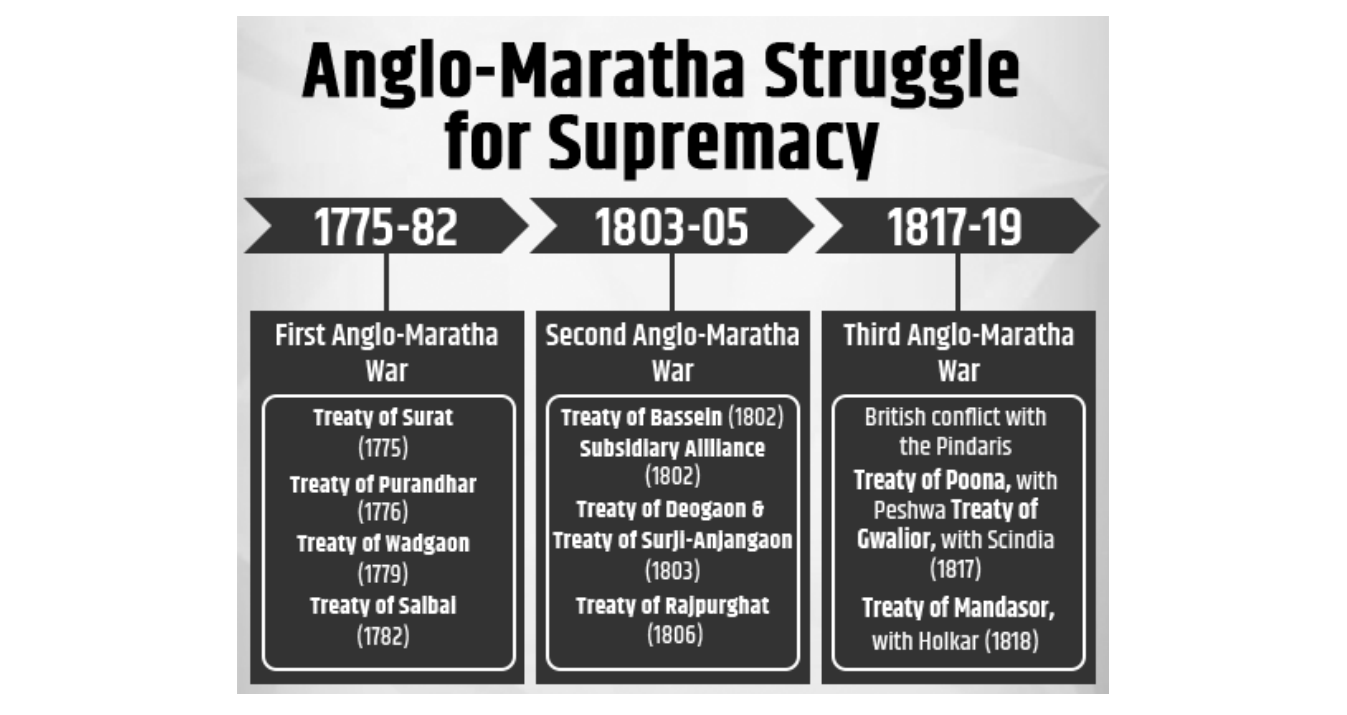
The British authorities in Bombay concluded the Treaty of Surat with Raghunatha Rao in March 1775.
Raghunatha Rao promised to cede Bassein and Salsette to the British but later when he was unwilling to fulfill his promise, the British captured them. This action of the Bombay Government was not approved by Warren Hastings.
In 1776, Warren Hastings sent Colonel Upton to settle the issue. He cancelled the Treaty of Surat and concluded the Treaty of Purandar with Nana Fadnavis, another Maratha leader. According to this treaty Madhava Rao II was accepted as the new Peshwa and the British retained Salsette along with a heavy war indemnity.
However, the home authorities rejected the Treaty of Purandar. Warren Hastings also considered the Treaty of Purandar as a ‘scrap of paper’ and sanctioned operations against the Marathas.
In the meantime, the British force sent by the Bombay Government was defeated by the Marathas.
The Maratha army was led by the brilliant general, Mahadji Sindhia.
Mahadji trapped the English army in the mountain passes near Talegaon and launched an attack on their supply base at Khopali.
The Marathas employed a scorched earth strategy, destroying farmland and contaminating wells to weaken the enemy.
As the English retreated toward Talegaon, the Marathas launched relentless attacks, forcing them to fall back to the village of Wadgaon.
Surrounded and cut off from essential supplies, the English surrendered in mid-January 1779 and signed the Treaty of Wadgaon.
The treaty compelled the Bombay government to return all territories acquired by the English since 1775.
He defeated the Maratha chief, Mahadaji Scindia, in a number of small battles and captured Gwalior.
Bengal's governor general, Warren Hastings, rejected the Treaty of Wadgaon and dispatched a sizable army led by Colonel Goddard, who took Bassein in December 1780 and Ahmedabad in February 1779. In August 1780, Gwalior was taken by a second Bengali contingent under the command of Captain Popham. General Camac led the English in their decisive victory over Sindhia at Sipri in February 1781.
The Treaty of Salbai was signed in 1782 between Warren Hastings and Mahadji Sindhia, with the following key provisions: ➤ The English retained control of Salsette. ➤ All territories captured since the Treaty of Purandhar (1776), including Bassein, were to be returned to the Marathas. ➤ Fateh Singh Gaekwad retained his pre-war territories in Gujarat and continued to serve the Peshwa as before. ➤ The English agreed to withdraw support for Raghunath Rao, and the Peshwa was to provide him with a maintenance allowance. ➤ He was required to restore all territories he had captured from the English and the Nawab of Arcot. ➤ The English retained their existing trade privileges. ➤ The Peshwa agreed not to support any other European power. ➤ Both the Peshwa and the English committed to ensuring their respective allies remained peaceful toward one another. ➤ Mahadji Sindhia acted as the mutual guarantor to ensure adherence to the treaty's terms.
Second Anglo Maratha War (1803-1805)
Background
The Maratha state was in a very bad shape during these years. The Maratha chiefs were trying to curb their independent principalities, Gaikwad at Baroda, Bhonsle at Nagpur, Holkar at Indore and Scindia at Gwalior.
There was also dissension regarding the succession to the Peshwaship and Nana Fadnavis was in complete control of the Maratha affairs at the centre.
During this time Lord Wellesley in order to establish complete control of the British over the Marathas invited them to enter into the ‘Subsidiary Alliance’ system. The Marathas rejected this British gesture of ‘friendship’, actually a ploy for their subjugation.
The death of Nana Fadnavis at this juncture gave the British an added advantage. Jaswant Rao Holkar, a powerful Maratha chief, defeated the combined armies of Scindia and the Peshwa at Poona in 1800 and captured the city.
The Peshwa approached Wellesley for help. This provided Wellesley an ideal opportunity to intervene in the Maratha affairs. Thus, the Second Maratha War started. Course of War
Peshwa Baji Rao II entered into a subsidiary alliance with the British by signing the Treaty of Bassein. Under this agreement, the Peshwa consented to: ➤ Accept a permanent British military presence in his territories, comprising a native infantry force of at least 6,000 troops, supported by field artillery and European gunners. ➤ Cede territories generating an annual revenue of Rs. 26 lakh to the British. ➤ Transfer control of the city of Surat to the British. ➤ Renounce all claims for Chauth on the Nizam’s territories. ➤ Accept British arbitration for resolving disputes with the Nizam or the Gaekwad. ➤ Refrain from employing Europeans from nations hostile to the British. ➤ Submit all his dealings with other states to British oversight and control.
Daulat Rao Scindia and Raghoji Bhonsle took the Treaty of Bassein as an insult to the national honour of the Marathas. Soon the forces of both the chieftains were united and they crossed the river Narmada. Wellesley seized this opportunity and declared war in August 1803.
Arthur Wellesley captured Ahmadnagar in August 1803 and defeated the combined forces of Scindia and Bhonsle at Assaye near Aurangabad.
Subsequently, Arthur Wellesley carried the war into Bhonsle’s territory and completely defeated the Maratha forces on the plains of Argaon. As a result, the Treaty of Deogaon was signed between Bhonsle and Wellesley. The former signed the subsidiary treaty which forced him to give up the province of Cuttack in Orissa.
The campaign of British commander Lord Lake against the forces of Scindia was rather dramatic. Lake triumphantly entered the historic city of Delhi and took Shah Alam, the Mughal Emperor under British protection.
Lake was quick in consolidating his conquests. By negotiating with the Raja of Bharatpur, he occupied Agra. Sadly, this military engagement proved to be a battle of great slaughter in which thousands of Maratha soldiers perished. Scindia signed a subsidiary treaty with the British. It is known as the Treaty of Surji –Anjangaon.
During the war against Bhonsle and Scindia, Holkar remained aloof because he was Scindia’s enemy. However, when Wellesley offered an alliance, Holkar made extreme demands. This made Wellesley declare war against Holkar. The campaign against Holkar was well organised but the English generals for the first time committed blunders. Holkar remained unsubdued.
Third Maratha War (1817-1819)
Background: Suppression of the Pindaris
Pindaris did not belong to any particular caste or creed. They used to serve the army without any payment but instead were allowed to plunder.
During the time of Baji Rao I, they were irregular horsemen attached to the Maratha army.
It is worth mentioning here that they never helped the British. They were mostly active in the areas of Rajputana and the Central Provinces and subsisted on plunder.
Their leaders belonged to both the Hindu as well as the Muslim communities. Chief amongst them were Wasil Muhammad, Chitu and Karim Khan. They had thousands of followers.
Lord Hastings determined to suppress the Pindaris. For this he gathered a large army of 1,13,000 men and 300 guns and attacked the Pindaris from four sides. He himself took command of the force from the north while Sir Thomas Hislop commanded the force from the south. By 1818, the Pindaris were completely suppressed and all their bands disintegrated.
Lord Hastings’ actions taken against the Pindaris were seen as a transgression of the sovereignty of the Marathas; they served to once again unite the Maratha confederacy. Role of Bajirao II
Peshwa Baji Rao II wanted to become the head of the Maratha Confederacy and at the same time wanted freedom from British control. His Chief Minister Tirimbakji encouraged him.
On the advice of the Company, the Gaekwar sent his Prime Minister Gangadhar Shastri to negotiate with the Peshwa. On his way back, Gangadhar Shastri, was murdered at Nasik in July 1815, at the instance of Tirimbakji.
This caused a lot of anger not only among the Marathas but also among the British. The latter asked the Peshwa to handover Tirimbakji to them. Peshwa handed over his Minister to the British, who lodged him in Thana jail from where he escaped.
Consequently, on 13 June 1817, the British Resident Elphinstone forced the Peshwa to sign the Treaty of Poona. Baji Rao gave up his desire to become the supreme head of the Marathas. Course of War
The Peshwa undid this treaty with the British and on 5 November 1817 attacked the British Residency. He was defeated at a place called Kirkee.
Similarly, the Bhonsle chief, Appa Sahib also refused to abide by the Treaty of Nagpur, which he had signed with the British on 17 May 1816. According to this treaty, Nagpur came under the control of the Company. He fought with the British in the Battle of Sitabuldi in November 1817, but was defeated.
The Peshwa now turned to Holkar for help, but Holkar too was defeated by the British on 21 December 1817 at Baroda. Treaty of Mandasor was signed in January 1818 between English and Holkar. Therefore, by December 1817 the dream of a Mighty Maratha Confederacy was finally shattered.
In 1818, Scindia was also forced to sign a new treaty with the British on the basis of which Ajmer was given to the Nawab of Bhopal, who also accepted the British suzerainty.
The Gaekwar of Baroda, while accepting the Subsidiary Alliance, agreed to hand over certain areas of Ahmedabad to the British. The Rajput states which were under the Pindaris were freed after the latter’s suppression.
The Peshwa eventually gave up in June 1818, and the Maratha confederacy was disbanded. Peshwaship was eliminated. At Bithur, close to Kanpur, Peshwa Bajirao was hired as a British retainer. Shivaji's lineal descendant Pratap Singh was appointed king of Satara, a little principality made up of the Peshwa's territories.
Causes of the Defeat of the Marathas
There were several reasons for the defeat of the Marathas in the Anglo-Maratha Wars. The main reasons were:
Lack of capable leadership.
Military weakness of the Marathas.
The Maratha leadership failed to evolve a stable economic policy to suit the changing needs of time.
The major drawback of the Maratha power was mutual bitterness and lack of cooperation amongst themselves.
The Marathas hardly left any positive impact on the conquered territories.
The Marathas did not have cordial relations with other princes and Nawabs of India.
The Marathas failed to estimate correctly the political and diplomatic strength of the British.
SINDH
In the early 19th century, the English started to show an interest in Sindh where they enjoyed some trade facilities authorised by a farman of the Mughal Emperor in 1630. The Farman provided the English with such privileges in the ports of Sindh which they enjoyed elsewhere.
Rise of Talpuras Amirs
In the eighteenth century, prior to the rule of Talpuras Amirs, Sindh was ruled by the Kallora chiefs. In 1758, an English factory was built at Thatta, owing to a parwana given by the Kallora prince, Ghulam Shah.
In 1761, Ghulam Shah, on the arrival of an English resident in his court, not only ratified the earlier treaty, but also excluded other Europeans from trading there.
This advantage was enjoyed by the English upto 1775 when a not-too-friendly ruler, Sarfraz Khan, made the English close their factory.
In the 1770s, a Baluch tribe called Talpuras, descended from the hills and settled in the plains of Sindh. They were excellent soldiers as well as adapted to hard life.
In 1783, the Talpuras, under the leadership of Mir Fath (Fatah) Ali Khan, established complete hold over Sindh and sent the Kallora prince into exile. The then Durrani monarch confirmed the claims of Mir Fath Khan and ordered the latter to share the country with his brothers (Mir’s brothers, popularly known as ‘Char Yar’).
When Mir Fath died in 1800, the Char Yar divided the kingdom among themselves, calling themselves the Amirs or Lords of Sindh. They conquered Amarkot from the Raja of Jodhpur, Karachi from the chief of Luz, Shikarpur and Bukkar from the Afghans.
Gradual Ascendancy over Sindh
A common belief in the late 18th century was that Napoleon was conspiring with Tipu Sultan to invade India.
In 1799 behind Lord Wellesley’s efforts to revive commercial relations with Sindh was the hidden aim to counteract the alliance of the French, Tipu Sultan and Shah Zaman, the Kabul monarch.
Negotiations were opened with Fath Ali Khan. But under the influence of Tipu Sultan and the jealousy of the local traders, aided by the anti-British party at Hyderabad (Sindh), the amir in October 1800, ordered the British agent to quit Sindh within ten days.
Treaty of ‘Eternal Friendship’
In June 1807, the alliance of Tilsit with Alexander I of Russia was joined by Napoleon Bonaparte. The alliance had as one of its conditions a combined invasion of India by the land route.
Now the British wanted to create a barrier between Russia and British India. To achieve this, Lord Minto sent three delegations under the leadership of various prominent persons to forge alliances.
Accordingly, Metcalfe was sent to Lahore, Elphinstone to Kabul and Malcolm to Teheran. Sindh was visited by Nicholas Smith who met the Amirs to conclude a defensive arrangement.
After negotiations, the Amirs agreed to a treaty—their first-ever treaty with the English. After professing eternal friendship, both sides agreed to exclude the French from Sindh and to exchange agents at each other’s court.
The treaty was renewed in 1820 with the addition of an article excluding the Americans and resolving some border disputes on the side of Kachchh after the final defeat of the Maratha confederacy in 1818.
Treaty of 1832
In 1832, William Bentinck sent Colonel Pottinger to Sindh to sign a treaty with the Amir’s. The provisions of the treaty were as follows:
Free passage through Sindh would be allowed to the English traders and travellers and the use of Indus for trading purposes; however, no warships would ply, nor any materials for war would be carried.
No English merchant would settle down in Sindh, and passports would be needed for travellers.
Tariff rates could be altered by the Amirs if found high and no military dues or tolls would be demanded.
The Amirs would work with the Raja of Jodhpur to put down the robbers of Kachchh.
The old treaties were confirmed and the parties would not be jealous of each other.
Lord Auckland and Sindh
Lord Auckland, who became the Governor-General in 1836, looked at Sindh from the perspective of saving India from a possible Russian invasion and wished to obtain a counteracting influence over the Afghans.
Ranjit Singh in Punjab was strong enough to resist coercion in this regard, but the Amirs were not. Thus, the English view was that they had to consolidate their position in Sindh as a necessary first step for their plans on Afghanistan.
When Ranjit Singh took control of the frontier town of Rojhan in Sindh, they were given an opportunity, and Pottinger was dispatched to Hyderabad to negotiate a new agreement with the Amirs.
The treaty offered protection to the Amirs, requiring them to either house Company troops in their capital at their expense or grant suitable concessions to the British in return.
Initially, the Amirs resisted but eventually agreed reluctantly in 1838 when it was suggested that Ranjit Singh might receive external assistance.
The treaty allowed British intervention in disputes between the Amirs and the Sikhs and permitted a British resident, escorted by English troops, to freely move across Sindh. This effectively made Sindh a British protectorate in 1838.
Tripartite Treaty of 1838
To address their perceived Afghan problem, the British adopted deceptive strategies.
They persuaded Ranjit Singh to sign a tripartite treaty in June 1838, agreeing to British mediation in his disputes with the Amirs.
They compelled Emperor Shah Shuja to relinquish his sovereign claims over Sindh, provided he received arrears of tribute.
The British determined the tribute amount, aiming to finance their Afghan campaign and secure portions of the Amirs’ territory for a strategic route through Sindh to Afghanistan.
Sindh Accepts Subsidiary Alliance (1839)
The British sought to compel the Amirs to finance their troops and to nullify a clause in the 1832 treaty that barred British troop movement through Sindh by land or river.
Under threat, the Amirs signed a treaty in February 1839, agreeing to Station a British subsidiary force at Shikarpur and Bukkar. Pay Rs. 3 lakh annually for the upkeep of Company troops.
Refrain from negotiating with foreign powers without British consent.
To provide Store-room at karachi for British military supplies. Abolish tolls on the Indus. Supply auxiliary troops for the Afghan war if required.
Capitulation of Sindh
The Amirs opposed the First Anglo-Afghan War (1839– 42), which was fought on Sindh’s soil, and resented the presence of British troops in their region.
Despite complying with the treaty and bearing the costs, they were accused of hostility and disloyalty by the British, receiving neither gratitude nor recognition for their contributions.
The Amirs were accused of engaging in treasonous activities against the British. Governor-General Ellenborough, facing a difficult situation due to the setbacks in the Afghan War, sent Outram to Sindh to negotiate a new agreement.
As per the treaty, the Amirs had to Surrender key provinces as reparation for their alleged offenses, to Provide fuel for British steamers navigating the Indus and to discontinue minting their own currency.
The British, led by Napier, intervened in a succession dispute involving the Amirs, which escalated into a conflict when the Amirs rebelled.
Sindh fell to the British in a short time, with the Amirs captured and exiled. In 1843, Governor-General Ellenborough annexed Sindh into the British Empire, appointing Charles Napier as its first governor.
PUNJAB
First Anglo-Sikh War (1845-46)
Causes On December 11, 1845, the Sikh army crossed the Sutlej River, which is thought to have been the catalyst for the start of the first Anglo-Sikh war. It was believed that this aggressive move gave the English the pretext to declare war. But the causes were far more intricate and may be enumerated as follows: Causes of the First Anglo-Sikh War
The political instability in the Lahore kingdom after Maharaja Ranjit Singh’s death led to a fierce power struggle between the Lahore court and the increasingly influential Sikh army.
The Sikh army grew suspicious of the British due to their military campaigns in 1841 to annex Gwalior and Sindh, and their operations in Afghanistan in 1842.
The British further fueled tensions by increasing their troop presence near the Lahore kingdom's borders. Course of War
The war began in December 1845, with the British fielding a force of 20,000 to 30,000 troops. The Sikh army, numbering around 50,000 men, was led by Lal Singh.
However, the treachery of commanders Lal Singh and Teja Singh led to successive Sikh defeats in five key battles at
Mudki(December 18, 1845), Ferozeshah (December 21-22, 1845) , Buddelwal , Aliwal (January 28, 1846) and at Sobraon ( february 10, 1846). The British captured Lahore on February 20, 1846, without encountering resistance
Treaty of Lahore (March 8, 1846) The war concluded with the Sikhs being compelled to sign the Treaty of Lahore on March 8, 1846, marking a significant loss of sovereignty for the Sikh kingdom. The main features of the treaty are as follows:
➤ The Sikhs were required to pay a war indemnity exceeding one crore rupees to the British. ➤ The Jalandhar Doab, the region situated between the Beas and Sutlej rivers, was annexed to British-controlled territory. ➤ A British resident, Henry Lawrence, was appointed in Lahore to oversee governance. ➤ The Sikh army's strength was significantly reduced to limit its military capacity. ➤ Daleep Singh was confirmed as the ruler, with Rani Jindan acting as regent and Lal Singh serving as wazir. ➤ Due to the Sikhs' inability to pay the full war indemnity, Kashmir, including Jammu, was sold to Gulab Singh. Gulab Singh paid 75 lakh rupees to the British as compensation for acquiring the territory. The formal transfer of Kashmir to Gulab Singh was finalized through a separate treaty signed on March 16, 1846.
Dissatisfaction with the Treaty of Lahore, especially regarding the Kashmir arrangement, led to a Sikh rebellion. In December 1846, the Treaty of Bhairowal was concluded, resulting in the removal of Rani Jindan as regent. A council of regency was established to govern Punjab, comprising eight Sikh sardars under the supervision of British Resident Henry Lawrence.
Second Anglo-Sikh War (1848-49)
Causes
The Sikh defeat in the first Anglo-Sikh War, coupled with the humiliating terms of the Treaties of Lahore and Bhairowal, deeply offended the Sikh community. The harsh treatment of Rani Jindan, who was exiled to Benares as a pensioner, further fueled Sikh discontent.
Mulraj, the governor of Multan, was replaced by a new Sikh governor due to an increase in the annual revenue demand. In protest, Mulraj rebelled and killed two British officers who had accompanied the new governor.
Sher Singh was dispatched to quell the rebellion, but instead, he sided with Mulraj, sparking a widespread uprising in Multan. This revolt is considered the immediate trigger for the subsequent conflict.
The then Governor-General of India, Lord Dalhousie, a hardcore expansionist, got the pretext to annex Punjab completely. Course of War Lord Dalhousie traveled to Punjab himself. Before Punjab was eventually annexed, three significant battles were fought. The three conflicts were:
The Company's commander-in-chief, Sir Hugh Gough, led the Battle of Ramnagar.
In January 1849 , Battle of Chillhanwala.
The Sikh army surrendered at Rawalpindi in the Battle of Gujarat on February 21, 1849, and their Afghan allies were driven from India. (Gujarat is a small town situated beside the Jhelum River.) Result At the end of the war came:
In 1849, the Sikh army and Sher Singh surrendered;
Punjab was annexed; the British Parliament thanked the Earl of Dalhousie for his services and promoted him to the rank of Marquess;
A three-member board comprising Henry and John Lawrence and Charles Mansel was established to govern Punjab. The board was abolished in 1853, and a chief commissioner was appointed to oversee Punjab. John Lawrence was appointed as the initial chief commissioner.
Significance of the Anglo-Sikh Wars
During the Anglo-Sikh wars, both sides respected one another's fighting skills. The Sikhs were expected to fight obediently for the British throughout the 1857 Revolt and numerous more campaigns and conflicts until 1947, when India gained its independence.