Whatsapp 88106-52225 For Details
Get Free IAS Booklet
Get Free IAS Booklet
CABINET MISSION [1946]
We will discuss the Cabinet Mission Plan, its response, formation of the Constituent assembly, Interim Government, Muslim League’s stance and the evolution of the two-nation theory, culminating in the Mountbatten Plan, Radcliffe Award and integration of Indian states.
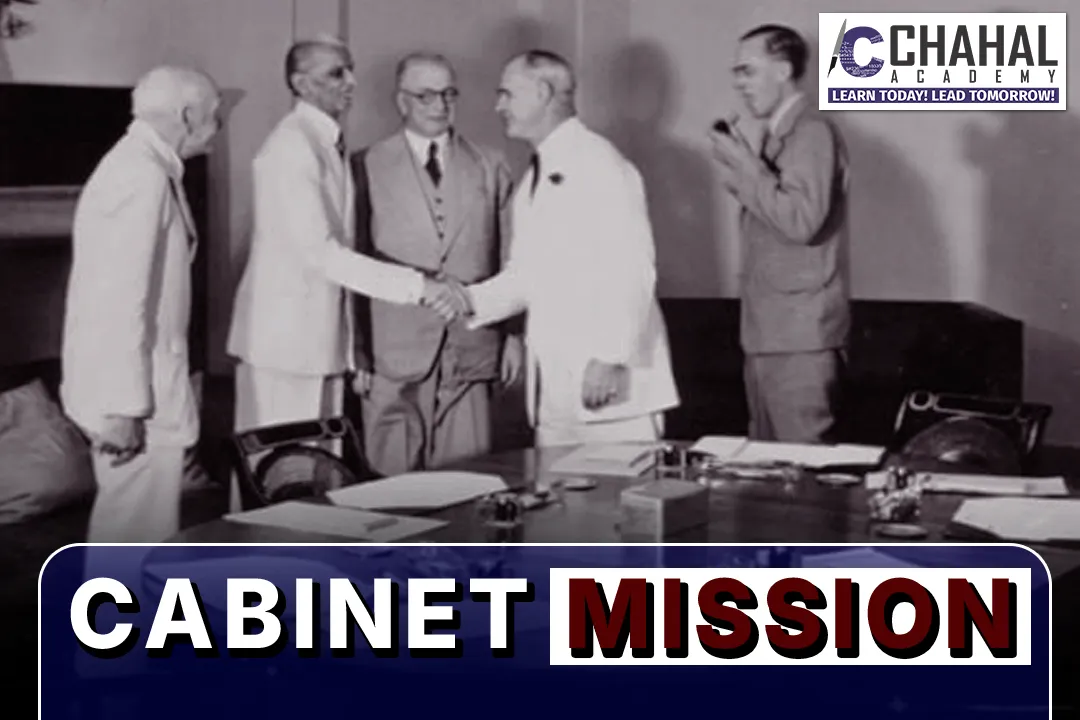
In February 1946, a committee of the British Cabinet, known as the Cabinet Mission, led by Sir Pethick-Lawrence (Secretary of State for India),visited India to assess the Indian political situation and frame a scheme for making a constitution for India and to discuss the transfer of power from British to Indian leadersip. So, the Mission issued its own plan. Other members of the commission were Stafford Cripps, President of the Board of Trade; and A.V. Alexander, First Lord of Admiralty.
CABINET MISSION PLAN
Rejection of the demand for a full-fledged Pakistan: It rejected the demand for a full-fledged Pakistan, because-
the Pakistan so formed would include a large non- Muslim population—38 per cent in the North-West and 48 per cent in the North-East;
the very principle of communal self-determination would claim separation of Hindu-majority western Bengal and Sikh- and Hindu-dominated Ambala and Jullundur divisions of Punjab
deep-seated regional ties would be disturbed if Bengal and Punjab were partitioned;
partition would entail economic and administrative problems, for instance, the problem of communication between the western and eastern parts of Pakistan; and
the division of the armed forces would be dangerous.
CONSTITUENT ASSEMBLY
The plan made by the Cabinet Mission recommended for a Constituent assembly consisting of the representatives of all the major groups.
Earlier that year provincial legislatures had been elected on the basis of a limited franchise and communal electorates. The Cabinet Mission proposed that the Constituent Assembly be elected by those provincial assemblies.
This constituent assembly would be a 389-member body with provincial assemblies sending 292, chief commissioner’s provinces sending 4, and princely states sending 93 members.
THE FEDERAL FORMULA
The Cabinet Mission proposed a federal structure to address Muslim concerns about a unitary, Hindu-majority state.
Provinces were to have maximum autonomy, with the Central government holding minimal power, primarily in areas like foreign affairs, defence, and communications.
The Union was to include both British Indian provinces and princely states under British paramountcy. Residual powers would be vested in the provinces and states.
The Union was to have an executive and legislature composed of representatives from provinces and states.
For major communal issues in the legislature, decisions would require a majority vote from both Hindu and Muslim representatives, except in cases where a simple majority was sufficient.
Three-Tier Federation
The Cabinet Mission made an extraordinary proposal: ‘Provinces should be free to form groups with executives and legislatures, and each group could determine the provincial subjects to be taken in common.
Thus, it proposed for a Three-tier executive and legislature at provincial, section and union levels.
Sections of provincial assemblies
More extraordinarily, the Cabinet Mission itself laid down a procedure for the Constituent Assembly that would necessarily create groups in a communal way.
According to that procedure provinces would sit in three sections as determined by the Mission.
Two of such sections would be Muslim-majority and the third section would be Hindu- majority.
The Hindu-majority section - Section A - would be made up of the provinces of Madras, Bombay, United Provinces (now Uttar Pradesh), Bihar, Central Province (now Madhya Pradesh) and Orissa.
Section B would comprise Punjab, Baluchistan, the North-West Frontier Province and Sind.
Section C would be made up of Assam and Bengal. Assam itself was not a Muslim-majority province. But Bengal and Assam together would be a Muslim-majority section.
In the constituent assembly, members from groups A, B and C were to sit separately to decide the constitution for provinces and if possible, for the groups also. Then, the whole constituent assembly (all three sections A, B and C combined) would sit together to formulate the union constitution.
No Way Out of a Group
The other extraordinary phenomenon was the formula that, once a section formed a group constitution, no province would be free to withdraw from the group it was in.
A province could leave such a group only after the first general election held under the group constitution.
Interim Government
The Cabinet Mission proposed that, while the work of Constitution making would proceed, the government should be carried on by the Governor-General with the help of representatives of the major parties.
Reaction of Congress and Muslim League
The difference of opinion between the League and the Congress was primarily over whether grouping was optional or compulsory. The Congress said it was assured by members of the Mission that provinces need not join if they did not wish to. It recommended this interpretation to Assam and NWFP, which did not want to be part of the League dominant Sections B and C. It challenged grouping and worked towards a strong centre, rather than a weak one. On the other hand, the League wanted to be able to question the constitution at the very start, rather than wait for ten years. The League accepted the Mission Plan to the extent Pakistan was implied in the compulsory grouping clause. The Muslim League on June 6 and the Congress on June 24, 1946 accepted the long-term plan put forward by the Cabinet Mission.
INTERIM GOVERNMENT
A pure Congress Interim Government was formed on 2 September 1946. Jawaharlal Nehru was sworn in as Vice-President of the Executive Council.
The League, however, declared civil war and warned that Pakistan could no longer be prevented. No Muslim League members joined at this point, making the government inherently unstable.
Wavell quietly brought the Muslim League into the Interim Government on October 26, 1946.
14 Ministers of Interim Government
1. 1. Jawaharlal Nehru held the position of Vice President of the Executive Council and was responsible for External Affairs and Commonwealth Relations. 2. Vallabhbhai Patel managed Home Affairs, Information, and Broadcasting. 3. Baldev Singh was in charge of Defence. 4. Dr. John Mathai handled Industries and Supplies. 5. C. Rajagopalachari oversaw Education. 6. C.H. Bhabha was responsible for Works, Mines, and Power. 7. Rajendra Prasad managed Agriculture and Food. 8. Jagjivan Ram served as the Minister for Labour. 9. Asaf Ali took care of Railways. 10. Liaquat Ali Khan (Muslim League) handled Finance. 11. Ibrahim Ismail Chundrigar (Muslim League) was responsible for Commerce. 12. Abdur Rab Nishtar (Muslim League) managed Communications. 13. Ghazanfar Ali Khan (Muslim League) oversaw Health. 14. Jogendra Nath Mandal (Muslim League) was in charge of Law.
Obstructionist Approach and Ulterior Motives of League
The League did not attend the Constituent Assembly which had its first meeting on December 9, 1946. Consequently, the Assembly had to confine itself to passing a general ‘Objectives Resolution’ drafted by Jawaharlal Nehru stating the ideals of an independent sovereign republic with autonomous units, adequate minority safeguards and social, political and economic democracy.
The League refused to attend informal meetings of the cabinet to take decisions.
The League questioned the decisions and appointments made by the Congress members.
Liaqat Ali Khan as the finance minister restricted and encumbered the efficient functioning of other ministries.
In February 1947, nine Congress members of the cabinet wrote to the viceroy demanding the resignation of League members and threatening the withdrawal of their own nominees. The last straw came with the League demanding the dissolution of the Constituent Assembly. A crisis seemed to be developing rapidly.
PAKISTAN DEMAND AND ITS CONSEQUENCES
The demand for Pakistan, raised in Lahore in March 1940, acquired stridency by the summer of 1946.
At the convention of Muslim League legislators at Delhi from 7 to 9 April 1946 it was clarified that Pakistan would be one nation though geographically spread across two regions.
Nehru declared on 7 July 1946 that Congress reserved the right to give shape to the Constituent Assembly as it wished. This invited the League’s charge of insincerity on the part of the Congress in working the plan. The League withdrew its acceptance of the plan on 29 July 1946 and gave a call for “direct action” from August 16 to achieve Pakistan.
16 August 1946 was declared as Direct Action Day. Trouble first broke out in Calcutta where a Muslim League government, headed by H. S. Suhrawardy, abetted the rioters. The slogans in Calcutta were “Larke lenge Pakistan, Lekar rahenge Pakistan.”
Far from revoking Direct Action after the tragedy in Calcutta, some League leaders went on to speak of “Jehad to achieve freedom for Islam in India”. Jinnah himself warned that the impending installation of a Congress Interim Government would result in unprecedented and disastrous consequences.
Tragically, the country was now thrown into the vortex of civil war, a qualitatively new phase and type of violence.
EVOLUTION OF THE TWO-NATION THEORY
The development of the two-nation theory over the years is as follows:
In 1887, the Congress came under direct criticism from Viceroy Dufferin and Lt. Governor Colvin of the United Provinces.
The British administration supported Syed Ahmed Khan and Raja Shiv Prasad of Bhinga to create an anti-Congress stance. Syed Ahmed Khan urged educated Muslims to distance themselves from the Congress, although some Muslims like Badruddin Tyabji, Mir Musharraf Hussain, A. Bhimji, and Hamid Ali Khan did join the party.
In 1906, Agha Khan led a Muslim delegation (known as the Shimla delegation) to Viceroy Lord Minto, demanding separate electorates and Muslim representation based on their numerical strength and “political significance and contributions to the Empire.” That same year, the All India Muslim League was formed by Agha Khan, Nawab Salimullah of Dacca, Nawab Mohsin-ul-Mulk, and Nawab Waqar-ul-Mulk to promote loyalty to British rule and discourage Muslim support for the Congress.
The Morley-Minto Reforms of 1909 introduced separate electorates. Around this time, U.N. Mukherji and Lal Chand established the Punjab Hindu Sabha.
From 1912 to 1924, the Muslim League was influenced by younger nationalist leaders, though their political ideology had communal overtones.
In 1916, the Congress accepted the Muslim League’s demand for separate electorates, and both parties presented a joint set of demands. However, they still functioned as distinct political entities, and the Congress thereby validated the League’s political presence.
Between 1920 and 1922, Muslims actively took part in the Rowlatt and Khilafat agitations under the Non-Cooperation Movement, though communal sentiments persisted within the Muslim political framework.
In the 1920s, the Arya Samaj initiated the Shuddhi (reconversion) and Sangathan (unity) movements, prompting a Muslim response through the Tabligh
Important Sessions of the Congress- Part 2
Congress Year President• Session Madras Rash Behari Ghosh (2) •
Lahore Madan Mohan Malviya (propagation) and Tanzeem (organization) campaigns. This period also saw some nationalists adopt communal ideologies, with several Responsivist Swarajists joining the Hindu Mahasabha.
The Nehru Report, which suggested constitutional reforms, faced rejection from Muslim conservatives and the Sikh League. In response, Jinnah presented his famous Fourteen Points, which called for separate electorates and reserved seats for Muslims in government and self-governing bodies.
Despite limited Muslim involvement in the Civil Disobedience Movement apart from groups like the Jamaat-i-Ulema-i-Hind, Khudai Khidmatgars, and representatives from Kashmir the communal factions remained consistently active and attended all three Round Table Conferences, even as Congress boycotted two of them.
The Communal Award accepted many of the demands articulated in Jinnah’s Fourteen Points.
After the Muslim League's poor performance in the 1937 provincial elections, it adopted a more hardline communal stance, pushing the idea of Muslims not as a minority but as a separate nation. The concept of a distinct Muslim nation was initially introduced in the early 1930s by Rahmat Ali and later expanded by poet-philosopher Muhammad Iqbal.
On March 24, 1940, the Muslim League passed the Lahore Resolution (commonly known as the Pakistan Resolution), demanding that Muslim-majority regions— primarily in northwestern and eastern India—be grouped into independent, sovereign states, with protections for Muslims living in minority areas.
During World War II, the British granted the League near-veto power on any political resolution. The League took advantage of this and remained firm in its demand for Pakistan during discussions over the August Offer, Cripps Mission, Shimla Conference, and Cabinet Mission Plan.
Ultimately, the League achieved its objective with the creation of Pakistan in 1947, comprising the Muslim-majority provinces of Punjab, Sindh, Baluchistan, North-West Frontier Province, and Bengal.
Remarks Constitution of the Congress drawn Expressed disapproval over formation of separate electorates on the basis of religion (of the Indian Councils Act, 1909).
AllahabadWilliam Wedderburn
CalcuttaBishan Narayan Dhar
BankipurR N Mudholkar KarachiSyed Mohammed MadrasBhupendra Nath Bose
BombaySatyendra Prasanna Sinha•
Lucknow Ambica Charan Mazumdar• CalcuttaAnnie Besant• Bombay and Syed Hasan Imam and DelhiMadan Mohan Malviya
AmritsarMotilal Nehru
Nagpur C.Vijayaraghavachariar•
Hakim Ajmal Khan (acting AhmedabadPresident in place of C R Das) Mohammad Ali Jinnah, who was then a 44-year-old barrister and firmly with the Congress, decried the colonial government’s decision to introduce separate electorates for Hindus and Muslims in municipalities and local bodies. He stated that this would disturb the amicable relations between the two communities. It is ironic that Jinnah became the main champion of a separate Muslim state two and a half decades later. Jana Gana Mana was sung for the first time in the INC The Congress at its Calcutta Session in 1911, congratulated Mahatma Gandhi and the Indian community in Transvaal on the repeal of the South African province’s anti-Asiatic legislation
The biggest achievement of the 1915 Bombay Session was that the constitution of the Congress was suitably altered to admit the delegates from the extremist section. Tilak responded by announcing the willingness of his supporters to re-enter the Congress. As a result the number of delegates rose to 2259 from 866 a year back. Lucknow Pact – joint session with the Muslim League First Woman President of the INC Two sessions were held, first in Bombay then in Delhi The Congress expressed its deep solidarity with the people killed in the Jallianwala Bagh massacre in the city earlier that year. Under the presidentship of Motilal Nehru, the Congress condemned the massacre in the strongest of terms. In this session, the Congress sought to intensify the Non-Cooperation Movement. It urged merchants to boycott any foreign trade relations and urged government servants to help the national cause. The importance of using non-violent means was reiterated. The party also made certain important organisational changes. The strength of the A I. C. C. increased to 350 and a Working Committee of 15 members was constituted. Hakim Ajmal Khan was unanimously elected to preside over the Session in the absence of C.R. Das, who was in jail. Gandhiji was appointed as the sole executive authority of the Congress and invested with full powers of the AICC. Chairs and benches for delegates were eliminated and Khadi tents made their appearance for first time.
GayaC R Das•
KakinadaMaulana Mohammad Ali
BelgaumM K Gandhi
KanpurSarojini Naidu • GuwahatiS Srinivasa Iyengar Madras MA Ansari
CalcuttaMotilal Nehru
LahoreJawaharlal Nehru
--•
Karachi Vallabhbhai Patel
DelhiAmrit Ranchchorddas Seth In this session, Congress leaders debated on the merits and demerits of continuing its boycott of the government-created councils. While the ‘no-changers’ led by C Rajagopalachari and those loyal, suggested to Gandhiji advocated continuing the boycott, the Swarajists led by C.R. Das suggesting participating in the councils.
Only time Gandhiji was the President of the Congress This was right after he was released from prison First Indian Woman President
During the Calcutta session, Gandhiji moved a resolution accepting the Motilal Nehru report’s recommendation of Dominion Status within two years. However, Jawaharlal Nehru moved an amendment reiterating the Congress’s commitment to independence. All India Youth Congress was also formed To arrive at a middle ground, the Congress gave the British a warning that a civil disobedience movement would start if India was not granted dominion status by December 31, 1929. In this session, Resolution for ‘Poorna Swaraj’ was passed and 26th January was to be observed as ‘Independence Day’ Civil Disobedience movement was launched and Gandhi- Irwin pact was endorsed. No session The Congress expressed its admiration of the bravery and sacrifice of Bhagat Singh, Sukhdev and Rajguru who were executed on March 23, 1931, while also voicing its disapproval of political violence. Resolutions on fundamental rights and national economic progress were passed Gandhiji was nominated to represent INC in the second round table conference Despite Police vigilance, over 500 delegates attended the Congress session in Delhi in April 1932. Pandit Madan Mohan Malviya, the President elect was arrested enroute. Four resolutions were passed reiterating complete Independence as the goal of the Congress, endorsing the revival of Civil Disobedience, expressing complete faith in Gandhiji’s leadership and reaffirming deep faith in non-violence.
Malaviya was elected Calcuttabut Mrs Nellie Sengupta presided
Bombay Rajendra Prasad•
--•
LucknowJawaharlal Nehru (2)
FaizpurJawaharlal Nehru (3)•
HaripuraSubash Chandra Bose
TripuriSubash Chandra Bose (2)
RamgarhAbul Kalam Azad
1941-45•
Meerut1946Acharya Kriplani• Wearing of Khadi was made a necessary criterion for elective membership. A cap of 2000 was put for the number of Congress delegates. A. I. C. C. was reduced to half its strength. The delegates were to be elected at the rate of 1 per every 500 primary members, thereby making them representatives of the people.
No session
First session to be held in a village
Towards the end of the session, there was a contest for who would be the president-elect for the next session between Netaji and Pattabhi Sittaramayya. Bose won with a margin even though Sittaramayya was seen as Gandhiji’s nominee.
The Congress met at Tripuri under special circumstances as president Subhas Chandra Bose was very ill and Gandhiji was fasting in Rajkot. As Bose was too ill to preside over some sittings, Maulana Azad conducted proceedings on his behalf. However, differences cropped up between Bose and a section of the Working Committee and the former resigned from his presidentship.
The Ramgarh Session was taken up entirely with the crisis brought about by the war and passed only one lengthy resolution on the issue. The Congress protested against the declaration of India as a belligerent country without any reference to the people and stated that the British government was carrying on the war fundamentally for imperialist ends. The party also declared that nothing short of complete independence is acceptable.
No sessions because of arrests
Last Session before Independence