Whatsapp 88106-52225 For Details
Get Free IAS Booklet
Get Free IAS Booklet
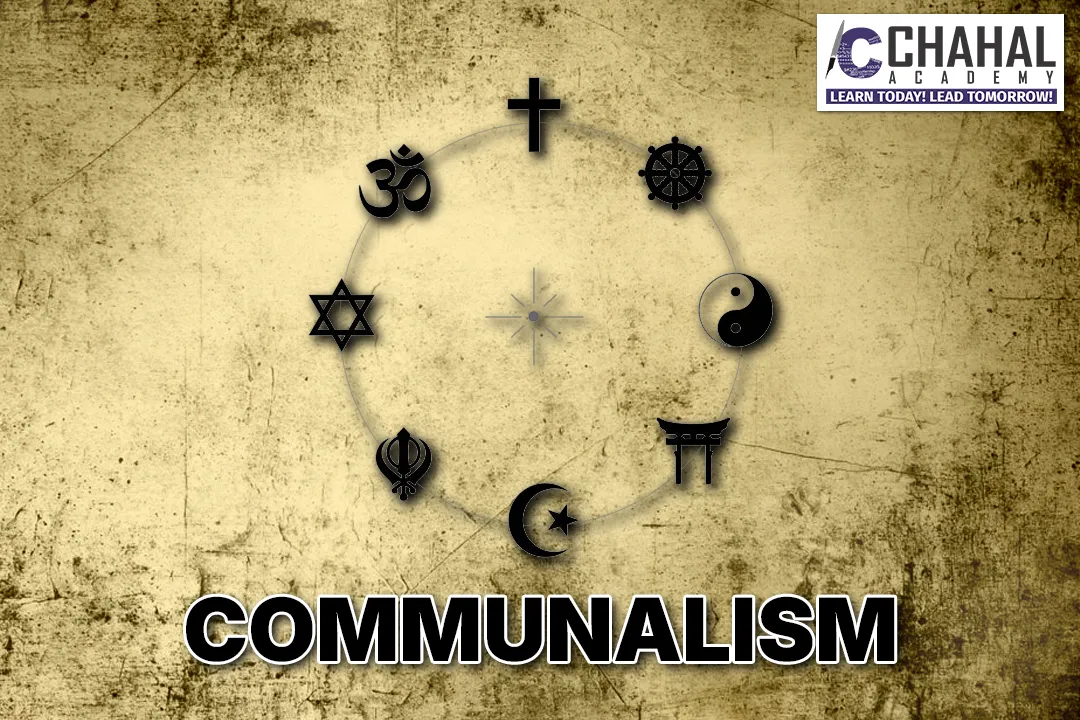
COMMUNALISM
In this unit
We will explore Communalism, its stages, socio-economic factors, and British Policies that contributed to it.
Communalism is fundamentally an ideology that prioritizes the interests of a particular religious or ethnic group over those of the broader society. In India, this ideology developed through three distinct stages:
Communal Nationalism: This stage is characterized by the belief that members of a religious group share identical secular interests meaning that issues unrelated to religion still affect all individuals of that community in the same way.
Liberal Communalism: At this stage, it is assumed that two different religious communities, due to their religious differences, also have separate political, economic, and cultural interests in the secular realm.
Extreme Communalism: This phase takes a more radical turn, suggesting that the interests of different religious groups are not only separate but also fundamentally conflicting. According to this view, peaceful coexistence between communities is impossible because the interests of one are perceived to clash directly with those of another. The emergence and spread of communalism in India can be traced to several causes, most notably the socio-economic and political structures established during colonial rule.
FACTORS RESPONSIBLE FOR THE GROWTH OF COMMUNALISM IN INDIA Socio-economic Factors
Communal and separatist ideologies grew among Muslims due to their lack of advancement in education, trade, and industry. Their resistance to modern Western ideas and scientific thought further contributed to this trend.
British officials and loyalist Muslim leaders fostered hostility between educated Muslims and Hindus. Leaders like Syed Ahmad Khan advocated for special privileges for Muslims in government service, suggesting that loyalty to the British would result in rewards such as jobs and other benefits.
The economic underdevelopment caused by colonial rule also fueled communalism. It reflected the aspirations and frustrations of the middle class in a society with limited opportunities for advancement.
British Policies
The British "Divide and Rule" policy fueled communalism by fostering divisions and offering preferential treatment to certain communities in jobs and promotions.
English education marginalized Arabic and Persian studies, worsening Muslims' exclusion from government services and deepening economic disparities.
As nationalism grew post-1870s, the British offered concessions, reservations, and favors to Muslims to counteract nationalist movements.
Sir Syed Ahmed Khan, initially a reformist, later supported colonial policies, discouraging Muslims from joining the Congress and emphasizing distinct Hindu-Muslim interests.
Institutional measures like the separate electorate (Government of India Act, 1909) and the Communal Award intensified communal divisions.
Communal leaders were favored by the British, and communal organizations were tolerated and even encouraged, deepening sectarian divides.
The British government's inaction against communalism and lack of proactive measures indirectly legitimized and encouraged communal ideologies.
Socio-religious reform movements like the Wahabi Movement and Shuddhi campaigns, with their militant overtones, heightened religious tensions.
Early nationalist activities sometimes carried a Hindu bias, such as Tilak’s Ganesh Puja and Shivaji Festival, alienating other communities.
A communal interpretation of Indian history divided periods into "Hindu" and "Muslim" eras, promoting divisive historical narratives.
Rumors amplified by vernacular media frequently incited communal riots and escalated tensions.
Political parties' vote-bank appeasement strategies often led to decisions that inadvertently fueled communal violence and societal divisions.