Whatsapp 88106-52225 For Details
Get Free IAS Booklet
Get Free IAS Booklet
Constitutional development between 1773 and 1858
We will examine the evolution of Constitutional, Administrative, Military, Judicial and Civil Services under the Company and British Rule spanning 200 years from 1757 to 1947.
The history of constitutional development in India begins from the passing of the Regulating Act in 1773. The Pitt’s India Act of 1784 and the successive Charter Acts from 1793 to 1853 form part of the constitutional changes under the East India Company’s rule. The Revolt of 1857 brought about important changes in the British administration in India. The rule of the East India Company ended. The administration of India came under the direct control of the British Crown. These changes were announced in the Government of India Act of 1858. The ‘Proclamation of Queen Victoria’ assured the Indians a benevolent administration. Thereafter, important development had taken place in the constitutional history of India as a result of the Indian National Movement.
CONSTITUTIONAL DEVELOPMENT BETWEEN 1773 AND 1858 The Regulating Act of 1773
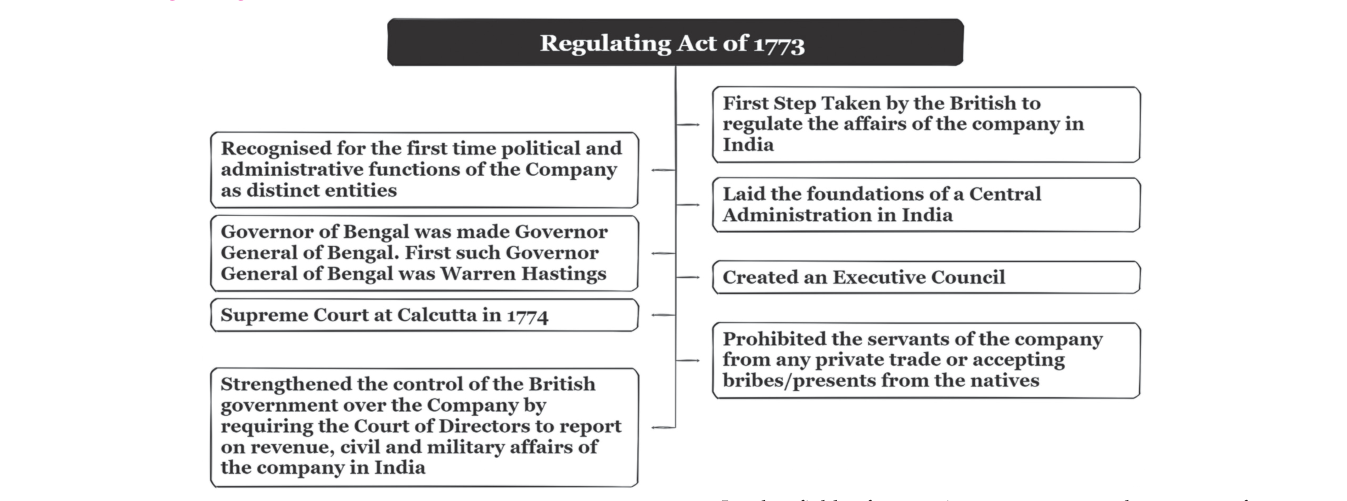
The Parliament passed its first important Act in 1773, called the Regulating Act to control the Company’s Administration. The Act made changes in the constitution of the Company at home; the whole of the territories in India were subjected to some degree of control.
The provision was made in a very efficient manner for the government to keep supervision over the Company. Changes were made in the Constitution of the Court of Directors of the Company.
It was required that it should submit to the Government all communications about civil and military affairs received from Bengal and revenues of India.
In the field of executive government, the status of Governor of Bengal was raised to Governor General. His Council would consist of four members.
The Governor General in Council was given the power to superintend and control the presidencies of Madras and Bombay in matters of war and peace.
In this body was vested the civil and military administration of the presidency and government of all the territorial acquisitions and revenues in the kingdoms of Bengal. Bihar and Orissa.
The Governor General in turn was under the direct control of the Court of Directors and kept it fully informed of the affairs concerning the interests of the Company.
The Act also provided for the establishment of a Supreme Court of Justice at Calcutta employees and citizens of Calcutta. to give justice to Europeans, their
powers were granted to the Governor General and Council
Legislative civil government of Fort William and subordinate factories.
The whole scheme was based on checks and balances. to make rules, ordinances and regulations for the
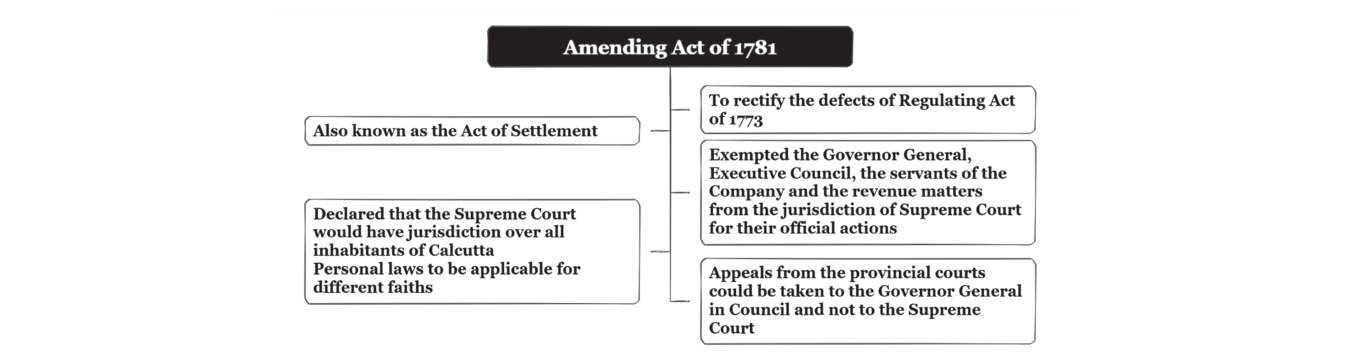
Amendments (1781)- The jurisdiction of the Supreme Court was defined—within Calcutta, it was to administer the personal law of the defendant. ➤ The servants of the government were immune if they did anything while discharging their duties. ➤ Social and religious usages of the subjects were to be honoured.
The significance of the Regulating Act is that it brought the affairs of the Company under the control of the
Pitt’s India Act of 1784
Parliament. Besides, it proved that the Parliament of England was concerned about the welfare of Indians. The greatest merit of this Act is that it put an end to the arbitrary rule of the Company and provided a framework for all future enactments relating to the governing of India.
The main defect of the Act was that the Governor-General was made powerless because the council which was given supreme power often created deadlocks by over-ruling his decision. However, many of these defects were rectified by the Pitt’s India Act of 1784.
The Regulating Act proved to be an unsatisfactory document as it failed in its objective. In January 1784, Pitt the Younger (who became Prime Minister of England after the General Elections) introduced the India Bill in the British Parliament. Despite bitter debate in both the Houses, the bill was passed after seven months and it received royal assent in August 1784. This was the famous Pitt’s India Act of 1784.
The purpose was to remove defects in the Regulating Act. Company’s public affairs and its administration in India were to come directly under supreme control of the British Government.
The Act established a Board of Control consisting of six commissioners, including two Cabinet ministers. A Board of Control consisting of the chancellor of exchequer, a secretary of state and four members of the Privy Council (to be appointed by the Crown) were to exercise control over the Company’s civil, military and revenue affairs.
The Board of Control was to guide and control the work of the Court of Directors and the Government of India. They were to control all matters of the civil and military Government of the British territories in India.
A secret committee consisting of three Directors was appointed to take the place of the Court of Directors in political and military matters.
The Act established the principle that the government of lndia be placed under the Governor General and a Council of three, so that if only one member of the Council supported him, he could have his way.
The Act clearly stated that the Presidencies of Madras and Bombay were to be subordinate to the Presidency of Bengal in all matters of war, diplomatic relations and revenue.
The Act of 1786
Cornwallis wanted to have the powers of both the governor-general and the commander-in-chief. The new Act conceded this demand and also gave him the power.
Cornwallis was allowed to override the council’s decision if he owned the responsibility for the decision. Later, this provision was extended to all the governors- general.
The Charter Act of 1793
The Act extended the East India Company’s commercial privileges for another 20 years.
After covering expenses like salaries, interest, dividends, and other costs from Indian revenues, the Company was required to pay £500,000 annually to the British government.
The appointment of the governor-general, governors, and commander-in-chief required royal approval.
Senior Company officials were prohibited from leaving India without prior permission, with unauthorized departure considered a resignation.
The Company was authorized to issue licenses for trade in India to individuals and its employees. These licenses, termed "privilege" or "country trade," facilitated opium shipments to China.
Revenue administration was separated from judicial functions, leading to the abolition of the Maal Adalats.
Members of the Home Government were to be compensated from Indian revenues, a practice that continued until 1919.
The Charter Act of 1813
In England, business groups advocated ending the East India Company’s trade monopoly in India, driven by the laissez-faire philosophy and Napoleon’s continental system, which closed European ports to Britain. The 1813 Act addressed these concerns.
The Company’s trade monopoly in India was abolished, but it retained control over trade with China and the tea trade.
Shareholders of the Company were assured a 10.5% dividend from India’s revenues.
The Company was allowed to retain control of Indian territories and revenue for another 20 years, while acknowledging the sovereignty of the Crown. This explicitly defined the constitutional status of British territories in India for the first time.
The powers of the Board of Control were significantly expanded.
An annual allocation of one lakh rupees was established to promote literature, education, and science among Indians, marking the first formal recognition of state responsibility for education.
Regulations passed by the Councils of Madras, Bombay, and Calcutta had to be presented before the British Parliament, further clarifying the constitutional framework of British rule in India.
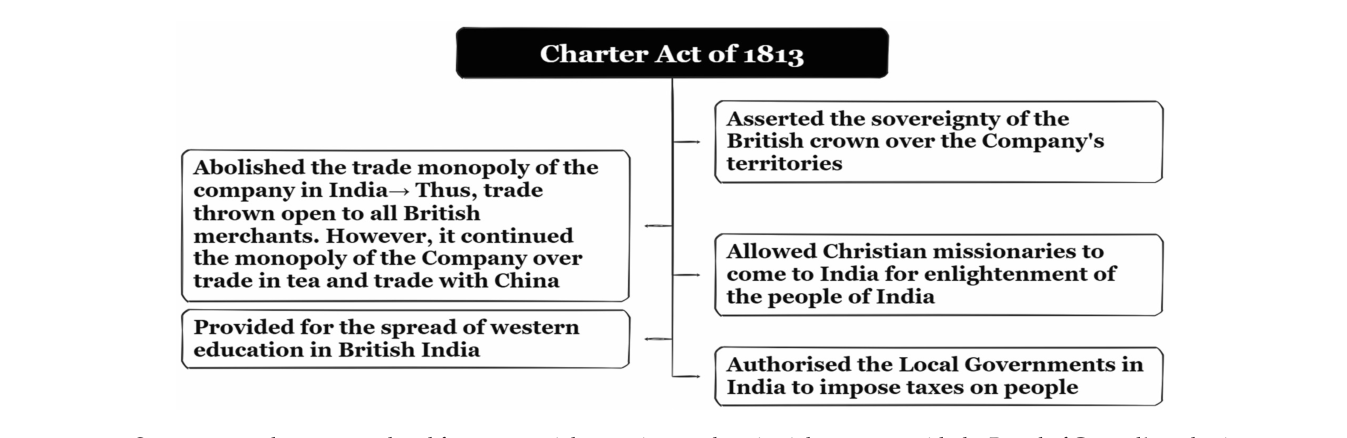
Separate records were mandated for commercial operations and territorial revenues, with the Board of Control’s authority in supervision and direction being significantly enhanced. Christian missionaries were allowed entry into India to propagate their religion.
The Charter Act of 1833
The Charter Act of 1833 served as a pivotal constitutional framework, shaping the authority and responsibilities of the East Bentham's liberal and utilitarian ideals, India Company. Influenced by its key provisions included:
The Company’s monopoly over trade with China and tea was abolished.
Restrictions on European immigration and property ownership in India were removed, facilitating large-scale European colonization in the country.
The Governor-General of Bengal was redesignated as the Governor-General of India, with William Bentinck becoming the first to hold this title.
The Governor-General in Council was tasked with overseeing and directing the civil and military affairs of the Company.
Regions such as Bombay, Bengal, and Madras were brought entirely under the control of the Governor-General in Council.
The Central Government gained full authority over revenue generation and expenditures.
Provincial Governments were placed under strict Central Government supervision concerning expenses, creation of new offices, and compliance by officials in Bombay and Madras.
The Governor-General in Council was empowered to legislate for all British territories in India, with laws applicable to all individuals—whether British, Indian, or foreign—and enforceable by courts across the country.
The Charter Act of 1853
The Act added one more member to the Executive council of the Governor General, the Law Member, whose work was fully legislative. Lord Macaulay, the Law member, influenced the educational policy of the government for a number of years.
The number of members of the Presidency Councils was reduced to two. Bombay and Madras were to keep their separate armies under the Commanders-in-Chief. They were to be under the control of the Central Government.
The Act provided for the codification of laws in India. (The first Law Commission was formed in 1834 as a result of the Charter Act, 1833 under the chairmanship of TB Macaulay. The first commission’s recommendations resulted in the codification of the penal code and the Criminal Procedure Code. )
The Act categorically stated “that no native of India, nor any natural born subject of His Majesty, should be disabled from holding any place, office, or employment, by reason of his religion, place of birth, descent or colour”. It was this enactment which laid the foundation for the Indianisation of public services.
The administration was urged to take steps to ameliorate the conditions of slaves and to ultimately abolish slavery. (Slavery was abolished in 1843.)
By the Act of 1853, separation of the executive and the legislative functions was carried a step further by the provision of the inclusion of six additional members of council for the purpose of legislation.
The Law Member was made a full member of the Executive Council of the Governor General.
The consent of the Governor General was made necessary for all legislative proposals.
Local representation was introduced in the Indian legislature. The legislative wing came to be known as
The Act for Better Government of India, 1858
the Indian Legislative Council. However, a law to be promulgated needed the assent of the governor-general, and the governor- general could veto any Bill of the legislative council.
The number of Directors was reduced from 24 to 18. Six of them were to be nominated by the Crown.
The Company’s patronage over the services was dissolved—the services were now thrown open to a competitive examination.
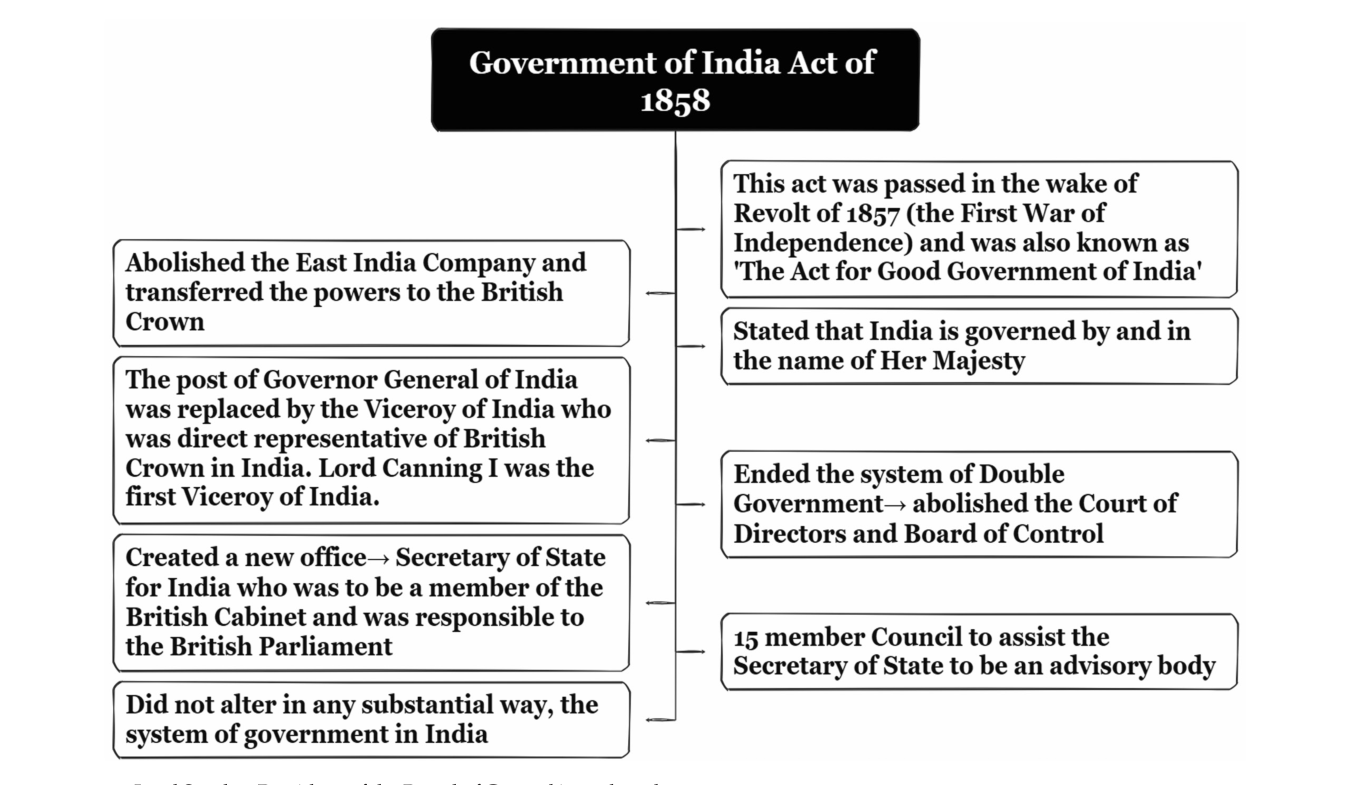
Lord Stanley, President of the Board of Control introduced a bill for the ‘Better Government’ of India which became an Act of Parliament in August 1858. The Government of India passed from the hands of the English East India Company to the crown. The armed forces of the company were transferred to the crown. Following are the main provisions of the Act:
East India Company’s rule came to an end and the Indian administration came under the direct control of the Crown.
In England, the Court of Directors and Board of Control were abolished. In their place came the Secretary of State for India and India Council were established. The Secretary of State would be a member of the British cabinet. Sir Charles Wood was made the first Secretary of State for India. India Council consisting of 15 members would assist him.
The Governor General of India was also made the Viceroy of India. The first Viceroy of India was Lord Canning.
All the previous treaties were accepted and honoured by the Act.
The assumption of power by the Crown was one of formality rather than substance. It gave a decent burial to an already dead horse—the Company’s administration
CONSTITUTIONAL DEVELOPMENTS AFTER 1858 TILL INDEPENDENCE Indian Councils Act of 1861
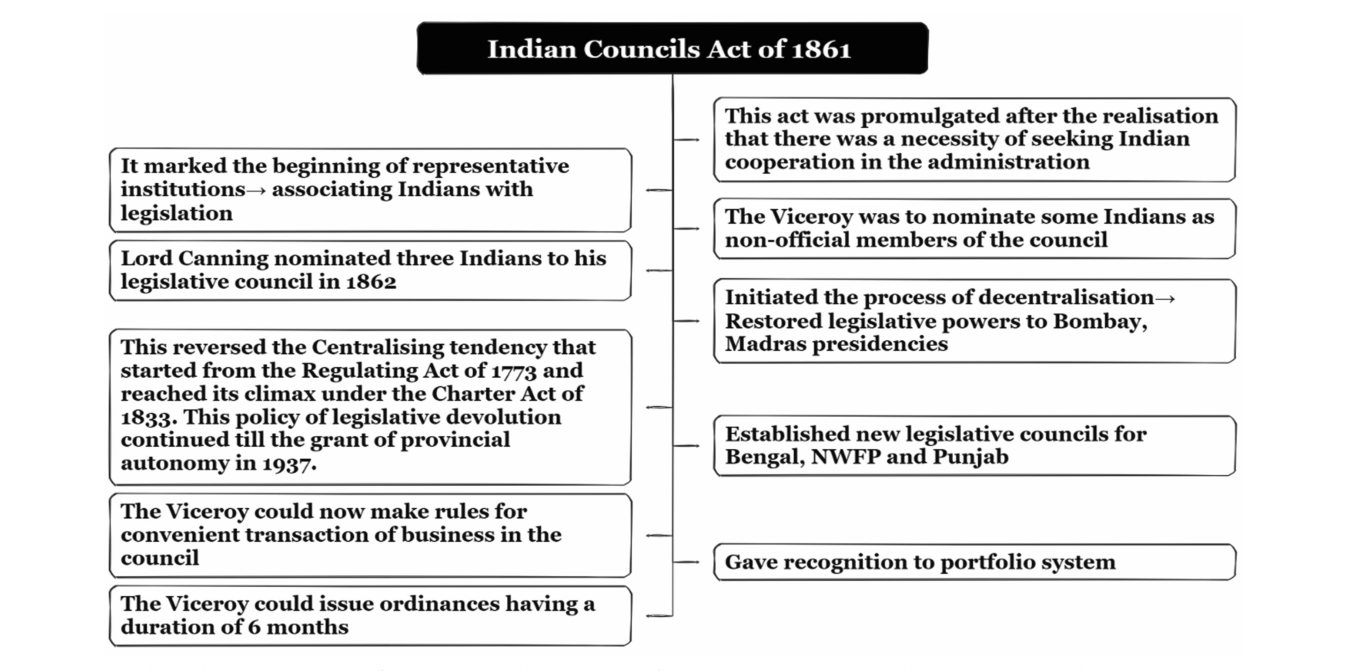
The Indian Councils Act of 1861 increased the number of members in the Governor-General’s executive Council from 4 to 5.
The Governor-General’s Executive Council was enlarged into a Central Legislative Council.
Six to twelve “additional members” were to be nominated by the Governor-General. Not less than half of these members were to be non-officials. Thus a provision was made for the inclusion of Indians in the Legislative Council.
The functions of these members were strictly limited to making legislation and they were forbidden from interfering in the matters of the Executive Council. They did not possess powers of administration and finance.
Lord Canning's introduction of the portfolio system marked the beginning of cabinet-style governance in India. Under this system, each department of administration had a designated official head and representative within the government who was accountable for its functioning.
The Act further enabled the transfer of legislative authority to the governments of Bombay and Madras and allowed for the establishment of similar legislative councils in other provinces, thereby initiating the process of legislative decentralization.
Despite these provisions, the legislative councils created under the Indian Councils Act of 1861 had limited authority and numerous shortcomings. These bodies were not permitted to deliberate on key issues or any financial matters unless they had prior government approval. They had no influence over the budget and were restricted from reviewing executive decisions. For a bill to become law, it had to receive the viceroy's consent, and even after that, it could still be nullified by the secretary of state. The Indian members included in these councils were from privileged, elite backgrounds and served only in a non-official capacity.
Indian Councils Act of 1892
The Indian Councils Act of 1892 was the first achievement of the Indian National Congress.
It had increased the number of “additional members” in the Central Legislative Council. They were to be not less than 10 and not more than 16.
It had also increased the proportion of non-officials – 6 officials and 10 non-officials.
The universities, district boards, municipalities, zamindars, trade bodies and chambers of commerce were empowered to recommend members to the provincial councils. Thus was introduced the principle of representation.
Though the term ‘election’ was firmly avoided in the Act, an element of indirect election was accepted in the selection of some of the non-official members.
The members were allowed to discuss the budget and criticize the financial policy of the government.
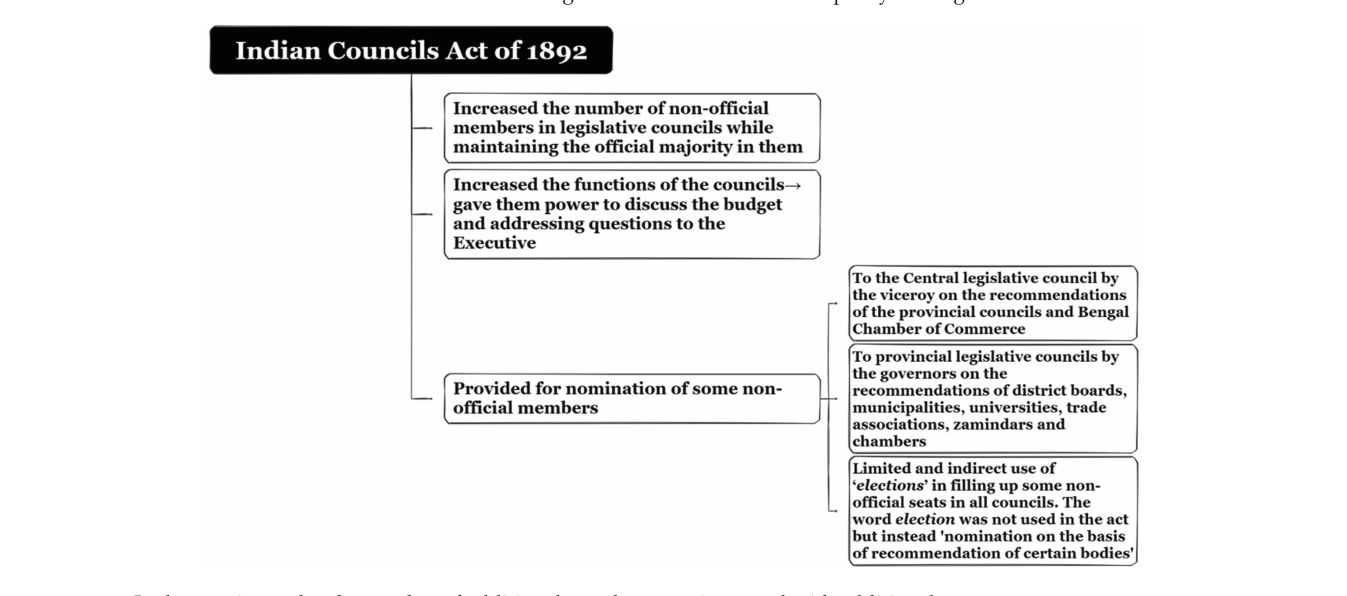
In the provinces also the number of additional members was increased with additional powers. giving six days’ They could also put questions within certain limits to the executive on matters of public interest after notice.
Morley-Minto Reforms of 1909
The Indian Councils Act of 1909 was also known as Morley-Minto Reforms in the names of Lord Morley, the Secretary of State for India and Lord Minto, the Governor-General of India. Both were responsible for the passing of this Act. It was passed to win the support of the Moderates in the Congress. The important provisions of this Act were:
The number of “additional members” of the Central Legislative Council was increased to a maximum of 60. Elected members were to be 27 and among the remaining 33 nominated members not more than 28 were to be officials.
The principle of election to the councils was legally recognized. But communal representation was for the first time introduced in the interests of Muslims. Separate electorates were provided for the Muslims.
The number of members in provincial legislative councils of major provinces was raised to 50.
The Councils were given the right to discuss and pass resolutions on the Budget and on all matters of public interest. However, the Governor-General had the power to disallow discussion on the budget.
An Indian member was appointed for the first time to the Governor-General’s Executive Council. Sir S. P. Sinha was- the first Indian to be appointed thus.
In Bombay and Madras, the number of members of the Executive Councils was raised from 2 to 4. The practice of appointing Indians to these Councils began.
Two Indians were also appointed to the India Council. (In England). The Morley- Minto reforms never desired to set up a parliamentary form of government in India. However, the Moderates welcomed the reforms as fairly liberal measures. The principle of separate electorates had ultimately led to the partition of India in 1947.
Government of India Act, 1919
The political developments in India during the First World War such as the Home Rule Movement led to the August Declaration. On 20th August, 1917 Montague, the Secretary of State for India made a momentous declaration in the House of Commons. His declaration assured the introduction of responsible government in India in different stages. As a first measure the Government of India Act of 1919 was passed by the Parliament of England. This Act is popularly known as Montague-Chelmsford Reforms. At that time Lord Chelmsford was the Viceroy of India.
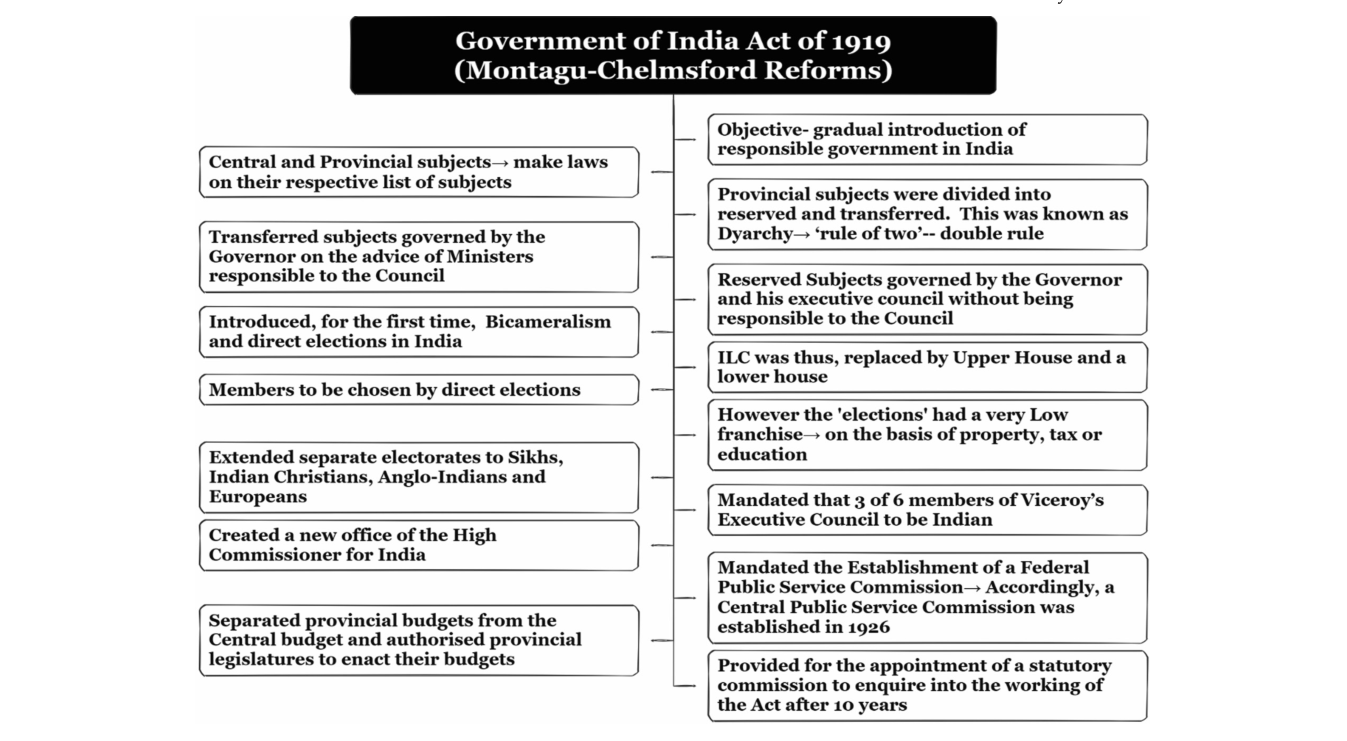
The main features of the Act were:
Dyarchy was introduced in the provinces. Provincial subjects were divided into “Reserved Subjects” such as police, jails, land revenue, irrigation and forests and “Transferred Subjects” such as education, local self-government, public health, sanitation, agriculture and industries.
The Reserved subjects were to be administered by the Governor and his Executive Council. The Transferred subjects by the Governor and his ministers.
A bicameral (Two Chambers) legislature was set up at the centre. It consisted of the Council of States and the Legislative Assembly.
The total member in the Legislative Assembly was to be a maximum of 145, out of which 105 were to be elected and the remaining nominated. In the Council of States there would be a maximum of 60 members out of which 34 were elected and the remaining nominated.
The principle of communal representation was extended with separate electorates for Sikhs, Christians and Anglo-Indians, besides Muslims.
The salaries of the Secretary of State for India and his assistants were to be paid out of the British revenues. So far, they were paid out of the Indian revenues.
The Act separated for the first time the provincial and central budgets, with provincial legislatures being authorised to make their budgets.
A High Commissioner for India at London was appointed.
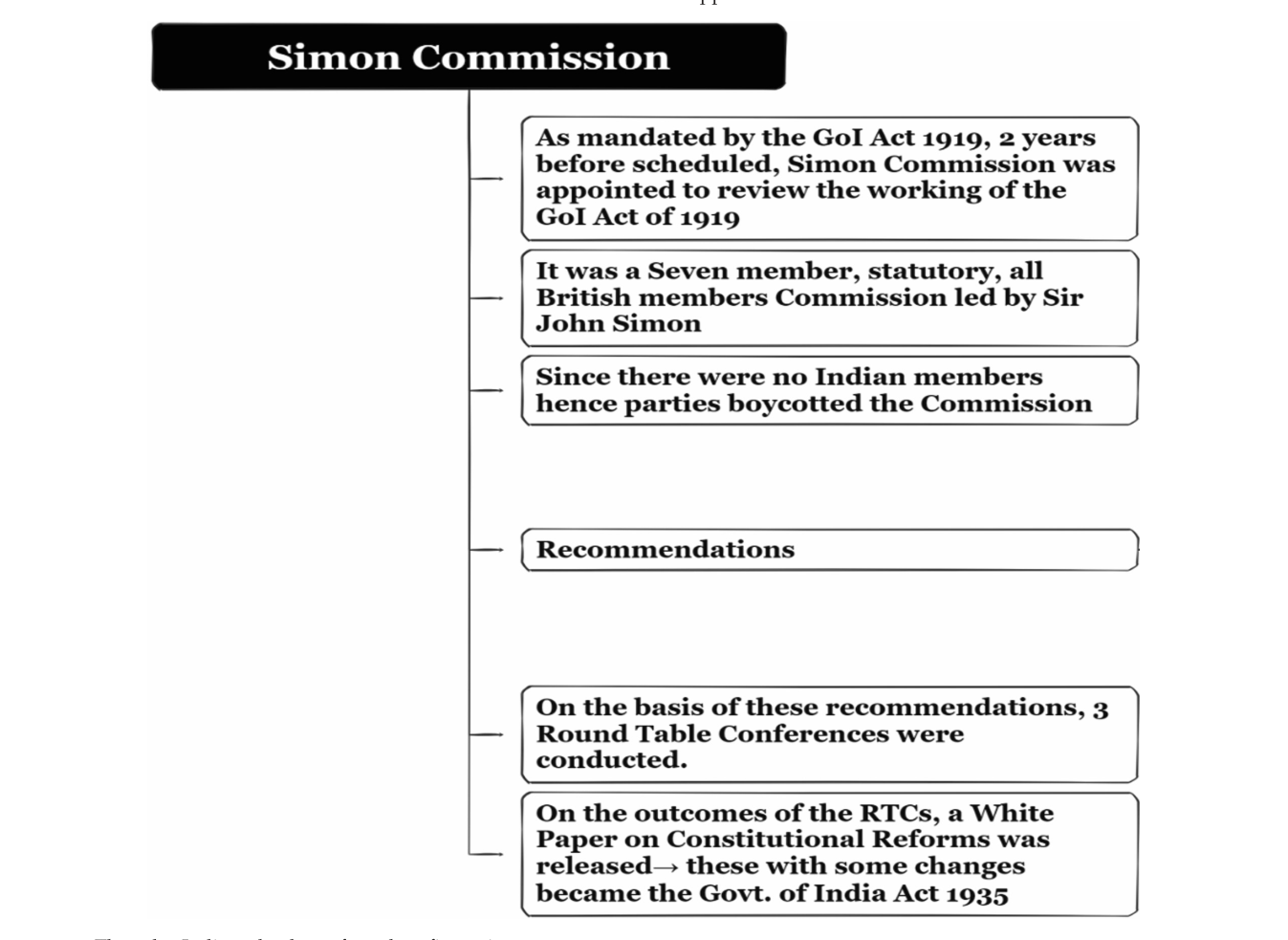
Though Indian leaders for the first time got some administrative experience in a constitutional set-up under this Act, there was no fulfilment of the demand for responsible government. The Central Legislature, though more representative than the previous legislative councils and endowed, for the first time, with power to vote supplies, had no power to replace the government and even its powers in the field of legislation and financial control were limited and subject to the overriding powers of the governor-general. Besides his existing power to veto any bill passed by the legislature or to reserve the same for the signification of the British monarch’s pleasure, the governor-general was given the power to secure the enactment of laws which he considered essential for the safety, tranquillity or interests of British India, or any part of British India.
The Government of India Act of 1935
The Government of India Act of 1935 was passed on the basis of the report of the Simon Commission, the outcome of the Round Table Conferences and the White Paper issued by the British Government in 1933. This Act contained many important changes over the previous Act of 1919.
Salient features of this Act:
An All-India Federation It was to comprise all British Indian provinces, all chief commissioners’ provinces and the Indian states (princely states). The federation’s formation was conditional on the fulfillment of: (i) states with allotment of 52 seats in the proposed Council of States should agree to join the federation; and (ii) aggregate population of states in the above category should be 50 per cent of the total population of all Indian states. Since these conditions were not fulfilled, the proposed federation never came up. The central government carried on upto 1946 as per the provisions of Government of India Act, 1919.
Federal Level: ➤ Executive: The governor-general was the pivot of the entire Constitution. Subjects to be administered were divided into reserved and transferred subjects. Reserved subjects—foreign affairs, defense, tribal areas and ecclesiastical affairs(Churhc-Related)— were to be exclusively administered by the governor-general on the advice of executive councilors. Executive councilors were not to be responsible to the central legislature. Transferred subjects included all other subjects and were to be administered by the governor-general on the advice of ministers elected by the legislature. These ministers were to be responsible to the federal legislature and were to resign on losing the confidence of the body. Governor-general could act in his individual judgment in the discharge of his special responsibilities for the security and tranquility of India. ➤ Legislature:
The bicameral legislature was to have an upper house (Council of States) and a lower house (Federal Assembly). The Council of States was to be a 260-member house, partly directly elected from British Indian provinces and partly (40 per cent) nominated by the princes. The Federal Assembly was to be a 375-member house, partly indirectly elected from British Indian provinces and partly (one-third) nominated by the princes. ➤ Oddly enough, election to the Council of States was direct and that to the Federal Assembly, indirect. ➤ The Council of States was to be a permanent body with one-third members retiring every third year. The duration of the assembly was to be 5 years. ➤ The three lists for legislation purposes were to be federal, provincial and concurrent. ➤ Members of the Federal Assembly could move a vote of no-confidence against ministers. The Council of States could not move a vote of no-confidence. ➤ The system of religion-based and class-based electorates was further extended.
➤ 80 per cent of the budget was non-votable. ➤ The Governor-general had residuary powers. He could (a) restore cuts in grants, (b) certify bills rejected by the legislature, (c) issue ordinances and (d) exercise his veto.
Provincial Autonomy
Provincial autonomy replaced dyarchy.
Provinces were granted autonomy and separate legal identity.
Provinces were freed from “the superintendence, direction” of the secretary of state and governor-general. Provinces henceforth derived their legal authority directly from the British Crown.
Provinces were given independent financial powers and resources. Provincial governments could borrow money on their own security. ➤ Executive: Governor was to be the Crown’s nominee and representative to exercise authority on the king’s behalf in a province. Governor was to have special powers regarding minorities, rights of civil servants, law and order, British business interests, partially excluded areas, princely states, etc. Governor could take over and indefinitely run the administration. ➤ Legislature: Separate electorates based on Communal Award were to be made operational. All members were to be directly elected. Franchise was extended; women got the right on the same basis as men. Ministers were to administer all provincial subjects in a council of ministers headed by a premier. Ministers were made answerable to and removable by the adverse vote of the legislature. Provincial legislature could legislate on subjects in provincial and concurrent lists. 40 per cent of the budget was still not votable. Governor could (a) refuse assent to a bill, (b) promulgate ordinances, (c) enact governor’s acts.
EVOLUTION OF CIVIL SERVICES IN INDIA
The civil service system introduced in India by the East India Company for the benefit of its commercial affairs got transformed into a well-structured machinery to look after the administrative affairs of the acquired territories in India.
Administrative Reforms under Cornwallis
Cornwallis (Governor-General, 1786-93) was the first to establish and structure the civil services in India.
His most notable contribution was improving the civil service by appointing competent and honest officials.
Cornwallis observed that Company servants were underpaid but earned substantial commissions from revenue collection and engaged in unauthorized private trade through relatives and associates.
To reform the system, he eliminated the practice of low salaries with excessive perks and implemented a structure of fair compensation.
He convinced the Company’s Directors to provide attractive salaries to employees, enabling them to focus on their duties and avoid engaging in commercial or corrupt practices.
Cornwallis introduced merit-based appointments, laying the foundation for the Indian Civil Service.
He also initiated the separation of the administrative system into three distinct branches: commercial, judicial, and revenue.
As part of these reforms, collectors, who played a central role in administration, were stripped of their judicial powers and restricted to revenue collection duties.
Role of Richard Colley Wellesley
The appointment of Richard Colley Wellesley as Governor-General marked a significant era in British India's history. A staunch imperialist, Wellesley referred to himself as the 'Bengal tiger.'
In 1800, he established Fort William College to provide training for newly recruited officials.
However, in 1806, the Court of Directors disapproved of Fort William College, leading to the establishment of the East India College at Haileybury in England, where recruits underwent two years of training.
Charter Act of 1853
While the Charter Act of 1833 theoretically allowed Indians to join civil services, its provisions were never effectively implemented.
The Charter Act of 1853 abolished the Company’s patronage system, mandating recruitment through open competitive examinations.
Indian Civil Service Act, 1861
The Act allocated specific positions to covenanted civil servants, with examinations conducted in England in English, emphasizing classical knowledge of Greek and Latin.
The upper age limit for candidates was progressively lowered from 23 years in 1859 to 22 years in 1860, 21 years in 1866, and 19 years in 1878.
In 1863, Satyendra Nath Tagore became the first Indian to successfully join the Indian Civil Service.
Statutory Civil Service
Lord Lytton in 1878 introduced the Statutory Civil Service exclusively for Indians.
According to this, one-sixth of covenanted posts to be filled by Indians of high families through nominations by local governments subject to approval by the secretary of State and the viceroy.
This system failed and was abolished.
Aitchison Committee
The Indian National Congress raised the demand for lowering the age limit for recruitment and holding the examination simultaneously in India and Britain. The Aitchison Committee on Public Services (1886), set up by Dufferin.
It recommended
Dropping of the terms ‘covenanted’ and ‘uncovenanted’;
Classification of the civil service into Imperial Indian Civil Service (examination in England), Provincial Civil Service (examination in India) and Subordinate Civil Service (examination in India); and,
Raising the age limit to 23.
In 1893, the House of Commons in England passed a resolution supporting holding of simultaneous examinations in India and England; but the resolution was never implemented.
Montford Reforms (1919)
The Montagu–Chelmsford Reforms are known as the Montford Reforms.
It recommended holding simultaneous examinations in India and England.
It recommended that one-third of recruitments be made in India itself—to be raised annually by 1.5 per cent.
Lee Commission (1923)
Lee Commission, a body appointed by the British government in 1923 to consider the ethnic composition of the superior Indian public services of the government of India. The chairman was Lord Lee of Fareham, and there were equal numbers of Indian and British members. It recommended that:
The secretary of state should continue to recruit theICS, the Irrigation branch of the Service of Engineers, the Indian Forest Service, etc.;
The recruitments for the transferred fields like education and civil medical service be made by provincial governments;
Direct recruitment to ICS on basis of 50:50 parity between the Europeans and the Indians be reached in 15 years;
A Public Service Commission be immediately established (as laid down in the Government of India Act, 1919).
Government of India Act, 1935
The 1935 Act recommended the establishment of a Federal Public Service Commission and Provincial Public Service Commission under their spheres.
The positions of control and authority remained in British hands and the process of Indianisation of the civil service did not put effective political power in Indian hands since the Indian bureaucrats acted as the agents of colonial rule.
Evaluation of Civil Services under British Rule
Just as Indians were systematically excluded from law and policy-making bodies, they were mostly kept out of the institutions responsible for policy implementation.
European supremacy was assured in the civil service as in other spheres of governance.
Although Indians had begun to enter the coveted ranks of the Indian Civil Services (ICS) ever since 1863, entering the civil services was still extremely difficult for the Indians.
The entrance examination for the ICS was held in London in English medium only, and the subjects included classical Greek and Latin learning.
The maximum age for appearing at the examination was reduced from twenty-three in 1859 to nineteen in 1878 under Lytton.
All key positions of power and authority and those which were well-paid were occupied by the Europeans. Though a slow process of Indianisation occurred after 1918 under nationalist pressure, important and senior positions continued to be occupied by Europeans. But gradually, the Indians came to realise that Indianisation of civil service had not, in any way, transferred effective power into Indian hands. The Indian members of the civil service continued to serve the imperialist interests of their British masters.
EVOLUTION OF POLICE SYSTEM IN MODERN INDIA
In pre-colonial India, the governments, under the Mughals and other native states, were autocratic in nature, and lacked a separate or formal police system. Under the Mughal rule there were the faujdars who helped in maintaining law and order, and amils who were basically revenue collectors but had to contend with rebels, if any. The kotwal was responsible for maintenance of law and order in the cities. Even during the dual rule in Bengal, Bihar and Orissa between 1765 and 1772 the zamindars were expected to maintain the staff including thanedars for law and order duties and for maintaining peace, as well as dealing with crime and criminals. In 1770, the institution of the faujdar and amils were abolished.
Reforms of Warren Hastings
In 1774, Warren Hastings restored the institution of faujdars and asked the zamindars to assist them in suppression of dacoits, violence and disorder.
In 1775, faujdar thanas were established in the major towns of large districts and were assisted by several smaller police stations.
Reforms of Cornwallis
In 1791, Cornwallis organized a regular police force to maintain law and order
Each district was divided into thanas or police circles each of which was about 20 square miles.
It was placed under an Indian officer called the daroga who was ably assisted by many constables.
He relieved the zamindars of their police duties.
Bird Committee (1808-12)
In the system of administration, evolved by Cornwallis, District Collectors combined the duties of revenue-collection and the police duties as Magistrates.
These functions were separated briefly at the recommendation of the Bird Committee (1808-12) when separate District Superintendents of Police were appointed.
Reforms under Mayo
In 1808, Mayo appointed an SP for each division helped by a number of spies (goyendas) but these spies committed depredations on local people.
In 1814, by an order of the Court of Directors, the appointment of darogas and their subordinates was abolished in all possessions of the Company except in Bengal.
Reforms under Lord William Bentinck
He abolished the office of the SP.
The collector/magistrate was now to head the police force in his jurisdiction and the commissioner in each division was to act as the SP.
Presidency towns were the first to have the duties of collector/magistrate separated.
Police Commission (1860)
The recommendations of the Police Commission (1860) led to the Indian Police Act, 1861. The commission recommended
a system of civil constabulary—maintaining the village set-up in the present form (a village watchman maintained by the village) but in direct relationship with the rest of the constabulary.
inspector-general as the head in a province, deputy inspector-general as the head in a range, and SP as the head in a district.
Reforms under Lord Curzon
Curzon believed in efficiency and discipline. He instituted a Police Commission in 1902 under the chairmanship of Sir Andrew Frazer.
It recommended that there should be an Imperial Service Branch in which recruitment was to be conducted in England and a Provincial Service Branch in which recruitment was done entirely in India.
It recommended the establishment of CID (Criminal Investigation Department) in the provinces and a Central Intelligence Bureau at the Centre.
Curzon accepted all the recommendations and implemented them.
He set up training schools for both the officers and the constables and introduced provincial police service.
MILITARY UNDER THE BRITISH
The colonial army was the mechanism used by the colonial state to maintain its paramountcy. Its emergence can be traced to the establishment of the Bengal army under the command of Calcutta Presidency.
The increasing financial power of the East India Company derived from its monopoly over trade and supplemented by the Diwani or the power to collect taxes enabled it to directly recruit and pay the sepoys instead of hiring soldiers through the indigenous chiefs.
Sepoys were grouped into companies and battalions and were commanded at the lower unit level by Indian officers from the sepoy’s own social-group.
The East India Company’s army consisted of the Bengal army and the armies of Bombay and Madras Presidencies, each with a different type of internal organisation and level of professionalisation.
The sepoys of the Bengal army generally hailed from the high-caste (Brahmin and Kshyatriya) Hindu families of Oudh and Bihar. They maintained the caste and village ties even in their ‘military villages’.
The Bombay and the Madras army recruits belonged to the Punjab, Oudh, and Rajputana and hailed from different castes.
These armies consisted of different ethnic groups and castes and were organised on a professional basis, e.g., Mer Corps.
The colonial state, also took special care to deny the Indian rulers the access to resources to prevent them from organising similar professional armies.
The system of subsidiary alliances with the Indian rulers was initiated with the aim of liquidating the local military and even the quasi-military forces so as to achieve almost complete “de-militarization” of the Indian kingdoms.
The revolt of 1857 necessitated certain reforms in the organisation of colonial armed forces.
DEVELOPMENT OF JUDICIARY IN BRITISH INDIA
The Royal Peel Commission (1859) spelt out the proportion which was to be maintained between the number of British and Indian soldiers in India.
Finally, the proportion of Europeans to Indians was carefully fixed at one to two in the Bengal Army and two to five in the Madras and Bombay Armies.
The mobile artillery was completely controlled by the British and the Arms Acts were passed to deny the possession of weapons in the hands of ‘unlawful’ elements.
The colonial state also evolved the ideology of martial-fitness of certain castes and races. The ideology of martial-race was an attempt by the colonial state to utilise ethnicity for promoting imperial interests.
The territorial nomenclature of the armies was abandoned and now the Bengal army was re-organised by absorbing soldiers from the so called “martial race such as the Sikhs”, the Jats, the Muslims, the Punjabis, the Pathans and the Dogras.
The soldiers from Awadh, Bihar, Central India and South India who had participated in the revolt were declared to be non-martial.
Although the colonial state professed that the maintenance of public order was ordinarily the duty of police, troops were frequently summoned to deal with disturbances.
This policing role of maintaining public order remained a major function of the colonial army even till 1947.
Besides maintaining the ‘internal frontier’ of India, the colonial army safeguarded the global strategic interests of the empire.
On the whole, the British Indian Army remained a costly military machine.
In the India of pre-colonial times—in the Mughal era or even prior to that (including the ancient period)—the judicial system, as a whole, neither adopted proper procedures nor had proper organisation of the law courts. The bulk of the litigation among the Hindus was decided by caste elders or village panchayats or zamindars. For Muslims, the unit of judicial administration was the qazi—an office held by religious persons. The beginning of a common law system, based on recorded judicial precedents, can be traced to the establishment of ‘Mayor’s Courts’ in Madras, Bombay and Calcutta in 1726 by the East India Company. With the Company’s transformation from a trading company into a ruling power, new elements of judicial system replaced the existing Mughal legal system.
Reforms under Warren Hastings
The judicial system at the time of Warren Hastings’ ascendancy was a store-house of abuses. The Nawab who was hitherto the chief administrator of justice, misused his powers. Warren Hastings felt the necessity of reorganising the judicial system.
Each district was provided with a civil court called District Diwani Adalats and had Hindu law applicable for Hindus and the Muslim law for Muslims.
District Fauzdari Adalats were set up to try criminal disputes and were placed under an Indian officer assisted by qazis and muftis. Muslim law was administered in Fauzdari Adalats.
To hear appeals from the district courts two appellate courts, one for civil cases and another for criminal cases, were established at Calcutta.
The highest civil court of appeal was called Sadar Diwani Adalat, which was to be presided over by the Governor and two judges recruited from among the members of his council.
Similarly, the highest appellate criminal court was known as Sadar Nizamat Adalat which was to function under an Indian judge appointed by the Governor-in-Council.
Experts in Hindu and Muslim laws were provided to assist the judges.
A digest of Hindu law was prepared in Sanskrit by learned Pandits and it was translated into Persian. An English translation of it – Code of Hindu Laws – was prepared by Halhed.
Under the Regulating Act of 1773, a Supreme Court was established at Calcutta which was competent to try all British subjects within Calcutta and the subordinate factories, including Indians and Europeans. It had original and appellate jurisdictions.
Reforms under Cornwallis
In the work of judicial reorganization, Cornwallis secured the services of Sir William Jones, who was a judge and a great scholar. Civil and criminal courts were completely reorganized.
At the top of the judicial system, the highest civil and criminal courts of appeal, namely Sadar Diwani Adalat and Sadar Nizamat Adalat were functioning at Calcutta. Both of them were presided over by the Governor-General and his Council and assisted by the chief qazi and the chief mufti.
The District Fauzdari Courts were abolished and, instead, circuit courts were established at Calcutta, Dacca, Murshidabad and Patna, each under three European judges assisted by Indian advisers.
Every district was provided with a court.
As already stated, Cornwallis had taken away from the collectors of their judicial powers and made them solely responsible for the collection of revenue. As a result, District Judges were appointed.
In criminal cases, Muslim law was improved and followed. In civil cases, Hindu and Muslim laws were followed according to the religion of the litigants.
In suits between Hindus and Muslims, the judge was the deciding authority.
A gradation of civil courts was established (for both Hindu and Muslim laws)- ➤ Munsiff’s Court under Indian officers, ➤ Registrar’s Court under a European judge, ➤ District Court under the district judge, ➤ Four Circuit Courts as provincial courts of appeal, ➤ Sadar Diwani Adalat at Calcutta, and
Cornwallis was merciful by temperament. He hated barbarous punishments and abolished those like mutilation and trial by ordeal.
With the help of his colleague, George Barlow prepared a comprehensive code, covering the whole field of administration, judicial, police, commercial and fiscal.
This Cornwallis Code was based upon the principle of Montesquieu, “the Separation of Powers”, which was popular in the West in the 18th century.
In order to curb undue exercise of authority Cornwallis made all officials answerable to the courts. European subjects were also brought under jurisdiction. There was a separation of revenue and justice administration. The principle of sovereignty of law was established.
Reforms under William Bentinck
In the judicial department he abolished the provincial courts of appeal established by Cornwallis. They were largely responsible for the huge arrears of cases.
The four Circuit Courts were abolished and their functions transferred to collectors under the supervision of the commissioner of revenue and circuit.
Sadar Diwani Adalat and a Sadar Nizamat Adalat were set up at Allahabad for the convenience of the people of Upper Provinces.
Another good measure of Bentinck was the introduction of local languages in the lower courts and English in the higher courts in the place of Persian.
In 1833, a Law Commission was set up under Macaulay for codification of Indian laws. As a result, a Civil Procedure Code (1859), an Indian Penal Code (1860) and a Criminal Procedure Code (1861) were prepared.
Later Developments
In 1860, it was provided that the Europeans can claim no special privileges except in criminal cases, and no judge of an Indian origin could try them.
In 1865, the Supreme Court and the Sadar Adalats were merged into three High Courts at Calcutta, Bombay and Madras.
In 1935, the Government of India Act provided for a Federal Court (set up in 1937) which could settle disputes between governments and could hear limited appeals from the High Courts.
Evaluation of Judiciary in British India
Positive Aspects of Judiciary under the British
The rule of law was established.
The codified laws replaced the religious and personal laws of the rulers.
Even European subjects were brought under the jurisdiction, although in criminal cases, they could be tried by European judges only.
Government servants were made answerable to the civil courts.
The Negative Aspects of Judiciary under the British
The judicial system became more and more complicated and expensive.
There was ample scope for false evidence, deceit and chicanery.
Dragged out litigation meant delayed justice.
Courts became overburdened as litigation increased.
Often, the European judges were not familiar with the Indian usage and traditions