Whatsapp 88106-52225 For Details
Get Free IAS Booklet
Get Free IAS Booklet
DEVELOPMENT OF EDUCATION
In this unit
We will cover various initiatives and debates on education under British Rule.
Developments in the field of education are fairly well documented during the rise and fall of colonial rule. Colonial era started no role to play with the entrenchment of East India Company as a mercantile interest in the sub-continent. Initially they had as they had no political control over the land . However, the Company was obliged to bring Christian missionaries on their The Christian missionaries did start their proselytizing ships and protect them according to the charter of the Company. activities and opened schools for the converted among lower castes and taught them Bible along with other basic skills.
The missionary activity in education became another instance of structural elaboration of the indigenous education system.
DEVELOPMENT OF EDUCATION UNDER COMPANY RULE Orientalist Policy
resistance by the upper-caste Indians,
The activities of Christian missionaries were met with whose backing was crucial for the East India Company to stabilize its vulnerable hold over the country. Consequently, the Company chose not
to interfere in the educational domain, despite being pressured by certain British politicians.
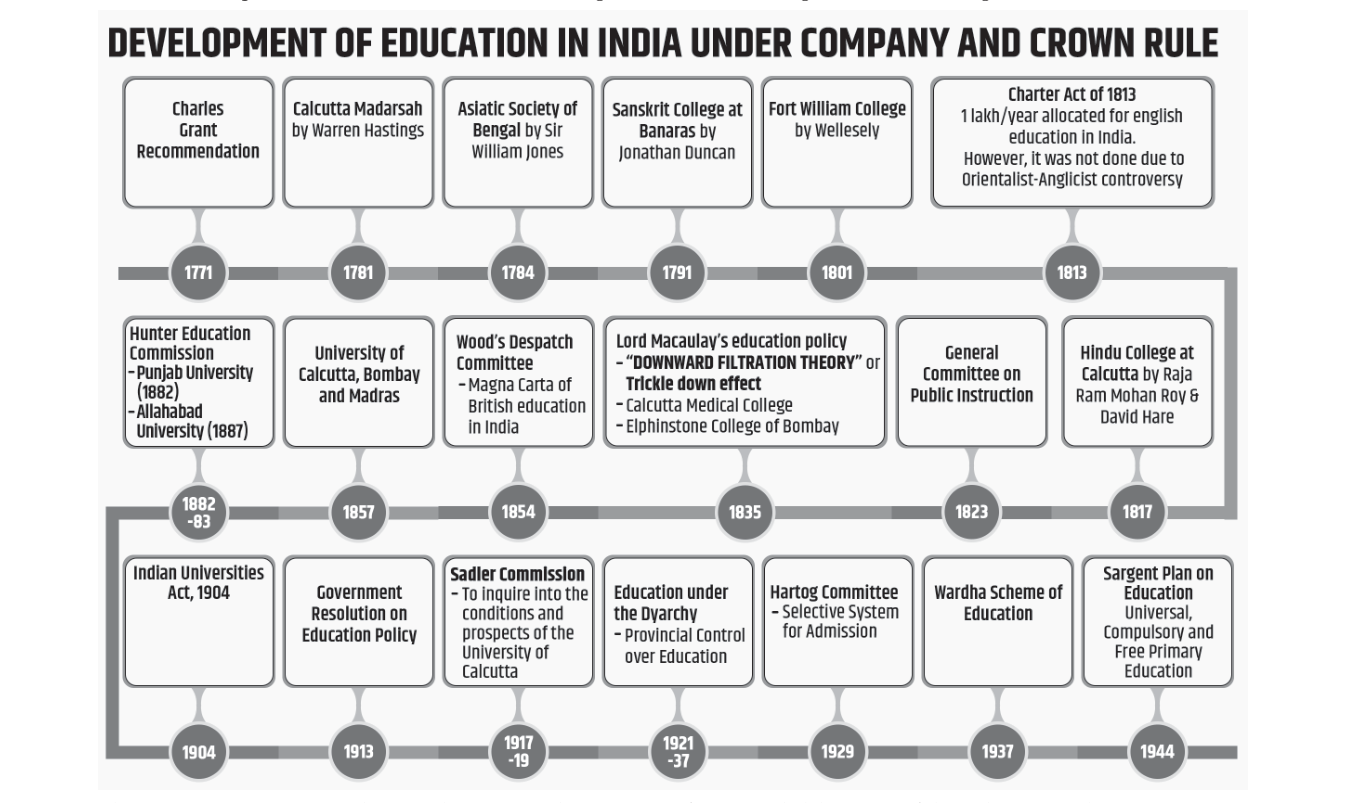
Political and economic considerations of the time led the British administration to favor a pro-indigenous approach to education. ➤ In 1781, Warren Hastings founded the Calcutta Madrasa to promote the study of Muslim law and associated disciplines, aiming to win over the influential sections of the Muslim and Hindu communities. ➤ Similarly, in 1791, Jonathan Duncan, then resident at Benaras, established the Sanskrit College to encourage the study of Hindu law and philosophy.
Graduates from these institutions, who generally belonged to the elite segments of Hindu and Muslim society, were recruited into higher ranks of the Company’s administration, thereby strengthening their allegiance to British rule.
Lord Wellesley also established Fort William College in 1800 to train Company civil servants in Indian languages and cultural practices, although the institution was shut down by 1802.]
Despite founding a few advanced centers for Sanskrit and Persian learning and curtailing missionary efforts for political expediency, the Company did not invest in primary education.
The Company allocated a modest budget of one lakh rupees for educational development, which was only put into effect in 1823 when a General Committee of Public Instruction was formed to execute the educational provisions of the Charter Act of 1813. This stage of educational development is referred to as the Orientalist phase.
Anglicist Policy
Right from 1797, Charles Grant, an influential statesman, who later became the Chairman of the Board of Directors of East India Company was advocating that English education to be introduced in India. His lobby called Anglicist challenged the policy of the orientalists.
Lord Macaulay, The Law Member of India heard the arguments of both the parties and rejected the position of the Orientalists.
Lord Macaulay’s Minute (1835)
The famous Lord Macaulay’s Minute settled the row in favour of Anglicists—the limited government resources were to be devoted to teaching of Western sciences and literature through the medium of English language alone.
Lord Macaulay held the view that “Indian learning was inferior to European learning”—which was true as far as physical and social sciences in the contemporary stage were concerned.
The government soon made English as the medium of instruction in its schools and colleges and opened a few English schools and colleges instead of a large number of elementary schools, thus neglecting mass education.
The British planned to educate a small section of upper and middle classes, thus creating a class “Indian in blood and colour but English in tastes, in opinions, in morals and in intellect” who would act as interpreters between the government and masses and would enrich the vernaculars by which knowledge of Western sciences and literature would reach the masses. This was called the ‘downward filtration theory’.
Efforts of Thomson
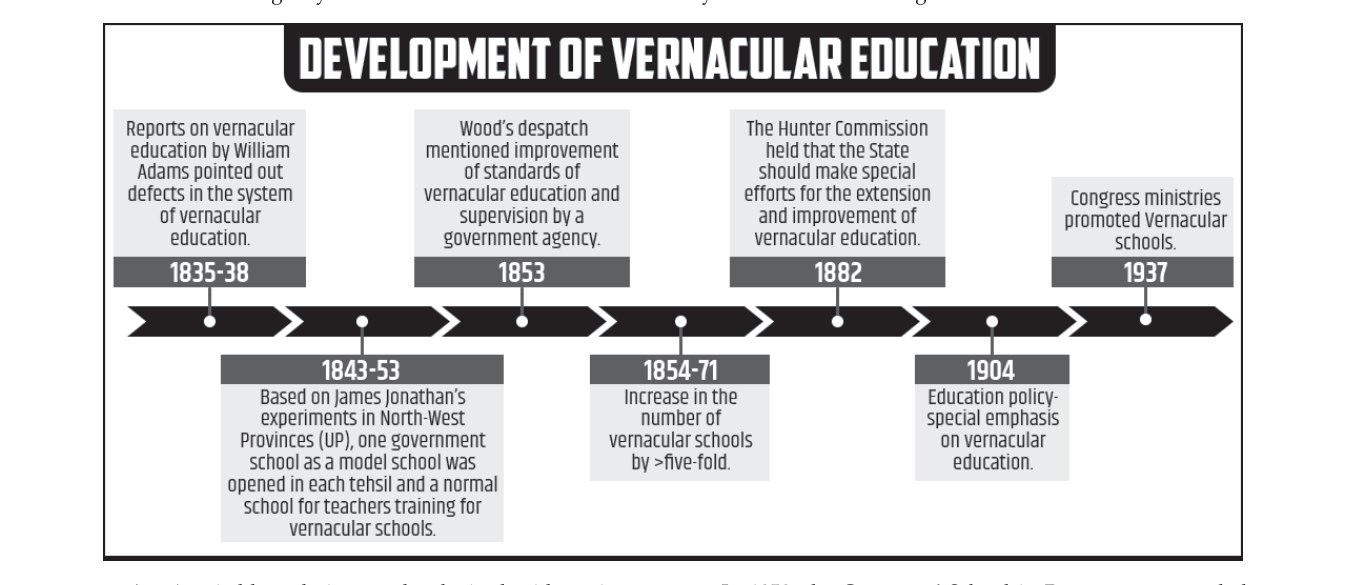
James Thomson developed a comprehensive scheme for village education using vernacular languages.
Village schools focused on teaching practical subjects such as mensuration and agricultural sciences.
The aim was to train personnel for the newly established Revenue and Public Works Department.
Wood’s Despatch (1854)
In 1854, Charles Wood prepared a Despatch on the educational system for India, often referred to as the "Magna Carta of English Education in India." This document was the first comprehensive plan for the spread of education in India.
It proposed that the government of India take responsibility for the education of the masses, moving away from the ‘downward filtration theory’ in theory at least.
It established a hierarchical structure for education, starting with vernacular primary schools in villages, followed by Anglo-Vernacular High Schools, district-level affiliated colleges, and universities in presidency towns like Calcutta, Bombay, and Madras.
It recommended English as the medium of instruction for higher education and vernacular languages for school-level education.
It emphasized female and vocational education and the need for teachers’ training.
It suggested that the education provided in government institutions be secular.
It proposed a system of grants-in-aid to promote private involvement in education.
Developments
In 1857, universities were established in Calcutta, Bombay, and Madras, with education departments set up in all provinces.
The Bethune School, founded by J.E.D. Bethune in 1849 at Calcutta, marked the beginning of the movement for women's education in the 1840s and 1850s.
DEVELOPMENT OF EDUCATION DURING THE CROWN RULE
Primary education in India faced challenges until 1882, when the first Indian Education Commission, popularly known as the Hunter Commission, was established. The Hunter Commission focused mainly on the implementation of Wood’s Despatch and the status of state-sponsored education across various provinces. The main recommendations of the commission included:
Emphasized the need for state intervention to extend and improve primary education, with a focus on teaching through vernacular languages.
Recommended transferring the control of primary education to newly established district and municipal boards for better local management.
Suggested two streams for secondary (High School) education: ➤ Literary stream leading to university education. ➤ Vocational stream aimed at careers in commerce.
Addressed the lack of facilities for female education, especially in regions beyond the presidency towns, and made recommendations for its expansion.
In 1884, the Commission’s report was accepted, and the management of primary education was handed over to local bodies, formed under the Local Self-Government Acts during that period.
Additionally, the Government introduced grant-in-aid to promote private initiatives in education. Several universities were established, such as Punjab University (1882) and Allahabad University (1887).
Indian Universities Act, 1904
Lord Curzon appointed ‘Indian University Commission’ in 1902 (Raleigh Commission). It was set up to go into conditions and prospects of universities in India and to suggest measures for improvement in their constitution and working. The commission precluded from reporting on primary or secondary education. Based on its recommendations, the Indian Universities Act was passed in 1904. As per the Act:
Universities were to give more attention to study and research;
The number of fellows of a university and their period in office were reduced and most fellows were to be nominated by the Government;
Government was to have powers to veto universities’ senate regulations and could amend these regulations or pass regulations on its own;
Conditions were to be made stricter for affiliation of private colleges; and
Five lakh rupees were to be sanctioned per annum for five years for improvement of higher education and universities.
Curzon favoured primary education in mother tongue. He emphasized its expansion to go with the improvement in quality which needed financial assistance from the State Government. Though the policy of Curzon had a significant effect in the field of Indian education, expansion of primary education was far from satisfactory. Curzon justified greater control over universities in the name of quality and efficiency, but actually sought to restrict education and to discipline the educated towards loyalty to the Government.
Government Resolution on Education Policy of 1913
Gopal Krishna Gokhale put a Bill before the Government in March, 1910. According to the contents of the bill, free and compulsory primary education was introduced for the children. The Department of Education was created under the Government of India, without accepting the Bill. Gokhale again introduced his Private Bill of historic importance on 16 March 1911. Government, again, rejected the Bill but partially followed the principles embodied in the Bill. Elementary education was made free in 1912, in some parts of British India. Another step in this direction was that the Government of India passed a resolution on Education Policy in 1913. Some of the important recommendations of this resolution were:
Separate curricula for rural and urban schools;
Appointment of teachers will be drawn from the same class/caste to which students belong; and
Expansion of university education.
This resolution served as a turning point in the History of higher education in India. It laid the foundation for the establishment of universities in various States.
Sadler Commission
In 1917, the Government of India appointed the Calcutta University Commission, chaired by Dr. Michael Sadler, making it commonly known as the Sadler Commission. The objective of the Commission was:
To examine the condition and future prospects of the University of Calcutta and to propose a constructive policy regarding its development.
Its key recommendations included:
The school curriculum should cover a 12-year period, with students entering university after an intermediate stage (instead of matriculation) for a three-year degree course.
Establishment of a separate board for secondary and intermediate education to oversee administration and management.
Greater flexibility in framing university regulations.
Universities should function as centralised, unitary
residential-teaching institutions, rather than being affiliated with scattered colleges.
Expansion of female education, applied scientific and technological education, teacher training, including professional and vocational colleges.
During the period from 1916 to 1921, seven new universities were established in Mysore, Patna, Benaras, Aligarh, Dacca, Lucknow, and Osmania. In 1921, the Government of India formed the Central Advisory Board of Education to provide guidance for improving education in India, which was reorganized in 1935 following the recommendations of the Hartog Committee.
EDUCATION DEVELOPMENT UNDER DIARCHY- 1921 TO 1937
On the basis of the Montague-Chelmsford Report, the Government passed an Act ‘Government of India Act 1919’, which was introduced in 1921. This Act introduced Dyarchy in the Provinces in which subjects of administration were divided into two categories. Certain subjects were reserved to be administered by the Governor and the Executive Council, while other subjects were transferred to the Councilors and Ministers. Education was transferred to the representatives of the people but it became difficult to improve education, because Finance was a reserved subject and was under the Governor.
Hartog Committee (1929)
The Hartog Committee recommended the following:
Focus should be placed on primary education, without rushing expansion or enforcing compulsory education.
Only deserving students should continue to higher levels of school and intermediate education, while average students should be directed towards vocational courses after the VIII standard.
To enhance the quality of university education, admissions should be limited.
EDUCATION UNDER PROVINCIAL AUTONOMY (1936-37 TO 1946-47)
During the last period of colonial rule, there was a shift in the political structure with the introduction of the Government of India Act, 1935, which abolished Dyarchy and granted autonomy to Provincial Governments. Initially, there were high expectations for advancements in education under this provincial autonomy. After World War II, the Government of India focused on the development of education through various phases. To address these needs, the Reconstruction Committee of the Executive Council appointed Sir John Sargent as the Education member to draft a memorandum for post-war education development. In 1944, he submitted his Memorandum to CABE, which accepted and recommended its implementation. This scheme is popularly known as the ‘Sergeant Scheme of Education’, which proposed:
Pre-primary education for children aged 3-6; free, universal, and compulsory elementary education for ages 6-11; high school education for ages 11-17 for selected students, followed by a 3-year university course after higher secondary education. High schools were to be of two types: academic and technical/vocational.
Provision for adequate technical, commercial, and arts education.
Abolition of the intermediate course.
The eradication of adult illiteracy within 20 years.
Emphasis on teacher training, physical education, and education for the physically and mentally handicapped.
ORIGIN AND DEVELOPMENT OF BASIC EDUCATION
Origin of Basic Education (also known as Nai-Talim) can be traced back to the writings of Mahatma Gandhi in ‘Harijan’.
His articles formed the basis of ‘Basic Scheme of Education’. Through this scheme of education, Mahatma Gandhi wanted to solve the socio-economic and educational problems of the nation.
An All-India National Educational Conference was organized under the Presidentship of Mahatma Gandhi in October, 1947, at Wardha in which eminent educationists, national leaders, social reformers and Provincial Ministers of education took part. This Conference is also known as Wardha Educational Conference.
In this conference, a resolution was passed giving importance to free and compulsory primary and elementary education, mother tongue as medium of instruction, craft-oriented education, and self-supporting education.
Later, a Committee chaired by Dr. Zakir Husain the scheme of Basic Education, which was appointed to formulate included the following provisions: ➤ Inclusion of a basic handicraft in the syllabus. ➤ First seven years of schooling to be part of a free and compulsory nationwide education system (through mother tongue). ➤ Teaching in Hindi from class II to VII, with English introduced only after class VIII. ➤ Establishing ways to maintain contact with the community around schools through service.
➤ A suitable technique to be devised with a view to implementing the main idea of basic education— educating the child through the medium of productive activity of a suitable handicraft.
There was not much development of this idea, because of the start of the Second World War and the resignation of the Congress ministries (October 1939).
DEVELOPMENT OF TECHNICAL EDUCATION
The Engineering College at Roorkee was established in 1847, and the Calcutta College of Engineering was founded in 1856.
In 1858, the Overseers’ School in Poona was upgraded to the Poona College of Engineering and affiliated with Bombay University.
Medical training began with the establishment of a medical college in Calcutta in 1835.
Lord Curzon played a significant role in expanding professional education by establishing institutions for fields like agriculture, engineering, veterinary sciences, and more, including an agriculture college at Pusa that became a model for similar institutions in other provinces.
EDUCATION POLICY IN INDEPENDENT INDIA University Education Commission (1948)
The first Commission to be appointed in independent India was the University Education Commission of 1948, under the chairmanship of Dr. S. Radhakrishnan.
It is set up to report on the status of Indian university education and suggest improvements and extensions that would be desirable to suit the present and future requirements of the country.
“Higher education for the next generations” was envisaged as one of the principal aims of the education policy that the country was proposing to formulate.
This Commission had aimed at creating universities which would provide knowledge and wisdom for a comprehensive development of the personality.
Secondary Education Commission (1952)
The Secondary Education Commission was set up under the chairmanship of Dr. A. Lakshmanaswami Mudaliar in 1952.
The report of the Commission suggested diversification of high school courses and the establishment of multipurpose high schools.
Another proposal was that of introducing a uniform pattern throughout India. Further, it also recommended the setting up of technical schools.
Indian Education Commission (1964-66)
The Mudaliar Commission was followed by the appointment of the Indian Education Commission under the chairmanship of D. S. Kothari.
Popularly known as the Kothari Commission, it was entrusted with the task of dealing with all aspects and sectors of education and to advise the Government on the evolution of a National System of Education.
It is in accordance with the recommendations of this Commission that the National Educational Policy of 1968 was formulated.