Whatsapp 88106-52225 For Details
Get Free IAS Booklet
Get Free IAS Booklet
ECONOMIC IMPACT OF THE BRITISH RULE IN INDIA
We will delve into the Economic Impact of British Rule in India, exploring how it transformed a rich country into one with widespread poverty.
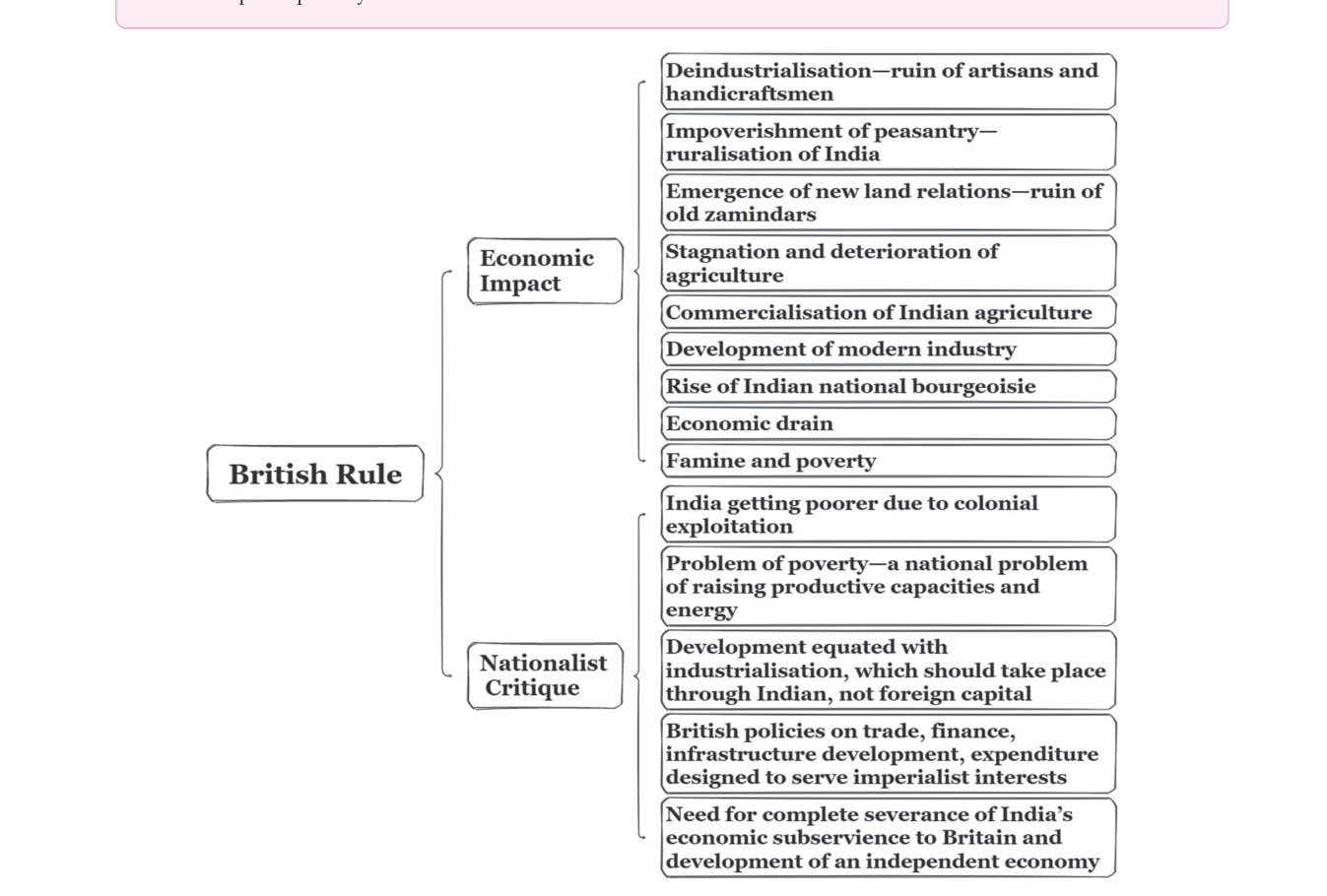
The British conquest had a pronounced and profound economic impact on India. There was hardly any aspect of the Indian economy that was not changed for better or for worse during the entire period of British rule down to 1947. The major difference between the British colonists in India and earlier invaders was that none of the earlier invaders made any structural changes in the Indian economy or drained away India’s wealth as tribute. British rule in India caused a transformation of India’s economy into a colonial economy, i.e., the structure and operation of the Indian economy were determined by the interests of the British economy. According to historians, at the beginning of the eighteenth-century India had some 23 per cent of the world economy. This share came down to some 3 per cent when India got independence.
DISRUPTION OF THE TRADITIONAL ECONOMY
The British economic policies transformed India’s economy into a colonial one, focused on serving the needs of the British economy.
Unlike previous conquests, which did not significantly alter the Indian economic structure, British rule disrupted the traditional self-sufficient village economy.
The British conquerors did not integrate into Indian life; instead, they maintained an exploitative relationship with Indian resources, extracting wealth and leaving the country impoverished.
The peasant, artisan, and trader continued to live a similar existence as before, with British rule ensuring that their surplus was appropriated by foreigners.
The British conquerors never became a part of Indian life; they remained outsiders who exploited Indian resources for their own gain.
The subordination of India’s economy to British interests led to significant economic imbalances and contributed to the stagnation of India’s development.
RUIN OF ARTISANS AND CRAFTSMEN
The urban handicrafts in India, which had been renowned for centuries, suffered a sudden and severe decline due to competition with cheaper imported machine-goods from Britain.
British economic policies, especially after 1813, imposed a one-way free trade system, allowing British manufacturers, particularly in cotton textiles, to flood the Indian market.
Indian goods, made using primitive techniques, could not compete with mass-produced goods from steam-operated machines.
The introduction of railways accelerated the destruction of traditional Indian industries by facilitating the spread of British manufactured goods to even the remotest villages.
The cotton weaving and spinning industries faced the most devastating impact.
Silk and woolen textiles also saw significant decline, along with industries such as iron, pottery, glass, paper, metals, shipping, oil-pressing, tanning, and dyeing.
The influx of foreign goods was not the sole factor; British policies further accelerated the decline.
The oppression of Indian craftsmen by the East India Company in the late 18th century forced them to sell their goods below market prices and accept low wages, leading many to abandon their ancestral professions.
Although the East India Company encouraged the export of handicrafts, their oppressive practices hindered their success.
The imposition of high import duties and restrictions on Indian goods entering Britain and Europe between the 18th and 19th centuries further restricted market access for Indian manufacturers.
The gradual disappearance of Indian rulers and courts, the primary consumers of Indian handicrafts, weakened these industries.
British officials and military officers, preferring home-produced goods, minimized patronage of Indian products.
The British policy of exporting raw materials such as cotton and leather raised costs, making Indian handicrafts less competitive against foreign imports.
The decline of traditional handicrafts mirrored the decline of Indian cities and towns known for their manufacturing prowess.
Cities like Dacca, Surat, and Murshidabad, which had survived wars and plunder, were depopulated and devastated under British rule.
The lack of modern machine industries in India contrasted with the growth of industrialization in Britain and Western Europe, leaving deindustrialized craftsmen without alternative employment.
As a result, many turned to agriculture, adding pressure on limited land resources.
British rule disrupted the balance of economic life in villages by dismantling the connection between agriculture and domestic industry, leading to the decline of self-sufficient village economies.
Millions of peasants, who once supplemented their incomes through part-time spinning and weaving, were now forced to rely solely on cultivation.
Similarly, rural artisans lost their traditional livelihoods and were either absorbed as agricultural laborers or became tenants with tiny plots, exacerbating land pressure.
The British conquest led to widespread deindustrialization and increased dependency on agriculture.
This agricultural dependency further fueled extreme poverty in India under British rule.
India transformed from a leading exporter of cotton goods to a market flooded with British cotton products, becoming an agricultural colony supplying raw materials to British industries.
IMPOVERISHMENT OF THE PEASANTRY
Under British rule, peasants experienced increasing poverty, despite being free from internal wars. Their living conditions deteriorated, leading to a steady decline in their economic status.
During the early British rule in Bengal, policies implemented by Clive and Warren Hastings resulted in the extraction of excessive land revenue, causing widespread devastation. Cornwallis noted that one-third of Bengal had turned into a wilderness inhabited by wild beasts.
Both Permanently Settled and Temporarily Settled Zamindari areas saw poor conditions for peasants.
Peasants were left at the mercy of zamindars who raised rents to unbearable levels, imposed illegal dues, and enforced forced labor or begar.
The situation in Ryotwari and Mahalwari areas was equally harsh. Here, the government replaced the zamindars, levying high land revenues that initially ranged from one-third to one-half of the produce.
Excessive land assessment contributed significantly to poverty and the deterioration of agriculture during the 19th century.
Although land revenue demands kept increasing year after year, the proportion of total produce taken as land revenue decreased due to rising prices and higher production levels.
The burden of high revenue demand worsened because peasants received little economic benefit in return. The government spent most of its revenue on British-Indian administration, meeting payments to England, and supporting British trade and industry.
Even law and order maintenance primarily served the interests of merchants and moneylenders rather than benefiting the peasant class.
The harmful effects of excessive land revenue were exacerbated by its rigid collection process. Revenue had to be paid promptly on fixed dates, regardless of poor harvests or complete crop failure.
Unable to pay the revenue, many peasants borrowed money from moneylenders at high-interest rates. Peasants often opted for debt by mortgaging their land to moneylenders or wealthy neighbors, fearing outright loss of their land.
Moneylenders charged exorbitant interest and used deceptive tactics such as falsifying accounts, forging signatures, and pressuring debtors into signing for larger sums.
Through these methods, moneylenders gradually acquired more and more land, reducing the peasant’s access to land.
Over time, cultivators in Ryotwari and Mahalwari areas became increasingly indebted, and more land passed into the hands of moneylenders, merchants, wealthy peasants, and other affluent classes.
The commercialization of agriculture further empowered moneylender-merchants to exploit peasants. Poor peasants had to sell their produce immediately after harvest at whatever price they could obtain to meet the demands of the government, landlords, and moneylenders.
The loss of land and overcrowding due to de-industrialization and lack of modern industry forced landless peasants and ruined artisans into tenancy or agricultural labor under harsh conditions.
Consequently, the peasantry suffered under a triple burden: the government, zamindars/landlords, and moneylenders.
RUIN OF OLD ZAMINDARS AND RISE OF NEW LANDLORDISM
The early decades of British rule led to the ruin of many old zamindars in Bengal and Madras, primarily due to policies such as auctioning revenue collection rights to the highest bidders.
Warren Hastings' policy of auctioning the right to collect revenue had a devastating impact on zamindars, especially when coupled with the Permanent Settlement of 1793.
Under the Permanent Settlement, the government claimed ten-elevenths of the rental income, and the rigid enforcement of revenue collection often resulted in the ruthless sale of zamindari estates in cases of delayed payment.
By 1815, nearly half of Bengal’s landed property had been transferred from traditional zamindars to merchants and moneyed classes who often lived in towns rather than villages.
Similarly, the Permanent Settlement in North Madras and the Ryotwari Settlement in other parts of Madras were equally harsh on local zamindars.
To ensure timely payment of land revenue, the authorities increased the power of zamindars over tenants, often by eliminating traditional tenant rights.
In Ryotwari areas, the spread of landlord-tenant relationships became widespread, leading to a system where many owner-cultivators leased land to land-hungry tenants at exorbitant rents.
Gradually, landlordism became a defining feature of agrarian relations in both zamindari and Ryotwari areas.
A significant consequence of the rise of zamindars and landlords was the emergence of subinfeudation, where landlords sublet their revenue collection rights to intermediaries.
This created a chain of rent-receiving intermediaries between actual cultivators and the government, further exploiting the poor peasants.
The rise of zamindars and landlords had a detrimental political role, especially during India’s struggle for independence.
STAGNATION AND DETERIORATION OF AGRICULTURE
Overcrowding in agriculture led to stagnation, resulting in extremely low yields per acre.
The excessive demand for land revenue and the rise of landlordism contributed to the worsening of agricultural conditions.
Subinfeudation, or the subdivision of land into smaller plots, led to the fragmentation of land holdings, many of which were too small to support their cultivators effectively.
The majority of peasants lived in extreme poverty, lacking the resources needed to improve agricultural practices such as better cattle, advanced seeds, fertilizers, and modern production techniques.
Heavy rent payments imposed by both the government and landlords created little incentive for cultivators to enhance productivity. Since the land was rarely owned by them, the benefits of any agricultural improvements would predominantly go to absentee landlords and moneylenders.
The subdivision and fragmentation of land further complicated efforts to implement improvements and advancements in agriculture.
Unlike European landlords who invested capital to increase productivity, Indian absentee landlords had no genuine connection to the land, functioning merely as rent receivers with little to no personal interest in its development.
These landlords preferred maximizing their income through exploitation of tenants rather than investing in productive improvements.
The government, while collecting heavy taxes from peasants, allocated only a small portion of this revenue toward agricultural development, with irrigation being one of the few areas where some progress was made.
Unlike other countries where agriculture was modernized, Indian agriculture remained technologically stagnant, with minimal use of modern machinery or equipment.
Regions like Bengal, Bihar, Orissa, and Sind lacked agricultural colleges, and peasants had limited access to formal education or knowledge about modern agricultural practices.
The financial system under British rule placed a disproportionate tax burden on peasants, leaving very little investment in their welfare or efforts to improve agricultural productivity.
DEVELOPMENT OF MODERN INDUSTRIES
In the second half of the 19th century, large-scale machine-based industries began to emerge in India.
The industrial revolution in India began with the establishment of cotton textile, jute, and coal mining industries in the 1850s.
The first textile mill was set up in Bombay by Cowasjee Nanabhoy in 1853, followed by the first jute mill in Rishra, Bengal, in 1855.
These industries expanded slowly but steadily. By 1879, there were 56 cotton textile mills in India, and by 1905, this number increased to 206 mills.
In 1882, there were 20 jute mills, and by 1901, the number rose to over 36 mills.
During the second half of the 19th and early 20th centuries, other mechanical industries such as cotton gins, rice and flour mills, leather tanneries, woolen textiles, paper and sugar mills, iron and steel works, and salt and mica production developed.
The cement, paper, matches, sugar, and glass industries saw significant development during the 1930s, though overall, these industries had limited growth.
Most modern Indian industries were owned or controlled by British capitalists, who were attracted by the promise of high profits.
Labour in India was extremely cheap, raw materials were readily available, and India provided a ready market for goods.
At the same time, investment opportunities in Britain were dwindling, and the colonial government was eager to support foreign capital, providing all possible assistance and privileges.
Consequently, foreign capital easily dominated many industries in India. The cotton textile industry was one exception where Indian capital had a substantial presence from the beginning.
In the 1930s, Indian involvement also grew in the sugar industry.
Indian capitalists struggled against British managing agencies and banks, which dominated the financial system. They often faced difficulty accessing credit, and when they did receive loans, they were burdened with higher interest rates compared to foreign investors.
In 1914, foreign banks held over 70% of all bank deposits in India. By 1937, their share had reduced to 57%.
The railway policy of the government favored foreign imports, making it difficult and costlier for Indian goods to be distributed.
India lacked heavy industries, such as iron and steel plants, which were essential for rapid and independent industrial development. The first steel was produced only in 1913.
Plantation industries like indigo, tea, and coffee were almost exclusively owned by Europeans.
Indigo was introduced at the end of the 18th century and flourished in Bengal and Bihar. Indigo planters were notorious for oppressing peasants, forcing them to cultivate indigo. This oppression was widely criticized, as portrayed by Dinbandhu Mitra’s play Neel Darpan in 1860.
The invention of synthetic dyes dealt a severe blow to the indigo industry, leading to its decline.
The tea industry expanded in Assam, Bengal, Southern India, and Himachal Pradesh, but it remained foreign-owned, with government support in the form of land grants and privileges.
Coffee plantations were also developed in South India under foreign control.
These foreign-dominated plantation industries did little to benefit the Indian people. Most profits flowed out of the country, and workers endured poor wages, harsh working conditions, and exploitation.
Industrial progress in India was slow and confined mainly to cotton and jute industries, with tea plantations flourishing in the 19th century.
During the 1930s, sugar and cement industries saw some development.
By 1946, cotton and jute textiles accounted for 40% of all factory workers in India.
Compared to other countries, India’s industrial development was limited. In 1951, only about 2.3 million people were employed in modern industries out of a population of 357 million.
Even the limited industrial growth had to develop largely independently and often in opposition to British policies. British manufacturers viewed Indian industries as rivals and pressured the Indian government to discourage their expansion.
In the 1920s and 1930s, under the pressure of the rising nationalist movement and Indian capitalists, the government introduced some tariff protections for Indian industries.
However, Indian industries like cement, iron and steel, and glass faced inadequate protection, while foreign-dominated industries, such as the match industry, were given more favorable treatment.
British imports enjoyed special privileges under the system of ‘imperial preferences,’ despite vehement protests from Indians.
Industrial development in India was highly uneven regionally, with industries concentrated in a few cities and regions, leaving large parts of the country underdeveloped.
An important social consequence of even limited industrial development was the emergence of two new social classes: the industrial capitalist class and the modern working
POVERTY AND FAMINES
One of the most defining features of British rule in India was the widespread and deep-rooted poverty it caused among the population.
This extreme poverty was the direct consequence of British economic exploitation, the collapse of traditional Indian industries, and the failure of modern industries to take their place. Excessive taxation, the constant outflow of wealth to Britain, and a regressive agrarian system resulted in stagnant agriculture and further impoverishment of the peasantry, who were exploited by zamindars, landlords, rulers, moneylenders, traders, and the colonial state itself. These factors collectively kept India’s economy at a chronically underdeveloped level.
The suffering of the Indian people was further worsened by frequent famines, which affected nearly every region of the country in the latter half of the 19th century.
Between 1925 and 1934, India and China recorded the lowest per capita incomes globally. An average Englishman earned five times more than an Indian. Moreover, despite significant advancements in medical science and sanitation, the life expectancy of an Indian in the 1930s was merely 32 years, whereas in Western Europe and North America, it had already crossed 60 years.
India's poverty and underdevelopment were not the result of natural scarcity. The country possessed rich natural resources that, if harnessed efficiently, could have ensured substantial prosperity.
However, decades of foreign domination, economic exploitation, and a stagnant socio-economic structure turned India into a land where immense wealth existed alongside extreme poverty—a striking contradiction of a wealthy land inhabited by impoverished people.