Whatsapp 88106-52225 For Details
Get Free IAS Booklet
Get Free IAS Booklet
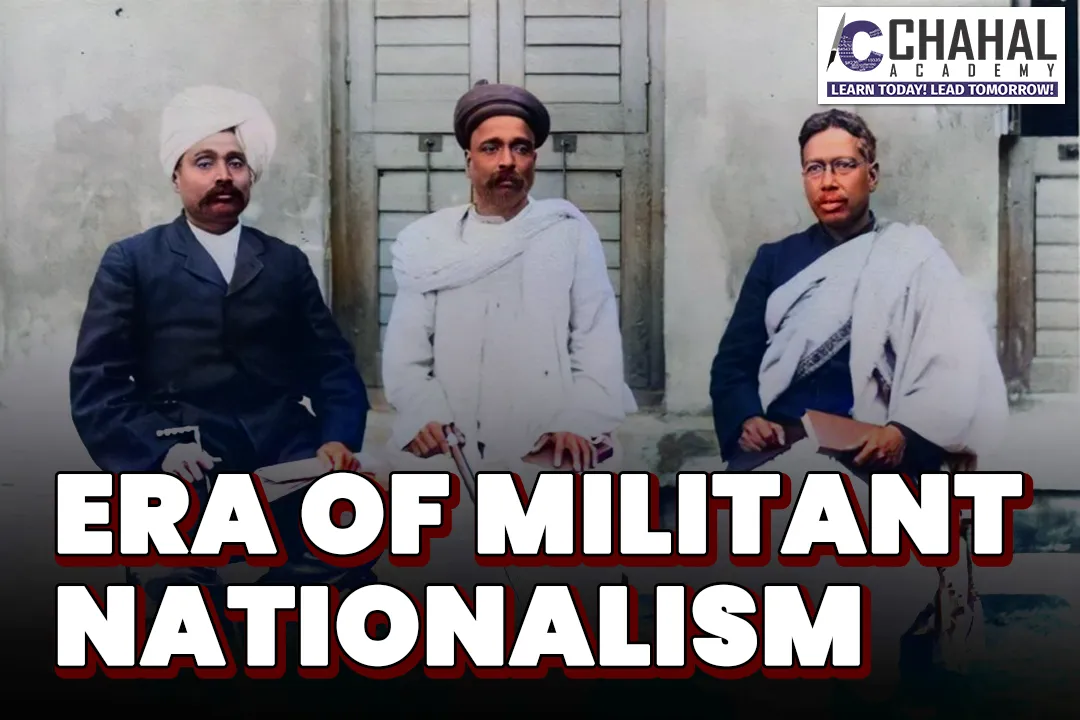
ERA OF MILITANT NATIONALISM
We begin by examining the rise of Extremists within the Congress. We will discuss the Partition of Bengal, the Swadeshi Movement launched by the INC in response, and the differences between the Moderates’ and Extremists’ ideologies and methods, culminating in the eventual Surat Split of the Congress.
GROWTH OF MILITANT NATIONALISM
The emergence of Militant Nationalism in India was due to several political, economic and social factors such as:
Changing Perception of British Rule
Both the exploitative nature of the British rule as well as the realization that the British government was not conceding to Indian demands became evident through various laws and policies of the government of India.
Confidence and Self-Respect
Influential leaders like Tilak, Aurobindo, and Bipin Chandra Pal emphasized the potential of self-effort and the need for the masses’ involvement in the struggle against colonialism. This cultivated a sense of confidence and self-respect among Indians.
Education and Unemployment
While education led to increased awareness, it also highlighted the underdeveloped state of the economy under colonial rule. This disparity between education and employment added to the dissatisfaction among radical nationalists.
International Influences
Success stories of other nations like Japan’s rapid progress and victories over European powers inspired Indians. They realized that united efforts could challenge even the mightiest empires.
Reaction to Westernization
There was a growing resistance to excessive Westernization and a desire to preserve Indian national identity. Intellectuals like Swami Vivekananda and others highlighted India’s rich past, challenging the notion of Western superiority.
Dissatisfaction with Moderate Methods
Younger members within the Congress were dissatisfied with the moderate approach of peaceful and constitutional agitation. They sought a more direct and assertive form of political action.
Reactionary Policies of Curzon
Lord Curzon’s policies and his disrespect towards Indian nationalism intensified the resentment against British rule.
Emergence of Trained Leadership
Influential leaders like Tilak, Aurobindo, and others advocated a more militant approach with swaraj (self-rule) as the ultimate goal.
PARTITION OF BENGAL
The oppressive regime of Curzon is mostly associated with his decision to partition Bengal in 1905, ostensibly to weaken the Bengali nationalists, who had been controlling the Congress. The move was calculated to hurt chiefly those who spearheaded the national movement in the eastern part of India, namely, the Bengali-speaking educated middle class. Having been the first to be brought under British rule, the Bengalis were among the pioneers in taking to English education, imbibing Western Liberal ideas and airing nationalistic and patriotic views. This annoyed the imperialist authorities and they decided to take action.
Plan of Partition
Curzon planned to take away from Bengal those territories where Muslims were more numerous, and join these with Assam to form a new province with Dacca as its Capital.
By partitioning Bengal, therefore, Curzon and his lieutenants wanted to set up Dacca as a parallel political centre to the nationalistically oriented Calcutta.
To make use, of the Muslims to counter-balance the Hindus they intended to create out of Bengal a Muslim-majority province (where 15 million Muslims would live with 12 million Hindus and reduce the Bengali speaking people into a minority in what would remain as Bengal (where 19 million Bengali speaking persons should be outnumbered by 35 million speakers of Hindi, Oriya and other languages).
The Partition
The Curzonian scheme to partition Bengal took a concrete shape gradually from the time the Viceroy wrote his minute on Territorial Redistribution on 1 June, 1903 to the day the final scheme of division was despatched to the home authorities in London for sanction on 2 February, 1905. On 19 July, 1905 the Government of India announced its decision to form the new province of “Eastern Bengal and Assam ‘’, comprising the Chittagong, Dacca and Rajshahi divisions, Hill Tippera (Tripura), Malda and Assam. The province came into existence on 16 October, 1905, by breaking up Bengal and its 41.5 million Bengali speaking people.
SWADESHI MOVEMENT
The partition of Bengal led to a radicalising in nationalist politics and this was witnessed in the method of agitation, and the change from the old political methods of prayer and petition to that of passive resistance. This meant opposition to colonial rule through violation of its unjust laws, boycott of British goods and institutions and development of indigenous alternatives i.e., Swadeshi and national education.
Moderate trends
The moderates began opposing the partition plan as early as 1903, believing the British might be persuaded through petitions, public meetings, memoranda, and propaganda published in newspapers like Hitabadi, Sanjibani, and Bengalee.
Their main goal was to build strong public opinion in both India and England to pressure the government into withdrawing the unjust partition of Bengal.
Despite their efforts, the partition was officially announced in 1905, prompting them to initiate a broader Swadeshi movement.
On July 17, 1905, Surendranath Banerjee called for a boycott of British goods and institutions during a meeting in Calcutta.
A formal resolution for the boycott was passed during a mass meeting at Calcutta Town Hall on August 7, marking the formal start of the Swadeshi movement.
October 16, 1905, the day the partition came into effect, was observed as a day of mourning across Bengal, with fasting, barefoot processions, and singing of Bande Mataram, which became the movement’s anthem.
Rabindranath Tagore composed Amar Sonar Bangla, now the national anthem of Bangladesh, which was sung by large crowds during the protests.
As a symbol of unity, people tied rakhis on each other’s wrists, while leaders like Surendranath Banerjee and Ananda Mohan Bose addressed massive gatherings.
This was the first time moderates sought to involve broader sections of society, beyond the educated elite of Bengal.
The movement soon spread to other regions, with Tilak leading in Poona and Bombay, Lala Lajpat Rai and Ajit Singh in Punjab, Syed Haider Raza in Delhi, and Chidambaram Pillai in Madras.
The Congress’s Position
In 1905, the Indian National Congress, presided over by Gokhale, passed resolutions to: ➤ Denounce the partition of Bengal and the regressive policies of Lord Curzon. ➤ Extend support to the anti-partition and Swadeshi Movement in Bengal.
Militant nationalists, including Tilak, Lajpat Rai, Bipin Chandra Pal, and Aurobindo Ghosh, sought to expand the movement beyond Bengal, advocating for a broader political mass struggle with the ultimate goal of achieving swaraj.
At the 1906 Congress session in Calcutta, under Dadabhai Naoroji’s leadership, a significant milestone was reached with the declaration that the Congress aimed for "self-government or swaraj," akin to that of Australia, Canada or the United Kingdom.
The growing rift between Moderates and Extremists over the movement’s direction and strategies led to a major split at the Surat session of the Indian National Congress in 1907, causing a setback to the Swadeshi Movement.
Extremist’s trends
After 1905, the Extremists gained significant influence over the Swadeshi Movement in Bengal due to three main factors: ➤ The failure of the Moderate-led initiatives to achieve concrete outcomes. ➤ The government's divisive policies in both parts of Bengal, which heightened nationalist resentment. ➤ The oppressive measures by the government, including corporal punishment for students, bans on public singing of *Vande Mataram*, restrictions on public gatherings, imprisonment and deportation of leaders, suppression of the press, and violent clashes between the police and citizens.
Initially, the Bengal Extremists emphasized constructive Swadeshi programs, such as: ➤ Promoting local industries, establishing national education systems, creating arbitration courts, and organizing village communities.
They called for passive resistance alongside Swadeshi and boycotts, extending the boycott to government-run schools, colleges, services, courts, legislative councils, municipalities, and titles.
The militant nationalists aimed to turn the anti-partition and Swadeshi Movement into a broader mass struggle, advocating for complete independence from foreign rule, with Aurobindo declaring, “Political freedom is the life breath of a nation.”
NEW FORMS OF STRUGGLE Boycott of Foreign Goods
Boycott included boycott and public burning of foreign cloth, boycott of foreign-made salt or sugar, refusal by priests to ritualise marriages involving exchange of foreign goods, refusal by washermen to wash foreign clothes.
Public meetings and processions emerged as major methods of mass mobilisation.
Corps of Volunteers or ‘Samitis’
Numerous national volunteer organizations, or samitis, were established in Calcutta and other districts.
Notable among these were the Dawn Society (inspired by the journal Dawn), the Anti-Circular Society (formed to oppose the "Carlyle Circular"), along with the Brati, Anushilan, Suhrid, and Sadhana samitis.
The Swadesh Bandhab Samiti, founded by Ashwini Kumar Dutta in Barisal, became a prominent and effective platform for mass mobilization.
In Tirunelveli, Tamil Nadu, leaders like V.O. Chidambaram Pillai, Subramania Siva, and other lawyers established the Swadeshi Sangam, which galvanized the local population.
These samitis promoted the principles of swadeshi and boycott, engaged in social work during famines and epidemics, provided physical and moral training, organized crafts and national schools, and created arbitration committees and village societies.
Religious revivalism and use of Traditional Popular Festivals and Melas
Extremist leaders like Aurobindo Ghosh recognized the significance of mass mobilization and used religion as a tool to connect with the people. Religious revivalism added a new dimension to their political efforts, with the Bhagavad Gita serving as a source of spiritual motivation for Swadeshi volunteers.
Swadeshi fairs (melas) became a common practice, providing a platform for selling handicrafts and promoting indigenous goods.
Festivals like Tilak’s Ganapati and Shivaji celebrations were utilized as effective channels for Swadeshi propaganda, influencing not just western India but also Bengal.
Emphasis given to Self-Reliance
The concept of "constructive swadeshi" focused on building national strength through self-help and self-reliance (Atmashakti as termed by Rabindranath Tagore). This involved establishing indigenous industries, promoting nationalist education, and forming village uplift societies to bridge the gap between rural and urban communities.
- Self-reliance emphasized restoring national pride, dignity, and confidence while fostering the social and economic revival of villages.
Programme of Swadeshi or National Education
The British issued the infamous Carlyle Circular on October 22, 1905, threatening student picketers with measures such as withdrawal of grants, scholarships, and institutional affiliations. This circular, authored by Carlyle, the Chief Secretary of Bengal, led to fines and rustication orders, prompting many students to leave these institutions, which they labeled as "schools of slavery."
The boycott of British-run schools and colleges encouraged Swadeshi leaders to develop an alternative educational system in Bengal.
As part of this effort, the Bengal Technical Institute was established on July 25, 1906 (later becoming the College of Engineering and Technology, Jadavpur, the precursor to Jadavpur University), alongside the Bengal National College and School, which opened on August 15, 1906, with Aurobindo Ghosh as its principal. Several national primary and secondary schools also emerged in various districts.
The National Council of Education was formed on August 15, 1906, to create a system of education— covering literary, scientific, and technical fields— aligned with national ideals and under national control.
The national education movement was spearheaded by figures like Satish Chandra Mukherjee, who established the Bhagavat Chatuspathi and the Dawn Society in Calcutta.
Notable contributions to the movement included Brahmabandhab Upadhyay’s Saraswat Ayatan and Rabindranath Tagore’s Ashram at Shantiniketan in Birbhum.
Swadeshi or Indigenous Enterprises
Even before the Swadeshi movement, the 1890s saw a focus on Swadeshi enterprises, marked by initiatives such as the establishment of Bengal Chemicals and a porcelain factory in 1901.
The Swadeshi movement sparked widespread enthusiasm for Indian enterprises, leading to the creation of companies like Bengal Chemicals, Bange Lakshmi Cotton Mills, Mohini Mills, and National Tannery.
Many indigenous industries, including soap, matchbox, and tobacco manufacturing units, oil mills, as well as financial ventures like Swadeshi banks, insurance firms, and steam navigation companies, gained momentum during this period.
V.O. Chidambaram Pillai launched the Swadeshi Steam Navigation Company in Tuticorin, directly challenging the dominance of the British Indian Steam Navigation Company.
Impact in the Cultural Sphere
The samitis encouraged folk singers and performers like Mukunda Das, Bhusan Das, and Mufizuddin Bayati to use local dialects to present swadeshi-themed performances.
These grassroots efforts complemented the patriotic works of renowned literary figures such as Rabindranath Tagore, Rajanikanta Sen, Dwijendralal Roy, Girindramohini Dasi, and Sayed Abu Mohammed, as well as playwrights like Girishchandra Ghosh, Kshirode Prasad Vidyavinode, and Amritalal Bose.
Rabindranath Tagore’s Amar Sonar Bangla, composed during this period, became an enduring symbol of freedom and was later adopted as the national anthem of Bangladesh.
In the field of art, Abanindranath Tagore rejected Victorian naturalism and drew inspiration from Ajanta murals, Mughal art, and Rajput paintings, reshaping Indian artistic expression.
Nandalal Bose, a pivotal figure in Indian art, became the first recipient of a scholarship from the Indian Society of Oriental Art, established in 1907.
EXTENT OF MASS PARTICIPATION
The national goal of swaraj, and the means to achieve it through boycott in all spheres, or through the method of passive resistance as it was then formulated necessitated not only a widespread awakening of the masses, but also their whole-hearted participation in well- organised anti-British mass movements.
The educated middle class had by and large awakened with the progress of the Swadeshi movement and even some members of the landed aristocracy and the representatives of commercial and mercantile interests were becoming sympathetic to the national cause.
But the vast majority of the poorer classes, especially the working class and the peasantry, had not yet been brought in the thick of the struggle.
Workers and Trade Unions
Some of the swadeshi activists (notably Aswini Kumar Banerji, Prabhat Kusum Roychoudhury, Althanasius Apurba Kumar Ghosh and Premtosh Bose) did, however, try to organize workers in Bengal, and direct their economic grievances into political channels.
The lead in the direction came from 247 clerks of Burn Company in Howrah who struck work in September 1905 in protest against a derogatory new work regulation. This was followed by strikes in the tramways in Calcutta, in the jute mills and railway workshops.
Coolies, carters and sweepers also took recourse to strikes in Calcutta to voice their economic demands. Such greater politicisation was noticed among the more militant printing press, jute mill and railway workers.
A bitter strike in the Government owned presses resulted in the formation of the first real labour union, namely the Printers Union in October 1905.
A similar struggle of the employees of the Eastern Indian Railway saw the organisation of a Railwaymen’s Union in July 1906.
There were attempts on the part of the swadeshi leaders like Bipin Chandra Pal, Shyarnsundar Chakrabarthy and Liakat Hussain to organise agitated railway workers in Asansol, Raniganj and Jamalpur, which ended up in police firing at the Jamalpur Workshop 27 August, 1906.
The jute mill workers, who agitated almost on similar lines from 1905, were led by Aswini Kumar Banerji from an Indian Millhands Union at Budge-Budge in August 1906.
However, all these unions later on suffered a setback in the face of the hostility of the Government. Not being ideologically committed to the cause of the workers, the enthusiasm of the nationalists in activating them steadily subsided after 1907.
Subramania Siva and Chidambaram Pillai led strikes in Tuticorin and Tirunelveli in a foreign-owned cotton mill.
In Rawalpindi (Punjab), the arsenal and railway workers went on strike led by Lala Lajpat Rai and Ajit Singh. However, by summer of 1908, the labour unrest subsided under strict action.
Students
Students actively participated in promoting and practicing swadeshi ideals, leading efforts to organize picketing of shops that sold foreign goods.
Their involvement was prominent in regions such as Bengal, Maharashtra (notably Poona), and parts of southern India, including Guntur, Madras, and Salem.
The authorities responded harshly, threatening to penalize schools and colleges involved in the agitation by revoking their affiliations or withdrawing grants and privileges.
Students participating in the movement faced severe consequences, including disqualification from government jobs and scholarships, along with fines, expulsions, arrests, and physical punishment.
Women
Women, who were traditionally home-cantered, especially those of the urban middle classes, took active part in processions and picketing. From now onwards, they were to play a significant role in the national movement.
Muslims
A few Muslims, including Barrister Abdul Rasul, Liaqat Hussain, Ghuznavi, and Maulana Azad (who joined revolutionary terrorist groups), participated in the movement.
However, the majority of upper and middle-class Muslims either abstained or, led by Nawab Salimullah of Dacca, supported the partition, arguing that it would create a Muslim-majority East Bengal.
Annulment of Partition
In 1911, the partition of Bengal was annulled primarily to address the rise of revolutionary terrorism, which came as a significant setback to the Muslim political elite.
Additionally, the decision was made to shift the capital to Delhi as a gesture to the Muslims, recognizing its historical association with Muslim rule; however, it did not satisfy the Muslim community.
Bihar and Orissa were separated from Bengal and Assam was established as an independent province.
THE COMMUNAL ANGLE
In traditional societies religion has often been used as a convenient means to arouse an indigenous and popular brand of nationalism, and it has usually led to unfortunate
consequences. The experience of the Swadeshi movement was no different. The Political capital that the leaders in Bengal tried to make out of Hinduism and Islam contributed in effect to the widening of the gulf between the two major communities there. Dividing the land and the people of Bengal, and playing the Hindus and Muslims against each other, were the known British imperialist ideas. These were taken up 1905 by Curzon, Sir Aridrew Fraser and Sir Herbert Risley and their successors like Lord Minto, Sir Bampfylde Fuller and Sir Lancelot Hare.
Simultaneously with the wooing of the educated Muslims, the authorities encouraged the aristocratic elements among them to think in terms of Muslim Political Power and to form in October, 1906 the Muslim League, under the leadership of Nawab Salimullah of Dacca, to protect the “separate” interests of the Muslims.
The stridently Hinduised exhortations of the nationalist organs like Bunde Muturum, Sandhya and Nabshakti, the uncritical glorification of Hindu past, the nostalgia for the lost Hindu Rashtra (nation), the practice of taking a pledge of swadeshi (for not using British goods) before a Hindu deity, the vow of self-sacrifice before the goddess Kali and the constant references to the Gita did not help the political leaders in bringing the Muslims closer to the Hindus. Rather, these contributed to a hardening of attitudes on the part of both the communities.
Such Hindu revivalistic propaganda at the height of the agitation, and that, too, by its leading figures, actually incited Nawab Salimullah’s men and the mullahs to spread communal hatred among the Muslims in accordance of course, with the Curzonian expectation.
It was comparatively easy in such circumstances for the communalists to take recourse to communal violence. The eastern part of Bengal saw a series of communal riots, first in Ishwarganj in Mymensingh district in May 1906, followed by disturbances in Comilla, Jamalpur, Dewanganj and Bakshiganj in March 1907, and then again in Mymensingh in April-May 1907. The riots also revealed a submerged agrarian character, since the targets were often found to be Hindu Zamindars and Mahajans (moneylenders). Although they were alarmed by these untoward developments, the nationalists would not try to understand the entire phenomena correctly. As a result, their religious fervour continued to increase rather than decrease.
EVALUATION OF THE SWADESHI MOVEMENT The Movement Fizzles Out
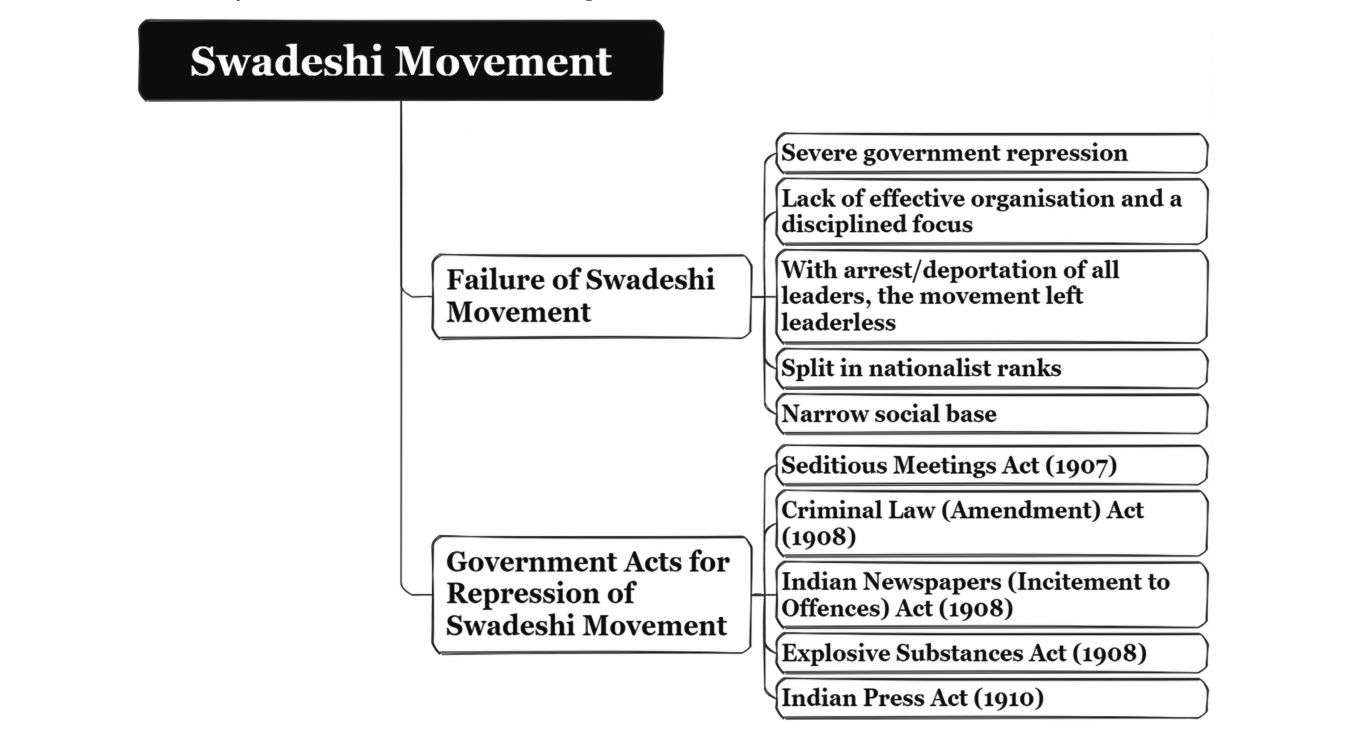
By 1908, the open phase of the Swadeshi and Boycott movement had largely come to an end due to various factors like : Severe government repression played a significant role in suppressing the movement.
The movement struggled to establish an effective organization or party structure.
Most of the leaders were either arrested or deported by 1908, leaving the movement leaderless, with Aurobindo Ghosh and Bipin Chandra Pal retiring from active politics.
Internal disputes among leaders, intensified by the Surat split in 1907, further weakened the movement.
The movement energized the people but lacked the means to channel this energy effectively or to find new forms to express popular resentment.
It remained largely confined to the upper and middle classes and failed to reach the broader masses, especially the peasantry.
Non-cooperation and passive resistance were still largely theoretical ideas, lacking practical implementation.
Impact of Swadeshi movement
Despite its gradual decline into inactivity, the movement was a turning point in modern Indian history.
The anti-partition agitation and the Swadeshi movement were responsible for the spread of national ideas beyond the official and elite circles.
In fact, these agitations were the formative experiences for the students and teachers who gave nationalism its main populist, idealist, progressive and even revolutionary meanings.
News, debates and folklore entered into the public culture in most major urban centres.
Nationalism became a political movement, which despite being small as compared to the vast population of the indigenous society, moved decisively beyond national moorings and attracted attention overseas.
Several million Indians settled abroad also became involved in the movement. In California, activists among Punjabi Sikh farmers launched newspapers and raised funds to support the Indian cause.
More importantly, the new generation of Indian politicians that emerged in the movement came primarily from Bengal, Punjab and Maharashtra.
The anti-partition movement witnessed the emergence of the cosmopolitan English literate youth whose professional prospects would be curtailed in partition of Bengal. The majority of the English educated youth who came to Calcutta for their education went back to villages and towns and spread the message of Swadeshi.
The popular appeal of Hindu devotionalism fanned the flames of movement among the poorest.
The aftermath of the Swadeshi movement led to unification of desperate political identities shaped by public activism which influenced most of the national leaders.
Moderate Methods Give Way to Extremist Modes
The Swadeshi and Boycott Movement revealed that the Moderates had become ineffective, as their focus on petitions and speeches was no longer relevant. They struggled to keep up with the changing times, especially due to their inability to gain support from the younger generation and engage with the masses. In contrast, the Extremists successfully emphasized mass participation, transforming patriotism from an academic exercise to a commitment of service and sacrifice for the nation.
THE EXTREMISTS
The period from 1905 was known as the era of extremism in the Indian National Movement. The extremists or the aggressive nationalists believed that success could be achieved through bold means.
Leaders of the Extremists
There were three groups of the Extremists-the Maharashtra group, headed by B.G. Tilak; the Bengal group represented by B.C. Pal and Aurobindo and the Punjab group led by Lala Lajpat Rai. The Bengal Extremists were greatly influenced by the ideas of Bankim Chandra, who was a liberal conservative like Edmund Burke.
Bal Gangadhar Tilak
He is regarded as the real founder of the popular anti-British movement in India. He was known as ‘Lokmanya’. He attacked the British through his weeklies The Mahratta and the Kesari. He was jailed twice by the British for his nationalist activities and in 1908 deported to Mandalay for six years. He set up the Home Rule League in 1916 at Poona and declared “Swaraj is my birth-right and I will have it.”
Lala Lajpat Rai
He is popularly known as the ‘Lion of Punjab’. He played an important role in the Swadeshi Movement. He founded the Indian Home Rule League in the US in 1916. He was deported to Mandalay on the grounds of sedition. He received fatal injuries while leading a procession against the Simon Commission and died on November 17, 1928.
Bipin Chandra Pal
He began his career as a moderate and turned an extremist. He played an important role in the Swadeshi Movement. He preached nationalism through the nook and corner of Indian by his powerful speeches and writings.
Aurobindo Ghosh
He was another extremist leader and he actively participated in the Swadeshi Movement. He was very much attracted by the Dayananda with more definite teachings of Dayananda who was hardly influenced by any ideas from the West. He credited he settled in the French territory of work for the nation than any other reformer. He was also imprisoned. After his release Pondicherry and concentrated on spiritual activities.
CAUSES FOR THE RISE OF EXTREMISM
The Swadeshi and Boycott Movement emerged in response to the growing recognition of the exploitative nature of British rule and the worsening economic conditions in the 1890s. Several factors contributed to the rise of extremism:
The failure of the Moderates to achieve significant success, with the Indian Councils Act (1892) being their only notable achievement.
The famine and plague of 1896-97 that impacted the entire country and increased the suffering of the masses.
Leaders like Tilak, Aurobindo and Bipin Chandra Pal emphasized the importance of relying on Indian character and capacities, fostering confidence and self-respect among nationalists.
The spread of education led to greater awareness, while unemployment and underemployment exacerbated discontent among the educated class.
The new leadership opposed excessive westernisation and recognized colonial efforts to submerge Indian identity under British rule.
The ill-treatment of Indians in South Africa due to racial discrimination further fueled nationalist sentiments.
International events, such as the defeat of the Italian army by Ethiopians (1896), the Boer Wars (1899-1902), and the Russo-Japanese War (1904-1905), encouraged Indians to resist British rule.
Differences between Moderates and Extremists
Moderates 1. Composed of zamindars and upper middle classes in towns. 2. Influenced by Western liberal thought and European history. 3. Held the view that England had a providential mission in India. 4. Considered political connections with Britain to be in India's social, political and cultural interests. 5. Professed loyalty to the British Crown. 6. Believed that the movement should be confined to the middle class intelligentsia, as the masses were not yet ready for political participation. 7. Called for constitutional reforms and greater Indian representation in government services. 8. Advocated the exclusive use of constitutional methods. 9. They were patriots who did not act as a comprador class.
The rise of extremism was also a reaction to Lord Curzon’s policies: ➤ The Calcutta Corporation Act (1899) reduced Indian control over the local body. ➤ The Universities Act (1904) diminished the autonomy of universities and reduced elected representation. ➤ The Sedition Act and Official Secrets Act curtailed civil liberties. ➤ The Partition of Bengal (1905) was a significant trigger for nationalist agitation.
Main Objective of Extremists
Their main objective was to attain Swaraj or complete independence and not just self-government.
Methods of the Extremists
The Extremists had no faith in the British sense of justice and fair play. They pointed out the forceful means by which the British had taken control of India. They believed that political rights will have to be fought for. They had the spirit of self-reliance and self- determination. The methods used by the extremists were:
Not cooperating with the British Government by boycotting government courts, schools and colleges.
Promotion of Swadeshi and boycott of foreign goods.
Introduction and promotion of national education.
Extremists 1. Composed mainly of educated middle and lower middle classes from towns. 2. Inspired by Indian history, cultural heritage, and Hindu traditional symbols. 3. Rejected the idea of a ‘providential mission theory’ as unrealistic. 4. Believed that political connections with Britain would continue to exploit India. 5. Held that the British Crown did not deserve Indian loyalty. 6. Trusted the ability of the masses to actively participate and make sacrifices. 7. Advocated for swaraj as a solution to India’s problems. 8. Willing to employ extra-constitutional methods such as boycott and passive resistance to achieve their goals. 9. Recognized as patriots who made sacrifices for the country’s sake
THE SURAT SPLIT
The Congress split at Surat came in December 1907, around the time when revolutionary activity had gained momentum. The two events were not unconnected.
Run-up to Surat
In December 1905, during the Benaras session of the Indian National Congress under the presidency of Gopal Krishna Gokhale, significant differences between the Moderates and Extremists came to light. The Extremists sought to expand the Boycott and Swadeshi Movement beyond Bengal and incorporate all associations, including government services, law courts, and legislative councils, into the boycott agenda to initiate a nationwide mass movement. They pushed for a strong resolution supporting their programme at the session.
Conversely, the Moderates were unwilling to extend the movement outside Bengal and strongly opposed boycotting councils and similar institutions. Advocating constitutional means to protest the partition of Bengal, they favored a more cautious approach. A compromise was reached with the passage of a relatively mild resolution that condemned the partition of Bengal, criticized Lord Curzon's policies, and endorsed the swadeshi and boycott movements within Bengal. This prevented a split in the Congress for the time being.
At the Calcutta session in December 1906, the Moderates' enthusiasm waned due to the growing influence of the Extremists and revolutionaries, as well as the communal tensions. The Extremists proposed Tilak or Lajpat Rai for the presidency, while the Moderates nominated Dadabhai Naoroji, a leader respected across factions. Naoroji was ultimately elected, and as a concession to the Extremists, the Congress formally adopted the goal of "swarajya" or self-rule akin to that in the United Kingdom or colonies like Australia and Canada. A resolution endorsing swadeshi, boycott and national education was also passed.
The term "swaraj" was mentioned for the first time, though its meaning was left vague, allowing both Moderates and Extremists to interpret it differently. Encouraged by the Calcutta session, the Extremists advocated widespread passive resistance and boycott of schools, colleges, legislative councils, municipalities, and law courts.
Meanwhile, the Moderates, optimistic about forthcoming council reforms, decided to moderate the Calcutta resolutions. The two factions appeared headed for a clash. The Extremists believed the people were ready for a decisive struggle for freedom and saw the Moderates as an impediment to their movement.
On the other hand, the Moderates feared that the Extremists' aggressive anti-imperialist agitation could provoke severe colonial repression. Viewing the council reforms as a step toward greater Indian participation in governance, the Moderates were ready to distance themselves from the Extremists. However, they failed to see that the reforms were intended to isolate the Extremists rather than reward the Moderates.
The Extremists did not recognize that the Moderates could act as a protective buffer against state repression. Neither side understood that, in a vast country like India, governed by a powerful imperialist regime, only a united, broad-based nationalist movement could achieve success.
Split Takes Place
The Extremists proposed holding the 1907 session in Nagpur with leaders like Tilak or Lajpat Rai as president, and emphasized swadeshi, boycott and national education resolutions.
The Moderates pushed for the session to be held in Surat to exclude Tilak from the presidency, as leaders from the host province could not preside.
They suggested Rash Behari Ghosh as president and sought to remove the resolutions on swadeshi, boycott and national education.
This led to an inevitable split, with the Congress now dominated by the Moderates, who focused on self-government within the British Empire through constitutional means only.
Government Repression
Between 1907 and 1911, the government introduced five new laws to curb anti-government activities.
These laws included the Seditious Meetings Act, 1907; Indian Newspapers (Incitement to Offences) Act, 1908; Criminal Law Amendment Act, 1908; and the Indian Press Act, 1910.
Tilak was sentenced to six years of transportation and fined Rs 1,000 for his articles, leading to his imprisonment in Mandalay (Burma) for six years.
Aurobindo Ghosh and Bipin Chandra Pal retired from active politics, while Lajpat Rai went abroad.
Following these events, the national movement faced a temporary decline.