Whatsapp 88106-52225 For Details
Get Free IAS Booklet
Get Free IAS Booklet
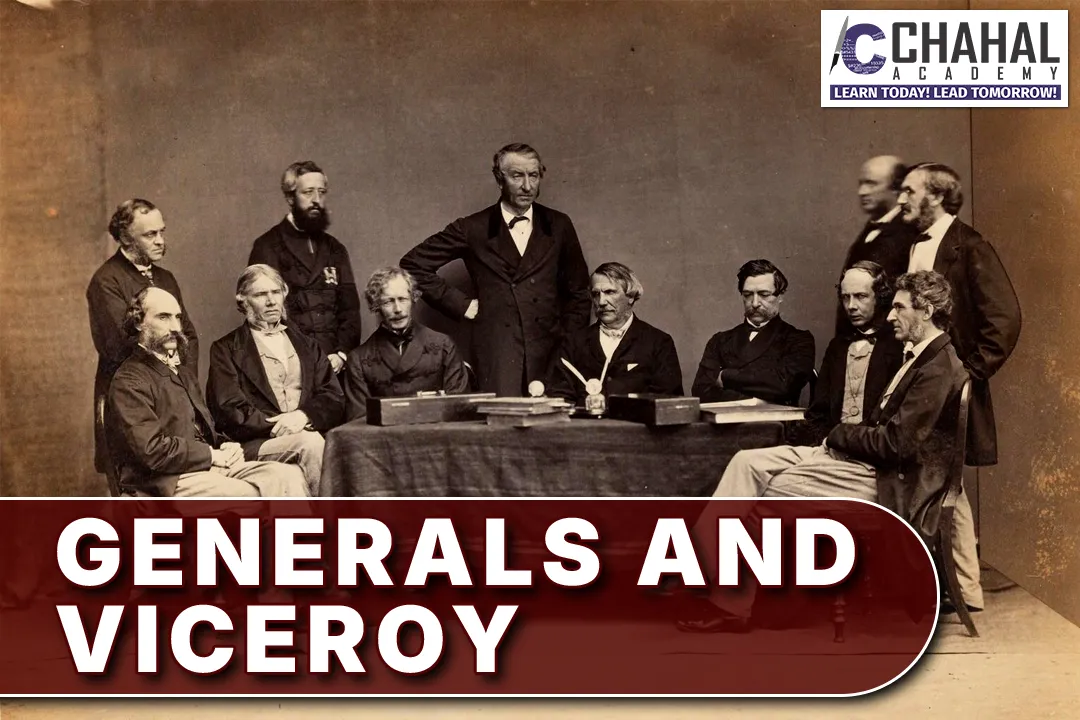
GENERALS AND VICEROY’S
In this unit
We will discuss significant Governor-Generals, Viceroys, and their contributions.
GOVERNOR GENERAL OF BENGAL Warren Hastings (1772-1785)
Pitt’s India Act - 1784.
Hastings brought the Dual Government system to an end by enforcing the Regulating Act of 1773.
He founded the Asiatic Society of Bengal with William Jones in 1784.
The Zamindars were given judicial powers and civil and criminal courts were established in each district during his tenure as the Governor General of India.
Treaty of Purandar (1776) between English and Peshwa
Lord Cornwallis (1786-1793)
Introduced Permanent Settlement of Bengal (1793).
Introduction of civil services. Cornwallis is called ‘the father of civil service in India’.
New Police System was introduced in 1791.
Third Anglo-Mysore War and Treaty of Seringapatam (1792).
Establishment of Appellate courts and lower grade courts.
Introduced the first Charter Act – 1793.
Lord Wellesley (1798-1805)
Introduced the Subsidiary Alliance system to achieve British Paramountcy (1798).
Fourth Anglo- Mysore war.
The Treaty of Bassein (1802) with Peshwa.
Described himself a “Bengal Tiger”.
GOVERNOR GENERAL OF INDIA Lord William Bentick (1828-35)
He was first Governor General of India.
Abolished provincial courts of appeal and circuit set up by Cornwallis, appointment of Commissioners of revenue and circuit.
He carried out social reforms such as abolition of Sati in 1829 with the help of Rajaram Mohan Roy.
Suppression of Thuggee, Bentinck placed William Sleeman in charge of the operation to eliminate the Thuggee menace. Between 1831 and 1837 more than three thousand Thugs were convicted.
Banned female infanticide in 1829.
Macaulay’s minutes on education were accepted declaring that “English” should be the official language of India in 1835.
Lord Auckland (1836-1842)
The first Anglo-Afghan war.
Lord Dalhousie (1848-1856)
Lord Dalhousie was one of the chief architects of the British Empire in India.
During Lord Dalhousie’s tenure first Railway line from Bombay to Thane was opened in 1853 and in the same year Calcutta and Agra were connected by telegraph.
Second Anglo-Sikh war 1849 was fought in which the Sikhs were again defeated and Lord
Dalhousie annexed the whole of Punjab to the British administration.
He Introduced Doctrine of Lapse and captured Satara (1848), Jaipur and Sambhalpur (1849), Udaipur (1852), Jhansi (1853) and Nagpur (1854).
‘Satara’ was the first state to fall under the policy of Doctrine of Lapse.
Established Postal system in India which made communication easier.
Abolished Titles and Pensions and Widow Remarriage Act (1856).
Made ‘Shimla’ as the summer capital of British India.
In 1854 Wood’s Dispatch was passed which provided the proper system of education from the School to the University.
Established Public Works Department.
Charter Act of 1853
Lord Canning (1856-1857)
The Calcutta, Madras and Bombay Universities were established.
Revolt of 1857.
VICEROYS OF INDIA Lord Canning (1857-1862)
Revolt of 1857
Establishment of three universities at Calcutta, Madras, and Bombay in 1857
Abolition of East India Company and transfer of power to the British Queen Government of India Act, 1858.
Indigo Revolt in Bengal in 1859–60.
Indian Councils Act of 1861
Establishment of Department of Archaeological survey of India in 1861.
Introduced Portfolio System which gave foundation for Cabinet System.
Elgin 1 (1862-1863)
Establishment of Calcutta High Court, Bombay High Court (14 August) and Madras High Court (15 August) in 1862
Wahabi movement suppressed.
John Lawrence (1864-1869)
Bhutan War (1864–65)
Establishment of Shimla as India’s summer capital in 1863
The Tabernacle of New Dispensation, a new Church established by Keshub Chandra Sen
Establishment of Allahabad High Court in 1866
Famine Commission was constituted in 1867 under Henry Campbell due to Orissa famine of 1866.
Tenancy Act was passed in Punjab and Oudh in 1868.
Lord Mayo (1869-1872)
Opening of Rajkot College in Kathiawad and Mayo College at Ajmer for political training of Indian Princes.
Statistical Survey of India was established.
Department of Agriculture and Commerce was established.
Introduction of state railways.
Lord Lytton (1876-1880)
The Great Famine of 1876 affecting Bombay, Madras, Mysore, Hyderabad, Central India and Punjab.
Appointment of Famine Commission under the presidency of Richard Strachey.
Vernacular Press Act was passed- 1878.
The Arms Act-1878.
Lord Ripon (1880 to 1884)
The Vernacular Press Act was repealed in 1882.
For improving Labour conditions – The First Factory Act 1881.
Resolution of government on Local self-government -1882
Under Chairmanship of Sir William Hunter- the Education Commission was appointed.
The controversy of Ilbert Bill 1883-84.
Lord Dufferin – (1884 to 1888)
Third Burmese War (1885-86)
Indian National Congress was established.
Lord Lansdowne (1888 to 1894)
Factory Act of 1891.
Civil services were categorized into imperial, provisional, and subordinate.
Indian Council Act-1892.
Durand Commission – 1893- for defining the Durand line between India and Afghanistan, (now in between Pakistan and Afghanistan, it also touches a small portion of India in POK).
Lord Elgin II (1894 to 1899)
The Chapekar Brothers assassinated two British officials in 1897.
Lord Curzon (1899 t0 1905)
To review Police administration- The Police Commission was appointed in 1902 – Under Sir Andrew Frazer.
University Commission- 1902 and Indian Universities Act- 1904
Calcutta Corporation Act- 1899.
Ancient Monument Preservation Act-1904.
Passed the Indian Coinage and Paper Currency Act (in 1899) and put India on a gold standard.
Passed the Indian Coinage and Paper Currency Act (in 1899) and put India on a gold standard.
Lord Minto II (1905–10)
Swadeshi Movement (1905–08).
Foundation of the Muslim League, 1906.
Surat session and split in the Congress (1907).
Newspapers Act, 1908.
Morley-Minto Reforms, 1909.
Lord Hardinge II (1910–16)
Annulment of the partition of Bengal (1911).
Transfer of Capital from Calcutta to Delhi (1911).
Delhi Darbar and Coronation of King George V and Queen Mary (1911).
Establishment of Hindu Mahasabha by Madan Mohan Malviya (1915).
Lord Chelmsford (1916–21)
Home Rule Movement was launched by Tilak and Annie Besant (1916).
Lucknow Pact between Congress and Muslim League (1916).
The arrival of Gandhiji in India (1915).
Champaran Satyagraha (1917).
Montague’s August Declaration (1917).
Kheda Satyagraha and Satyagraha at Ahmedabad (1918).
Government of India Act (1919).
Repressive Rowlatt Act (1919).
Jalianwala Bagh Massacre (1919).
Khilafat Movement (1920–22).
Non-cooperation Movement (1920–22).
Saddler Commission (1917) and an Indian Sir S. P. Sinha was appointed Governor of Bengal.
Lord Reading (1921-1926)
Malabar rebellion (also known as Moplah Rebellion), first Ethnic Rebellion (1921)
Rabindranath Tagore founded Visva-Bharati University in 1921.
Chauri Chaura incident (1922) and withdrawal of Non-cooperation movement by Mahatma Gandhi.
Establishment of Swaraj Party by C.R. Das and Motilal Nehru (1922).
Appointment of Lee Commission in 1923 on public services reforms.
Railway budget was separated from general budget since 1924.
Kakori train robbery in 1925.
Foundation of the Rashtriya Swayamsevak Sangh by K. B. Hedgewar in 1925
Foundation of the Communist Party of India in Kanpur in 1925.
Annulment of Press Act of 1910 and Rowlatt Act of 1919.
Lord Irwin (1926-1931)
Appointed the Harcourt Butler Indian States Commission (1927) to give recommendations to improve relationship of the Indian Princely States with the British Colonial Government. The committee gave its report in 1929.
Nehru Report (1928)
Death of Lala Lajpat Rai (1928)
Fourteen Points of Jinnah (1929)
Visit of Simon Commission to India (1928) and the boycott of the commission by the Indians
Lahore session of the Congress (1929); Purna Swaraj Resolution.
Meerut Conspiracy Case (1929)
Bombing in Central Legislative Assembly on 8 April 1929 by Bhagat Singh and Batukeshwar Dutt
“Deepavali Declaration” on 31 October 1929 (to grant India dominion status in due course)
Appointment of “Hartog Committee” (1929) to survey the growth of education in British India
Launching of Civil disobedience movement with Salt March (1930)
Dharasana Satyagraha (1930)
First Round Table Conferences (1930)
Allahabad Address by Sir Muhammad Iqbal (1930)
Chittagong armoury raid in 1930
Boycott of the First Round Table Conference (1930), Gandhiji-Irwin Pact (1931) and suspension of Civil Disobedience Movement.
Execution of Bhagat Singh, Shivaram Rajguru, and Sukhdev Thapar (1931)
Lord Willingdon (1931–36)
2nd Round Table Conference (1931) and failure of the conference, resumption of Civil Disobedience Movement.
The announcement of MacDonald’s Communal Award (1932) under which separate communal electorates were set up.
‘Fast unto death’ by Gandhiji in Yeravada prison, broken after the Poona Pact (1932). Poona Pact was signed between Ambedkar and Gandhiji.
3rd Round Table Conference (1932).
Launch of Individual Civil Disobedience (1933).
Foundation of Congress Socialist Party-CSP (1934) by Acharya Narendra Dev and Jayaprakash Narayan.
Government of India Act (1935).
Burma separated from India (1935).
All India Kisan Sabha (1936).
Poona Pact was signed between Ambedkar and Gandhiji
Lord Linlithgow (1936-1944)
Resignation of ministers of Congress (1939), following the start of the Second World War.
1939 Tripuri Crisis and the founding of the Front bloc.
Muslim League Resolution of Lahor, 1940, calling for a Muslim-only state.
1940’s August Offer.
The Indian National Army was founded in 1941.
1942’s Cripps Mission.
1942 Quit India Movement.
Lord Wavell (1944 -1947)
The Wavell Plan and the Simla Conference (1942). C. Rajagopalachari’s CR Formula (1944).
1946 Cabinet Mission
The Muslim League declared January 31 as Direct Action Day (1946).
Clement Attlee’s announcement of the end of British sovereignty in India (1947).
Lord Mountbatten (1947 -1948)
Redcliff Commission (1947),
The June Third Plan or Mountbatten Plan (1947)
India’s Independence (15 August 1947)