Whatsapp 88106-52225 For Details
Get Free IAS Booklet
Get Free IAS Booklet
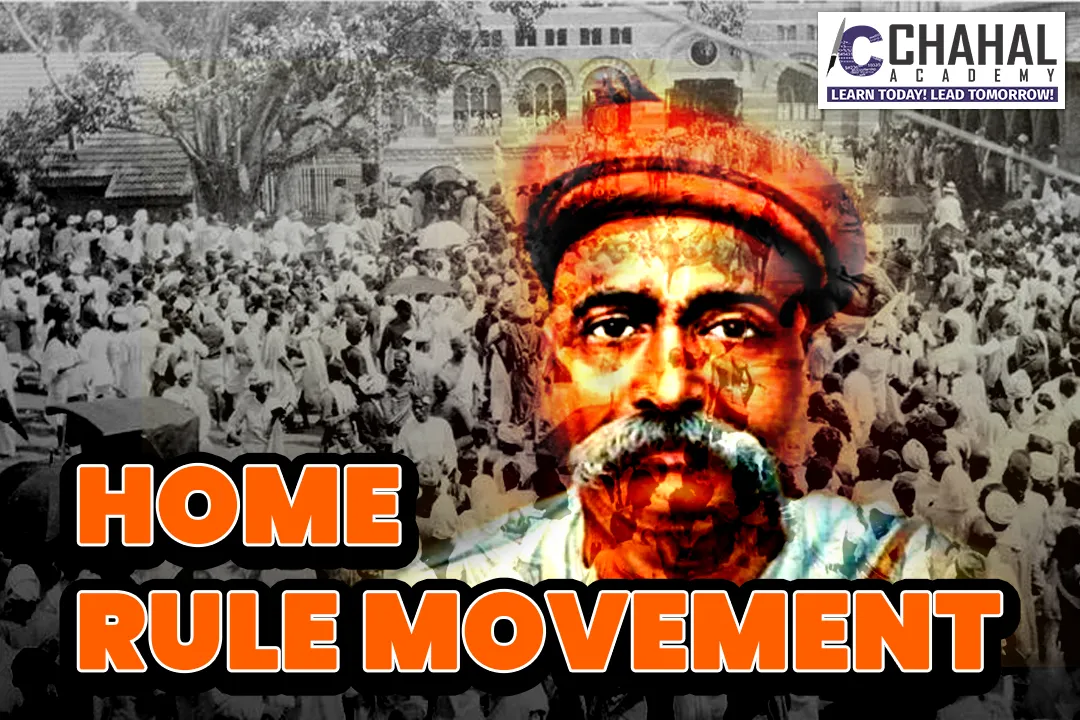
We will start with the factors leading to the Home Rule Movements by Tilak and Annie Besant. Topics like the reunification of the INC, the Lucknow Pact between INC and the Muslim League, and the impact and methods of the Home Rule Movements will be discussed, ending with Montagu’s Statement of August 1917. The Home Rule Movement emerged as India's response to the First World War, offering a more moderate yet effective approach compared to the overseas Ghadar adventure. This movement was inspired by the Irish Home Rule Leagues and signified the rise of a new trend in aggressive politics. Annie Besant and Bal Gangadhar Tilak were the key figures behind this movement, laying the foundation for a more assertive nationalist approach.
FACTORS LEADING TO THE FORMATION OF THE HOME RULE MOVEMENT
A segment of the nationalist leadership believed that mass pressure was essential to extract concessions from the British authorities.
The Moderates had grown disheartened by the limited scope of the Morley-Minto reforms.
The hardships brought on by the war—including heavy taxation and inflation—had left the public frustrated and willing to join any forceful protest movement.
The global conflict between imperialist powers, combined with overt propaganda campaigns, shattered the illusion of white racial superiority.
Upon his release in June 1914, Tilak expressed willingness to lead the movement, adopting a conciliatory tone—he reassured the British of his loyalty and made it clear to the Moderates that he, like the Irish Home Rulers, sought administrative reforms rather than the overthrow of British rule.
Meanwhile, Moderate leaders were being strongly influenced by Annie Besant, who aimed to start a Home Rule movement in India modeled after the Irish example and was urging them to reintegrate the Extremists into the Congress.
TWO LEAGUES
The Extremists failed to be allowed re-entry into the Congress at its session in December 1914, but consistent efforts throughout 1915, including the campaigns launched separately by Annie Besant and Tilak through newspapers and local associations, secured them their re-entry in December 1915. The opposition to the Extremists was also considerably whittled down by the death of Pherozeshah Mehta who had been the most recalcitrant in his opposition. The Congress, still dominated as it was by the Moderates, however, failed to keep its promise of reviving local level Congress Committees and beginning a programme of educative propaganda by September 1916. Therefore, Annie Besant and Tilak launched their own organisations, the Home Rule Leagues, in 1916.
TILAK’S LEAGUE
Tilak’s Home Rule League, launched at the Bombay provincial Conference held at Belgaum in April 1916, was organised into 6 branches, one each in Central Maharashtra, Bombay city, Karnataka and Central Provinces, and two in Berar.
It published 6 pamphlets in Marathi and 2 in English. Pamphlets were also brought out in Kannada and Gujarati.
Apart from these, the most crucial role was played by Tilak’s tours of Maharashtra during the course of which he lectured on and explained the demand for Home Rule. His speeches during this period also show no trace of a religious appeal. Nor did his ideas reflect any narrow regional linguistic chauvinism or caste bias.
He demanded formation of state on linguistic basis.
He wanted all the regional languages and cultures to develop, and argued for education to be imparted in the vernaculars. He frontally opposed untouchability.
He also urged Brahmins to be tolerant of the non-Brahmin demands and not oppose them, and simultaneously urged non- Brahmin not to see their problems of lack of jobs, etc., in terms of Brahmin vs. non- Brahmin, but to understand that it was the greater spread of education among Brahmins that gave them greater access to jobs.
Government reaction
As soon the Tilak’s movement began to gain ground, the
government decided to strike a blow by demanding that he furnish securities of Rs. 60,000 and threatening to bind him for good behaviour for a period of one year. Tilak lost the case in the lower court but the High Court exonerated him in November 1916. The government’s attempt to silence him and its subsequent failure gave a big fillip to the movement, and Tilak pushed home the advantage by declaring that Home Rule now had legal sanction.
ANNIE BESANT’S HOME RULE LEAGUE
Annie Besant established her league in September 1916 in Madras, with branches spread across India, including Bombay city. It had 200 branches and was less formally organized compared to Tilak’s League.
The headquarters at Adyar, led by Annie Besant and her lieutenants such as George Arundale as organising secretary, was supported by key contributors like B.W. Wadia and C.P. Ramaswamy Aiyar, who edited the newspapers New India and Commonweal.
The Home Rule League Programme
The League campaign sought to communicate the idea of home rule as self-government to the common people.
It had a broader appeal than previous mobilisations, attracting regions that were previously considered politically backward, such as Gujarat and Sindh.
The movement promoted political education and discussion through public meetings, libraries, reading rooms with national political literature, conferences, classes for students on politics, and various forms of propaganda including newspapers, pamphlets, posters, plays, and religious songs.
Funds were collected, social work was organized, and participation in local government activities was encouraged.
The Home Rule agitation later gained support from leaders like Motilal Nehru, Jawaharlal Nehru, Bhulabhai Desai, Chittaranjan Das, Madan Mohan Malaviya, Mohammad Ali Jinnah, Tej Bahadur Sapru, and Lala Lajpat Rai, many of whom took leadership roles in local branches.
However, Anglo-Indians, most Muslims, and non-Brahmins from the South did not support the movement, fearing that Home Rule would lead to Hindu majority rule, especially by high-caste Hindus.
Government Attitude
The government imposed severe repression, particularly in Madras, where students were barred from attending political meetings.
In June 1917, Annie Besant, along with her associates B.P. Wadia and George Arundale, were arrested, triggering nationwide protests.
Sir S. Subramaniya Aiyar symbolically renounced his knighthood, while Tilak promoted a programme of passive resistance in response to the repression.
Change in British Attitude
Faced with this growing agitation, the government in Britain decided to adopt a soft line. The signal for the change of policy was the declaration of Montagu. After Montagu’s declaration, the demand for self-government or Home Rule could no longer be treated as seditious, and this was an important achievement. The immediate gain of the new policy was that Annie Besant was released in September 1917. She was, at Tilak’s instance, elected President of the annual session of the Congress in December 1917.
Decline of the Home Rule Leagues
The Home Rule agitation proved to be short-lived. By 1919, it had petered out. The reasons for the decline were as follows.
The Home Rule movement faced a lack of effective organization.
Communal riots during 1917-18 created tensions and challenges for the movement.
Moderates who joined the Congress after Annie Besant’s arrest were pacified with promises of reforms and her eventual release.
The talk of passive resistance by the Extremists distanced the Moderates from active participation from September 1918 onwards.
The Montagu-Chelmsford reforms, announced in July 1918, further deepened the divisions among nationalists.
With Tilak going abroad in September 1918 and Annie Besant vacillating in her approach, the movement was left without strong leadership.
Achievements of Home Rule movement
The Home Rule movement successfully created a politically aware group of nationalist leaders who would lead future mass struggles.
It played a significant role in popularizing the idea of Home Rule and awakening national sentiment.
The movement shifted focus from the educated elite to the broader masses, redirecting the nationalist movement away from the Moderates' vision.
Leaders of the Home Rule Movement paved the way for the next phase, which was deeply influenced by the leadership and philosophy of Mahatma Gandhi.
LUCKNOW SESSION OF THE INDIAN NATIONAL CONGRESS (1916)
At the Lucknow session of the Indian National Congress,
presided over by Ambika Charan Majumdar, the Extremists led by Tilak were readmitted to the Congress fold. Various factors were responsible for this reunion :
Old controversies between Moderates and Extremists had become insignificant, fostering unity.
Both factions recognized that the split had led to political inactivity and weakened the nationalist movement.
Annie Besant and Tilak made significant efforts to reunite the Congress, with Tilak emphasizing his support for administrative reform and denouncing violence.
The deaths of Moderates like Gokhale and Pherozshah Mehta, who had strongly opposed the Extremists, facilitated the reunion.
LUCKNOW PACT
The outbreak of the First World War compelled the British government to seek cooperation of Indian people for the British war efforts and politically conscious Indians found it an opportunity to press for demand for self-government. The overriding concern among various groups of Indian nationalists in the course of the First World War was to make effort of unity in opposition to British rule. In this context the Lucknow Pact is considered as a major move towards solidarity between Hindus and Muslims.
Why the Change in the League’s attitude?
The partition of Bengal in 1911 and Britain’s involvement in the war against the Ottoman Empire in 1914 led many Muslims to feel that they could no longer rely on the British government.
The neutrality of Britain during Italy’s war against Turkey in 1911 and Russia’s massacre of Muslims in Persia increased the fear among Muslims that Islam was under threat and European powers were conspiring to dismantle Turkey.
The Muslim press in India played a significant role in spreading the fear of ‘Islam in danger,’ leading many Muslims to pledge to defend Islam at any cost, fostering cooperation between nationalist Muslims and the Congress.
A group of young lawyers, journalists, and small zamindars formed the ‘Young Party’ in Lucknow, led by Wazir Hasan, who took control of the Muslim League. Leaders like Maulana Azad and Mohammad Ali were suppressed and interned, generating anti-imperialist sentiments within the ‘Young Party.’
The British government’s refusal to establish a university at Aligarh with the authority to affiliate colleges across India also alienated certain Muslim communities.
Despite internal differences, the Congress resolved to move towards rapprochement with the League, agreeing to respect Muslim separate interests and separate electorates for Muslims.
The Nature of the Pact
In 1915, members of both the Congress and the League met in Bombay, supporting the idea of a national government.
Following this, a meeting in Lucknow in 1916 led to the agreement known as the Lucknow Pact, where both organisations jointly agreed on common demands, including self-government and separate electorates for Muslims.
The Lucknow Pact allowed Muslims separate electorates in seven states where they were in a minority and secured half of the elected seats in Punjab and one-third in the central legislature.
The joint demands were
The government should announce the early conferral of self-government on Indians.
Representative assemblies at both the central and provincial levels should be expanded with an elected majority and more powers.
The term of the legislative council should be set at five years.
The salaries of the Secretary of State for India should be funded by the British treasury, not Indian funds.
Half of the members in the viceroy’s and provincial governors’ executive councils should be Indians.
Critique
There were critics from both Muslim and Hindu communities opposing the Congress-League alliance.
Muslim landed classes and their allies, who benefited from British protection, viewed the alliance as a threat to their dominance, fearing the rise of nationalist sentiments among Muslims.
Urdu newspapers, such as Al-Bashir, Aligarh Institute Gazette, and Al-Mizan, initiated a vilification campaign against the alliance. Despite opposition, the Lucknow Pact facilitated cooperation between the Congress and the League, strengthening a united campaign against British rule and encouraging younger Muslims to actively participate in nationalist movements
MONTAGU’S STATEMENT OF AUGUST 1917
On August 20, 1917, Secretary of State for India Edwin Samuel Montagu made the August Declaration in the British House of Commons.
The statement emphasized increasing Indian participation in administration and the gradual development of self-governing institutions toward responsible government within the British Empire.
The nationalist demand for self-government or home rule could no longer be considered seditious, as self-government became an official government policy, contrasting with Morley's 1909 statement that reforms were not intended to provide self-government.
The term ‘responsible government’ implied that rulers would be answerable to elected representatives rather than the imperial government in London.
However, it was clear that the British had no intention of transferring power to legislatures with an Indian majority.
In response to Montagu’s statement, Indian leaders raised two main objections: ➤ There was no specific time frame provided for achieving self-government. ➤ The British government retained the power to decide the pace and nature of advancement toward responsible government, causing resentment among Indians.