Whatsapp 88106-52225 For Details
Get Free IAS Booklet
Get Free IAS Booklet
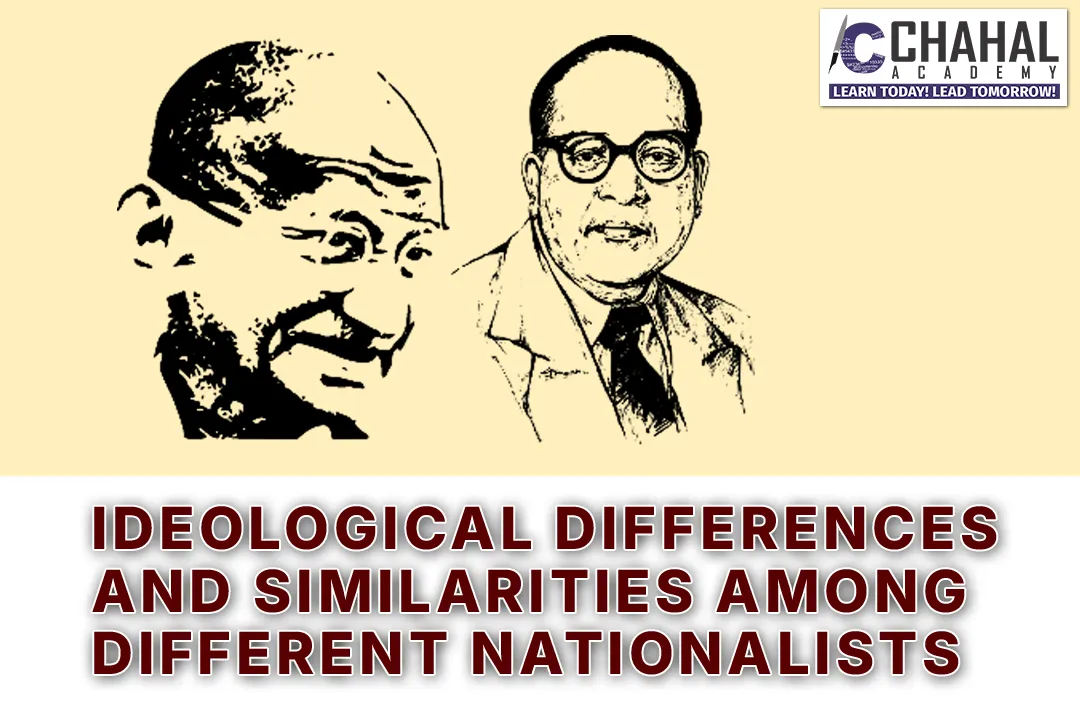
IDEOLOGICAL DIFFERENCES AND SIMILARITIES AMONG DIFFERENT NATIONALISTS
We will explore the ideological and political differences among various Nationalist Leaders of the INC.
IDEOLOGICAL DIFFERENCES BETWEEN RABINDRANATH TAGORE AND MAHATMA GANDHI Perspective on Nationalism
Gandhiji: Gandhiji’s nationalism was deeply rooted in the idea of self-reliance and nonviolence. He believed in the concept of “Sarvodaya,” emphasizing the well-being of all, and advocated for rural economic development. Tagore: Tagore’s concept of nationalism was more cosmopolitan. He was critical of narrow nationalism and believed in a Universalist approach, where cultural exchange and appreciation could lead to global harmony.
Approach to Industrialization
Gandhiji: Gandhiji was sceptical of rapid industrialization, favouring cottage industries and rural development. He believed in the dignity of labour and self-sufficiency at the local level. Tagore: Tagore, while valuing traditional crafts, recognized the importance of modern education and technology. He established the Visva-Bharati University, combining Western and Indian educational philosophies.
Ideas on Education
Gandhiji: Mahatma Gandhi criticized colonial education, asserting that it instilled a sense of inferiority in Indians by promoting the superiority of Western civilization. He believed this education was poisonous, enslaving Indians and eroding pride in their own culture. Advocating for an education that restored dignity and self-respect, Gandhiji urged students to leave institutions to protest British rule. He emphasized the use of Indian languages as the medium of instruction, arguing that English education distanced individuals from their culture. Gandhiji stressed the need for education to go beyond literacy, encouraging practical knowledge and skill development for a holistic understanding of life. He emphasized learning through manual labor and self-sufficiency, promoting “Nai Talim” or basic education. Tagore: Rabindranath Tagore disenchanted by his oppressive school experience, established Santiniketan (Abode of Peace) in 1901. Tagore’s childhood aversion to the constraining school atmosphere fueled his vision for a school where children are happy, free, and creative. He perceived traditional schools as prisons, stifling a child’s natural instincts. Santiniketan, located in a rural setting 100 kilometers from Calcutta, became Tagore’s solution— an educational haven harmonizing with nature. Here, Tagore emphasized an environment where teachers fostered curiosity and embraced imagination, aiming to cultivate children’s innate creativity, in stark contrast to the confining discipline of British-designed schools.
Views on Untouchability
Gandhiji: Gandhiji actively worked towards the upliftment of the untouchables. He referred to them as “Harijans” (Children of God) and undertook campaigns like the Temple Entry Movement to promote social equality. Tagore: Tagore, while expressing concern for social justice, did not engage as directly in social reform movements. His focus was more on cultural and educational initiatives.
Role in the Freedom Struggle
Gandhiji: Gandhiji was a prominent leader in the Indian National Congress and played a central role in various movements, including Non-Cooperation, Civil Disobedience, and the Quit India Movement. Tagore: Tagore, while supportive of the freedom movement, maintained a certain distance from active politics. He expressed his concerns about the excesses and violent tendencies that could arise in the pursuit of political goals.
View on Modern Civilization
Gandhiji: Gandhiji critiqued modern civilization, particularly its materialism and exploitation, it has a ‘Satanic Nature’. He advocated for a simpler and more sustainable way of life. Tagore: Tagore engaged with modernity and appreciated its achievements but cautioned against its dehumanizing aspects. He emphasized the need for a balance between tradition and progress.
Examples
Gandhiji’s Nonviolent Resistance The Salt March (1930) was a nonviolent protest led by Gandhiji against the British monopoly on salt production. This act of civil disobedience aimed to challenge the oppressive salt tax and promote self-sufficiency.
Tagore’s Embrace of Modernity
Tagore’s establishment of Visva-Bharati University in 1921 reflected his commitment to a modern educational institution that combined Indian and Western traditions. The university aimed to foster creativity, critical thinking, and a global outlook.
Gandhiji’s Critique of Industrialization
Gandhiji’s emphasis on Khadi (handspun cloth) as a symbol of self-reliance and resistance to mass-produced British goods illustrated his skepticism towards industrialization.
Tagore’s Universalist Vision
Tagore’s composition of the poem “Where the mind is without fear” reflected his vision of a country free from narrow domestic walls, embracing a Universalist perspective.
Gandhiji’s Concern for the Untouchables
Gandhiji’s efforts during the Harijan Movement included campaigns for temple entry, removal of untouchability, and advocacy for the rights of the Dalits.
Tagore’s Writings on Cultural Harmony
Tagore’s poem “Ekla Chalo Re” conveyed a message of self-reliance and individual strength, emphasizing the importance of standing alone against the crowd.
Points of Similarities between Rabindranath Tagore and Mahatma Gandhi
Championing Social Justice Gandhiji: Gandhiji dedicated himself to social causes, fighting against untouchability, and advocating for the welfare of marginalized communities. Tagore: Although not directly involved in social reform movements, Tagore expressed concerns about societal injustices through his writings, showcasing a shared commitment to social justice.
Promotion of Holistic Education
Gandhiji: Gandhiji believed in the transformative power of education and promoted a holistic approach through his concept of “Nai Talim” (basic education). Tagore: Tagore, through the establishment of Visva-Bharati University, aimed to combine intellectual pursuits with creativity and a connection to nature, advocating for a well-rounded education.
Critique of Materialism
Gandhiji: Gandhiji critiqued the materialistic aspects of Western civilization, advocating for simpler living and emphasizing spiritual and moral values over material wealth. Tagore: Similarly, Tagore expressed reservations about the dehumanizing aspects of modernity and cautioned against excessive materialism. In summary, while both Tagore and Gandhiji were influential figures during the Indian independence movement, their ideologies and methods differed significantly, reflecting diverse perspectives on nationalism, spirituality, and the means of achieving freedom.
MAHATMA GANDHI AND SUBHAS CHANDRA BOSE: A COMPARATIVE ANALYSIS Philosophy of Leadership
Mahatma Gandhi
Gandhiji was a proponent of non-violent civil disobedience and believed in the transformative power of truth (Satyagraha) and non-violence
He emphasized moral and spiritual leadership, urging individuals to lead by example and adhere to principles of non-violence even in the face of adversity. Subhas Chandra Bose
Bose, while initially aligned with Gandhiji, grew frustrated with the slow progress of the independence movement and the non-violent approach.
He believed in a more assertive and militant form of nationalism, advocating for armed resistance to achieve India’s independence.
Approach to Independence
Mahatma Gandhi
Gandhiji’s leadership was pivotal in the Indian National Congress, where he led various campaigns, including Non-Cooperation, Civil Disobedience and Quit India.
His focus was on mass mobilization, non-violent protests, and winning the moral high ground to force the British to leave India. Subhas Chandra Bose
Bose, dissatisfied with the Congress’s methods, formed the Forward Bloc and later the Indian National Army (INA) during World War II.
His approach involved seeking external support, initially from Axis powers and later from Japan, to mount a military campaign against the British.
Ideological Differences
Mahatma Gandhi
Gandhiji was a staunch advocate of non-violence and believed in the inherent goodness of human nature.
He sought to transform society through moral regeneration and self-discipline. Subhas Chandra Bose
Bose, influenced by a more pragmatic and militaristic approach, believed in the necessity of force to overthrow colonial rule.
His ideology was rooted in a strong and centralized leadership, which stood in contrast to Gandhiji’s decentralized and morally driven approach.
Post-Independence Vision
Mahatma Gandhi
Gandhiji envisioned an independent India based on decentralized, village-centric governance and harmonious coexistence among diverse communities.
He was an advocate for social justice, equality, and the upliftment of the marginalized sections of society. Subhas Chandra Bose
Bose’s vision was more focused on a strong and centralized government, reflecting his belief in a disciplined and united nation.
While he shared a commitment to India’s independence, his vision differed significantly from Gandhiji’s decentralized and morally grounded approach. In conclusion, Mahatma Gandhi and Subhas Chandra Bose, both prominent leaders in the Indian independence movement, differed significantly in their philosophy of leadership, approaches to achieving independence, ideological perspectives, and visions for post-independence India. Gandhiji’s commitment to non-violence and moral leadership contrasted with Bose’s advocacy for a more assertive and militaristic path to freedom. These differences continue to shape perceptions of their legacies in India’s history.
IDEOLOGICAL DIFFERENCE AND SIMILARITIES BETWEEN MAHATMA GANDHI AND BR AMBEDKAR Perspective on Caste System
Gandhiji: Gandhiji acknowledged the existence of the caste system but believed in its reform through nonviolent means. He envisioned a society where different castes could coexist harmoniously, emphasizing the idea of ‘Varna Vyavastha’ based on individuals’ professions rather than birth. Ambedkar: Ambedkar, being born in a Dalit family, had a more radical stance. He saw the caste system as inherently discriminatory and advocated for its annihilation. Ambedkar believed in the need for separate electorates for Dalits to ensure their political representation.
Approach to Untouchability
Gandhiji: Gandhiji acknowledged the existence of untouchability and worked towards its removal. He called the untouchables ‘Harijans’ (Children of God) and undertook campaigns like the Temple Entry Movement to allow them access to religious places. Ambedkar: Ambedkar, while appreciating some of Gandhiji’s efforts, deemed them insufficient. He argued for more concrete measures, including reserved seats in educational institutions and jobs, to uplift the socio-economic condition of the Dalits.
Religious Outlook
Gandhiji: Gandhiji was deeply spiritual and believed in the essence of all religions. His philosophy of ‘Sarvodaya’ aimed at the welfare of all, embracing the principles of truth and nonviolence from Hinduism. Ambedkar: Ambedkar, though born a Hindu, later converted to Buddhism. He saw Buddhism as a path to liberation for the oppressed, rejecting certain aspects of Hinduism, especially its caste-based discrimination.
Economic Philosophy
Gandhiji: Gandhiji advocated for decentralized, village-based economies. He believed in the concept of ‘Sarvodaya,’ where everyone’s well-being is considered, and stressed the importance of self-sufficiency at the grassroots level. Ambedkar: Ambedkar, while acknowledging economic issues, placed more emphasis on political rights and social equality. He called for industrialization and urbanization to break the shackles of traditional occupations that oppressed the Dalits.
Perspective towards Freedom Struggle
Gandhiji: Gandhiji’s approach to the freedom struggle was rooted in nonviolence (Ahimsa) and civil disobedience. The Salt March and the Quit India Movement are notable examples where he mobilized people through nonviolent means to protest against British rule. Ambedkar: Ambedkar’s focus during the freedom struggle was on securing political rights and representation for the marginalized sections. He played a crucial role in the framing of the Indian Constitution.
Examples Justifying their Viewpoints
Differing Approaches to Untouchability Gandhiji: Undertook fasts and protests against untouchability, promoting reforms within the Hindu social structure. Ambedkar: Actively worked towards legal reforms and advocated for political safeguards, believing that mere social reform was insufficient.
Role in the Round Table Conferences
Gandhiji: Participated in the Round Table Conferences, emphasizing the need for Hindu-Muslim unity and an inclusive political structure. Ambedkar: Raised concerns about the political representation of the depressed classes and their socio-economic conditions, demanding reserved seats.
Poona Pact (1932)
Gandhiji: Negotiated the Poona Pact with Ambedkar, compromising on separate electorates for Dalits to maintain Hindu unity. Ambedkar: Agreed to reserved seats for Dalits within joint electorates, ensuring political representation for his community.
Participation in the Constituent Assembly
Gandhiji: Though not a formal member, Mahatma Gandhi’s influence on the Constituent Assembly of India was pivotal. His philosophy of non-violence permeated the Constitution, evident in the preamble’s commitment to justice, liberty, equality, and fraternity. The assembly, inspired by Gandhiji’s fight against untouchability, included provisions for its eradication. Moreover, the Gandhian principle of decentralized governance was reflected in the constitutional support for Panchayati Raj. Though absent in person, Gandhiji’s ideas echoed through the constitutional framework, shaping the foundational values of India’s democratic and inclusive system. Ambedkar: B.R. Ambedkar’s pivotal role in framing India’s Constitution is evident in the eradication of untouchability (Article 17) and affirmative action for marginalized communities. His influence permeates fundamental rights, ensuring constitutional guarantees of equality and freedom. Ambedkar’s commitment to gender equality is reflected in Article 15. His labour rights provisions emphasize humane conditions and union rights. As a key architect of federalism, he balanced central and state powers. Additionally, Ambedkar safeguarded an independent judiciary, contributing significantly to India’s democratic and inclusive constitutional fabric.
Similarities
Commitment to Social Justice: Both Gandhiji and Ambedkar were deeply committed to social justice, albeit with different approaches. Gandhiji aimed at reforming society through non-violence and moral transformation, while Ambedkar sought legal and political measures for the rights of marginalized communities. Participation in the Freedom Struggle: Despite their ideological differences, both leaders actively participated in the Indian freedom struggle. While Gandhiji led non-violent movements, Ambedkar contributed to the struggle by advocating for political and social rights for Dalits. In summary, Mahatma Gandhi and B.R. Ambedkar, though differing in their ideologies and approaches, shared a commitment to social justice and played crucial roles in the broader context of the Indian freedom struggle. Their contributions, shaped by their unique perspectives, enriched the discourse and paved the way for a more inclusive and equitable post-independence India.
IDEOLOGICAL DIFFERENCES DADABHAI NAOROJI AND BAL GANGADHAR TILAK
AspectDadabhai Naoroji Advocated Drain Theory, Economic Theories economic exploitation. Called for Indian representation Political representation Parliament. Approach to colonial ruleModerate approach, favored petition) Bal Gangadhar Tilak Focused on economic self-sufficiency, exposing British promoting Swadeshi. in the British Emphasized the need for self-rule (Swaraj) and direct action.. PPP(Press, Prey, More assertive and militant, advocated passive resistance. Methods with British authorities. Founding member and President of INC Role in the INC (1886, 1893). Bridged gaps Prominent leader in the INC, associated with the extremist faction. Advocated for Swadeshi movement and between moderate and radical Contributions factions in the INC. LegacyKnown as the passive resistance. Hailed as a key figure in the extremist wing “Grand Old Man of India.”
Naoroji’s Drain Theory
of the INC.
“Poverty and Un-British Rule in India” (1901), Example: Naoroji’s Drain Theory, presented in his book how the British systematically drained India’s wealth. meticulously detailed
Tilak’s Swadeshi Movement
Tilak’s launch of the Swadeshi Movement in 1905 encouraged the use of indigenous products and the boycott of British goods, aiming at economic self-reliance.
Naoroji’s Election to British Parliament
In 1892, Naoroji’s election to the British Parliament symbolized his belief in Peaceful political representation. His presence aimed to influence policies favourably for India.
Tilak’s Role in the Extremist Faction
Example: Tilak’s active role in the extremist faction of the Congress was evident during the Swadeshi Movement and his call for Swaraj, advocating a more assertive stance against British rule.
Naoroji’s Social Activism
Example: Naoroji’s involvement in founding the East India Association in 1864 showcased his commitment to social and economic issues, striving for Indian welfare.
Tilak’s Celebration of Ganesh Chaturthi
Example: Tilak’s promotion of Ganesh Chaturthi as a public festival aimed at fostering cultural pride and nationalism, aligning with his broader political agenda.
Approaches towards Freedom Struggle
Dadabhai Naoroji- Advocated a moderate approach, emphasizing dialogue with the British authorities. Examples: Founding member and President of the INC, where he used his presidency to articulate Indian grievances and present them to British authorities. Bridged gaps between moderate and radical factions within the INC. Bal Gangadhar Tilak- Adopted a more assertive and militant approach, calling for passive resistance and non-cooperation against British rule. Examples: Advocated economic self-sufficiency through the Swadeshi movement, emphasizing the need for self-rule (Swaraj). Played a prominent role in the extremist faction of the INC, pushing for complete independence. As we draw the curtains on the historical stage where these two luminaries played their roles, their ideological divergence becomes a testament to the multiplicity of paths woven into the fabric of India’s quest for sovereignty. The symphony of their ideas, though distinctive, contributed harmoniously to the larger orchestration of the independence movement, reminding us that the struggle for freedom is a symphony composed by many, each note adding its unique resonance to the overarching melody of India’s liberation. In the grand finale of history, Naoroji and Tilak stand as timeless chords, echoing the spirit of resilience and diversity that defines the march towards a free and united India.
IDEOLOGICAL ANALYSIS BETWEEN SARDAR PATEL AND JAWAHARLAL NEHRU
Aspect Jawaharlal Nehru Sardar Vallabhbhai Patel Known for decisive and Leadership Styleleadership, often called India.” Role in Independence Played a key role in states pragmatic charismatic leader A emphasized democratic the “Iron Man of ideals and intellectual vision. uniting princely A prominent figure in the Indian National Congress, advocated for Purna Swaraj and , contributing to the integration of Movement India. non-violent resistance. Played a key role in the integration of building a strong, united Focused on Approach to Nation BuildingIndia, emphasizing efficiency. Advocated for planned Economic Policiesdevelopment, particularly agricultural sector. princely states through the “Instrument of administrative Accession ,” uniting them under the Indian Union. economic Implemented the mixed economy model, in the combining private and public sectors for economic growth. and Pioneered the Non-Aligned Movement, non-alignment Emphasized Foreign Policydiplomatic pragmatism, relations with all nations. promoting global peace and neutrality seeking friendly during the Cold War. Served as the Chairman of the Advisory Role in Constitution MakingCommittee on The first Prime Minister of India, played a Rights, Fundamental significant role in the framing of the Indian Minorities, and Tribal and Excluded Constitution.E.g., Objective Resolution. Areas.E.g., Integration of States. Remembered as the first Prime Minister, Revered for his role in the integration of Legacy Architect instrumental in shaping India’s democratic princely states, often called the “ of Modern India.” and socialist framework.
INDIVIDUAL PERSPECTIVES TOWARDS FREEDOM STRUGGLE Sardar Vallabhbhai Patel
Sardar Patel’s creative brilliance during the freedom struggle transformed India. As the key architect of national integration, he orchestrated the unification of over 500 princely states into the Indian Union, a feat exemplified in the successful accession of Junagadh, Hyderabad and Jammu and Kashmir.
Patel’s resolute leadership during the Bardoli Satyagraha and his pivotal role in the Quit India Movement showcased his commitment to the cause. His creative vision lies in the seamless amalgamation of diverse regions into a singular, sovereign nation, an enduring legacy etched in the foundations of independent India.
Jawaharlal Nehru:
Jawaharlal Nehru envisioned an independent India rooted in democracy, socialism, and secularism. He championed civil liberties, economic planning and modernization. As a leader in the independence movement, he actively participated in non-violent resistance.
Nehru’s global outlook led to a non-aligned foreign policy. His commitment to education, youth involvement, and the integration of princely states reflected his vision for a united and progressive India.
Similarities
Commitment to Independence: Both Patel and Nehru were committed leaders in the Indian National Congress, working towards the goal of Indian independence. While Patel focused on integration and unity, Nehru emphasized democratic ideals and non-violent resistance.
Role in Constitution Making: Both leaders played crucial roles in the making of the Indian Constitution. Patel served as the Chairman of the Advisory Committee on Fundamental Rights, Minorities and Tribal and Excluded Areas, while Nehru was the first Prime Minister and contributed significantly to the constitutional framework. In summary, Sardar Vallabhbhai Patel and Jawaharlal Nehru, though differing in leadership styles and approaches, were instrumental figures in India’s freedom struggle and the subsequent nation-building process. Patel’s pragmatic approach to integration complemented Nehru’s emphasis on democratic ideals, and their collective contributions laid the foundation for the modern Indian state.