Whatsapp 88106-52225 For Details
Get Free IAS Booklet
Get Free IAS Booklet
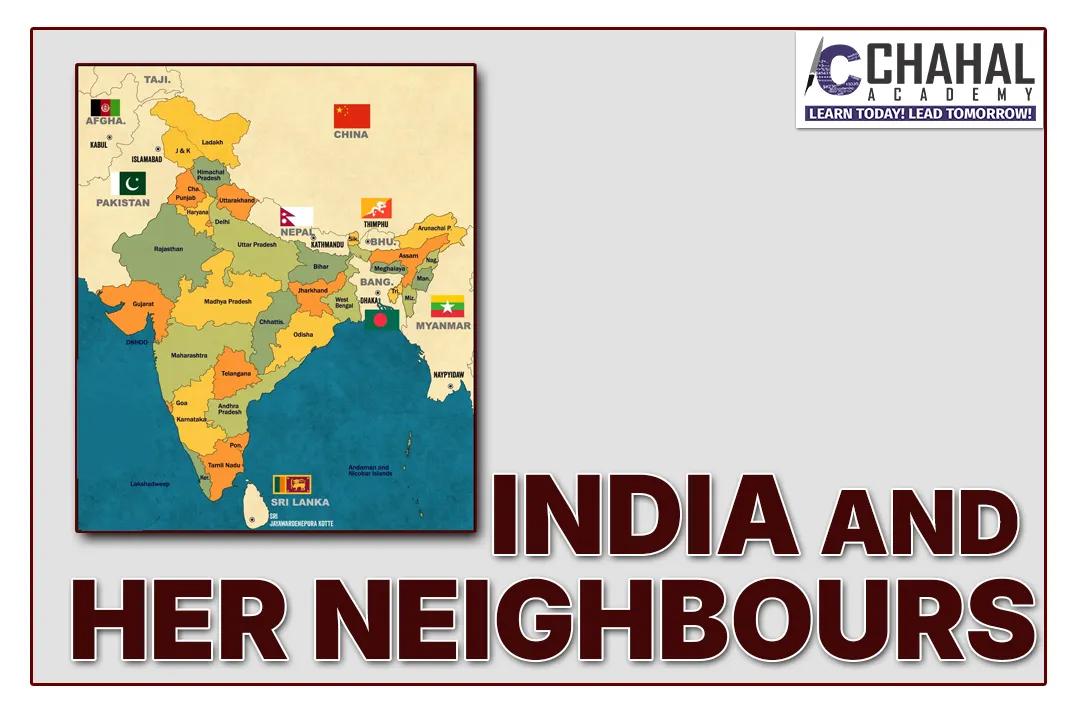
INDIA AND HER NEIGHBOURS
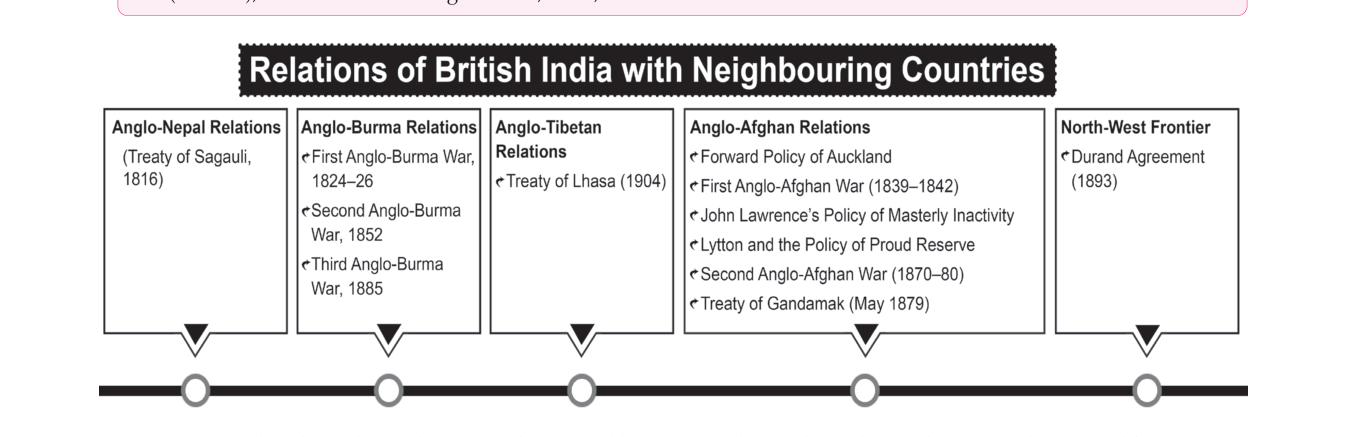
We will examine significant events such as the War with Nepal (1814), Burma's conquest, including the First (1824-26), Second (1852) and Third (1885) Burmese Wars. We will also focus on diplomatic engagements, including the First Afghan War (1839-42), interactions with Afghanistan, Tibet, Sikkim and Bhutan.
During British rule, India's relations with its neighbors were redefined due to two key factors: the advancement of modern communication systems and the political-administrative unification of the country, which prompted the government to extend its influence to India's natural geographical boundaries.
A key factor shaping India's foreign relations under British rule was the foreign nature of its governance, with policies dictated by the British Government in London.
Britain's primary goals in Asia and Africa were to safeguard its Indian Empire and expand its commercial and economic interests in these regions.
These objectives led to British territorial conquests beyond India’s natural borders, often bringing Britain into conflict with other European imperialist powers competing for colonies and markets in Africa and Asia between 1870 and 1914.
To protect their empire and economic interests, the British frequently engaged in aggression against India’s neighbors, shaping India’s foreign relations according to imperialist needs.
This pursuit of British goals led to wars involving India, with Indian soldiers fighting and Indian taxpayers bearing the financial burden, as exemplified in 1904 when 52% of India’s revenue was allocated to the military.
Ultimately, India’s relations with its neighbors during British rule were dictated by the priorities of British imperialism, often at great cost to the Indian people.
WAR WITH NEPAL, 1814
The Gurkhas, a Western Himalayan tribe, conquered the Nepal Valley in 1768, building a strong army and expanding their control from Bhutan to the Sutlej River.
The British conquest of Gorakhpur in 1801 brought the two expanding powers face-to-face along an undefined border.
A border clash in October 1814 escalated into war, with the Gurkhas fiercely resisting British forces and initially achieving repeated victories.
Despite early defeats, the British occupied Kumaon in April 1815 and forced the surrender of Gurkha commander Amar Singh Thapa on May 15
British forces advanced within 50 miles of Kathmandu, compelling the Nepal Government to make peace, accept a British Resident, cede Garhwal and Kumaon, abandon Terai claims, and withdraw from Sikkim.
The agreement favored the British, extending their empire to the Himalayas, enhancing trade opportunities with Central Asia, and providing locations for key hill stations like Shimla, Mussoorie and Nainital.
Friendly relations developed between the British and Nepal, with the Gurkhas significantly strengthening the British-Indian army by enlisting in large numbers.
CONQUEST OF BURMA
The independent kingdom of Burma was conquered by the British during the 19th century through three successive wars, sparked by border clashes and fueled by expansionist ambitions.
British merchants sought to exploit Burma’s forest resources and promote the export of British goods to its population.
The British also aimed to counter French commercial and political influence in Burma and South-East Asia.
These combined factors drove the British conquest and eventual control over Burma.
The First Burmese War, 1824-26:
By the late 18th century, Burma and British India shared a common frontier as both expanded, with Burma achieving unification under King Alaungpaya (1752–60) and extending its borders under his successor, Bodawpaya.
Bodawpaya repelled Chinese invasions, invaded Siam, and conquered border regions like Arakan (1785) and Manipur (1813), bringing Burma’s frontier to British India’s border.
The Burmese continued their westward expansion, conquering Assam in 1822, which, along with their control of Arakan, caused persistent friction along the ill-defined Bengal-Burma border.
Tensions escalated due to Arakanese fugitives in Chittagong organizing raids into Burmese-occupied Arakan and retreating into British territory when defeated.
The Burmese government urged the British authorities to take action against the insurgents and hand them over to the Burmese officials.
Additionally, Burmese forces pursuing the insurgents frequently crossed into Indian territory. Tensions along the Chittagong-Arakan border escalated over the control of Shahpuri Island in 1823, which was initially occupied by the Burmese and later by the British.
The British rejected the Burmese suggestion to neutralize the island, causing growing friction between the two powers.
The Burmese occupation of Manipur and Assam added another point of contention, as the British viewed it as a significant threat to their interests in India.
To counter this, the British extended their influence over the key border states of Cachar and Jaintia. Angered by this, the Burmese sent troops into Cachar, leading to a confrontation with British forces, after which the Burmese retreated back to Manipur.
Seizing the moment, the British Indian authorities declared war on Burma. For many years, they had been attempting to convince the Burmese government to sign a commercial treaty and exclude French traders from Burma.
The British were also displeased with having a powerful neighbor who openly boasted about its strength. They believed that Burmese power needed to be crushed quickly, especially since they considered their own military superiority overwhelming at that time.
Meanwhile, the Burmese made no effort to avoid conflict. Having been isolated from the world, they underestimated the British strength and were misled into thinking that an Anglo-Burmese war would incite uprisings among Indian rulers.
War was officially declared on 24 February 1824. Despite early setbacks, British forces pushed the Burmese out of Assam, Cachar, Manipur and Arakan.
The British naval forces captured Rangoon in May 1824 and advanced to within 45 miles of the Burmese capital, Ava. During this time, the renowned Burmese General Maha Bandula was killed in April 1825.
Nonetheless, Burmese resistance remained fierce, especially through effective guerrilla tactics in the jungles.
The war was also financially draining. Consequently, both the victorious British and the defeated Burmese were eager to negotiate peace, which was finalized in February 1826 with the Treaty of Yandabo.
Under the treaty, the Burmese government agreed to pay one crore rupees as war compensation; cede its coastal regions of Arakan and Tenasserim; relinquish claims to Assam, Cachar, and Jaintia; recognize Manipur as an independent state; negotiate a commercial treaty with Britain; and accept a British Resident in Ava while sending a Burmese envoy to Calcutta.
This treaty significantly reduced Burma’s coastline and gave the British a strong foothold in Burma, paving the way for future expansion.
The Second Burmese War, 1852:
The Second Burmese War of 1852, unlike the First War caused partly by border clashes, was primarily driven by British commercial greed and their desire to exploit Burma's timber resources and large population as a market for British goods.
The British, already occupying Burma's coastal provinces, sought to expand trade relations into the interior, but the Burmese Government resisted foreign commercial penetration.
British merchants in Rangoon began complaining of trade restrictions and "oppressive treatment" by Burmese authorities, escalating tensions.
At the height of British imperialism, British merchants believed in their "divine right" to impose trade, reflecting the imperial arrogance of the era.
Lord Dalhousie, the aggressive Governor-General of India, aimed to enhance British imperial prestige and push British interests in Burma.
In November 1851, Dalhousie sent an envoy, Commodore Lambert, with warships to Rangoon to demand compensation for grievances against two British merchants, adopting a hostile approach.
Lambert demanded the removal of Rangoon's Governor before negotiations, intimidating the Court at Ava, which agreed to investigate the complaints and recall the Governor.
The Burmese Government further conceded to British demands, agreeing to accept a British Resident in Rangoon and pay full compensation.
Despite these concessions, the British escalated their demands to unreasonable levels, including recalling the new Governor of Rangoon and issuing a formal apology for perceived insults.
These excessive demands were unacceptable to an independent government, setting the stage for further conflict between Burma and the British.
The Second Burmese War of 1852 was driven by British commercial greed, focused on exploiting Burma’s timber resources and market for British goods.
The British, having already occupied Burma’s coastal provinces, sought to expand trade into the interior, but faced resistance from the Burmese Government.
British merchants in Rangoon complained about trade restrictions and oppressive treatment by Burmese authorities, escalating tensions.
Lord Dalhousie, the aggressive Governor-General of India, pushed for British imperial interests in Burma, sending an envoy, Commodore Lambert to demand excessive concessions.
Despite initial Burmese concessions, British demands continued to escalate, leading to conflict between Burma and the British.
The Third Burmese War, 1885
Relations between Burma and Britain remained calm for several years following the annexation of Pegu.
The British, however, continued their attempts to gain access to Upper Burma. British merchants and industrialists were particularly interested in the potential trade routes to China through Burma.
There was strong demand both in Britain and Rangoon to open a land route to Western China.
Eventually, in 1862, Burma was persuaded to sign a commercial treaty allowing British merchants to settle anywhere in Burma and navigate their vessels up the Irrawaddy River to reach China.
Despite this, British merchants were not fully satisfied because the Burmese king maintained royal monopolies on several key goods such as cotton, wheat and ivory.
Frustrated by these trade restrictions and limits on their profits, the merchants pushed for more decisive action against the Burmese government. Many even called for the British to conquer Upper Burma. As a result, the king agreed to abolish all trade monopolies in February 1882.
Numerous other political and economic issues continued to cause disagreements between the Burmese king and the British government.
In 1871, the British Government humiliated the Burmese king by announcing that relations with him would be conducted through the Viceroy of India, treating him as a ruler of an Indian state.
Another source of friction was King Thibaw’s efforts to develop friendly relations with other European powers, particularly France.
King Mindon died in 1878, and King Thibaw succeeded him. The British offered shelter to rival princes and interfered in Burma’s internal affairs under the guise of protecting citizens from alleged cruelties of King Thibaw.
Thibaw’s desire to continue his father’s policy of fostering commercial and political relations with France further annoyed the British.
In 1885, Thibaw signed a purely commercial treaty with France, which deepened British concern about growing French influence in Burma.
British officials feared that an alliance with France might lead to the creation of a French dominion in Burma, thereby endangering the safety of their Indian Empire.
Chambers of commerce in Britain and British merchants in Rangoon pressured the British Government for the immediate annexation of Upper Burma.
The British had already prepared a military plan for the invasion of Upper Burma and used this opportunity to demand full control over Burma’s foreign relations through the Viceroy of India.
The Burmese Government could not accept such demands without losing its independence, leading to the British invasion on 13 November 1885.
King Thibaw surrendered on 28 November 1885, and his dominions were annexed to the Indian Empire soon after.
Burmese patriotic soldiers and officers refused to surrender, vanishing into the jungles to conduct widespread guerrilla warfare.
The people of Lower Burma rose in rebellion, requiring the British to employ a 40,000-strong army for nearly five years to suppress the popular revolt.
Burmese nationalists soon joined forces with the Indian National Congress in their struggle for freedom.
In 1935, the British separated Burma from India in an attempt to weaken the Burmese independence movement, but the nationalists opposed this decision.
The Burmese nationalist movement gained momentum under U Aung San during World War II.
Finally, Burma achieved independence on 4 January 1948.
RELATIONS WITH AFGHANISTAN
Britain was an expanding imperial power in West, South, and East Asia, while Russia sought to extend its control in Central Asia and across Asia, leading to clashes between the two powers.
The British were especially concerned about the security of their dominion in India, fearing a Russian attack through Afghanistan and the North Western frontier. They sought to maintain a safe distance between Russia and India’s borders.
Anglo-Russian rivalry extended into Central Asian trade. If Russia gained full control of Central Asia, British participation in future Central Asian commerce would be obstructed.
Afghanistan played a strategic role in British policy. It served as a buffer zone to counter Russia’s military threats and was seen as crucial for promoting British commercial interests in Central Asia.
The British policy towards Afghanistan became more active in 1835 when Dost Muhammed ruled the country.
Dost Muhammed maintained a fragile stability in Afghanistan but faced constant threats from both internal and external forces. He had high regard for English strength and sought an alliance with the Government of India. Despite this, he refused Russian overtures and adopted a more favorable stance towards the British envoy, Captain Bums.
However, the British offered only verbal support and sympathy, unwilling to strengthen Afghanistan beyond a weak, divided state that could be easily controlled while ensuring the end of Russian influence.
Forward Policy of Auckland
Auckland, who became Governor-General of India in 1836, supported a forward policy. This policy meant that the Company’s government in India needed to proactively safeguard British India’s borders against a potential Russian threat.
To achieve this, the British aimed either to secure treaties with neighboring states or to annex them outright.
The Amir of Afghanistan, Dost Mohammed, sought friendship with the British but made it contingent upon their assistance in reclaiming Peshawar from the Sikhs—a demand that the British authorities in India declined. ➤ Shah Shuja would be enthroned with the Sikhs providing military help, with the British remaining in the background to manage finances. ➤ Shah Shuja would conduct foreign affairs with advice from the Sikhs and the British. ➤ Shah Shuja would surrender his sovereign rights over the Amirs of Sindh in exchange for a substantial sum of money. ➤ Shah Shuja would recognize Maharaja Ranjit Singh’s claims over Afghan territories on the right bank of the River Indus.
The First Afghan War (1839–42):
After the Tripartite Treaty of 1838, the political situation drastically changed with Persia lifting its siege of Herat and Russia recalling its envoy from Kabul.
The allies launched an attack on Afghanistan in February 1839. However, Ranjit Singh did not participate beyond Peshawar, leaving the British forces to lead and fight most of the campaign.
Kabul fell to the British on 7 August 1839, and Shah Shuja was placed on the throne. Despite initial victories, the Afghan people resented British interference, and patriotic Afghans began resisting British occupation.
On 11 December 1841, the British signed a treaty with Afghan chiefs agreeing to evacuate Afghanistan and restore Dost Muhammed.
As the British forces withdrew, they were attacked continuously, leading to a complete failure of the Afghan expedition and one of the greatest disasters for British arms in India.
A new expedition was organized, and Kabul was reoccupied on 16 September 1842. After avenging their defeat, the British settled with Dost Muhammed, recognizing him as the independent ruler of Afghanistan while evacuating Kabul once again.
Policy of Non-Interference or the Policy of Masterly Inactivity
In 1855, Anglo-Afghan friendship was renewed with the signing of a treaty of friendship between Dost Muhammed and the Government of India.
The treaty established a commitment to peaceful relations, mutual respect for territories, and non-interference in internal affairs.
Lord Lawrence and his successors vigorously pursued a policy of non-interference in Afghan affairs after 1864, maintaining Afghanistan as a strong buffer state.
The British provided occasional aid to the Amir of Kabul to help him manage internal rivalries and prevent alignment with Russia.
Lytton and the Policy of Proud Reserve
Lytton, appointed by the Conservative government under Benjamin Disraeli (1874-80), became the Viceroy of India in 1876.
He adopted a new foreign policy of ‘proud reserve’, focusing on establishing clear frontiers and safeguarding British influence, particularly in Afghanistan.
The Second Afghan War (1870–80):
The policy of non-interference did not last very long. From 1870 onwards, there was a resurgence of imperialism all over the world. The Anglo-Russian rivalry intensified.
The British Government was keen on commercial and financial penetration of Central Asia.
Anglo-Russian ambitions clashed even more openly in the Balkans and West Asia.
British statesmen once again thought of bringing Afghanistan under direct political control to serve as a base for British expansion in Central Asia.
Moreover, British officials and public opinion were haunted by the fear of a Russian invasion of India, the ‘brightest jewel’ in the British Empire.
The Indian Government was directed by London to make Afghanistan a subsidiary state whose foreign and defence policies would be definitely under British control.
Sher Ali, the Afghan ruler or Amir, was fully aware of the Russian threat to his independence. He was willing to cooperate with the British in eliminating any such threats.
He offered a defensive and offensive alliance against Russia and sought extensive military aid in times of need against internal or external threats.
The Indian Government refused to enter into a reciprocal and unconditional commitment. Instead, it demanded unilateral rights to maintain a British mission in Kabul and control over Afghanistan’s foreign relations.
Mission at Kabul: Ensure oversight of diplomatic relations.
Influence on Decision-Making: Strong influence in Afghanistan’s foreign policy.
Exclusion of Other Powers: Control would exclude other foreign influences.
When Sher Ali refused, he was branded anti-British and pro-Russian.
To force British terms, a new attack on Afghanistan was launched in 1878.
Peace came in May 1879 when Sher Ali’s son, Yakub Khan, signed the Treaty of Gandamak, securing British demands: ➤ The Amir would conduct foreign policy with British advice. ➤ A permanent British resident would be stationed at Kabul. ➤ The Government of India would provide support against foreign aggression, with an annual subsidy.
However, the British success was short-lived.
The national pride of the Afghans was hurt, and they rose again to defend their independence.
On 3 September 1879, the British Resident, Major Cavagnari, and his military escort were attacked and killed by rebellious Afghan troops.
Afghanistan was again invaded and occupied. However, the Afghans made their point.
A change of government took place in Britain in 1880, and Lytton was replaced by a new Viceroy, Lord Ripon, who reversed the aggressive policy and moved back to non-interference in Afghanistan’s internal affairs. Abdur Rahman was recognized as the new ruler of Afghanistan.
The Third Anglo-Afghan War (1919):
The First World War and the Russian Revolution of 1917 significantly influenced Anglo-Afghan relations, fueling anti-British sentiment in Muslim countries and inspiring anti-imperialist feelings worldwide, including Afghanistan.
The collapse of Imperial Russia removed the fear of northern aggression, which had previously compelled Afghan rulers to seek British support.
With a renewed sense of autonomy, Afghans demanded full independence from British control.
After the assassination of Amir Habibullah in February 1919, his son Amanullah declared war on British India. Peace was achieved in 1921 through a treaty that granted Afghanistan full independence in foreign affairs.
RELATIONS WITH TIBET
Tibet lies to the north of India, separated by the Himalayan peaks, and was ruled by a theocracy of Buddhist monks (lamas) under nominal Chinese suzerainty.
The Chinese Government discouraged contact with India, though limited trade and pilgrim traffic existed between the two regions.
During the 19th century, the Chinese Empire under the Manchu monarchy experienced a decline, allowing foreign powers like Britain, France, Russia, Germany, Japan, and the USA to establish commercial and indirect political control over China.
This weakened China’s ability to assert even nominal control over Tibet from the mid-19th century, though Tibet continued to acknowledge Chinese overlordship in theory to deter foreign penetration.
Both Britain and Russia sought to establish relations with Tibet, driven by economic and political considerations.
Economically, the British aimed to develop Indo-Tibetan trade and exploit its mineral wealth. Politically, they wanted to secure India’s northern frontier.
Russian ambitions in Tibet prompted the Government of India, under Lord Curzon, to counter these moves and integrate Tibet into its system of protected border states.
In March 1904, Curzon dispatched a military expedition to Lhasa, led by Francis Younghusband. The unarmed Tibetans, despite lacking modern weapons, resisted bravely but were unsuccessful.
By August 1904, the expedition reached Lhasa without encountering any Russians. A treaty was signed after prolonged negotiations.
Treaty of Lhasa (1904)- Terms: ➤ Tibet was to pay Rs. 25 lakhs as indemnity. ➤ The Chumbi valley would be occupied by the British for three years. ➤ A British trade mission would be stationed at Gyantse. ➤ The British agreed not to interfere in Tibet’s internal affairs.
Tibet would refrain from granting concessions for railways, roads, telegraph, etc., to any foreign state and grant Britain some control over its foreign affairs.
The British achieved limited success through the Tibetan expedition, as it secured Russia’s withdrawal from Tibet but confirmed Chinese suzerainty.
The Anglo-Russian Convention of 1907 further impacted Tibet. Both nations agreed not to seek territorial concessions in Tibet or send diplomatic representatives to Lhasa.
Britain and Russia reaffirmed China’s suzerainty over Tibet to avoid conflict, underestimating the possibility of a strong and independent government emerging in China in the future.
RELATIONS WITH SIKKIM
The state of Sikkim lies to the north of West Bengal, adjacent to Nepal, and serves as a border region between Tibet and India.
In 1835, the Raja of Sikkim ceded the territory around Darjeeling to the British in exchange for an annual monetary grant.
Relations soured in 1849 due to a minor quarrel, leading Dalhousie to send troops into Sikkim. This resulted in the ruler ceding nearly 1,700 square miles of territory to British India.
A conflict in 1860 between British forces and the Diwan of Sikkim’s troops culminated in a peace treaty in 1861, reducing Sikkim to the status of a virtual British protectorate.
Following the treaty, the Raja of Sikkim expelled the Diwan, paid a fine of Rs. 7,000, compensated British war losses, opened his country to British trade, and capped transit duties on goods exchanged between India and Tibet through Sikkim.
In 1886, tensions arose when Tibetans, with the support of pro-Tibetan Sikkimese rulers, attempted to bring Sikkim under their control. To protect its northern frontier and Darjeeling's tea gardens, the Government of India conducted military operations against the Tibetans in 1888.
A final settlement was reached in 1890 with the signing of the Anglo-Chinese agreement, which recognized Sikkim as a British protectorate, granting the Government of India exclusive control over its internal administration and foreign relations.
RELATIONS WITH BHUTAN
Bhutan is a large hilly country situated to the east of Sikkim and at India’s northern border.
Warren Hastings established friendly relations with the ruler of Bhutan in 1774, after Bhutan allowed Bengal to trade with Tibet through its territory.
Relations between the Government of India and Bhutan deteriorated after 1815, as the British began eyeing a narrow strip of territory at the base of Bhutan hills, covering around 1,000 square miles and containing important duars or passes.
The British occupation of Assam in 1816 brought them into closer contact with Bhutan.
Frequent Bhutanese raids into neighboring territories in Assam and Bengal, coupled with the mistreatment of Elgin’s envoy in 1863-64 and the treaty that forced the British to surrender the passes to Assam, prompted British annexation of these passes and cessation of payments to Bhutan.
In 1865, Bhutan was compelled to cede these passes to the British in exchange for an annual subsidy. The surrendered district later became a productive area, especially with the establishment of tea gardens..