Whatsapp 88106-52225 For Details
Get Free IAS Booklet
Get Free IAS Booklet
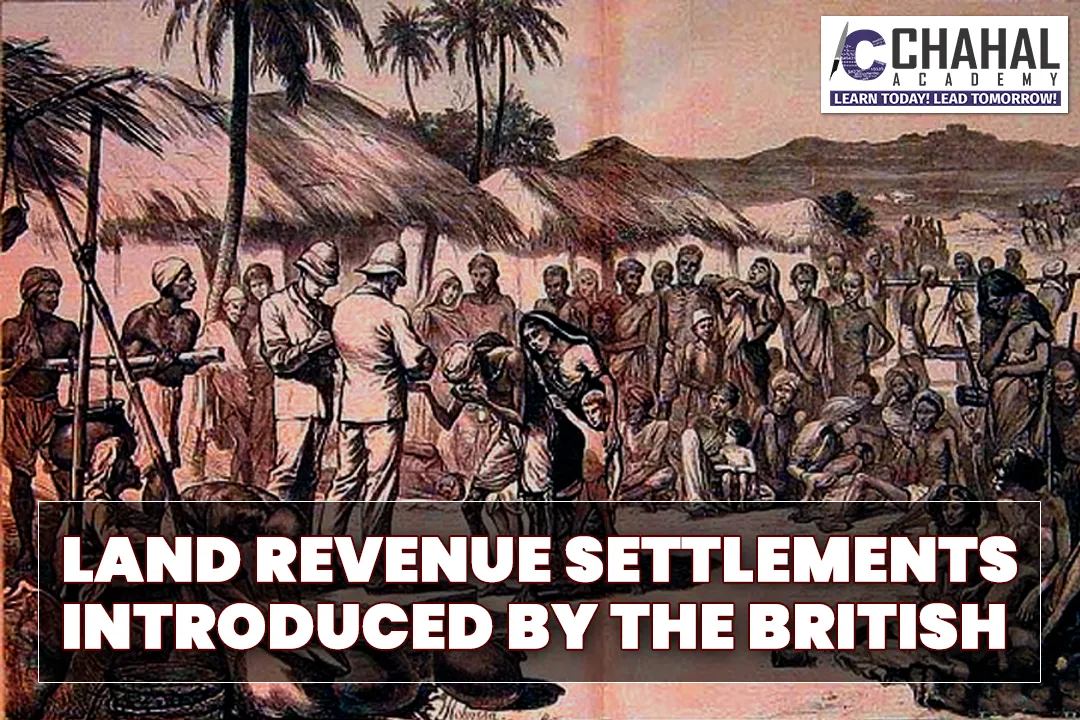
LAND REVENUE SETTLEMENTS INTRODUCED BY THE BRITISH
We will talk about Land revenue policies under British Rule, from the Permanent Settlement to the Ryotwari and ending at the Mahalwari Settlement. From 1772, a new system was introduced by Warren Hastings: this was the farming system. Under this system the government gave out the collection of land revenue on a contract basis. The contractor who offered to pay the largest amount from a certain district or sub-division was given full powers for a certain number of years. But his experiment did not succeed. This introduced instability in the Company’s revenues at a time when the Company was hard pressed for money. It was at this stage that the idea first emerged of fixing the land revenue at a permanent amount.
THE PERMANENT SETTLEMENT
The Permanent Settlement, initially planned by John Shore, was implemented in Bengal and Bihar in 1793 by Lord Cornwallis.
A key feature was transforming zamindars and revenue collectors into landlords who acted as agents of the government for revenue collection and owners of their zamindaris, with ownership rights being hereditary and transferable.
Zamindars were required to pay 10/11ths of the revenue collected to the state, retaining only 1/11th, with the revenue amount fixed in perpetuity.
Failure to pay taxes would result in the government auctioning the zamindari, transferring all rights to the new owner.
Cultivators were reduced to tenant status, stripped of long-standing and customary rights, leaving them vulnerable to the zamindars' control.
The system was later extended to Orissa, the Northern Districts of Madras and the District of Varanasi.
In Central India and Awadh, a temporary zamindari settlement was introduced, granting ownership to zamindars but revising revenue payments periodically.
The policy of recognizing zamindars as land proprietors was influenced by political, financial and administrative expediency. ➤ Political motive: The British sought local allies to stabilize their foreign rule by creating a buffer between themselves and the Indian populace. ➤ Financial motive: The system ensured stable revenue and maximized the Company’s income as land revenue was fixed higher than previous levels. ➤ Agricultural motive: By fixing land revenue, zamindars were incentivized to expand cultivation and improve agricultural productivity without fear of increased taxation.
Effects of the Permanent Settlement
Many of the zamindaris were rated for large sums that left no margin for shortfalls due to flood, drought or other calamity. As a result, many zamindars had their zamindaris taken away and sold in the decades immediately after the permanent Settlement.
In Bengal alone it is estimated that 68 per cent of the zamindari land was sold between 1794 and 1819.
On the other hand, the tax payable to the government was fixed, so the position of the zamindars improved, and they were able to lead lives of indolence and luxury at the expense of their tenants.
Cornwallis had also decreed that the zamindars should issue written agreements (called pattas) to each cultivator. In practice, however, no such pattas were issued, and the peasants were wholly at the mercy of the zamindars.
In addition to this the zamindars often resorted to illegal methods, such as locking up or beating tenants who did not pay whatever was demanded. The immediate effect of the Settlement was, therefore, to greatly worsen the position of the actual cultivators of the soil, in order to benefit the zamindars and the British Government.
THE RYOTWARI SETTLEMENT
In 1792, Thomas Munro and Alexander Read were assigned to administer a newly acquired region in Madras.
They bypassed zamindars and started collecting revenue directly from villages, fixing the amount payable by each village.
Gradually, they assessed individual cultivators, leading to the development of the "Ryotwari" system, which was initially a field-based tax assessment system.
The system allowed a government officer to determine the tax on each field, and the cultivator could choose to cultivate and pay the tax or leave the field uncultivated if no one else took it up.
Under this system, cultivators were recognized as the owners of their plots, subject to paying land revenue.
Proponents of the Ryotwari system argued that it reflected the traditional landholding and revenue practices of the past.
British officials believed that introducing a zamindari system would disrupt existing practices, as large zamindar estates did not exist in these regions.
The Ryotwari system was implemented in parts of the Madras and Bombay Presidencies in the early 19th century.
The settlement under this system was not permanent and was revised periodically, typically every 20 to 30 years, often resulting in increased revenue demands.
The Ryotwari system failed to establish true peasant ownership, as the state effectively became the sole zamindar, treating peasants as government tenants whose land could be confiscated for unpaid taxes. ➤ High revenue demands: Land revenue was excessively high, leaving cultivators with minimal subsistence. For instance, in Madras, the government claimed 45–55% of gross production during earlier settlements. ➤ Right to enhance revenue: The government retained the authority to increase land revenue arbitrarily. ➤ Revenue during calamities: Cultivators were required to pay land revenue even when crops were destroyed by droughts or floods.
Effects of the Ryotwari System in Madras and Bombay
The social effects of the ryotwari settlements were less dramatic. In many areas the actual cultivating peasants were recorded as the occupants or ‘ryots’, and thus secured the title to their holdings.
The tax was so heavy that many peasants would have gladly abandoned at least some of their land, and had to be prevented from doing so.
It was also possible for non-cultivating landlords to have their names entered as the occupants (or owners) of particular holdings, while the actual cultivation was carried on by their tenants, servants or even bonded labourers.
This was particularly the case in irrigated districts like Thanjavur (in Tamil Nadu) where many of the ‘ryots’ held thousands of acres of land. There was no limit to the amount of land that a ryot could hold, so there could be great difference in wealth and status between one ryot and another.
However, money-lenders and other non-cultivators were not much interested in acquiring lands because of the heavy taxes that came with them. Hence the small peasants, though might be oppressed by the tax-collector did not have to fear expropriation by the money-lender or landlord.
Under the reformed ryotwari system that gradually developed in Bombay after 1836 and Madras after 1858 the burden of the land revenue was somewhat reduced, and land acquired a saleable value.
The purchaser could now expect to make a profit from owning land. One result of this was that money-lenders began to seize the lands of their peasant debtors and either evict them or reduce them to tenants.
This process led to considerable social tension, and caused a major rural uprising in the Bombay Deccan in 1875.
THE MAHALWARI SYSTEM
The aggressive policies of Lord Wellesley led to large territorial gains for the British in North India between 1801 and 1806. These areas came to be called the North-Western Provinces.
Initially the British planned a settlement on the Bengal pattern, Wellesley ordered the local officials ro make the settlement with the zamindars wherever they could, provided they agreed to pay a suitably high land revenue.
Only if the zamindars refused to pay, or nor zamindars could be found were the settlements to be made village by village ‘giving the preference to the pradhan or muqaddam (headman) or any respectable Ryots of the village. Ultimately, the settlement was to be made permanent, as in Bengal.
Such enormous increases provoked resistance from many of the big zamindars and rajas, who had been almost independent in the earlier period. Many of them were therefore driven off their lands by the new administration.
Mahalwari Theory and Practice
In 1819, Holt Mackenzie proposed the idea that taluqdars and zamindars were originally appointed by the state, while the actual owners of villages were zamindars living in those villages or forming part of the village community.
A modified version of the zamindari system, known as the Mahalwari settlement was introduced in the Gangetic valley, North-West Provinces, parts of Central India and the Punjab.
The Mahalwari settlement involved revenue collection village by village or estate (mahal) by estate, with landlords or family heads collectively recognized as the owners of the village or estate.
In Punjab, a variant of the Mahalwari system, referred to as the "village system," was implemented and land revenue in these areas was revised periodically.
The Zamindari and Ryotwari systems significantly deviated from India’s traditional land systems, creating new private property structures that largely excluded cultivators from the benefits.
Land across the country was made transferable, mortgageable, and salable to ensure that the government could secure its revenue.
Transferable land allowed cultivators to borrow against it or sell portions to pay their taxes, and failing this, the government often auctioned the land to recover dues.
The belief that ownership rights would motivate landlords or cultivators to improve agricultural practices was another reason behind the introduction of private land ownership.
By turning land into a tradable commodity, the British disrupted India’s traditional land systems, undermining the stability and continuity of village life.
This transformation led to the disintegration of rural social structures, profoundly altering the foundations of Indian villages and their communities.
Effects of the Mahalwari Settlement
One of the early effects was that the areas under the control of the big taluqdars were reduced. The British officers made direct settlements with the village zamindars as far as possible, and even supported them in the law courts when the taluqdars brought suits against them.
But the so-called village zamindars were supported only because it was planned to extract the highest possible revenue from them. They were freed from taluqdars’ claims only to subject them to a full measure of government taxation.
The result of this situation was that large areas of land began to pass into the hands of money-lenders and merchants who ousted the old cultivating proprison or reduced them to tenants-at-will.
Overall, therefore, The Mahalwari settlement brought impoverishment and widespread dispossession to the cultivating communities of North India in the 1830s and 1840s and their resentment expressed itself in popular uprisings in 1857.
In that year villagers and taluqdars all over North India drove off government officials, destroyed court and official records and papers, and ejected the new auction purchasers from the villages.