Whatsapp 88106-52225 For Details
Get Free IAS Booklet
Get Free IAS Booklet
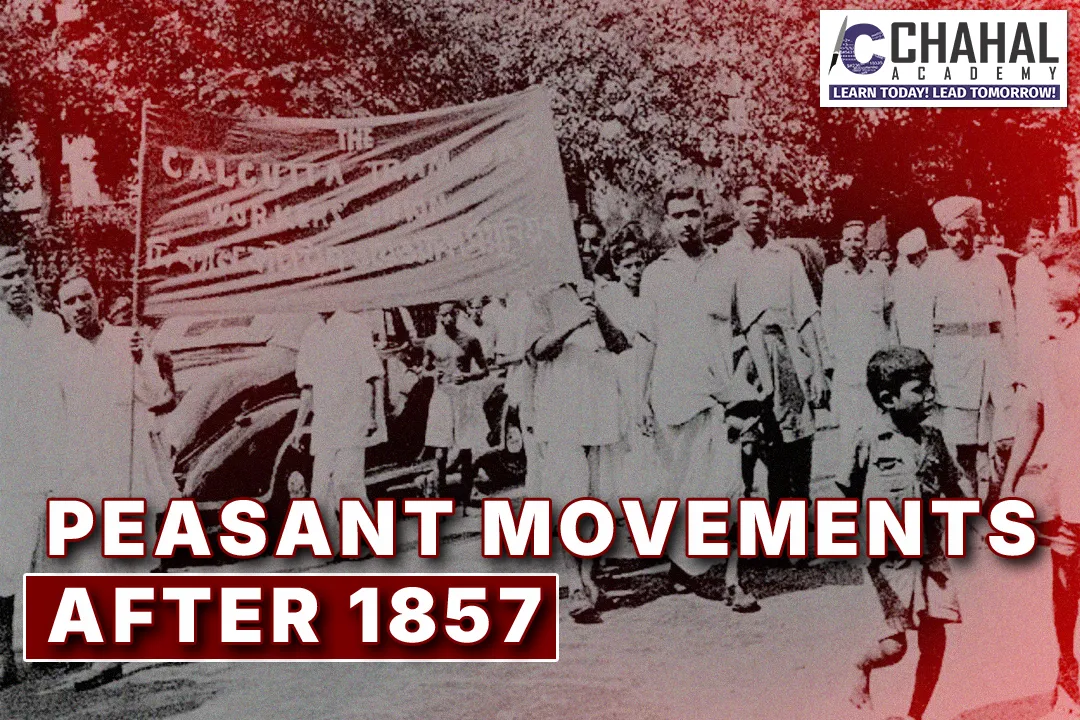
PEASANT MOVEMENTS AFTER 1857
We will focus on Peasant Movements post 1858, analysing their nature and activities.
Historically, peasants have always borne the brunt of the extreme forms of subordination and oppression in society. However, the specific socio-economic conditions of their existence have largely shaped the roles of the peasantry in social change and transformation. At an operational level, peasant movement has been conceptualised by as an organised and collective effort of the peasantry (subsistence and small producers, tenants, sharecroppers and agricultural labourers) to bring about change in the pattern of ownership, control and use of land, share of agricultural produce, wage structure, credit and institutional support system and in other aspects of socio- economic life that have subjugated them in agrarian society. The impoverishment of the Indian peasantry during the colonial period was primarily a result of significant transformations in the agrarian structure due to several factors:
Colonial economic policies
Ruin of handicrafts leading to overcrowding of land
The new land revenue system
Colonial administrative and judicial system In Zamindari areas, peasants suffered from high rents, illegal levies, arbitrary evictions, and unpaid labour. In Ryotwari areas, the Government imposed heavy land revenue directly on the farmers. Overburdened farmers, fearing the loss of their only source of livelihood, often turned to local moneylenders who exploited their difficulties by charging exorbitant interest rates. As a result, over large areas, actual cultivators were reduced to the status of tenants-at-will, sharecroppers, and landless labourers. The peasants frequently resisted this exploitation, understanding that their real adversary was the colonial state. The periodic recurrence of famines, combined with economic depression during the late 19th century, further worsened the rural conditions, leading to numerous peasant revolts across various regions.
Radical and Reformative Movements
Peasant movements can broadly be categorised as ‘radical’ or ‘reformative’, depending on their particular combination with ideology, form of mass mobilisation, and orientation towards change.
Radical movements are those that use non-institutional mass mobilisation, guided by an ideology of rapid change in the social structure. Though these movements are usually short-lived, they may be spread over a large geographical area.
A reformative peasant movement, in contrast, uses institutionalized mass mobilisation, is guided by an ideology of gradual social change, and tends to exhibit a longer life span.
Analysis of Peasant Movements in India
On the basis of period, the peasant movements in India can broadly be grouped in three distinct time phases.
The initial phase: Characterized by the sporadic growth of peasant movements in the absence of proper leadership.
The second phase: Marked by the emergence of the class-conscious peasant organizations.
Post-independence phase: this era witnessed the uninterrupted continuity of the agrarian movements due to the failure of the ruling party to resolve any of the basic problems of the working masses of rural India.
THE INITIAL PHASE
During this period the main reason for a series of spontaneous peasant uprising in different parts of the country was high handedness of zamindars or landlords along with the excessive rates of land revenue. Colonialism was not the target of these movements. There was a lack of an adequate understanding of colonialism.
The Indigo Rebellion (1859-1862)
The British adopted many ways through which they could increase their profits. They also started interfering with the basic means of livelihood of the people. Not only
did they introduce new crops, they also brought new techniques of farming.
Heavy pressure was put on the zamindars and peasants to pay high taxes and grow commercial crops. One such commercial crop was Indigo. The cultivation of indigo was determined by the needs of the English cloth markets.
The discontent of the farmers, growing indigo was mainly for three reasons: ➤ They were paid very low prices for growing indigo ➤ Indigo was not lucrative as it was planted at the same time as food crops ➤ And loss of fertility of the soil because of planting indigo.
As a result, food stocks declined. The peasants suffered at the hands of the traders and the middleman on whom they depended to sell their goods, sometimes at very low prices.
The anger of the peasants exploded in 1859 when, led by Digambar Biswas and Bishnu Biswas of Nadia district, they decided not to grow indigo under duress and resisted the physical pressure of the planters and their lathiyals (retainers) backed by police and the courts. The planters also tried methods like evictions and enhanced rents.
The ryots replied by going on a rent strike by refusing to pay the enhanced rents and by physically resisting the attempts to evict them.
Pabna Agrarian Leagues
Another important movement was the Pabna (in Bengal) peasants’ movement of 1873-1885. The peasants of Pabna did not object to rent hikes, and, in fact between 1858 and 1873 they met the rent demands of their landlords without any resistance.
At the root of the movement was the tendency of the zamindars to annihilate the tenants’ newly acquired occupancy rights under the act of 1859.
Occupancy tenants were being converted into tenants-at-will through forcible written agreements.
In 1873 the Pabna peasants formed an agrarian league which spread out the entire district very soon.
Most of the newspapers which were pro-landlord (like Amrita Bazar Patrika) opposed the league.
As the movement developed popular forms of mobilisation - i.e., blasts from conch-shell, drumbeats, etc. brought people together to resist the illegal demands of the landlords.
Funds were raised by ryots to fight the court cases. The struggles spread throughout Patna and to other districts of East Bengal.
The main form of struggle was that of legal resistance; there was very little violence.
Though the peasant discontent continued to linger on till 1885, most of the cases had been solved, partially through official persuasion and partially because of zamindars’ fears. In 1885, the Bengal Tenancy Act was passed.
Again, several young Indian intellectuals supported the peasants’ cause. These included Bankim Chandra Chatterjee, R.C. Dutt, and the Indian Association under Surendranath Banerjea.
Deccan Riots
The basis of the Deccan Riots, which erupted in 1875, lay in the evolution of the ryotwari system itself.
The emergence of a class of moneylenders fleeced the peasants through high interest on loans (25% to 50%). The courts and the new laws polarized the caste differences between the Vanis (village moneylenders) and the Kunbis (cultivator caste) by favoring the former.
These moneylenders were mostly outsiders—Marwaris or Gujaratis.
The conditions had worsened due to a crash in cotton prices after the end of the American Civil War in 1864, the Government’s decision to raise the land revenue by 50% in 1867, and a succession of bad harvests.
In 1874, the growing tension between the moneylenders and the peasants resulted in a social boycott movement organised by the Ryots against the “outsider” moneylenders.
The ryots refused to buy from their shops. No peasant would cultivate their fields. The barbers, washermen, and shoemakers would not serve them. This social boycott spread rapidly to the villages of Poona, Ahmednagar, Sholapur and Satara.
The Government succeeded in repressing the movement. As a conciliatory measure, the Deccan Agriculturists Relief Act was passed in 1879.
Moplah Rebellion in Malabar (1921)
The Moplah peasant movement was engineered in August 1921 among the peasants of Malabar district in Kerala.
The Moplah tenants were Muslims and they agitated against the Hindu landlords and the British government.
While the elite among the Moplahs were traders and merchants, the Moplah masses of the Moplah worked as agriculturists who were tenants of Hindu landlords called Jenmis.
The major grievances of the Moplah tenants were (i) Insecurity due to unfavourable land tenure system due to which Moplahs could be ejected from their land without any appropriate notice (ii) High renewal of fees fixed by the Jenmis (iii) High rent fixed for Moplah and discriminating them against Hindu Tenants.
The impetus for the 1921 movement started with meeting of Malabar District Congress Committee at Manjeri in 1920 that supported the tenants’ cause and demanded legislation to regulate landlord-tenant relations.
Following this the Moplah tenants formed an association with branches in the whole of Kerala and thus brought the Moplah tenants under one organization.
During the same time, there was the Khilafat movement, in which Moplahs actively took part but finally ended up with an agitation against the landlords.
In the agitation the targets of Moplah attack were the unpopular Jenmis, police stations, treasuries and offices, and British planters.
However, the Moplahs lost the sympathy of general the Malabar population because of the communal flavor and Moplah rebels were isolated.
British repression did the rest and by December 1921 all resistance had come to a stop.
Eka Movement
Towards the end of 1921, peasant discontent resurfaced in northern districts of the United Provinces, including Hardoi, Bahraich, and Sitapur.
Key issues raised included high rents that were 50 per cent higher than the recorded rates, oppression by thikadars responsible for revenue collection, and the practice of share-rents.
The Eka or Unity Movement involved a symbolic religious ritual where peasants vowed to pay only the recorded rent on time, resist eviction, refuse forced labour, provide no assistance to criminals, and adhere to panchayat decisions.
The grassroots leadership of the Eka Movement consisted of low-caste leaders like Madari Pasi and small zamindars. By March 1922, the movement was suppressed due to severe repression by authorities.
Bardoli Satyagraha
The Bardoli taluqa in Surat district experienced significant political activism following Gandhiji's entry into the national political scene.
The movement began in January 1926 when authorities decided to raise the land revenue by 30 per cent. ➤ A Bardoli Inquiry Committee was quickly established to examine the issue, revealing the unjustified nature of the revenue hike. ➤ Vallabhbhai Patel was called to lead the movement in February 1926. Women in Bardoli gave Patel the title of “Sardar”. ➤ Under Patel’s leadership, Bardoli peasants resolved to withhold payments of the revised assessment until either an independent tribunal was appointed or the current amount was accepted as full payment.
Patel established 13 chhavanis (workers’ camps) in the taluqa to organise the movement.
The Bardoli Satyagraha Patrika was published to mobilise public opinion.
An intelligence wing was set up to ensure that all tenants adhered to the movement’s resolutions, with a focus on the mobilisation of women.
In support of the movement, K.M. Munshi and Lalji Naranji resigned from the Bombay Legislative Council.
By August 1928, tension had escalated significantly, with the possibility of a railway strike in Bombay looming.
Gandhiji arrived in Bardoli to stand by in case of any emergency.
Eventually, the Government sought a graceful withdrawal and set conditions for a reduced rent increase, recommending only a 6.03 per cent rise.
THE SECOND PHASE
The Congress policy of safeguarding the interests of zamindars and landlords led to the emergence of independent class organizations of kisans in rural India. Consequently, the kisan organizations came into existence in different parts of the country.
Kisan Sabha Movement
The Kisan Sabha movement in Bihar began under the leadership of Swami Sahajanand Saraswati, who established the Bihar Provincial Kisan Sabha (BPKS) in 1929 to address peasant grievances against zamindari oppression.
The United Provinces Kisan Sabha was formed in February 1918 by Gauri Shankar Mishra and Indra Narayan Dwivedi.
Madan Mohan Malaviya supported their efforts in mobilizing peasants.
By June 1919, the UP Kisan Sabha had expanded to include 450 branches. Prominent leaders included Jhinguri Singh, Durgapal Singh, and Baba Ramchandra.
The Awadh Kisan Sabha was established in October 1920 due to differences within the nationalist movement.
The Awadh Kisan Sabha encouraged peasants to refuse to till bedakhali land, boycott landlords who did not accept these conditions, and settle disputes through panchayats.
These radical developments culminated in the formation of the All-India Kisan Sabha (AIKS) at the Lucknow session of the Indian National Congress (INC) in April 1936, with Swami Sahajanand Saraswati elected as the first president.
The All India Kisan Sabha included radical forces both within and outside the Indian National Congress, with support from the Congress Socialist Party and later the Communist Party of India (CPI).
The Communist Party of India played a crucial role in mobilizing peasants, starting serious engagement with the peasantry after the formation of AIKS.
The CPI increased its membership in the peasant front, setting the stage for revolutionary struggles in rural areas.
Initially, the Kisan Sabhas were not class-based organizations, with rich farmers well represented.
In 1941-43, under Swami Sahajanand, the All-India Kisan Sabha transformed into an organization for the rural poor, alienating rich and middle farmers.
By 1944-45, the CPI gained complete control over the Kisan Sabha, turning it into a platform for poor peasants, tenants, sharecroppers, and landless agricultural labourers.
PEASANT ACTIVITY IN PROVINCES Kerala
In the Malabar region, peasants were mobilized primarily by Congress Socialist Party activists.
Several Karshak Sanghams (peasants’ organizations) emerged to represent and address the concerns of the peasantry.
The most effective tactic used by these organizations was organizing jaths or marches of peasants to landlords to press for their demands.
One notable campaign by the peasants took place in 1938, focusing on the amendment of the Malabar Tenancy Act, 1929, to secure their rights and interests.
Andhra
The region had already seen a decline in the influence of zamindars following their defeat by Congressmen in elections, with anti-zamindar movements gaining momentum in some areas.
N.G. Ranga established the India Peasants’ Institute in 1933 to support and promote peasant rights.
After 1936, Congress socialists began actively organizing peasants to address their issues.
Summer schools of economics and politics were conducted at various locations, featuring leaders like P.C. Joshi, Ajoy Ghosh and R.D. Bhardwaj to guide and educate the peasant movements.
Bihar
Sahjanand Saraswati, along with Karyanand Sharma, Yadunandan Sharma, Rahul Sankritayan, Panchanan Sharma and Jamun Karjiti, were key leaders involved in the movement.
In 1935, the Provincial Kisan Conference adopted the anti-zamindari slogan as a central demand.
The Provincial Kisan Sabha experienced a rift with the Congress due to an unfavorable government resolution regarding ‘bakasht land,’ which the Sabha rejected.
The movement gradually faded by August 1939.
Punjab
The earlier peasant mobilisation in Punjab was led by the Punjab Naujawan Bharat Sabha, the Kirti Kisan Party, the Congress, and the Akalis.
In 1937, the Punjab Kisan Committee provided a new direction to the movement.
The movement primarily targeted the landlords of western Punjab who held significant influence in the Unionist ministry.
Key issues addressed included resettlement of land revenue in Amritsar and Lahore, and the rise in water rates in canal colonies of Multan and Montgomery, where feudal levies were imposed by private contractors.
The peasant activity was concentrated in regions like Jullundur, Amritsar, Hoshiarpur, Lyallpur, and Shekhupura.
Muslim tenants-at-will in west Punjab and Hindu peasants in south-eastern Punjab (present-day Haryana) remained largely unaffected.
POST-INDEPENDENCE PHASE Tebhaga Movement in Bengal (1946-47)
The word “Tebhaga” literally means three shares of harvests. The movement was started for the reduction in the share of the produce from one-half to one-third, which they traditionally used to pay to the jotedars, the intermediary landowners.
The movement arose in North Bengal and included the districts of Dinajpur and Rangpur in East Bengal and
Jalpaiguri and Malda in West Bengal. This was organised by the Kisan Sabha and marked a departure from the pattern of movements by Indian National Congress.
This movement grew against the backdrop of the deteriorating economic conditions of the sharecroppers (known locally as bargardars); while the intermediary landowners (known as jotedars) flourished.
The Permanent settlement 1793 introduced in Bengal, brought in a number of intermediaries between the Zamindars and the peasants.
These jotedars used to sublet their land to the sharecroppers, known as bargardars, who cultivated the land and used to pay a half of the produce to the jotedars.
The bargardars had only temporary rights in the piece of land for a fixed period usually five years.
In addition, there was exploitation of the rural economy by moneylenders who were giving credit to the jotedars and peasant owners (middle peasants) at high rates.
The peasant owners often lost their land and became bargardars on their own pieces of land or agricultural labourers when they failed to pay back their debts.
The Krishak Praja Party formed the first popular Ministry in Bengal in 1937. The Land Revenue Commission (Floud Commission) appointed by it recommended in 1940 that “All bargadars should be treated as tenants, that the share of the crops legally recoverable from them should be one-third, instead of half”.
The colonial rulers used all possible repressive measures to crash this movement by introducing a reign of terror in the rural areas and the movement eventually collapsed in mid-1947.
However, the movement was successful to an extent as an estimated 40 percent of the sharecroppers were granted Tebhaga rights by the landowners themselves.
Telangana Movement (1946-52)
The Telangana Movement arose as a resistance against the oppressive feudal practices of rulers and local landlords in Andhra Pradesh.
It was initiated by the Communist Party of India (CPI) through its peasant wing, the Kisan Sabha, targeting the exploitative agrarian system in the Hyderabad state under the Nizams during the 1920s and beyond.
The state featured two types of land tenure systems: "Khalsa (Diwani)", akin to the Ryotwari system, where peasants held registered pattas but were under intermediary shikmidars, and "Jagirdari", where lands were granted to the Nizam’s nobles, subjecting peasants to severe exploitation.
Local intermediaries like "jagirdars" and "deshmukhs", often from upper-caste or influential Muslim backgrounds, held significant power, forcing peasants into "vethi (forced labor)" and generational servitude.
Another exploitative system, "Bhagela", required tenant families indebted to landlords to work without repayment freedom.
The Communist-led movement began in Nalgonda in 1946, spread to Warangal and Bidar districts, and eventually engulfed the entire Telangana region.
The uprising targeted excessive exploitation by feudal landlords and demanded measures like debt waivers for peasants.
By 1948, the movement escalated into a revolutionary struggle, with peasants forming guerrilla armies and establishing over 2,000 village-level "People’s Committees" that took control of land, maintained their own administration, and enforced reforms.
These committees eradicated forced labor, redistributed land, improved irrigation and addressed public health issues like cholera.
The Razakars, a militia led by Qasim Razvi in support of the Nizam, suppressed the movement with brutality, but armed resistance persisted until 1950 when the Indian army intervened. The movement officially ended in 1951.
The Telangana Movement achieved several positive outcomes: ➤ Forced labor was eliminated, and agricultural wages increased. ➤ Illegally seized lands were restored to peasants. ➤ Land redistribution and irrigation improvements were initiated. ➤ Women experienced better conditions, and the feudal system in Hyderabad was dismantled, paving the way for Andhra Pradesh’s creation on linguistic lines. Peasant movements in India have historically highlighted fundamental issues like land ownership and livelihood. Although their contribution to restructuring the social order is debated, these movements compelled the state to implement reforms like land ceilings and the abolition of zamindari, though the efforts remain incomplete. Additionally, modern peasant movements overlap with environmental concerns, as seen in movements like Chipko and anti-SEZ protests, reflecting the interconnected nature of such struggles in the globalized era. These movements have debunked myths about the revolutionary potential of peasants, demonstrating their capacity to challenge social and economic inequalities effectively.