Whatsapp 88106-52225 For Details
Get Free IAS Booklet
Get Free IAS Booklet
CAUSES OF PEOPLE’S UPRISINGS
The imposition of colonial land revenue systems, excessive taxation, displacement of peasants from their lands, and intrusion into tribal territories.
Exploitation in rural areas, exacerbated by the rise of intermediary revenue collectors, tenants, and moneylenders.
The extension of revenue administration into tribal regions, resulting in the erosion of tribal communities' control over agricultural and forest lands.
Support for British manufactured goods and the imposition of steep duties on Indian industries, particularly on exports, leading to the collapse of Indian handloom and handicraft sectors.
The decline of traditional industries forced many workers to shift from industrial work to agriculture, thereby increasing pressure on agricultural resources.
CIVIL REBELLIONS
These uprisings were typically spearheaded by displaced native rulers or their heirs, former zamindars, landlords, poligars, ex-retainers, and officials of defeated kingdoms, and occasionally by religious leaders.
Major Causes of Civil Uprisings
During the Company’s rule, swift changes in the economy, administration, and land revenue systems adversely affected the populace.
Many zamindars and poligars, having lost control over their lands and revenues due to colonial policies, sought to settle personal grievances with the new regime.
The priestly class fueled resentment and incited uprisings against foreign rule.
The British rulers’ foreign origins, their persistent detachment from the land, and their disdainful treatment of the native population deeply wounded the pride of the people.
SANYASI REBELLION, 1763-1800
The East India Company’s official correspondence in the second half of the eighteenth century referred many times to the incursion of the nomadic Sanyasis and Fakirs, mainly in northern Bengal.
Though the Sanyasis and Fakirs were religious mendicants, originally, they were peasants, including some who were evicted from land.
However, the growing hardship of the peasantry, increasing revenue demand and the Bengal famine of 1770 brought a large number of dispossessed small Zamindars, disbanded soldiers and rural poor into the bands of Sanyasis and Fakirs.
Their target of attack was the grain stocks of the rich and at later stage, government officials. They looted local government treasuries.
One noticeable feature of these insurrections was the equal participation of Hindus and Muslims in it.
Some of the important leaders of these movements were Manju Shah, Musa Shah, Bhawani Pathak and Debi Chaudhurani.
Debi Chaudharani’s role in early resistance against the British showcases women’s importance to the national movement.
Anandamath, a semi-historical novel by Bankim Chandra Chattopadhyay, is based on the Sanyasi Revolt. He also wrote Vande Mataram (love of the land by the peasant) and Devi Chaudharani.
Encounters between the Sanyasis-Fakirs and the British forces became a regular feature all over Bengal and Bihar till 1800.
It was only after a prolonged action that Warren Hastings could subdue the sanyasis.
REVOLT IN MIDNAPORE AND DHALBHUM (1766-74)
The harmonious relations between zamindars and talukdars with their ryots changed after the introduction of a new land revenue system by the English in 1772.
British Governor Vansittart observed that the zamindars of Midnapore supported the ryots in disputes involving the English revenue officials.
Key figures leading these uprisings were Damodar Singh and Jagannath Dhal.
REVOLT OF MOAMARIAS (1769-99)
The Moamaria rebellion of 1769 was a major challenge to the authority of the Ahom rulers in Assam.
The Moamarias were low-caste peasants who followed the teachings of Aniruddhadeva (1553–1624).
These uprisings significantly weakened the Ahom kingdom, making it vulnerable to external invasions.
To suppress the rebellion, the Ahom rulers sought assistance from the British.
The regions most affected by the revolt were Rangpur (now in Bangladesh) and Jorhat.
In 1792, the king of Darrang, Krishnanarayana, supported by burkandazes (disbanded soldiers from Muslim armies and zamindars), intervened in the conflict.
Although the Ahom kingdom survived the rebellion, the ensuing instability led to a Burmese invasion and eventually resulted in the kingdom falling under British rule.
CIVIL UPRISINGS IN GORAKHPUR, BASTI AND BAHRAICH (1781)
To fund the wars against the Marathas and Mysore, Warren Hastings devised a plan to involve English officers as revenue farmers (izaradars) in Awadh.
Major Alexander Hannay acquired the revenue farming rights for Gorakhpur and Bahraich for 22 lakh rupees annually.
Hannay's oppressive practices and excessive revenue demands caused panic in the region, which had previously prospered under the Nawab's rule.
In 1781, zamindars and cultivators, unable to bear the heavy exactions, revolted, leading to the killing or besieging of Hannay's subordinates by guerrilla forces.
Although the uprising was eventually quelled, Hannay was dismissed, and his revenue farming rights were revoked.
REVOLT OF RAJA OF VIZIANAGARAM (1794)
The East India Company demanded a tribute of three lakh rupees from Vizayaramaraju, the Raja of Vizianagaram, and asked him to disband his troops.
This demand angered the raja, as there were no dues owed to the Company. In response, the raja, along with his subjects, revolted.
In 1793, the English captured the raja and ordered him into exile with a pension, but he refused.
The raja died in the Battle of Padmanabham (modern Visakhapatnam district, Andhra Pradesh) in 1794, and Vizianagaram came under the Company’s rule. Later, the Company offered the estate to the raja’s son and reduced the tribute demand.
REVOLT OF DHUNDIA IN BEDNUR (1799-1800)
Dhundia Wagh, a local Maratha leader, who was converted to Islam by Tipu Sultan and put into jail due to his mis-adventures, got released with the fall of Seringapatam.
Dhundia organised a force which consisted of anti-British elements, and carved out a small territory for himself.
A defeat by the English in August 1799 forced him to take refuge in Maratha region from where he instigated the disappointed princes to fight against the English and he himself took on the leadership.
In September 1800, he was killed while fighting against the British forces under Wellesley. Though Dhundia failed, he became a venerated leader of the masses.
RESISTANCE OF KERALA VARMA PAZHASSI RAJA (1797;1800-05)
Kerala Varma Pazhassi Raja, popularly known as Kerala Simham (Lion of Kerala) or ‘Pyche Raja’, was the de facto ruler of Kottayam (Cotiote) in the Malabar region.
The Third Anglo-Mysore War (1790-92) led to the extension of English paramountcy over Kottayam, violating an earlier agreement of 1790 that had recognized Kottayam’s independence.
The English appointed Vira Varma, the uncle of Pazhassi Raja, as the Raja of Kottayam.
To meet the revenue targets set by the Company, the new raja imposed exorbitant taxes on the peasants.
This sparked a mass resistance led by Pazhassi Raja in 1793. He fought bravely using guerrilla warfare, and in 1797, a peace treaty was established.
However, a dispute over Wayanad in 1800 reignited the conflict, leading to insurgent warfare. Pazhassi Raja organized a large force of Nairs, supported by Mappilas and Pathans—demobilized soldiers of Tipu Sultan who became unemployed after his death.
In November 1805, Kerala Simham died in a gunfight at Mavila Todu near the present-day Kerala-Karnataka border.
CIVIL REBELLION IN AWADH (1799)
Wazir Ali Khan, the fourth Nawab of Awadh, ascended the throne with the help of the British in September 1797.
However, his relations with the British soon deteriorated, leading to his replacement by his uncle, Saadat Ali Khan II. Wazir Ali Khan was granted a pension in Benares.
In January 1799, Wazir Ali killed British resident George
Frederik Cherry during a luncheon invitation. His guards also killed two other Europeans and attacked the Magistrate of Benares. This incident became known as the Massacre of Benares.
Wazir Ali fled to Butwal and was granted asylum by the ruler of Jaipur. Arthur Wellesley requested the Raja of Jaipur to extradite Wazir Ali.
In December 1799, Wazir Ali was extradited under the condition that he would neither be hanged nor put in fetters. After surrendering, he was placed in confinement at Fort William, Calcutta.
UPRISINGS IN GANJAM AND GUMSUR (1800, 1835-37)
In the Northern Circars, the region of Ganjam and its surrounding areas witnessed an uprising against British authority.
Strikara Bhanj, a zamindar from Gumsur in Ganjam district, refused to pay land revenue in 1797 and, by 1800, had openly rebelled against British officials.
He received support from Jlani Deo of Vizianagar (Poddakimedi) and Jagannath Deo of Pratapgiri (Chinakimedi).
In 1804, Jagannath Deo was captured and sent to Masulipatnam.
The British were eventually compelled to grant certain territories to Strikara Bhanj. However, in 1807–08, his son, Dhananjaya Bhanj, ousted him from the estate and initiated a rebellion against British rule. Dhananjaya was eventually forced to surrender in June 1815.
Dhananjaya Bhanj launched another revolt in November 1835 when British forces occupied Gumsur and Kolaida.
Although this insurrection seriously undermined British control, Dhananjaya passed away in December 1835, and his followers continued their resistance.
The British government appointed Russell with full discretionary powers to suppress the rebellion. The conflict persisted until February 1837, ending with the capture of Doora Bisayi, a key rebel leader. Following this, the Gumsur zamindari was confiscated by the British.
UPRISINGS IN PALAMAU (1800-02)
The political landscape of Palamau was made more complex by conflicts arising from agrarian landlordism and the feudal structure.
In 1800, Bhukhan Singh, a leader of the Chero tribe, initiated a rebellion. Colonel Jones remained stationed in Palamau and Sarguja for two years to quell the uprising.
The rebellion subsided following Bhukhan Singh’s death in 1802.
THE REVOLT OF DEWAN VELU THAMBI
The Revolt of Dewan Velu Thambi occurred in Travancore state that encompasses several southern districts of present-day Kerala (such as Kottayam, Allapuzha, Pathanamthitta, Kollam, Trivandrum, Idukki, and parts of Ernakulam).
Velu Thambi was the Dewan (minister) of Travancore.
Initially, the Travancore State and the British shared an amicable relationship. However, Velu Thambi soon realised that the trust they had placed in the British was misplaced.
The British signed a treaty with Travancore that imposed the subsidiary alliance system, causing a financial burden on the state. British residents of Travancore started interfering with the internal matters of the state.
The British, sensing danger, sent a strong contingent asking for the removal of the Dewan. This order led to Velu Thambi starting a revolt in 1808.
Velu Thampi addressed a gathering in Kundara, openly calling for taking up arms against the British to oust them from the native soil.
This was later known as the Kundara Proclamation.
Though Thambi received support from the neighbouring State of Cochin, he was defeated by the British. In 1809, Trivandrum (the capital of Travancore) fell into British hands, and Velu Thambi died of serious injuries.
POLYGAR REBELLIONS (KURNOOL, 1795-1805)
The Polygars emerged from the Nayankara system that existed under the Vijayanagar administration. Comparable to the Rajputs of North India, they were granted land in return for rendering military service whenever required.
Between 1795 and 1805, the Polygars (also known as Palayakkarargal) of South India fiercely resisted British authority.
The main hubs of these uprisings were Tinneveli (present-day Thirunelveli), Ramanathapuram, Sivaganga, Sivagiri, Madurai, and North Arcot.
The conflict began in 1781 when the Nawab of Arcot handed over control of Tinneveli and the Carnatic provinces to the East India Company.
This shift in governance angered the Polygars, who had long operated as autonomous rulers within their domains.
The first major revolt by the Polygars against the British was triggered by taxation issues. Kattabomman Nayakan, the Poligar of Panjalankurichi, led this resistance from 1795 to 1799.
After a fierce confrontation where Kattabomman’s forces initially defeated the Company troops, a bounty was placed on his head, inciting broader rebellion among the Polygars. With reinforcements, British forces eventually overcame Kattabomman.
His capture was made possible by betrayal—this time by Ettappan, the Raja of Pudukottai, who allied with the British. Kattabomman was publicly executed.
The Panjalankurichi palayam and the estates of five other Polygars involved in the revolt were seized. Leading figures among the rebels were either executed or imprisoned.
A more intense second phase of the rebellion erupted in February 1801 after some imprisoned Polygars escaped from the fort at Palamcotta.
Between 1803 and 1805, the Polygars of North Arcot rose again in protest after being stripped of their traditional right to collect kaval fees. (Kaval was a traditional village watch or policing system in Tamil Nadu, typically a hereditary role with defined responsibilities and privileges.)
The Poligar of Yedaragunta, known for his boldness and desperation, became a key leader in this movement, joined by the ousted Poligar of Charagallu.
By February 1805, the rebellion was subdued.
Several rebel chiefs were relocated to Madras, while others were granted a stipend amounting to 18 percent of the revenues from their former estates.
DISTURBANCES IN BUNDELKHAND (1808-12)
Bundelkhand, conquered by the British during the Second Anglo-Maratha Wars (1803-05), was placed within the Presidency of Bengal.
The Bundela chiefs resisted the new government by holding nearly one hundred and fifty forts.
The first major resistance came from Lakshaman Dawa, the killadar (fort commander) of Ajaygarh fort. The second resistance was from Darya Singh, killadar of Kalanjar, which was suppressed in January 1812.
The most serious threat came from Gopal Singh, a famous military adventurer, who resisted for four years against British forces.
To manage these disturbances, the British introduced a policy of binding hereditary chieftains of Bundelkhand through contractual obligations—Ikarnamahs.
PARLAKIMEDI OUTBREAK (1813-34)
Parlakimedi, located on the western border of the Ganjam district (now in Odisha), saw resistance from zamindars and rajas.
When the Company acquired Ganjam, Narayan Deo was the raja of Parlakimedi. His resistance led the British to dispatch an army under Colonel Peach.
Colonel Peach defeated Narayan Deo in 1768 and made Gajapathi Deo, his son, a zamindar. However, Narayan Deo, along with his son and brothers, rebelled again.
As the resistance continued, the Presidency of Madras appointed George Russell as commissioner of the region in 1832.
Russell, with full powers to suppress the revolt, managed to pacify the region by 1834.
KUTCH REBELLION (1816-1832)
In 1816, a treaty was established between the British and Maharaja Bharamal II of Kutch, granting power to the throne.
The British interfered in Kutch’s internal affairs, and in 1819, Raja Bharmal II raised Arab and African troops with the aim of expelling the British from his territory.
The British defeated and deposed Rao Bharamal in favor of his infant son, who was placed under a regency council.
A British resident governed the region as the de facto ruler.
Despite this, some chieftains continued to rebel against the British rule. The news of British reverses in the Burma War emboldened the chiefs to demand the restoration of Bharamal II.
After several military efforts failed to control the situation, the Company adopted a conciliatory policy.
RISING AT BAREILLY (1816)
The immediate cause of the upsurge was the imposition of a police tax, which provoked strong resentment among the citizens.
The situation took a religious turn when Mufti Muhammad Aiwaz, a respected old man, submitted a petition to the magistrate in March 1816.
Tensions escalated further when the police, during tax collection, injured a woman, leading to a violent clash between the followers of the Mufti and the police.
Within two days, several armed Muslims from nearby towns like Pilibhit, Shahjahanpur, and Rampur rose in rebellion in defense of their faith and the Mufti.
The upsurge seemed to stem more from general discontent than from specific grievances.
UPSURGE IN HATHRAS (1817)
Dayaram, a talukdar of several villages in Aligarh district, had a stronghold in the fort of Hathras.
The English had entered into a settlement of Hathras estate with Dayaram as a farmer.
However, due to increasing high revenues and arrears, Dayaram struggled to make payments and harbored government fugitives.
In February 1817, the Company, with a large army, attacked Hathras.
After a prolonged struggle lasting over 15 days, Dayaram surrendered under the condition of submission and was settled with a pension.
PAIKA REBELLION (1817)
Preceding what is widely regarded as the first war of independence in 1857, the Paika Bidroha of 1817 in Odisha marked a significant challenge to British rule in eastern India.
Paikas were the peasant militias of the Gajapati rulers of Odisha, serving both in military and agricultural capacities.
Under the leadership of Bakshi Jagabandhu Bidyadhara, the Paikas rose in rebellion against British rule as early as 1817, seeking to liberate Odisha from colonial domination.
The rulers of Khurda were historically the custodians of the Jagannath Temple and governed as the deputy of Lord Jagannath on earth, symbolizing Odisha’s political and cultural freedom.
The British, having established control over Bengal Province and Madras Province, annexed Odisha in 1803.
The oppressive land revenue policies and rising costs of goods like salt due to taxes imposed by the Company led to widespread discontent among zamindars and peasants.
Underage Gajapati King Mukunda Deva-II faced initial resistance from Jai Rajguru, who was brutally executed by the British.
In 1817, Paikas under Bakshi Jagabandhu, supported by tribals and other sections of society, began a widespread rebellion against British rule.
The rebellion started in March 1817 and rapidly gained support from the local population, including tribals from Ghumusar and other regions.
Paikas targeted British symbols of power, including police stations, administrative offices, and treasuries, leading to the British retreating from Khurda.
The British initially struggled to regain control but eventually launched a brutal suppression campaign, killing and imprisoning many rebels.
Although some rebels continued a guerilla war till 1819, most were captured and executed.
Bakshi Jagabandhu was arrested in 1825 and died in captivity in 1829..
WAGHERA RISING (1818-1820)
Resentment against the alien rule coupled with the exactions of the Gaekwad of Baroda supported by the British government compelled the Waghera chiefs of Okha Mandal to take up arms.
The Wagheras carried out inroads into British territory during 1818-19. A peace treaty was signed in November 1820.
AHOM REVOLT (1828)
The Sibsagar district of the state of Assam has been central to several significant phases of Assam’s history, especially in the context of the Ahom Kingdom.
The Ahom Revolt of 1828 was one such event that has immense importance in the history of resistance to British rule in the region.
The Ahom Revolt unfolded in the context of the continued occupation of Assam even after the “Treaty of Yandaboo 1826”, which had raised the suspicions and dissatisfactions of the Ahom nobility since the British had promised to leave after the end of the Anglo-Burmese War.
Gomadhar Konwar, an Ahom Prince, had started a rebellion along with the support of Dhanjay Borgohain and Jairam Khargharia Phukan.
Gomadhar Konwar proclaimed himself the Svargadev (lord of the heavens) and also interfered with the collection of revenues.
Under his leadership, the rebels started advancing toward the British stronghold in Rangpur. But their plans were revealed and the British caught them and quelled the rebellion.
Although they escaped to Naga Hills, later Gomadhar Konwar surrendered. They were tried, convicted for treason, and condemned to death. However, their sentences were reduced later as a conciliatory gesture.
Ultimately, the Company adopted a conciliatory approach and restored Upper Assam to Maharaja Purandar Singh Narendra, granting him partial control of the kingdom.
SURAT SALT AGITATIONS (1840S)
A strong anti-British sentiment resulted in attacks by the local Surat population on the Europeans in 1844 over the issue of the government’s step to raise the salt duty from 50 paise to one rupee.
Faced with a popular movement, the government withdrew the additional salt levy.
Again in 1848, the government was forced to withdraw its measure to introduce Bengal Standard Weights and Measures in face of people’s determined bid to resort to boycott and passive resistance.
KOLHAPUR AND SAVANTVADI REVOLTS
The Gadkaris were a hereditary military class which was garrisoned in the Maratha forts. These garrisons were disbanded during administrative reorganisation in Kolhapur state after 1844.
Facing the spectre of unemployment, the Gadkaris rose in revolt and occupied the Samangarh and Bhudargarh forts.
Similarly, the simmering discontent caused a revolt in Savantvadi areas. The British authorities introduced many laws to bring the region under control.
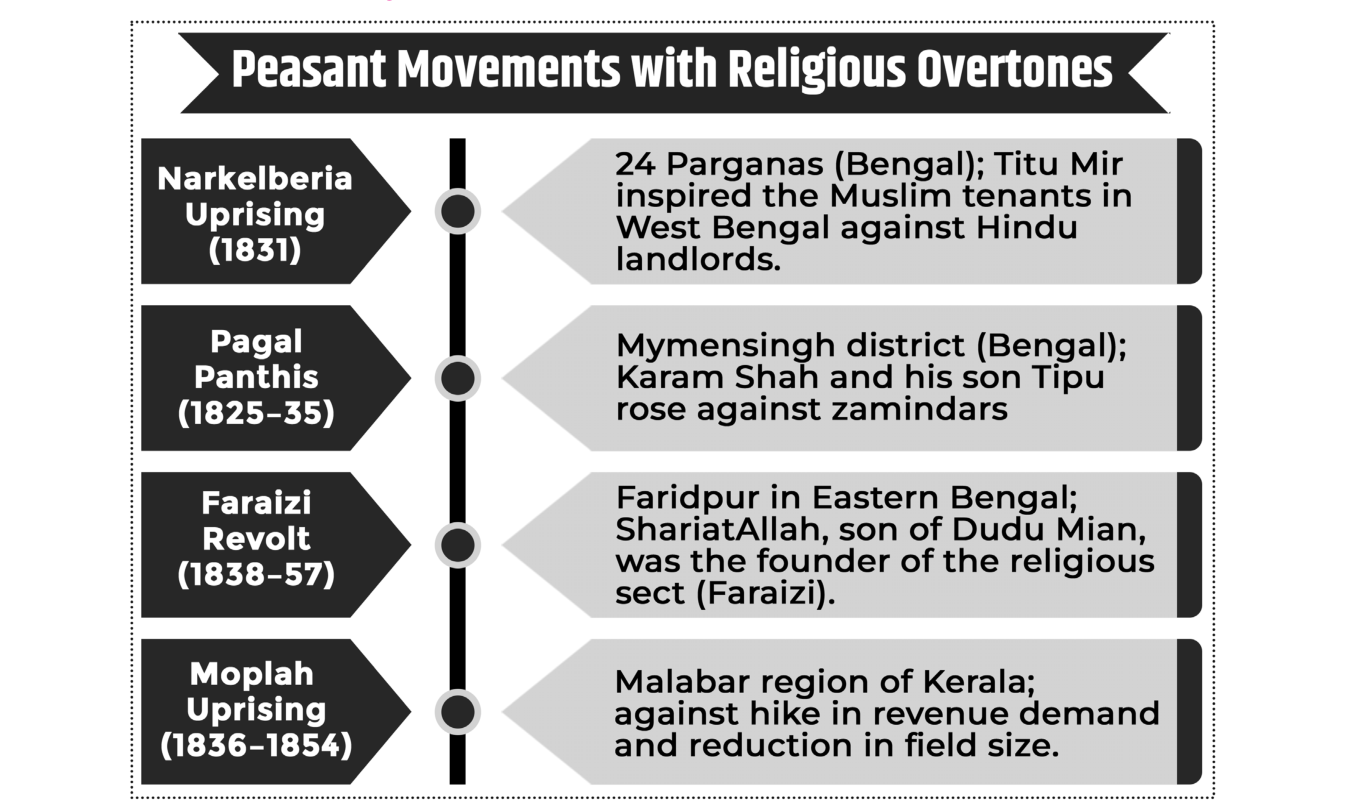
Peasant Movements with Religious overtones
THE PAGAL PANTHIS
The Pagal Panthi Movement (1825-1833) was a peasant movement led by religious mendicants known as Pagal Panthis.
Initially, the movement targeted the zamindars (landlords), but it later evolved into an anti-British movement.
The Pagal Panthi group, primarily consisting of Hajong and Garo tribes from the Mymensingh district (formerly part of Bengal), was founded by Karam Shah.
After Karam Shah's death in 1813, his son, Tipu alias Tipu Pagal, succeeded him as the leader of the Pagal Panthis.
Under Tipu’s leadership, the movement transformed into a peasant uprising.
From 1825 to 1833, the Pagal Panthis refused to pay excessive rent and attacked the homes of zamindars.
Despite the introduction of an equitable arrangement to protect the peasants, the movement was violently suppressed by the British authorities.
NARKELBERIA UPRISING
Mir Nithar Ali (1782-1831) or Titu Mir inspired the Muslim tenants in West Bengal to rise against landlords, mainly Hindu, who imposed a beard-tax on the Faraizis, and British indigo planters.
Often considered the first armed peasant uprising against the British, this revolt soon took on a religious hue. The revolt later merged into the Wahhabi movement.
FARAIZI MOVEMENT
The Faraizi Movement was established by Haji Shariatullah in 1818, advocating for the revival of strict monotheism and opposing unorthodox religious practices.
The movement primarily operated in East Bengal, focusing on eradicating social innovations and promoting the duties of Muslims according to orthodox Islamic teachings.
After Haji Shariatullah's death, his son, Dudu Mian, took over and transformed the movement into a revolutionary force starting from 1840. ➤ Dudu Mian introduced a structured organization from village to provincial levels, appointing Khalifas or deputies at each level.
➤ He also formed a paramilitary force armed with clubs to challenge Hindu zamindars and some Muslim landlords, as well as indigo planters.
The movement weakened after Dudu Mian’s arrest in 1847 and eventually became a purely religious movement without political objectives following his death in 1862.
Dudu Mian organized a paramilitary force armed with clubs to challenge zamindars, including Hindu and some Muslim landlords, as well as indigo planters.
He instructed his followers not to pay rent and established his own Law courts to support the movement. ➤ After Dudu Mian’s arrest in 1847, the movement weakened and eventually became a purely religious movement after his death in 1862.
MOPLAH REBELLION
The Moplahs of Malabar experienced widespread peasant unrest due to oppressive revenue demands, reduction in field size, and harsh treatment by officials.
Between 1836 and 1854, twenty-two rebellions occurred, none of which were successful, though the Moplahs participated again during the Non-Cooperation Movement in 1921, eventually being subdued due to Hindu-Muslim differences.
Peasants’ Role in the 1857 Revolt
Peasant participation was active only in some areas affected by the 1857 rebellion, mainly those in western Uttar Pradesh. Moreover, the peasants united with the local feudal leaders in many places to fight against foreign rule. After the revolt, the plight of the peasants worsened with the British Government’s decision to gain the support of the landed People’s Resistance Against British Before 1857 while ignoring the peasants. Obviously peasants’ interests suffered. In Avadh, for instance, land was restored to the taluqdars and they were given revenue and other powers as well, and the peasants could not avail of the provisions of the 1859 Bengal Rent Act. As a punishment for their participation in the 1857 revolt, the peasants had to pay an additional cess in some regions.
TRIBAL REVOLTS
Tribal movements, whether peasant, forest, land-based, identity-focused, or politically oriented, can be understood through two main paths: violent and non-violent approaches.
Non-violent movements involve strategic negotiation and bargaining with oppressors, avoiding any form of violence.
In contrast, violent movements are characterized by direct resistance through revolts and other violent actions.
Examples of non-violent and violent tribal movements include Tana Bhagat Movement and Mauriya Movement respectively.
Causes For Mainland Tribal Revolts
The mainland tribal rebellions were triggered by government actions, such as new forest regulations that stripped tribals of their traditional rights to use forests for timber and grazing. ➤ This led to a loss of livelihood and socio-economic hardship for the tribals.
Non-tribal agricultural expansion disrupted the traditional multiparty landownership system among tribals, fostering socio-economic differentiation and exploitation by moneylenders.
Tribals faced increased taxes on timber usage and constraints on shifting cultivation.
The arrival of Christian missionaries further exacerbated tensions by interfering with tribal customs and values. ➤ Their efforts were perceived as an extension of colonial control, making them unpopular among tribals.
Causes For North-Eastern Tribal Revolts
The tribal movements in the north-eastern frontier differed from non-frontier tribal revolts in that they often focused on political autonomy or complete independence rather than the nationalist struggle.
Additionally, these movements were not forest-based or agrarian, as the tribes had control over land and forest areas, and British influence in the north-eastern regions came later than in other tribal areas.
Salient Features Of The Tribal Movements
The tribals organized revolts and movements against outsiders (dikus) such as landlords, moneylenders, thekedars, missionaries, and European government officials, primarily due to their exploitation through land encroachment, eviction, denial of traditional rights, and imposition of unfair rent.
These movements were social and religious in nature, but were directed against the fundamental issues of existence, often led by tribal chiefs. The tribals fought using traditional weapons like bows, arrows, lathis, and axes, and faced brutal suppression from the government.
Serial NumberTribal Movement Year Paharias Rebellion, 11778 Rajmahal Hills Chuar Uprising (Jungle 21776 Mahal Revolt)
3Kol Uprising1831
1827
1831
4Ho and Munda Uprising 1899-90
1860-1920
5Santhal Rebellion1855-56
1837-56; 6Kondh Uprising 1914
7Naikada Movement 1860s
8Kharwar Rebellion1870s 9Khonda Dora Campaign 1900
1817-19; 1913 10Bhil Revolt
Bhuyan and Juang 1867-68; 11 Rebellions 1891-93
1879-80 12Koya Revolts 1886
Tana Bhagat Movements 131914-15 [Munda+Oraons] LeaderRemarks Mainly because of intrusion of Raja Jagganath outsiders or ‘dikus’ Against rise in demands and Durjol Singheconomic privation by the British Against expansion of British Buddho Bhagatrule on their lands and transfer of their lands to outsiders Against occupation of Raja Parahat Singhbhum by British Ho and Munda Against the newly introduced tribalsfarming revenue policy Birsa was captured and Birsa Munda imprisoned Against introduction of feudal, zamindari tenures, and Ulgulan Uprising exploitation by moneylenders and forest contractors. Siddhu and They called the movement hul; Kanhu Murmusal branches Emissaries with Phulo and Jhanu were sent as a form of Murmu → secret communication; Highlighting the After the revolt, the Santhal role of women in Pargana was created with tribal revoltsspecial laws Against interference in tribal Chakra Bisnoicustoms and imposition of new taxes Against British policies and caste Hindus Against revenue settlement activities
Against Company rule and then later to form an independent Bhil Raj Against the installation of a British protege on the throne after the death of their raja in 1867 Tomma SoraAgainst oppression by police, moneylenders; new regulations and denial of their rights over Raja Anantayyarforest areas Jatra Bhagat;Against interference of outsiders; began as Balram BhagatSanskritisation movement
1916; 14Rampa Revolts 1922-24
16Ahoms’ Revolt 1828-33
16Singphos’ Rebellion1830
17Naga Movement1905-31
18Kukis Revolt1917-19
19Zeliangsong Movement1920s
1863
20Revolts in Tripura1942-43
1920
21Khasis’ Revolt1830
22Bastar Revolt1910
PAHARIYAS’ REBELLION
The Pahariyas, who lived around the Rajmahal Hills, relied on forest produce and practiced shifting cultivation, considering the entire region their territory.
Faced with inadequate means of sustenance, especially during times of scarcity, the Pahariyas frequently raided the plains inhabited by settled agriculturists, asserting dominance over these communities.
The British intervention in the late 18th century, promoting forest clearance and settled agriculture, led to increased conflict. In response, the Pahariyas resisted through violent uprisings, such as the 1778 rebellion led by Raja Jagganath, continuing their resistance even after British pacification attempts.
CHUAR UPRISING or the JUNGLE MAHAL REVOLT
The Chuar tribals from the Midnapur and Bankura regions in West Bengal relied on primitive farming and forest resources.
They faced frequent abuse from zamindars, who referred to them derogatorily as "chars" (pigs in Bengali), leading to the Chuar rebellion. Against British interference; Alluri Sitarama capture and execution of Raju Raju in 1924 Against the non-fulfilment of the pledges of the Company after the Burmese War Led to murder of British political agent of Assam by Singphos in 1839 Against British rule and for the Jadonang setting up of Naga raj Against British policies of recruiting labour during the first World War Against the failure of British to Zemi, Liangmei; protect them during the Kuki Rongmei tribes violence in 1917–19. Parikshit Jamatia; Against hike in house tax Reangs’ revolt-rates and against settlement of Ratnamani outsiders in the region led by Bharti Singh Nunklow Ruler;Against the occupation of the Tirath Singh hilly region Against new feudal and forest levies
In 1768, Jagannath Singh, the zamindar of Ghatsila, led thousands of Chuars in a revolt against the Company government, forcing them to capitulate. ➤ 1771, the rebellion was suppressed after leaders like Shyam Ganjan, Subla Singh, and Dubraj rose in arms, only to be defeated.
The most significant uprising occurred in 1798 under Durjan Singh, whose followers violently opposed the auctioning of his estate, ultimately leading to brutal suppression by the British.
KOL MUTINY (1831)
The Kols, along with other tribes, inhabited Chotanagpur, including Ranchi, Singhbhum, Hazaribagh, Palamau, and parts of western Manbhum.
In 1831, the Kols faced land transfers to outsiders like Hindus, Sikhs, and Muslims, along with oppressive money-lenders who imposed heavy taxes.
Under the leadership of Buddho Bhagat, the Kol rebels retaliated by killing or burning around a thousand outsiders, which was only subdued through extensive military intervention.
HO UPRISING
The Raja of Parahat led his Ho tribals in a revolt against the British occupation of Singhbhum, which lasted until 1827 when they were eventually forced to submit.
In 1831, the Ho tribals, along with the Mundas of Chotanagpur, rose again to oppose the new farming revenue policy and the influx of Bengalis into their region, continuing their resistance until 1837.
THE SANTHAL REBELLION OF 1855
The Santhal rebellion, also known as Santhal Hul, occurred in present-day Jharkhand and West Bengal, specifically in the Rajmahal foothills. ➤ It was a protest against British colonial rule, zamindars who exploited peasants by imposing heavy rents, and against moneylenders charging exorbitant interest rates.
Santhals were being evicted from their lands and forced into tenancy or bonded labour due to inability to pay taxes and debts. ➤ The revolt began in July 1855 when thousands of Santhals gathered at Bhogandih village and declared their freedom.
The rebellion was led by Sidhu and Kanhu, who claimed divine messages to end the oppression by government officials and merchants.
Despite their bravery with traditional weapons, the Santhals were no match for the advanced firearms of the East India Company, leading to the suppression of the rebellion by early 1856. However, the movement led to policy changes, and the land was renamed ‘Santhal Parganas’.
KHOND UPRISINGS (1837-1856)
From 1837 to 1856, the Khonds from the hilly regions of Odisha to Srikakulam and Visakhapatnam districts in Andhra Pradesh revolted against Company rule.
Chakra Bisnoi, a young raja, led the Khonds along with other tribal groups like the Ghumsar and Kalahandi to oppose the suppression of human sacrifice, new taxes, and the intrusion of zamindars.
The uprising ended with the disappearance of Chakra Bisnoi.
KOLI RISINGS
The Kolis, living near the Bhils, rebelled against the Company’s rule in 1829, 1839, and again between 1844-48.
They opposed the imposition of British rule, which led to widespread unemployment and the dismantling of their forts.
RAMOSI UPRISING
The Ramosis, hill tribes of the Western Ghats, resisted British rule and the British administrative system, particularly resenting the policy of annexation.
After the annexation of Maratha territories by the British, Ramosis lost their livelihoods, which had been supported by their employment in the Maratha administration.
In 1822, they rose under Chittur Singh and plundered the area around Satara.
Disturbances reoccurred in 1825-26, led by Umaji Naik of Poona and his supporter Bapu Trimbakji Sawant, continuing until 1829.
The uprising emerged again in 1839 due to the deposition and banishment of Raja Pratap Singh of Satara, with further disturbances in 1840-41.
Ultimately, a superior British force restored peace in the region. The British adopted a pacifist approach towards the Ramosis, even recruiting some into the hill police.
TRIBAL MOVEMENTS OF THE NORTH-EAST Khasi Uprising
After occupying the hilly regions between Garo and Jaintia Hills, the East India Company aimed to build a road connecting the Brahmaputra Valley with Sylhet.
To facilitate this, a large number of outsiders, including Englishmen, Bengalis, and laborers from the plains, were brought into the region.
In response, the Khasis, Garos, Khamptis, and Singphos united under Tirath Singh to drive away these strangers from the plains.
The uprising grew into a widespread revolt against British rule, but by 1833, the superior military force of the English managed to suppress the rebellion.
Singphos Rebellion
The rebellion broke out in early 1830, and it was suppressed just after three months.
An uprising in 1839 saw the death of the British political agent. Chief Nirang Phidu led an uprising in 1843, which involved an attack on the British garrison and the death of many soldiers.
SEPOY MUTINIES
A number of sporadic sepoy mutinies took place before the Great Revolt of 1857 in different parts of the country.
Causes
discrimination in payment and promotions;
mistreatment of the sepoys by the British officials;
refusal of the government to pay foreign service allowance while fighting in remote regions;
Further, the sepoys shared all the discontent and grievances—social, religious and economic—that afflicted the civilian population.
Important Mutinies
Several significant mutinies occurred before the major uprising of 1857. These include:
The revolt by sepoys in Bengal in 1764.
The Vellore Mutiny – This was a significant act of resistance that took place on July 10, 1806, and is considered the first large-scale and violent uprising by Indian sepoys against the East India Company. The rebellion was sparked by interference in the religious and social customs of the Indian soldiers. Sepoys raised the flag of the Mysore ruler in rebellion. Hindu soldiers were ordered to remove their caste marks, while Muslim soldiers were required to shave their beards, which caused widespread resentment.
The 1824 mutiny of the 47th Native Infantry Regiment.
The 1825 uprising of the Grenadier Company in Assam.
The 1838 mutiny by an Indian regiment stationed at Sholapur. Despite their significance, these revolts were all localized and failed to spread beyond their immediate areas. The British swiftly and brutally suppressed them, often resorting to extreme violence, executing the leaders, and dissolving the rebellious units.