Whatsapp 88106-52225 For Details
Get Free IAS Booklet
Get Free IAS Booklet
POLICIES OF THE ENGLISH EAST INDIA COMPANY
WARREN HASTINGS (1772-1785) Reforms of Warren Hastings
When Warren Hastings assumed the administration of Bengal in 1772, he found it in utter chaos. The financial position of the Company became worse and the difficulties were intensified by famine. Therefore, Warren Hastings realized the immediate need for introducing reforms.
Abolition of the Dual System
The East India Company decided to act as Diwan and to undertake the collection of revenue by its own agents. Hence, the Dual System introduced by Robert Clive was abolished.
As a measure to improve the finances of the Company, Warren Hastings reduced the Nawab’s allowance of 32 lakhs of rupees to half that amount. He also stopped the annual payment of 26 lakhs given to the Mughal Emperor.
Revenue Reforms
After the abolition of the Dual System, the responsibility of collecting the revenue fell on the shoulders of the Company. For that purpose, a Board of Revenue was established at Calcutta to supervise the collection of revenue. English Collectors were appointed in each district.
The treasury was removed from Murshidabad to Calcutta and an Accountant General was appointed. Calcutta thus became the capital of Bengal in 1772 and shortly after British India.
The Board of Revenue farmed out the lands by auction for a period of five years instead of one year in order to find out their real value. The zamindars were given priority in the auction.
Trade Regulations and other Reforms
Warren Hastings abolished the system of dastaks, or free passes and regulated the internal trade.
He reduced the number of custom houses and enforced a uniform tariff of 2.5 percent for Indian and non-Indian goods.
Private trade by the Company’s servants continued but within enforceable limits.
Weavers were given better treatment and facilities were made to improve their condition. He also introduced a uniform system of pre-paid postage system.
A bank was started in Calcutta. He improved the police in Calcutta and the dacoits were severely dealt with.
Expansionist Policy of Warren Hastings
Warren Hastings was known for his expansionist policy. His administration witnessed the Rohilla War, the First Anglo-Maratha War and the Second Anglo-Mysore War.
The Rohilla War (1774)
Rohilkhand was a small kingdom situated in between Oudh and the Marathas. Its ruler was Hafiz Rahmat Khan.
He concluded a defensive treaty in 1772 with the Nawab of Oudh fearing an attack by the Marathas.
But no such attack took place. But the Nawab demanded money. When Rahmat Khan evaded, the Nawab with the help of the British invaded Rohilkhand. Warren Hastings, who sent the British troops against Rohilkhand was severely criticized for his policy on the Rohilla affair.
The Second Anglo-Mysore War (1780-84)
(Already covered) page no 52
First Anglo-Maratha War (1775-82)
(Already covered) page no 56
The Impeachment of Warren Hastings
The Pitt’s India Act of 1784 was a rude shock and bitter disappointment for Warren Hastings. The Prime Minister’s speech censuring the policy of the Government of Bengal was considered by Warren Hastings as a reflection on his personal character. His image and reputation were tarnished in England. Therefore, he resigned and left India in June 1785.
In 1787, Warren Hastings was impeached in the Parliament by Edmund Burke and the Whigs for his administrative excess.
Burke brought forward 22 charges against him. The most important of them were related to the Rohilla War, the Case of Nanda Kumar, the treatment of Raja Chait Singh of Benares and the pressures on the Begums of Oudh.
After a long trail which lasted till 1795, Warren Hastings was completely acquitted. He received pension from the Company and lived till 1818. Case of Nanda Kumar - Nanda Kumar was an influential official in Bengal. He was hanged to death by the verdict of the Supreme Court at Calcutta for a petty offence of forgery. The English law was applied in this judgement. It was contended that Warren Hastings and Sir Elija Impey, the judge of the Supreme Court conspired against Nanda Kumar. Raja Chait Singh of Benares- Warren Hastings imposed heavy penalty on the Raja Chait Singh of Benares for his delay in payment of tribute and deposed him in an unjust manner. Begums of Oudh- The Begums of Oudh were mother and grandmother of the Nawab of Oudh. Warren Hastings helped the Nawab by sending his troops to the help of the Nawab who squeeze money from the Begums. This was a highhanded policy.
LORD CORNWALLIS (1786-1793)
In 1786, the Court of Directors sent Cornwallis, a nobleman of high rank and aristocratic disposition, to India to carry out the policy of peace outlined in Pitt’s India Act, 1784 and to reorganise the administrative system in the country. Cornwallis was specially charged with the duty of finding out a satisfactory solution of the land revenue problem, establishing an honest and efficient judicial machinery and of reorganising the commercial department of the Company. In India Cornwallis took up the threads of the administrative system devised by Warren Hastings and built a superstructure which remained substantially in force till 1858. Cornwallis introduced a set of code known as Cornwallis code. The Cornwallis Code is a body of legislation enacted in 1793 by the East India Company to improve the governance of its territories in India. The code contained significant provisions governing, policing and judicial and civil administration. Its best-known provision was the Permanent Settlement (or the zamindari system), which established a revenue collection scheme that lasted until the 20th century.
Reforms
Administrative Reforms
The greatest work of Cornwallis was the purification of the civil service by the employment of capable and honest public servants.
He aimed at economy, simplification and purity. He found that the servants of the Company were underpaid. But they received very high commissions on revenues.
In addition to that they conducted forbidden and profitable private trade in the names of relatives and friends. Cornwallis, who aimed at cleansing the administration, abolished the vicious system of paying small salaries and allowing enormous perquisites.
He persuaded the Directors of the Company to pay handsome salaries to the Company servants in order that they might free themselves from commercial and corrupting activities.
Further, Cornwallis inaugurated the policy of making appointments mainly on the basis of merit thereby laying the foundation of the Indian Civil Service.
To cut down on extravagances, he abolished a number of surplus posts. Another major reform that Cornwallis introduced was the separation of the three branches of service, namely commercial, judicial and revenue. The collectors, the king-pins of the administrative system were deprived of their judicial powers and their work became merely the collection of revenue.
Police Reforms
The effective implementation of judicial reforms required the reorganisation of police administration. The District Judge controlled the police.
Each district was divided into thanas or police circles each of which was about 20 square miles. It was placed under an Indian officer called the daroga who was ably assisted by many constables.
However, the police organization was not effective. In the words of Marshman, “the daroga enjoyed almost unlimited power of extortion and became the scourge of the country”.
Other Reforms
Cornwallis reformed the Board of Trade which managed the commercial investments of the Company. With the aid of Charles Grant, he eradicated numerous abuses and corrupt practices.
Fair treatment was given to weavers and Indian workers. He increased the remuneration for honest service.
THE MARQUESS OF WELLESLEY (1798-1805)
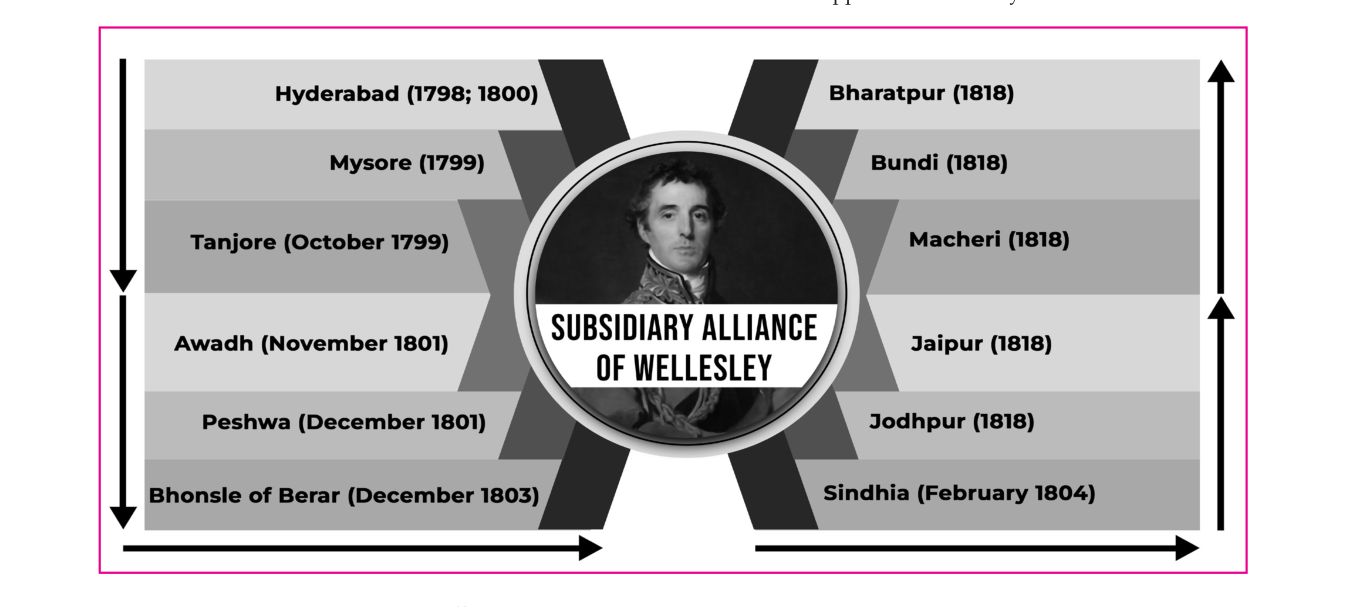
The Subsidiary System The subsidiary alliance system was used by Lord Wellesley, who was governor-general from 1798-1805, to build an empire in India.
Main Features of Subsidiary Alliance
Any Indian ruler who entered into the subsidiary alliance with the British had to maintain a contingent of British troops in his territory. It was commanded by a British officer. The Indian state was called ‘the protected state’ and the British hereinafter were referred to as ‘the paramount power’. It was the duty of the British to safeguard that state from external aggression and to help its ruler maintain internal peace. The protected state should give some money or give part of its territory to the British to support the subsidiary force.
The protected state should cut off its connection with European powers other than the English and with the French in particular.
The state was also forbidden to have any political contact even with other Indian powers without the permission of the British.
The ruler of the protected state should keep a British Resident at his court and disband his own army. He should not employ Europeans in his service without the sanction of the paramount power.
The paramount power should not interfere in the internal affairs of the protected state.
Benefits to the British
It increased the military strength of the Company in India at the expense of the protected states.
The territories of the Company were free from the ravages of war thereby establishing the stability of the British power in India.
The position of the British was strengthened against its Indian and non-Indian enemies. Under the system, expansion of British power became easy.
Defects of the Subsidiary System
The immediate effect of the establishment of subsidiary forces was the introduction of anarchy because of the unemployment of thousands of soldiers sent away by the Indian princes.
The freebooting activities of disbanded soldiers were felt much in central India where the menace of Pindaris affected the people.
Further, the subsidiary system had a demoralizing effect on the princes of the protected states. Safeguarded against external danger and internal revolt, they neglected their administrative responsibilities. They preferred to lead easy-going and pleasure- seeking lives. As a result, misgovernment followed.
In course of time, the anarchy and misrule in several states had resulted in their annexation by the British. Thus, the subsidiary system proved to be a preparation for annexation.
Furthermore, the British collected very heavy subsidies from the protected princes and this had adversely affected their economy.
Enforcement of the Subsidiary System
The Indian rulers who accepted the Subsidiary Alliance included the Nizam of Hyderabad (1798, 1800), the rulers of Mysore and Tanjore (1799), the Nawab of Awadh (1801), the Peshwa and Bhonsle Raja of Berar (1801, 1803), the Sindhia (1804), Rajput states like Jodhpur, Jaipur, Macheri, Bundi, Bharatpur (1818), and the Holkars, who were the last Maratha confederation to join in 1818.
Sir George Barlow and Lord Minto
Sir George Barlow was the next Governor-General for two years (1805-07). The Vellore Mutiny of 1806 took place during his administration. He was succeeded by Lord Minto (1807-13) who concluded the Treaty of Amritsar with Ranjit Singh of Punjab in 1809. The Charter Act of 1813 was passed during this period.
LORD HASTINGS (1813-1823)
Lord Hastings became Governor- General in 1813. He adopted a vigorous forward policy and waged wars extensively.
Suppression of the Pindaris
The first reference about them is during the Mughal invasion of Maharashtra. They did not belong to any particular caste or creed.
They used to serve the army without any payment but instead were allowed to plunder. During the time of Baji Rao I, they were irregular horsemen attached to the Maratha army. It is worth mentioning here that they never helped the British.
They were mostly active in the areas of Rajputana and the Central Provinces and subsisted on plunder.
Their leaders belonged to both the Hindu as well as the Muslim communities. Chief amongst them were Wasil Muhammad, Chitu and Karim Khan. They had thousands of followers.
In 1812, the Pindaris plundered the districts of Mirzapur and Shahabad and in 1815 they raided the Nizam’s dominions. In 1816, they plundered the Northern Circars.
Lord Hastings determined to suppress the Pindaris. For this he gathered a large army of 1,13,000 men and 300 guns and attacked the Pindaris from four sides.
He himself took command of the force from the north while Sir Thomas Hislop commanded the force from the south.
By 1818, the Pindaris were completely suppressed and all their bands disintegrated.
Karim Khan was given a small estate in the Gorakhpur district of the United Provinces. Wasil Muhammad took refuge in the Scindia’s camp but the latter handed him over to the British. Wasil committed suicide in captivity and Chitu escaped to the forest, where a tiger killed him. Thus, by 1824, the menace of the Pindaris came to an end.
Reforms of Hastings
He approved the Ryotwari system of land revenue introduced in the Madras Presidency by Sir Thomas Munroe.
Hastings had also encouraged the foundation of vernacular schools by missionaries and others. In 1817, the Hindu College was established at Calcutta by the public for the teaching of English and western science. Hastings was the Patron of this college. He encouraged the freedom of the Press and abolished the censorship introduced in 1799. The Bengali Weekly, Samachar Darpan was started in 1818 by Marshman, a Serampore missionary.
LORD WILLIAM BENTINCK (1828-1835) Policy Towards Indian States
William Bentinck adopted a policy of non-intervention and non-aggression with Indian states. If at all he interfered in the affairs of the Indian states, it was only to end any form of misgovernment and never to annex any territory.
Mysore
In Mysore, Hindu rule under Krishnaraja III was restored by Wellesley. In the beginning, the young Raja functioned well along with his able minister Puranaiya.
Later, when the young raja assumed full control of the government, he proved incompetent. The peasantry of the state suffered from many grievances. There was no redressal.
Consequently, a revolt of the peasants broke out in 1830 and it was suppressed with the help of an army from Madras.
Nonetheless, the British authorities took over the administration of Mysore State and placed it under the control of a commissioner Sir Mark Cubbon. The Raja was given a pension.
Sir Mark Cubbon was commissioner from 1834 to 1861 and his administration was beneficial to the people of Mysore. Even today, the famous Cubbon Park in Bangalore city has been named after him to remind his services to Mysore.
Coorg war of 1834
Vira Raja was a ruthless ruler of Coorg who treated his people with savage barbarity and killed all his male relatives. Lord William Bentinck decided to deal with him effectively and sent Colonel Lindsay to capture Mercara, the capital of the Coorg state. The Raja was deposed in 1834 and the state was annexed.
Relations with Ranjit Singh
Lord William Bentinck was the first Governor-General to visualize a Russian threat to India. Hence, he was eager to negotiate friendly relations both with the ruler of Punjab, Maharaja Ranjit Singh and also with the Amirs of Sind.
His earnest desire was that Afghanistan should be made a buffer state between India and any possible invader. As an initial measure, an exchange of gifts took place between Lahore, the capital of Punjab and Calcutta, the seat of Governor-General.
It was then followed by the meeting of Bentinck and Ranjit Singh on 25 October, 1831 at Rupar on the bank of the river Sutlej amidst show and splendour.
The Governor-General was successful in winning the friendship of Ranjit Singh and the Indus Navigation Treaty was concluded between them.
This treaty opened up the Sutlej for navigation. In addition, a commercial treaty was negotiated with Ranjit Singh. A similar treaty was also concluded with the Amirs of Sind.
Reforms of Lord William Bentinck
The advent of Lord William Bentinck ushered in a new era in the annals of India in many ways. Although his tenure of office covered only a short span of seven years, it saw a period of enduring reforms. They may be classified as financial, administrative, social and educational.
Financial Reforms
When Bentinck assumed the Governor-Generalship in 1828, the financial position of the Company was poor. It became necessary on the part of the Governor-General to take effective steps to improve the financial condition. To achieve this, he adopted the following measures:
He reduced the salaries and allowances of all officers and additional staff were removed.
In the military department, he abolished the system of double batta. (Batta was an allowance to troops on active service.)
Administrative Reforms
Bentinck’s administrative reforms speak of his political maturity and wisdom. In the judicial department he abolished the provincial courts of appeal established by Cornwallis.
Another good measure of Bentinck was the introduction of local languages in the lower courts and English in the higher courts in the place of Persian.
He launched the revenue settlements of the North West Province under the control of R.M. Bird. This settlement was for a period of 30 years and it was made either with the tillers of the soil, or with the landowners.
Social Reforms
The social reforms of William Bentinck made his name immortal in the history of British India. These include the abolition of Sati, the suppression of Thugs and the prevention of female infanticide.
Abolition of Sati
The practice of sati, the age-old custom of burning widows alive on the funeral pyre of their husbands, was prevalent in India from ancient times.
This inhuman social custom was very common in northern India more particularly in Bengal. Bentinck was greatly distressed when he received a report of 800 cases of sati in a single year and that from Bengal.
He was determined to abolish this practice which he considered an offense against natural justice. Therefore, he became a crusader against it and promulgated his Regulation XVII on 4 December 1829 prohibiting the practice of sati.
Those who practiced sati were made liable for punishment by law courts as accessories to the crime. The Regulation was extended to the Madras and Bombay Presidencies in 1830.
Suppression of Thugs
The most commendable measure which Bentinck undertook and which contributed to the material welfare of the people was the suppression of the thugs.
They were hereditary robbers. They went about in small groups of fifty to hundred posing as commercial gangs or pilgrims strangling and robbing peaceful travellers.
They increased in number in central and northern India during the 18th century when anarchy reigned after the disintegration of the Mughal Empire.
A campaign was systematically organised by Colonel Sleeman from 1830 against the thugs. During the course of five years nearly 2000 of them were captured.
A greater number of them were exterminated and the rest were transported to the Andaman and Nicobar Islands. For his role in the suppression of thugs, Sir William Sleeman was known as “Thugee Sleeman”.
Female Infanticide
Female infanticide was one of the horrible and heartless deeds committed even by civilized people. This practice of killing female infants was very much prevalent in places like Rajputana, Punjab, Malwa and Cutch.
Bentinck took effective steps to prevent the ritual of child sacrifice at Saugar Island in Bengal. He not only prohibited female infanticide but declared them as punishable crime.
Introduction of English Education
The introduction of English Education was a significant event of Lord William Bentinck’s administration. He appointed a committee headed by Lord Macaulay to make recommendations for the promotion of education.
In his report, Macaulay emphasized the promotion of European literature and science through English medium to the people of India.
This recommendation was wholeheartedly accepted by William Bentinck. The Government Resolution in 1835 made English the official and literary language of India. In the same year, William Bentinck laid the foundation of the Calcutta Medical College.
LORD DALHOUSIE (1848-1856)
Appointed as Governor-General of India in 1848, succeeding Lord Hardinge, Dalhousie, aristocratic and autocratic by nature, embraced his role decisively. Unlike his predecessors, who avoided annexation when possible, Dalhousie pursued annexation wherever it could be justified, whether through war or peaceful means, marking his tenure with significant events across various domains.
Doctrine of Lapse
Dalhousie also took advantage of every opportunity to acquire territory by peaceful means. The East India Company was rapidly becoming the predominant power in India.
It had concluded alliances with Indian rulers. It promised to support them and their heirs in return for various concessions. Although this type of agreement favoured the British, Dalhousie sought to acquire even more power.
According to the Hindu Law, one can adopt a son in case of no male heir to inherit the property. The question arose whether a Hindu ruler, holding his state subordinate to the paramount power, could adopt a son to succeed his kingdom. It was customary for a ruler without a natural heir to ask the British Government whether he could adopt a son to succeed him. According to Dalhousie, if such permission was refused by the British, the state would “lapse” and thereby become part of British India. Dalhousie maintained that there was a difference in principle between the right to inherit private property and the right to govern. This principle was called the Doctrine of Lapse.
Although the Doctrine of Lapse is often linked to Lord Dalhousie, he did not originate it; its frequent application during his tenure as governor-general was due to the occurrence of several significant cases where it could be enforced.
Annexed Lapsed States
The Doctrine of Lapse was applied by Dalhousie to Satara and it was annexed in 1848. Jhansi and Nagpur were annexed in 1854. The other small states included Jaitpur (Bundelkhand), Sambhalpur (Orissa), and Baghat (Madhya Pradesh). As a result of these annexations, a large part of the Central Provinces came under British rule. The new province was governed by a Chief Commissioner from 1861. Although the Doctrine of Lapse cannot be regarded as illegal, its application by Dalhousie was disliked by Indian princes. The advantages of the annexations of Satara, Jhansi and Nagpur were substantial to the British. Dalhousie was blamed for using the Doctrine of Lapse as an instrument in pursuing his policy of annexation. After the Mutiny of 1857, the doctrine of lapse was withdrawn.
Annexation of Awadh
Lord Dalhousie directed Sleeman, the Resident in Awadh, to make a tour throughout the state and ascertain the actual
Lord Dalhousie instructed Sleeman, the Resident in Awadh, to personally tour the region and assess the state of affairs. Sleeman's report highlighted the widespread anarchy in the area. In 1854, his successor, Outram, submitted a report that corroborated these findings. While Dalhousie was initially reluctant to proceed with annexation, favoring direct British administration while allowing the Nawab to retain his titles and rank, the Court of Directors mandated annexation and the abolition of the throne in 1856. Nawab Wajid Ali Shah refused to sign a treaty relinquishing his rights and was subsequently exiled to Calcutta. Dalhousie’s annexation of Oudh, the last one among his annexations, created great political danger. The annexation offended the Muslim elite. More dangerous was the effect on the British army’s Indian troops, many of whom came from Oudh, they had occupied a privileged position before its annexation. Under the British Government they were treated as equals with the rest of the population. This is a loss of prestige for them. In these various ways, the annexation of Oudh contributed to the Mutiny of 1857.
Domestic Reforms of Dalhousie
His greatest achievement was the moulding of the new provinces into a modern centralized state. For the newly acquired territories, he introduced a centralized control called “Non-Regulation System”. Under this system a commissioner was appointed for a newly acquired territory.
Under military reforms Dalhousie shifted the headquarters of Bengal Artillery from Calcutta to Meerut. Shimla was made the permanent headquarters of the army. Railways
The introduction of railways in India inaugurated a new economic era. There were three major reasons for the British to take interest in its quick development.
The first reason was commercial, the second main reason was administrative and the third reason was defence.
Lord Dalhousie’s contribution in the development of railways is worth commending. In 1853, he penned his Railway Minute formulating the future policy of railways in India.
He started the “guarantee system” by which the railway companies were guaranteed a minimum interest of five percent on their investment.
The government retained the right of buying the railway at the end of the period of contract. The first railway line
Policy OriginatorYear Policy of Ring Fence Warren Hastings1773• connecting Bombay with Thane was opened in 1853. Railway lines connecting from Calcutta to the Raniganj coal-fields were opened in 1854 and from Madras to Arakkonam in 1856.
Telegraph
In 1852, O’Shaughnessy was appointed the Superintendent of the Telegraph Department by Lord Dalhousie. Main cities of the country viz Calcutta, Peshawar, Bombay and Madras were telegraphically connected.
During the 1857 Revolt, the system of telegraphic communication proved a boon for the English and the military value of Dalhousie’s creation was much realized at that time.
Postal Reform
The foundation of the modern postal system was laid down by Lord Dalhousie. A new Post Office Act was passed in 1854.
Consequently, irrespective of the distance over which the letter was sent, a uniform rate of half an anna per post card was charged throughout India. Postage stamps were introduced for the first time.
Education
Dalhousie had also evinced in the development of education. The educational Despatch of Sir Charles Wood (1854) was considered the “Intellectual Charter of India”.
It provided an outline for the comprehensive scheme of education at primary, secondary and collegiate levels.
Departments of Public Instructions were organized. The Universities of Calcutta, Bombay and Madras were founded in 1857.
Public Works Department
Before the period of Dalhousie, the job of the Public Works Department was done by the Military Board. Dalhousie created a separate Public Works Department and allocated more funds for cutting canals and roads.
The Upper Ganges Canal was completed in 1854. Many bridges were constructed. By modernizing the Public Works Department, he laid the foundations of the engineering service in India.
Features To defend the frontiers by creating buffer zones Ally states need to maintain subsidiary alliance During war with Mysore and Marathas
Subsidiary AllianceWellesly1798•
Policy of Paramountcy Warren Hastings 1813•
Doctrine of LapseDalhousie 1848•
Forward Policy Auckland1836•
Policy of Masterly John Lawrence 1865 Inactivity
Policy of Proud ReserveLytton1876 To keep check on French expansion in India Company forces to be placed in signatory state’s capital Company assured protection to the state from internal or external aggression No European alliance without permission from the Governor General No investments can be made except by British Princely states were defined as protected under guardianship of the British who were paramount and whose authority could not be questioned States had to act subordinate to the British and had to extend their cooperation An adopted son could not be declared as the successor of the state and ultimately state was to be annexed by the British in the absence of a legal heir Used the shortcomings of Hindu Laws and Indian customs Awadh was annexed under this as well as on the charges of misgovernance On the suspicion of a Russian attack on the British territories in India through the north western front, this policy was adopted Under the policy, the neighbouring countries of the vulnerable border should either be annexed or won over in order to guard the frontiers It rested on two conditions: Peace at the frontier was not disturbed No candidate in civil war sought foreign help It aimed at having scientific frontiers and safeguarding the British sphere of influence