Whatsapp 88106-52225 For Details
Get Free IAS Booklet
Get Free IAS Booklet
In this unit
We will delve into Revolutionary Activities during the 1920s. We will discuss the HRA, HSRA, Bengal, Chittagong Armoury Raid, Kakori Conspiracy Case, and the HSRA’s actions, concluding with the poignant note of freedom fighters involved in these activities.
The world economic situation worsened during the First World War. The peacetime industries and agriculture were in a miserable shape in all the belligerent countries. This was accompanied by direct and indirect taxes, which were levied on workers and peasants to replenish the empty treasury. The British government was aware of the storm of political feeling in India during the period of the First World War. The threat of revolutionary “terrorism” and Bolshevism goaded the British to arm its Indian administration with powers of preventive detention. There was a chorus of universal condemnation joined even by the sophisticated elements of Indian polity like the moderates and the Congress. However, the sudden suspension of the non-cooperation movement after Chauri Chaura led to utter frustration among Mahatma’s young cadres. Many young men like Chandra Shekhar Azad, Bhagat Singh, Sukhdev, Manmath Nath Gupta and many others could not appreciate Gandhiji’s concept of combining politics with morality which had dealt a fatal blow to the popular movement. They were drawn towards the violent creed and thus, the sudden bottling up of a great movement saw the revival of the revolutionary activities in India.
MAJOR INFLUENCES
A surge in working-class trade unionism emerged after the War, with revolutionaries aiming to channel the revolutionary potential of this rising class toward the nationalist struggle.
The Russian Revolution of 1917 and the successful establishment of the Soviet state inspired revolutionary movements globally.
Newly formed communist groups emphasized Marxism, socialism, and the empowerment of the proletariat, influencing revolutionary thought.
Journals like Atmashakti, Sarathi, and Bijoli published articles and memoirs celebrating the selflessness of revolutionaries.
Literary works, including Bandi Jiwan by Sachin Sanyal and Pather Dabi by Sharatchandra Chatterjee, highlighted themes of resistance and sacrifice, inspiring the revolutionary spirit.
REVOLUTIONARY ACTIVITIES IN PUNJAB-UNITED PROVINCES-BIHAR Birth of HRA (Hindustan Republican Association)
The revolutionary activity in this region was dominated by the Hindustan Republican Association/Army or HRA.
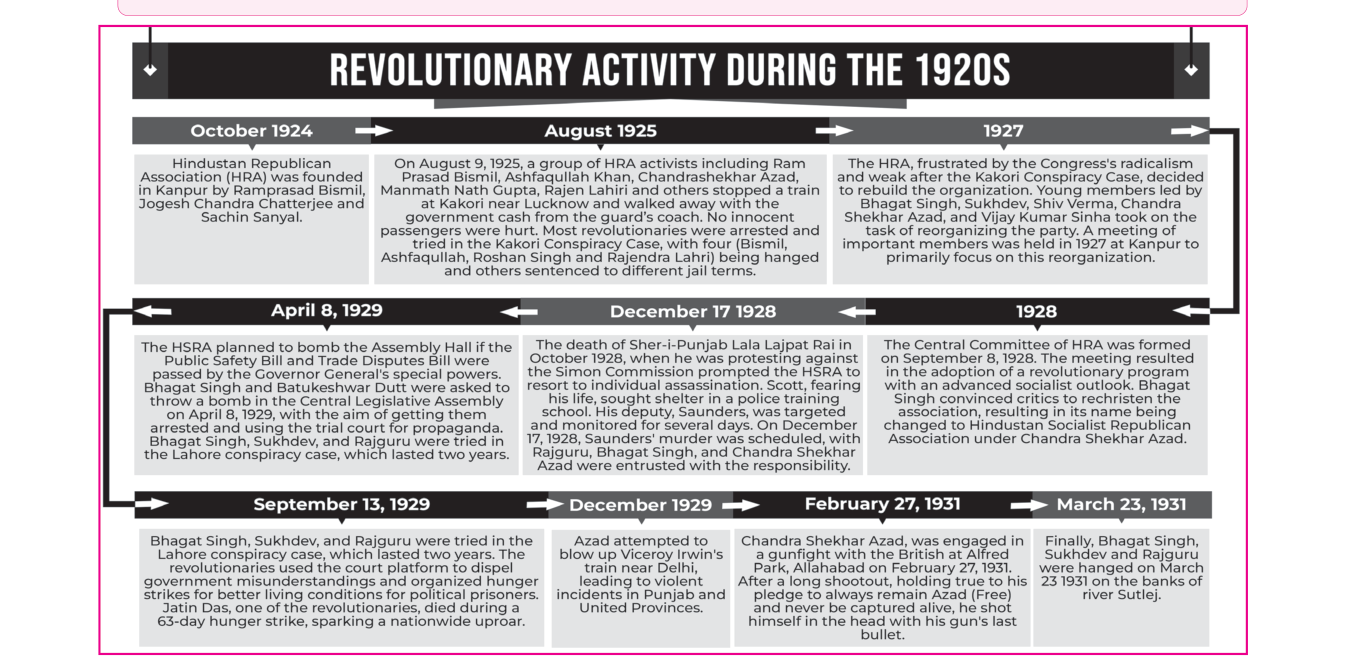
The HRA was founded in October 1924 in Kanpur by Ramprasad Bismil, Jogesh Chandra Chatterjee and Sachin Sanyal.
The Constitution of the HRA declared its objective “to establish a Federated Republic of the United States of India by an organised and armed revolution.”
The association envisaged that the “basic principle of the republic shall be universal suffrage and the abolition of all systems which make any kind of exploitation of man by man possible.”
It was committed to “the organisation of labour and kisans” as it was necessary for the successful struggle against capitalism and feudalism.
The Hindustan Republican Association shifted ideologically from a narrow selfless patriotism to a vague sort of socialism—and even internationalism. This came out clearly, in its pamphlet entitled ‘The Revolutionary’ published on January 1, 1925, and which was said to be the manifesto of the revolutionary party of India.
Kakori Conspiracy Case
One of the major actions of HRA was the Kakori Train dacoity Case, which is also known as Kakori Conspiracy Case.
The HRA did believe in armed action against the imperialist government, they planned this dacoity to generate money, which they desperately needed.
On August 9, 1925, a group of HRA activists including Ram Prasad Bismil, Ashfaqullah Khan, Chandrashekhar Azad, Manmath Nath Gupta, Rajen Lahiri and others stopped a train at Kakori near Lucknow and walked away with the government cash from the guard’s coach.
No innocent passenger was harmed. Within a few months, most of the revolutionaries were arrested and tried in the famous Kakori Conspiracy Case.
Four of them including Bismil, Ashfaqullah, Roshan singh and Rajendra Lahri were hanged while others were sentenced for different jail terms.
Formation and Activities of HSRA (Hindustan Socialist Republican Association)
The late 1920s saw severe economic depression followed by intense labour upsurge. The Indian working class was increasingly coming under Bolshevik influence leading to the formation of a number of labour unions with distinct communist leanings.
Besides, there were youth movements in 1928 and 1929, raising the demand for complete independence and radical social and economic changes.
Both Jawaharlal Nehru and Subhas Bose organised the Independence for India League as a pressure group within the Congress to carry forward the campaign for acceptance of the goals of complete independence.
The HRA was frustrated with the verbal radicalism of the Congress, and was itself rendered weak and powerless after the Kakori Conspiracy Case. Thus, it decided to rebuild the organisation.
Most of the experienced revolutionaries were behind the bars and the rest were underground to escape arrest. In these circumstances, the young members of the HRA led by Bhagat Singh, Sukhdev, Shiv Verma, Chandra Shekhar Azad and Vijay Kumar Sinha, undertook the task of reorganising the party.
A meeting of the important members was held in 1927 at Kanpur, primarily for this purpose. It was soon followed by another crucial meeting for the formation of the Central Committee of HRA on 8 and 9 September, 1928 in the romantic surroundings of the ruins of the Feroz Shah Kotla at Delhi.
This was an important meeting which was attended by ten participants from U.P., Bihar, Punjab and Rajasthan. The meeting resulted in the adoption of a revolutionary programme with an advanced revolutionary socialist outlook for their organisation. The participants included Bhagat Singh, Sukhdev, Bhagwaticharan Vohra from Punjab and Bejoy Kumar Sinha, Shiv Verma and Jaidev Kapur from the United Provinces.
Finally Bhagat Singh and his friends succeeded in convincing their critics who agreed to rechristen the association by including socialism as one of the main goals. Thus, the name of the Hindustan Republican Association was finally changed to Hindustan Socialist Republican Association under the leadership of Chandra Shekhar Azad.
The HRA aimed at the establishment of a Federal Republic of the United States of India where the basic principle would be adult suffrage, while the HSRA, as indicated by its name, proclaimed the goal of establishing a socialist republic.
Long before this, Bhagat Singh and his comrades formed Naujawan Bharat Sabha in Lahore with a distinct goal of establishing a socialist republic in India.
Bhagat Singh was convinced that the salvation of India lay not merely in political independence but in economic freedom. The newly formed HSRA also decided that the soldiers of the HSRA will leave their homes, keep no contact with their families and devote full time and energy for the party work. Religious communalism and ritualism were banned.
Saunders’ murder
The trade union movement steadily advanced, promoting a militant ideology that nurtured class consciousness among workers.
Amid this charged atmosphere, the Simon Commission arrived in Bombay on February 3, 1928. This all-white commission was tasked with assessing India’s political situation.
The exclusion of Indians from the Commission was seen as a national insult, sparking unanimous opposition from all major political parties.
The Commission faced widespread boycotts, with a hartal in Bombay and protests echoing slogans like "Go Back Simon."
The death of Lala Lajpat Rai from injuries sustained during a lathi charge on an anti-Simon Commission protest (October 1928) reignited the HSRA revolutionaries' resolve for individual assassination.
Lala Lajpat Rai's death outraged the nation’s youth, who perceived it as a national humiliation. The HSRA resolved to assassinate Scott, the police chief involved in the lathi charge.
Fearful for his safety, Scott confined himself to the police training school, prompting the HSRA to target Saunders, his deputy, instead.
On December 17, 1928, Saunders was assassinated by Rajguru, Bhagat Singh, and Chandra Shekhar Azad, who had meticulously planned the operation.
Assembly Bomb Explosion
The HSRA planned to bomb the Assembly Hall if the Public Safety Bill and the Trade Disputes Bill were passed by the special powers of the Governor General.
Bhagat Singh and Batukeshwar Dutt were asked to throw a bomb in the Central Legislative Assembly on April 8, 1929.
The bombs had been deliberately made harmless and were aimed at making ‘the deaf hear’.
The objective was to get arrested and to use the trial court as a forum for propaganda so that people would become familiar with their movement and ideology.
Action against the Revolutionaries
Bhagat Singh, Sukhdev and Rajguru were tried in the Lahore conspiracy case.
The trial went on for about two years, and the revolutionaries used the court platform very effectively to clear the misunderstandings being spread by the government about them.
They even organised long hunger strikes to fight for better living conditions and facilities for all the political prisoners in jail who were treated like ordinary criminals by the British government.
One of the revolutionaries Jatin Das sacrificed his life on September 13 1929, after 63 days of hunger strike, which caused a huge uproar in the whole of India.
Finally, Bhagat Singh, Sukhdev and Rajguru were hanged on March 23 1931 and were cremated on the banks of river Sutlej.
Azad was involved in a bid to blow up Viceroy Irwin’s train near Delhi in December 1929. During 1930 there were a series of violent actions in Punjab and towns of United Provinces.
Azad died in a police encounter in a park in Allahabad in February 1931.
REVOLUTIONARY ACTIVITIES IN BENGAL
In the 1920s, several revolutionary groups reorganized their underground operations, while some worked alongside the Congress, gaining access to the masses and strengthening the Congress’s organizational presence in towns and villages.
Many revolutionaries supported C.R. Das in his Swarajist efforts. After his death in 1925, the Bengal Congress split into two factions—one led by J.M. Sengupta, supported by the Anushilan group, and the other by Subhash Bose, backed by the Yugantar group.
Reorganized groups undertook actions such as an assassination attempt on Calcutta Police Commissioner Charles Tegart by Gopinath Saha in 1924, though the attempt mistakenly killed another man named Day.
Armed with a new ordinance, the government launched a severe crackdown on revolutionaries, leading to arrests, including that of Subhash Bose, and Gopinath Saha's execution by hanging.
Despite setbacks from government repression and internal factionalism, revolutionary activity saw a revival, with groups like the Chittagong group led by Surya Sen becoming prominent.
Chittagong Armoury Raid (April 1930)
While Bhagat Singh and his associates were in prison and facing trial in the Lahore Conspiracy Case, Surya Sen planned a revolutionary action along with his associates Anant Singh, Ganesh Ghosh and Loke Nath Baul in Bengal called the Chittagong Armoury Raid.
The well organised raid was conducted on April 18 1930 under the leadership of Surya Sen, popularly called Master da.
They took control of the telegraph office as well as telephone exchange and cut off all communication channels to Calcutta and Dacca and the other group took control of the club.
They distributed leaflets explaining the object of the raid, the leaflets were signed by Surya Sen as president of the Indian Republican Army, Chittagong branch.
The attacks continued for a few years and gradually the revolutionaries were arrested and punished in the trials.
Surya Sen himself was arrested in February 1933, while Kalpana Dutt and Tarakeshwar Dastidar were captured on May 19 1933.
In the Armoury Raid Case, Surya Sen and Dastidar were sentenced to death while several others were sentenced for life imprisonment. Surya Sen was hanged on January 12 1934 in Chittagong jail with his last message of “ideal and unity” and “a golden dream...a dream of free India.”
Role of Women in Revolutionary Movement in Bengal
Young women played a significant role under Surya Sen, actively participating in the revolutionary movement by providing shelter, delivering messages, and even engaging in armed combat.
Notable women revolutionaries in Bengal included Pritilata Waddedar, who lost her life while leading a raid.
Kalpana Dutt, another prominent figure, was arrested, tried alongside Surya Sen, and sentenced to life imprisonment.
Santi Ghosh and Suniti Chandheri, two schoolgirls from Comilla, assassinated the district magistrate in December 1931.
Bina Das made a bold attempt to assassinate the governor by firing at him during her convocation ceremony in February 1932.