Whatsapp 88106-52225 For Details
Get Free IAS Booklet
Get Free IAS Booklet
RISE OF IMPERIALISM IN INDIA [15th C TO MID 19th C]
In this unit
We will delve into the historical narrative of Imperialism's Rise in India during the 15th Century. We will track pivotal events like the fall of Constantinople, setting the stage for European powers like the Portuguese, English, Dutch, and French to leave an enduring imprint on Indian history.
THE FALL OF CONSTANTINOPLE AND EUROPEAN EXPLORATION BACKGROUND
The fall of Constantinople in 1453 to the Ottoman Empire marked a turning point in history, disrupting traditional land routes to Asia. This geopolitical shift prompted European powers to seek new maritime routes to access valuable resources from the East, particularly spices, silks, and precious metals. In this context, the European exploration of India gained momentum, shaping the course of history and fostering significant interactions between the East and the West.
Impact on India
Cultural Exchange: The European exploration of India facilitated a rich cultural exchange, with interactions influencing art, architecture, cuisine and language. Example: The Feast of St. Xavier in Goa blends Portuguese Catholic traditions with Indian cultural elements
Colonialism and the Portuguese Presence: Portugal’s establishment of colonies in Goa and other parts of India laid the groundwork for European colonial rule.
Dutch and English Trading Posts: The Dutch and English East India Companies established trading posts in India, competing for control over lucrative spice trade routes. This laid the foundation for later colonial rule. Example: Pulicat, on the Coromandel Coast and Cochin in Kerala, became crucial Dutch strongholds, Madras (Chennai), Bombay (Mumbai), and Calcutta (Kolkata) emerged as major English trading hubs.
British Colonialism: The European exploration of India set the stage for British colonial dominance, as the East India Company gradually expanded its influence, leading to direct British rule in the 19th century. Example: The establishment of Calcutta as the capital of British India marked a pivotal moment in British colonial administration. The fall of Constantinople set European sails on a transformative journey. From Vasco da Gama’s sea odyssey to the lingering spices of Goa, exploration reshaped history. India’s diverse culture, influenced by these encounters, stands testament to a journey beyond horizons.
RISE OF IMPERIALISM IN INDIA
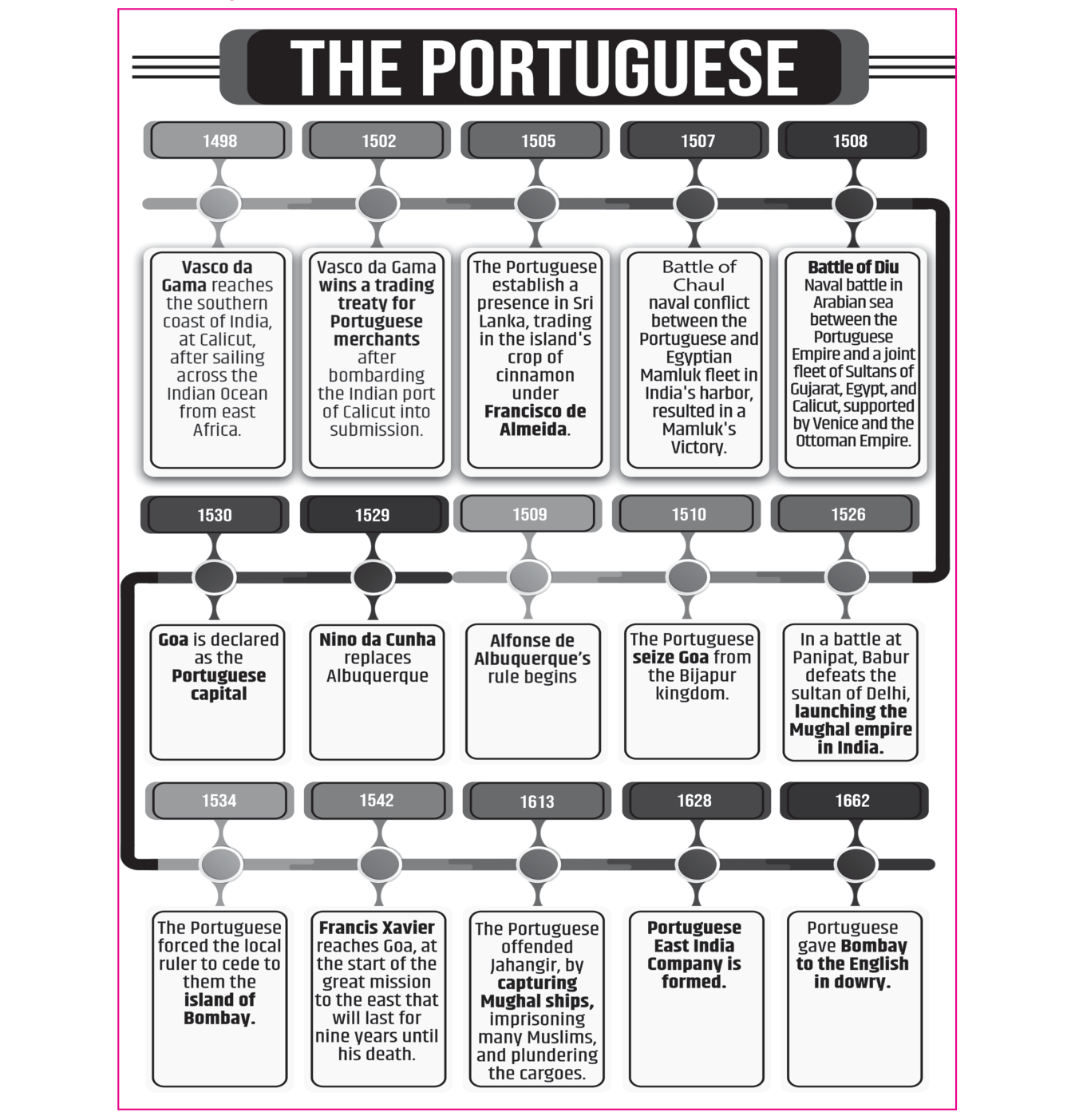
Disruptions in trade routes and changing political scenarios in the Middle East compelled the European traders to search for new trading routes to India. After many efforts the European traders first appeared on the Indian sea coast at the end of the fifteenth century.
The coming of Vasco de Gama at Calicut in May, 1498 marked the beginning of a new era in Euro-Asian trade.
Initially the Portuguese established their control over the mercantile activity between India and Europe since they had discovered the route to India via Cape of Good Hope.
However, Portugal lacked a powerful merchant class and the Crown took the lead in providing finances and political support to the Portuguese overseas mercantile enterprises.
By the end of the sixteenth century, the Dutch and English corporate merchant companies entered the arena and started challenging the Portuguese monopoly.
These commercial empires were sustained by the naval supremacy of their nations and were based on attempts to monopolise trade.
Their activities were confined to coastal port cities in India and did not impinge upon the sovereignty of the indigenous polities to any great extent.
They utilised the existing network of indigenous system of procurement and trade.
They generally exchanged Indian goods for “bullion”. This turned the balance of foreign trade in India’s favour and became an instrument of economic growth. This was a reason for the tolerant view of Indian rulers towards them.
The French were the first to attempt some sort of territorial empire in India on a large scale. The British East India Company later imitated their methods followed by the Dutch. There also emerged conflicts amongst these European powers for securing trade monopolies and territorial control.
Arrival of the Portuguese
Portuguese monarch, D. Manuel (1495-1521)
The desire of the to open a direct sea-route to India was primarily commercial, though sometimes it was disguised under the garb of the Christian religious ideology which stressed the proselytising mission of Christianity.
The basic aim of the Portuguese was to enrich themselves and their state by establishing their monopoly over the “spice trade” with Europe - a lucrative business of the times.
The Portuguese Sea-Borne Empire (1500-1640)
Henry the Navigator, was a central figure in the early days of the Portuguese Empire and in the 15th-century European maritime discoveries and maritime expansion. Through his administrative direction, he is regarded as the main initiator of what would be known as the Age of Discovery.
In 1497, under the Treaty of Tordesillas (1494), the rulers of Portugal and Spain divided the non-Christian world between them by an imaginary line in the Atlantic.
Under the treaty, Portugal could claim and occupy everything to the east of the line while Spain could claim everything to the west.
The empire created by the attempts of the Portuguese was a maritime network within which territories, establishments, ships, persons and administrative arrangements in Asia and East Africa were placed subordinate to the Portuguese Crown.
In Lisbon, Casa da India, a royal trading firm headed this Sea-Borne “empire”.
In addition to the Crown, groups of merchants, financiers and bankers of various countries of Europe were also associated with the Casa da India.
In Asia, the enterprise was under the control of an administrative set-up known as Estada da India (state in India).
Instruments of the Portuguese Commercial “Empire”
As the Portuguese reached India, they had successfully tried to monopolise trade in spices. Monopolise all eastern trade by excluding the competitors i.e., the Arabs.
Throughout the sixteenth century, a series of orders and instructions from Lisbon and Goa made it clear that trade in spices was reserved for the Portuguese Crown and its agents. This monopoly right was strictly enforced and the naval supremacy of the Portuguese played a significant role in it. The regulation and control of all sea-borne traffic was essential to achieve this aim. The Crown organised expeditions to specific places within Asia on a monopolistic basis.
Only designated ships could make a given voyage in a particular year. The cargo space on the royal ships were sold in the early sixteenth century to the private merchants on a high premium.
The Crown found such commercial ventures costly after the 1540s because the construction of ships became a costly affair.
The Portuguese state started issuing licenses to private merchants and individuals to undertake such commercial ventures.
These licenses were given out on several grounds such as a reward for military service; as dowries to daughters of prominent but impoverished fidalgos (son of somebody- someone important); as prerequisites of a particular post. But mostly, these licenses were given to the highest bidder and as such could be very profitable for the holder.
The Portuguese also tried to control and tax the trade carried on by the other traders on the Indian Ocean. The main instrument used was the Cartazes or passport backed up by the armadas.
The Portuguese justification for their attempt to control the sea trade in Asia was based on their claim to be the lords of the seas.
All the ships trading
• The Cartazes system
within Asia were thus required to take a pass The Cartazes System or Cartazes issued by a was a maritime control competent Portuguese system implemented by authority. The pass the Portuguese during the identified as the captain 16th century in the Indian of the ship, stated its size Ocean. Under this system, and what crew it carried.ships were required to obtain a pass known as
The quantity of arms and a "Cartazes" to navigate munitions allowed was in specific designated strictly limited. The ship areas. The Cartazes served had to call at a Portuguese as a permit issued by fort to pay custom duties Portuguese authorities, before it proceeded to its granting ships permission destination. to travel through or trade
The fee charged for in certain regions. Failure issuing the Cartazes was to possess a Cartazes often small, but the Portuguese led to the interception benefited in terms of and seizure of the ship, custom duties.allowing the Portuguese to control and monopolize
Later in the sixteenth trade routes in the Indian century, the Portuguese Ocean during that period. invented a new instrument of trade control, the Kafila. This consisted of a convoy of small local merchant ships guarded by a Portuguese fleet.
The basis of the Kafila principle was twofold: income for the Portuguese custom houses and protection for the native traders. Some Kafilas also brought food for the Portuguese forts and ports.
FROM TRADING TO RULING Vasco Da Gama
Vasco Da Gama's three ships, commanded by Abdul Majid, a Gujarati pilot, arrived in Calicut in May 1498, and their arrival had a significant impact on Indian history.
However, the Zamorin (Samuthiri), the Hindu ruler of Calicut, was unconcerned about the European's intentions. Indians, Arabs, east coast Africans, Chinese, Javanese and others had all participated in the Indian Ocean trading system for centuries, but they all followed certain unspoken rules of conduct and none of them sought total dominance, even though their goal was to make money. Vasco da Gama spent three months in India. He brought a wealth of goods back to Portugal, where he made a tidy profit by selling them in the European market.

The fact that Europeans would have had to pay 10 times as much for the same quantity of pepper elsewhere, where they would have to purchase it through Muslim intermediaries, demonstrated the significance of direct access to the pepper trade. Arriving in Calicut in September 1500, Pedro Alvarez Cabral embarked on a journey to trade for spices, negotiating and setting up a factory there.
In 1501, Vasco da Gama returned to India. When Vasco Da Gama joined his intense animosity and financial greed and exacted revenge on Arab shipping wherever he could hence , the Zamorin refused to excluded the Arabs merchants in favour of the Portuguese.
Vasco da Gama established a trading facility at “Cannanore”.
Over time, Cochin, Calicut and Cannanore emerged as significant trading hub of the Portuguese
Eventually, the Portuguese were granted authorization to fortify these centers under the guise of safeguarding the factories and their trading operations.
Francisco De Almeida
A governor in India was appointed for a three- year term by the King of Portugal in 1505, and the incumbent was given enough power to defend Portuguese interests.
The newly appointed governor, Francisco De Almeida, was instructed to take control of Aden, Ormuz and Malacca in order to strengthen Portuguese influence in India and obliterate Muslim trade.
Additionally, he was counseled to construct fortresses in Kilwa, Cannanore, Cochin and Anjadiva.
The united Egyptian and Gujarati navy killed Almeida's son in 1507 , when they routed the Portuguese squadron in a naval engagement off Diu in Chaul.
Almeida completely destroyed the two navies in the Battle of Diu the next year, in 1508, to exact revenge for his defeat.
Almeida’s vision was to make the Portuguese the masters of the Indian Ocean. His policy was known as the Blue Water Policy. This policy aimed at maintaining the Portuguese naval supremacy and had several components:
Cartazes and the Kafila system
Non-interference with the local politics
No evangelical activities by the Portuguese
Alfonso de Albuquerque
Albuquerque, who succeeded Almeida as the Portuguese governor in India, was the real founder of the Portuguese power in the East, a task he completed before his death. He was the real founder of Portuguese power in India.
By building bases that overlooked every sea entrance, he gave Portugal strategic supremacy over the Indian Ocean.
Portuguese strongholds were located at Ormuz, Malabar, and Malacca in East Africa, off the Red Sea.
By imposing a permit system for foreign ships and controlling the main shipbuilding hubs in the area, the Portuguese, led by Albuquerque, strengthened their grasp.
The Portuguese also achieved their goals because there was no timber available for shipbuilding in the Red Sea and Gulf regions.
Goa was taken easily by Albuquerque from the Sultan of Bijapur in 1510 , making it "the first bit of Indian territory to be under the Europeans since the time of Alexander the Great." The outlawing of sati in Goa was an intriguing aspect of his reign.
Since Albuquerque's time, Portuguese males who had traveled to India and remained there were encouraged to marry native women.
They established themselves as village landlords in Goa and the Province of the North, frequently constructing new roads and irrigation systems, bringing in new crops like cashew and tobacco , or cultivating better plantation varieties of coconut in addition to planting massive coconut groves to supply the demand for cordage and coir rigging.
In addition to being traders, they established themselves as expert craftsmen and artisans in the cities like Goa and Cochin. The majority of these Portuguese began to see their new communities as home instead of Portugal.
In the latter part of his rule, Albuquerque persecuted Muslims.
Nino da Cunha
Nearly a year after taking over as governor of Portuguese interests in India in November 1529, Nino da Cunha moved the Portuguese government's headquarters from Cochin to Goa.
In order to get support from the Portuguese during his war with the mughal emperor Humayun, Bahadur Shah of Gujarat gave them the island of Bassein in 1534, along with its resources and dependents.
A base in Diu was another promise he made to them. However, when Humayun left Gujarat in 1536, Bahadur Shah's ties with the Portuguese soured.
Bahadur Shah sought to raise a wall of division, after the town's residents began battling the Portuguese.
Contrary to this, the Portuguese initiated talks, during which the Gujarati ruler was invited to a Portuguese ship and assassinated in 1537.
With Hooghly as their headquarters, Da Cunha also made an effort to expand Portuguese influence in Bengal by relocating a large number of Portuguese citizens there.
Martin Alfonso de Souza
He was mainly known for introducing evangelical activities in India by allowing the entry of Christian missionaries.
It was during his rule Francis Xavier reached India and converted seven lakh untouchables to Christianity. He later on went to China and died there.
His followers brought back his remains and buried him in Goa as per his instructions.
St. Jesus Basilica stands in his memory to this day in Goa and an annual feast is organised in his honour.
Favourable Conditions for Portuguese
The northern region of India was heavily divided among numerous petty forces, with the exception of Gujarat, which was dominated by the strong Mahmud Begarha (1458–1511).
The Bahmani Kingdom was disintegrating into lesser kingdoms in the Deccan. None of the powers considered building up their naval forces, nor did they have a fleet worthy of the name.
The Chinese emperor's proclamation restricted the Chinese ships' ability to navigate in the Far East.
The Portuguese were more organized and cohesive than the Arab shipowners and merchants who had previously controlled the Indian Ocean commerce. Additionally, the Portuguese equipped their ships with cannons.
Portuguese State
Within fifty years of Vasco da Gama's arrival, Portuguese rule had spread to much of India's coastal regions.
They ruled over a small area with four significant ports and hundreds of cities and villages on the west coast, extending from Mumbai to Daman and Diu to the approaches to Gujarat.
They controlled a network of commercial posts and seaport castles in the south, including Mangalore, Cannanore, Cochin and Calicut.
On the east coast, the Portuguese founded further military installations and towns at San Thome in Chennai and Nagapattinam in Andhra.
A prosperous community had developed in Hooghly in West Bengal by the end of the sixteenth century.
It's interesting to note that the Portuguese, who arrived in India first among Europeans, were also the last to go. Before the Indian government reclaimed Goa, Daman, and Diu from them, it was 1961.
Religious Policy of the Portuguese
In North Africa, the Moors were the Portuguese's worst adversaries. So were The Arabs.
When the Portuguese arrived in the East, they carried with them the same desire to persecute all Muslims and to spread Christianity.
The Portuguese were initially quite tolerant of Hindus but intolerant of Muslims. However with the introduction of the Inquisition in Goa, things changed over time, and Hindus were punished as well.
However, despite this intolerance, the Jesuits had a positive impact at the Akbar's court, primarily because the Mughal emperor was interested in theological issues.
Akbar had sent a letter to the Goan authorities asking them to send two knowledgeable priests. Seeing an opportunity to convert the emperor, his court, and the populace to Christianity, the Church officials in Goa enthusiastically welcomed the invitation. Antonio Monserrate and Rodolfo Aquaviva, two Jesuit fathers, were chosen for the task.
Akbar called on them three times in total between 1583 and 1595 and the last one was attended by Fathers Jerome Xavier and Emanuel Pinheiro.
After taking the throne as Jahangir, Prince Salim reassured the Muslims by ignoring the Jesuit fathers. His brief separation from the Jesuits, however, gradually came to an end, and in 1606, he once more extended his favors to them.
Because of Jahangir's actions, the Jesuit missionaries began to hope that he would convert to Christianity. But these expectations were not fulfilled. Furthermore, the Portuguese viceroys' arrogant behavior strained relations with the Mughal emperor.
Portuguese Lose Favour with the Mughals
The Portuguese were outraged when the English were granted trading facilities.
But following discussions, the Portuguese and the Mughal ruler agreed on a truce.
The English ships were prevented from entering the port of Surat by the Portuguese. Unable to stop the Portuguese intrigues or monitor the erratic Mughal policies, a frustrated Hawkins departed the Mughal court in 1611.
Portuguese piracy also led to hostilities with the Mughal imperial authorities. When the Portuguese captured Mughal ships in 1613, imprisoned several Muslims, and looted the cargo, they outraged Jahangir.
However, the benefits that the Portuguese had at the Mughal court were permanently lost under Shah Jahan's rule.
Capture of Hooghly
According to an imperial Farman from 1579, the Portuguese had established themselves on a riverbank in Bengal, not far from Satgaon, to continue their commercial activity.
They strengthened their standing over time by erecting large structures, which caused the trade to move from Satgaon to the new port of Hooghly.
They established a monopoly on the production of salt, constructed their own custom home, and began rigorously enforcing the duty on tobacco, which had grown in importance as a commodity since its introduction at the start of the 17th century.
Three months after the siege of Hooghly started on June 24, 1632, it was captured.
The governor of Bengal, Qasim Khan, was directed by Shah Jahan to take action against the Portuguese. The Portuguese eventually fled Hooghly after a siege.
Significance of the Portuguese power on Indian land
The arrival of the Portuguese signaled the rise of naval might in addition to the start of what could be referred to as the European era.
A foreign power had arrived in India via the sea for the first time, although the Cholas and others had before been a maritime power.
Using the threat or actual use of force to obtain a monopoly over trade began when Portuguese ships began carrying cannon.
The Portuguese demonstrated military ingenuity in the sixteenth-century Malabar by using matchlock men, body armor and weapons that were landed from the ships.
The French and English were the first to adopt the technique, followed by the Marathas and Sikhs. These armies of sepoys became fresh instruments of empire in India.
The Portuguese were experts in using better methods at sea. Because their multidecked ships were built to withstand Atlantic gales rather than sailing ahead of the usual monsoons, they were able to carry more armaments.
But much more remarkable was the Portuguese ability to organize, as demonstrated by the establishment of royal arsenals and dockyards, the upkeep of a regular piloting system and the charting and matching of state troops versus private commerce ships.
The Mughals and Marathas may certainly have learnt from the Portuguese but the more certain heirs of this knowledge were other Europeans, especially the Dutch and English, in Asia.
In India, the memory of religious persecution and cruelty detracts from the other contributions made by the Portuguese in the cultural field.
The art of the silversmith and goldsmith flourished at Goa, and the place became a centre of elaborate filigree work, fretted foliage work and metal work embedding jewels.
However, though the interior of churches built under the Portuguese have plenty of woodwork and sculpture and sometimes painted ceilings, they are generally simple in their architectural plan.
The Portuguese also tried to monopolise horse trade by centralising the whole horse trade from Arabia and Persia via Goa. All ships coming from South Arabia or Hurmuz with horses could come only to Goa.
They also introduced several inventions such as the Printing Press, clock, etc. to India.
PHASE OF THE DUTCH DOMINATION (1600- 1680)
The Mughals' employment of field cannons and "artillery of the stirrup" may have been influenced by Portuguese practice.
However, an important military contribution made by the Portuguese onshore was the system of drilling groups of infantries, on the Spanish model, introduced in the 1630s as a counter to Dutch pressure.
The States-General, the national governing body of the Dutch republic, founded the Verenigde Oost-Indische Compagnie. The company was formed as a result of the merger of a few companies.
The Charter of States-General had given the company monopoly rights to trade in the east for 21 years.
Armed with this, the Dutch East India Company established its first factory at the Coromandel Coast which was the principal supply point of textile to the south-east Asian markets including the Spice Islands of Moluccas, Banda and Celebes and to the European markets.
By 1680, the Dutch and the English Companies accounted for practically the entire trade. The Dutch East India Company was dominant in this trade while the English East India Company started catching up by 1680 especially in the sphere of Euro-Asian trade.
Nature and Pattern of the Dutch Trade
While the Dutch ascendancy in the seventeenth century was based on their ability to compete in the market, they still made use of monopoly rights in paying the producers in the Spice Islands at low rates.
They also made use of force and violence to obtain exclusive rights in particular products and markets to minimise competition from the indigenous merchants.
The Dutch East India Company also utilised the pass system as evolved by the Portuguese to keep the Asian competitors out of the trade in monopoly products.
India remained a prominent supplier to the Dutch due to its role in Dutch company’s intra-Asian trade. Textiles from Coromandel and Gujarat were exchanged for pepper and other spices in the Indonesian archipelago. The Company also exported raw silk and opium from Bengal.
One significant aspect of this "bullion for goods" paradigm of Euro-Asian trade was that, for Europeans, the majority of trade gains came from selling Asian goods in Europe as opposed to selling European commodities in Asia.
Apart from bullion or precious metals, the Dutch also exported to India woollen, silk and other textiles manufactured mainly at Leiden, and non-precious metals such as lead, iron and mercury besides wine and beer.
In 1663, the Raja of Cochin managed to expel the Portuguese out of his kingdom with the help of the Dutch East India Company which obtained monopoly privileges similar to the Portuguese.
However, the Mughal administration exempted the Dutch and English Companies from the payment of the Indian transit (rahdari) duties, giving them a slight advantage over Indian merchants.
Administrative Functioning of the Dutch Factories
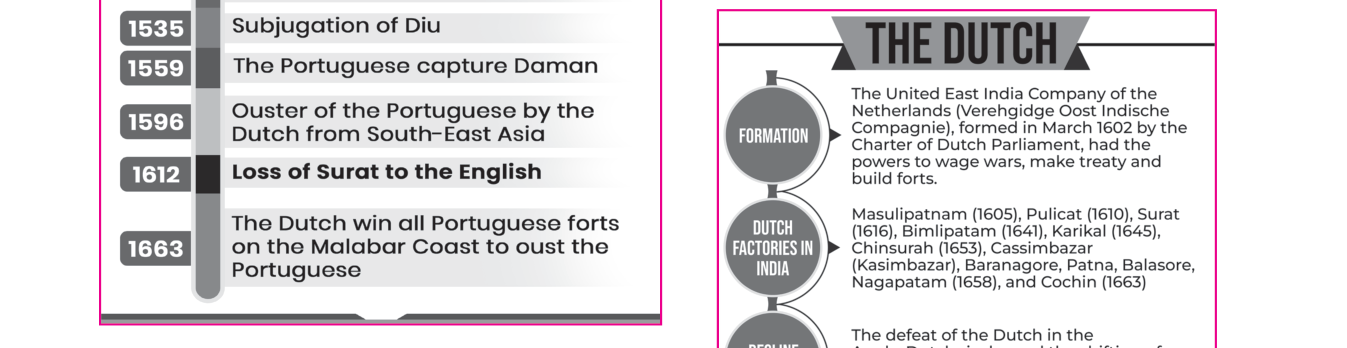
The Dutch East India Company established its first factory at Petapuli on the North Coromandel Coast in 1606. Another factory was established in the same year at the port of Masulipatnam.
They went on to establish trading centres at different parts of India and thus became a threat to the Portuguese. They captured Nagapatnam near Madras (Chennai) from the Portuguese and made it their main stronghold in South India.
In 1610, a factory at Pulicat was established which also became the headquarters of the Dutch directorate of the Coromandel. Fort Geldria was constructed at Pulicat in 1613.
Surat (1616), Bimlipatam (1641), Karaikal (1645), Chinsura (1653), Baranagar, Qasimbazar (near Murshidabad), Balasore, Patna, Nagapatnam (1658), and Cochin (1663) were the locations of their other major factories in India.
They brought with them textiles and silk from Bengal, Gujarat, and the Coromandel, saltpetre from Bihar, opium and rice from the Ganga valley, and indigo produced in the Yamuna valley and Central India.
A significant feature of factories in Bengal and Gujarat was the absence of military personnel (as employees). The Dutch and the European officials in Bengal and Gujarat were, thus, mostly assigned commercial duties.
The overall control of the Coromandel factories was given to the governor. The head of Masulipatnam factory was to be the second-in-command and was designated as President in 1621.
Anglo-Dutch Rivalry
The Dutch's commercial interests were seriously threatened by the English's ascent to prominence in Eastern commerce during this time.
The Dutch and English hostility in the East reached its peak in 1623 when the Dutch slaughtered 10 Englishmen and nine Japanese in Amboyna (a location in modern-day Indonesia that the Dutch had taken from the Portuguese in 1605). The competition between the two European businesses grew even more intense as a result of this episode.
Following years of conflict, the parties reached an agreement in 1667, whereby the Dutch left India to focus on their more lucrative commerce in Indonesia and the British agreed to renounce all claims on Indonesia.
Decline of the Dutch in India
The trade of the Malay Archipelago attracted the Dutch. Furthermore, during the third Anglo-Dutch War (1672–74), the Dutch forces captured three homebound English ships in the Bay of Bengal as the communications being cut off between Surat and the new English town of Bombay. Dutch hopes in India were severely damaged when the English retaliated by defeating the Dutch in the Battle of Chinsurah/ Hooghly or Bedara(November 1759).
Impact of the Dutch “Empire” on the Indian Society and State
The Indian rulers found the Dutch company’s trade beneficial. The gold and silver imported by the Companies into India led to a substantial increase in the supply of bullion. It also helped in the rise of banking firms so crucial to the world of expanding commerce. It was in this context that the a mint in Fort Geldria at Pulicat Dutch East India Company was allowed to operate of minting pagodas at Nagapattinam in 1658.
THE ARRIVAL OF ENGLISH
and later it obtained the privilege

‘English Association of the Merchant Adventurers’
In 1599 the Note: was formed to trade with the East. Ralph Fitch was the first English merchant to visit the court of Mughal Emperor Akbar at Fatehpur Sikhri in 1585. Royal Charter with her trade monopoly in the East by This company (popularly known as the East India Company) got a Queen Elizabeth on 31 December 1600.
Initially, a monopoly of 15 years was granted which was extended indefinitely by a fresh charter in May, 1609.
In 1609, William Hawkins arrived at Jahangir’s court. Captain Middleton obtained the permission of the Mughal governor of Surat to trade there in 1611. And in 1613, a permanent factory of East India Company was established at Surat.
Jahangir, initially, welcomed the English envoy and a mansab of 400 zat was bestowed on him by the emperor. Though in 1611 Hawkins got permission to open trade at Surat, later, under the Portuguese influence, he was forced to leave Agra.
The English realised that if they wanted any concessions from the Mughal court, they had to counter the Portuguese influence. It resulted in armed conflict between the two at Swally near Swat. The Mughals wanted to counter the Portuguese naval might by joining hands with the English. Captain William Hawkins sailed to India from a ship named Hector. He was the first Englishman who came to India via the sea route.
Soon, Captain Best succeeded in getting a royal Farman (January, 1613) to open factories in the west coast-Swat, Cambay, Ahmedabad and Goa.
In 1615, Sir Thomas Roe was sent to Jahangir’s court. He tried to take advantage of the naval weakness of Indian rulers. They harassed the Indian traders and ships. These pressures resulted in the issue of another Farman by which the English merchants got the right to open factories in all parts of the Mughal Empire.
By 1619, they succeeded in establishing factories at Agra, Ahmedabad and Broach.
Conditions were more favourable to establish a factory in the South as there was no strong Indian state in that part.
The English success led to an English-Portuguese conflict from 1620 to 1630 to the advantage of the English. After that, the Portuguese gradually lost almost all of their Indian possessions except Goa, Daman and Diu. In 1662, they gave the island of Bombay to king Charles II of England in dowry. Later Bombay was made the headquarters by shifting the seat of Western Presidency from Surat to Bombay in 1687.
The rulers of Golconda also maintained friendly relations with the English Company. In 1632, the ruler of Golconda issued a ‘Golden farman’ by which they were allowed to trade freely in the ports belonging to Golconda on payment of 500 pagodas irrespective of the volume of trade. This certainly gave a great boost to English trade in the Coromandel region.
Francis Day, a British merchant and member of the Masulipatnam council, was granted permission by the ruler of Chandragiri in 1639 to construct a fortified factory in Madras. This factory was later renamed the Fort St. George, and it eventually replaced Masulipatnam as the seat of government for the English settlements in south India, eventually becoming the Southern Presidency.
In 1651, the English East India Company got a nishan from Sultan Shuja, the son of Shah Jahan, the then governor of Bengal. By this nishan they received trading privileges in return for a fixed annual payment of Rs. 3000.
However, after Shuja’s withdrawal from Bengal his successors ignored his orders for the obvious reason that it affected the treasury. But later Shaista Khan (1672) and Emperor Aurangzeb’s farman finally ensured a custom-free English trade.
The English penetration in the East was comparatively late. They established their first factory in Orissa at Hariharpur and Balasore in 1633.
In 1651, they got permission to trade at Hugli. Soon they also opened their factories at Patna (Bihar) and Qasimbazar (Bengal).
In 1686, the English declared war against the Mughal Emperor and sacked Hugli. However, they were highly mistaken in assessing the Mughal might. Unlike their counterparts in South India, the Mughals were more than a match for a small trading Company. It resulted in the latter’s humiliation. They had to lose all their possessions
in Bengal. Their factories at Surat, Masulipatnam and Vishakhapatnam were seized and their fort at Bombay was besieged.
After the Mughal raid on Hooghly, Job Charnock, a company agent, started negotiations with the Mughals so as to return to a place called Sutanuti. Charnock signed a treaty with the Mughals in February 1690, and returned to Sutanuti in August 1690. In 1696, they fortified their settlements in Sutanuti on the pretext of local rebellions. By 1698, the English succeeded in getting the zamindari of three villages of Sutanuti, Gobindpur and Kalikata (Kalighat) from their owners. The fortified settlement was named as Fort William in the year 1700 and it also became the seat of Eastern Presidency with Sir Charles Eyre as its first President.
In 1714-17 another mission was sent under John Surman who was able to procure three farmans from Farrukh Siyar that exempted them from paying custom dues in
FortsBuilt by Fort of St. Angelo Portuguese
Fort of St. George English Madras
Fort William English Calcutta, 1690
Fort of St. David Marathas
Fort LouisFrench
Fort St. Thomas Portuguese Kollam, 1519
Factories and Their Organisation
As for the internal management of the English Company it was administered by a ‘Court of Committees’ whose nomenclature later was changed to ‘Court of Directors’ in 1709.
It consisted of a governor, a deputy governor and 24 members to be elected annually by a general body of the merchants forming the Company. Besides, there was a secretary and a treasurer. Its members were known as Directors.
The Company’s superior body ‘Court of Directors’ was Gujarat and Deccan as well. The farmans thus obtained were regarded the Magna Carta of the Company. Their important terms were- ➤ In Bengal, the Company’s imports and exports were exempted from additional customs duties accepting the annual payment of 3,000 rupees as settled earlier. ➤ The Company was permitted to issue dastaks (passes) for the transportation of such goods. ➤ The Company was permitted to rent more lands around Calcutta. ➤ In Hyderabad, the Company retained its existing privilege of freedom from duties in trade and had to pay the prevailing rent only for Madras. ➤ In Surat, for an annual payment of 10,000 rupees, the East India Company was exempted from the levy of all duties. ➤ It was decreed that the coins of the Company minted at Bombay were to have currency throughout the Mughal empire. Remarks Seized by the Dutch and ultimately by the English Permission was obtained from the Raja of Chandragiri in 1639; It was the first company settlement in India to be fortified in 1641 Built under the orders of Sir Jhon Goldsborough, permitted by Aurangzeb
Sold by the Marathas to the English in 1690. Located near Cuddalore, 100kms from Madras (Chennai)
Situated in Pondicherry, it was built around 1701 by François Martin and completed posthumously around 1706. Also known as Thangassery Fort; was captured by the Dutch who eventually ceded it to the English in 1795.
based in London while its subordinate body was in Asia. The directors were to be annually elected by the shareholders of the Company meeting in a ‘Court of Proprietors’.
Each shareholder, irrespective of the value of the share, had only one vote. The membership of the Company was not confined to shareholders only. But it could be secured through inheritance or presentation by paying an entrance fee through apprenticeship, services, etc.
The Company enjoyed extensive powers to issue orders and to make laws in accordance with the laws and customs of the realm. The Company also possessed
judicial powers to punish its servants for their offenses by imprisonment or fine.
In India, each factory was administered by a Governor-in-Council. The governor was the President of the ‘Council’ with no extra privileges.
Everything was decided in the ‘Council’ by majority votes. The members of the ‘Council’ consisted of senior merchants of the Company.
While the ‘Court of Directors’ was the supreme authority in framing policies for the Company, the rights of its presidencies in Asia were limited.
Generally, various day-to-day matters were directly referred to the sub-committees unless the matter was for the consideration of the Court.
The Presidents and the members of the Council in Asia could communicate directly with the ‘Court’ or the Secretary of the Company at home (London). But this freedom and privilege were rarely given to the factories under the authority of the presidencies.
The maintenance and implementation of the policies of the Company obviously rested upon the Company’s President and Council in India.
The administration of the English factories of the Eastern coast was governed from Fort St. George (Madras) having their President and Council stationed there. The Council advised the governor in administrative matters.
THE FRENCH IN INDIA
In 1700, English factories in Bengal were placed under the separate control of a President and Council located at Calcutta.
Merging of Two English Companies
With their increased power during the English Revolution of 1688, the Whigs opposed the East India Company's monopoly. As a result, a competing business was established, and in order to get trading rights for itself, it sent Sir William Norris as its ambassador to the court of Aurangzeb (January 1701–April 1702). However, the new business turned out to be a failure.
Under pressure from the Crown and the Parliament, the two companies were amalgamated in 1708 under the title of ‘United Company of Merchants of England Trading to the East Indies’. This was the East India Company— from 1708 to 1873—which was to establish British political power in India.
THE DANES
After being created in 1616, the Danish East India Company built a factory at Tranquebar, close to Tanjore, on India's east coast, in 1620.
Serampore, which is close to Calcutta, was their main settlement. In 1845, the British government purchased the Danish factories, which at the time were of no significance.
The Danes are more well-known for their work as missionaries than for their commerce ventures.
The French established their first factory in India at Surat in 1668. Subsequently Francois Martin established Pondicherry in 1674, which emerged as the Headquarters of the French in India
Like other European trading companies, the French added other important factories to the existing ones at Balasore, Masulipatnam, Chandernagore, Tellicherry and Calicut.
More commercial centres were established in Bihar and Bengal in the seventeenth and eighteenth century. Indeed, the French were the last Europeans to come to India with the purpose of trade.
In 1664, during Louis XIV's reign, the renowned minister of the king, Colbert, established the Compagnie des Indes Orientales (French East India Company), in which the king also had a significant stake.
French trade in the Indian and Pacific Oceans was given to the Compagnie des Indes Orientales for a period of 50 years. In addition, the firm was given a perpetual concession by the French king for the island of Madagascar and any other lands it could capture.
The Company invested a significant amount of its funds and efforts but were unsuccessful to revitalize the Madagascar colonies.
Francois Caron then led a mission to India in 1667 and established a factory in Surat.
After receiving a license from the Sultan of Golconda, Mercara, a Persian who traveled with Caron, established another French workshop in Masulipatnam in 1669.
Shaista Khan, the Mughal Subahdar of Bengal, granted the French permission to build a colony at Chandernagore, close to Calcutta, in 1673. Pondicherry—Nerve Centre of French Power in India
Francois Martin, the director of the Masulipatnam factory, was given a settlement site in 1673 by Sher Khan Lodi, the administrator of Valikondapuram (under the Bijapur Sultan).
In 1674, Pondicherry was established. Caron was replaced as the French governor that same year by Francois Martin.
Additionally, the French corporation set up plants in various parts of India, especially around the coast. The French East India Company had several significant trading hubs, including Mahe, Karikal, Balasore, and Qasim Bazar.
Francois Martin established Pondicherry as a significant location after assuming control of it in 1674. Indeed, it was the French stronghold in India.
Early Setbacks to the French East India Company
The start of the Dutch-French conflict had a negative impact on France's standing in India.
The Dutch took Pondicherry in 1693, supported by their alliance with the English after the Revolution of 1688.
The Dutch garrison retained Pondicherry for two more years even after the Treaty of Ryswick, which was signed in September 1697, gave it back to the French.
Once more, under the capable leadership of Francois Martin, Pondicherry thrived and became the most significant French settlement in India.
Once more, the French company's fortunes in India took a negative turn when the War of Spanish Succession broke out in Europe. They were forced to close their facilities in Surat, Masulipatnam, and Bantam in the early 1700s as a result.
Reorganization of the French Company
The French company's strength was restored in 1720 when it was restructured as the "Perpetual Company of the Indies." This was significantly improved between 1720 and 1742 under the leadership of two capable and involved governors, Lenoir and Dumas.
Additionally, the French ownership of Mauritius and Reunion in the southern Indian Ocean supported French India. Transition from “Commercial Empire” to “Territorial Empire”
The initial acquisitions of the French were similar to the Portuguese and the Dutch. The French Company acquired Mahe on the Malabar Coast in 1721, followed by Yanam in 1731 and Karaikal in 1758.
The headquarters of the French were in Pondicherry where Fort Louis was established during 1700-1707.
The French Governors Dumas and Joseph Francois Dupleix wanted to establish a territorial colony in India so, that the revenues raised from such a territorial empire would replace the need to bring precious metals as a means of procuring exportable goods in India.
However, the French shareholders of the Company were unwilling to pay the heavy costs for such colonisation ventures. Besides this, the East India Company’s opposition to such an imperial design of the French was also a major hurdle in the realisation of Dupleix’s dreams.
The Marquis de Bussy, second-in-command under Dupleix, was more successful in establishing French domination in the Deccan.
The war of succession after the death of Nizam-ul-mulk provided him the opportunity to interfere in Deccan politics. Nizam’s grandson Muzaffar Jang was supported by the French against the claim of Nizam’s second son, Nasir Jang who was recognised by the English.
Muzaffer Jang emerged victorious in the battle of Ambur (1749) and appointed Dupleix as his deputy to all the lands to the South of river Krishna.
He recognised the French Protege, Chanda Sahib as the ruler of Arcot. The sarkar of Masulipatnam was gifted to
the French, and they were given access to all the revenues of the Carnatic.
A permanent contingent of French troops was placed at the disposal of the new Nizam. The French were granted a few more Sarkars after Muzaffar Jang’s death when Salabat Khan was raised to the throne. This brought almost the whole of Coromandel Coast under French domination.
Bussy enjoyed enormous powers in the Nizam’s court and administration. The French were on the verge of giving shape to the dream of a territorial empire. But Dupleix was recalled in 1754 after his disastrous experiment in the Carnatic.
Godeheu, his successor, failed to defend French positions against the English. Although Count de Lally, the commander of the French expeditionary force in India, temporarily captured Cuddalore in 1758, his tactlessness led to the occupation of Pondicherry ‘and Chandernagore by the English.
The French also suffered heavily in battles of Chandurthi and Wandiwash. Thus, instead of being able to establish a territorial regime the French power was vanquished after the conclusion of the Paris treaty (1763) which ended the seven-year war between Britain and France in Europe.
After the treaty of Paris (1763), the French surrendered the significant role they had played in the military and political affairs of India.
However, the French had shown to the British the ways and means of establishing a territorial colonial empire. The French were the forerunners of colonisation in another sense.
After acquiring Pondicherry from the king of Bijapur in 1672, they developed this port-city. The French quarters maintained their exclusivity behind high walls and secluded gardens, while incorporating some features of Indian building techniques. Later on, the British colonisers also developed their settlements on the basis of the separation of the communities and religion.
The Role of the French Parties in the Indian States
The French also made a significant contribution as the French parties in the service of the Indian rulers. The French were the forerunners in organizing and commanding Indian armed contingents.
Soldiers were poorly paid in France and the common citizens could not aspire for the rank of officers, as this was a prerogative of the nobility.
The Indian rulers were willing to pay the French soldiers handsomely and there were ample opportunities to rise in rank and status if one had military competence. Hence, a large number of French mercenaries or professional soldiers served in the armies of Indian rulers.
As early as 1764, Yusuf Khan rose against the British in Madurai and resisted two long sieges with the help of the French soldiers and officers.
The French-trained Indian troops offered a number of advantages to the Indian rulers. They provided “hierarchies of command” to sustain control during the battle.
The new organization of the army needed routine drills so that they were deployed in mass-formation, and equipped with good muskets and supported by rapid-firing cannons, they could have lethal effect. This relegated cavalry to an auxiliary role and infantry emerged as the mainstay of warfare.
The Indian rulers used the service of the French to re-organise, re-equip and re-train their armies. The French also helped in matters of military engineering such as fortification and casting of guns. The fortifications of Srirangpatnam, Palaghat, Udayagiri and Aligarh were some important examples of the French military constructions.
Michel Joachim Marie Raymond entered the services of the Nizam in 1786 after having distinguished himself in commanding the Mysore army. The Nizam gave him many titles besides a personal jagir of Rs.7 lakhs.
Another notable French commander De Boigne who served under Mahadji Sindhia, organised battalions on the French model whose strength reached 50,000 men. He was given the title of the viceroy of Hindustan, a handsome salary and a jagir for the maintenance of his troops in the fertile Yamuna Doab.
The composition of his famous Brigade resembled the later British Indian army with soldiers recruited from the Jats, the Sikhs, the Afghans and the Rajputs etc.
Similarly, Eustache de Lannoy was instrumental in the fortification of Udaiyagiri fort, construction of a gun- foundry and a gun-powder factory.
Similarly, Allard and Ventura organized the fauj-i-khas of Ranjit Singh, which was an integrated all-arms formation consisting of two regiments of cavalry, four battalions of infantry and troops armed with 24 guns or artillery under the over-all French command.
In fact, about one-third of Ranjit Singh’s army was trained in European fashion and was based on the principle of promotion on merit. The French not only exercised financial and judicial authority within their jagirs in such Indian politics, they also enjoyed considerable clout and influence in them.
THE ANGLO-FRENCH STRUGGLE FOR SUPREMACY THE CARNATIC WARS
Background of Rivalry
Despite traveling to India for trade, the British and French were eventually captivated by Indian politics. Both envisioned gaining political dominance over the area.
Beginning with the start of the Austrian War of Succession and ending with the end of the Seven Years' War, the Anglo-French rivalry in India mirrored the historical rivalry between England and France.
In particular, the struggle in India, which took the shape of three Carnatic wars, definitively determined that the English, not the French, would rule India.
The political climate in south India was unclear and perplexing in 1740. Hyderabad's Nizam Asaf Jah was old and actively fighting the Marathas in the western Deccan, while his followers speculated about what may happen if he died.
The Coromandel coast, which was to the south of his realm, lacked a strong leader to keep the balance of power.
On the east were the little principalities of Madura (Madurai), Tanjore (Thanjavur), and Trichinopoly (Thiruchirapally), while in the interior were the ruins of the former Vijayanagara empire in Mysore, Cochin, and Travancore on the Malabar coast.
The decline of Hyderabad marked the end of Muslim expansionism, and English explorers prepared their strategies accordingly. Additionally, the Peshwa of Pune had the Maratha kingdom of Tanjore as a pretext for meddling whenever he felt like it.
First Carnatic War (1740-48)
Background
The coast and hinterland of the Coromandel were referred to be "Carnatic" by Europeans.
The Austrian War of Succession sparked the Anglo-French War in Europe, which extended into the First Carnatic War. Immediate Cause
The English fleet, led by Barnet, captured some French ships in an attempt to incite France, despite the fact that France did not support an extension of hostilities to India due to its comparatively inferior position there.
With the aid of the fleet from Mauritius, the Isle of France, led by Admiral La Bourdonnais, the French governor of Mauritius, France retaliated back in 1746 by capturing Madras. The first Carnatic War therefore started. Result
When the Treaty of Aix-La Chapelle was signed in 1748, the Austrian War of Succession came to an end, ending the First Carnatic War.
The English received Madras back under the provisions of this treaty, and the French received their North American colonies in return. Significance
The Battle of St. Thome (in Madras), which pitted French forces against those of Anwar-ud-din, the Nawab of the Carnatic, to whom the English turned for assistance, is what is remembered as the First Carnatic War.
The powerful Indian army led by Mahfuz Khan was routed at St. Thome, on the banks of the Adyar River, by a small French army led by Captain Paradise.
The fact that even a tiny, well-trained force could easily beat a much bigger Indian army opened the eyes of the Europeans in India.
Furthermore, the significance of naval force in the Anglo-French fight in the Deccan was sufficiently highlighted by this war.
Second Carnatic War (1749-54)
Background
The competition in India served as the backdrop for the Second Carnatic War.
By meddling in regional dynastic conflicts to defeat the English, Dupleix, the French governor who had led the French forces in the First Carnatic War, aimed to expand his authority and French political clout in southern India. Immediate Cause
Nizamul-Mulk, the founder of the independent kingdom of Hyderabad, passed away in 1748, and the Marathas freed Chanda Sahib, the son-in-law of Dost Ali, the Nawab of Carnatic, the same year, creating the opportunity
Muzaffar Jang, the grandson of the Nawab, claimed the throne of Hyderabad and argued that the Mughal Emperor had designated him as the governor of the Carnatic, opposing the succession of Nasir Jang, the son of the Nizam.
Chanda Sahib in the Carnatic was unhappy with Anwar-ud-din Khan's appointment as the Nawab.
In the Deccan and Carnatic, the French backed Muzaffar Jang and Chanda Sahib's claims, respectively, while the English sided with Nasir Jang and Anwar-uddin. Course of the War
At the Battle of Ambur (near Vellore) in 1749, Anwar-ud-din was routed and killed by the united armies of Muzaffar Jang, Chanda Sahib, and the French.
Dupleix was named governor of all Mughal lands south of the Krishna River, while Muzaffar Jang was made the subahdar of the Deccan.
Under Bussy, a French army was positioned in Hyderabad to protect French interests there. Masulipatnam and other parts of the Orissa Coast, as well as the territories close to Pondicherry, were given to the French.
After failing to effectively support Muhammad Ali at Trichinopoly, Robert Clive, an English company agent at the time, proposed a diversionary attack on Saunders, the governor of Madras.
To ease the strain on Trichinopoly, he proposed an unexpected attack on Arcot, the capital of the Carnatic.
He reasoned that Chanda Sahib would scramble to preserve his capital in such a situation. Thus, Robert Clive attacked and took Arcot in August 1751 with a force of just 210 men.
As anticipated, Chanda Sahib quickly led a force of 4,000 troops from Trichinopoly to his capital, but despite a 53-day siege from September 23 to November 14, the fort was not retaken.
Now, Mysore, Tanjore, and Morari Rao, the Maratha chief, aided Trichinopoly as well as Clive and Stringer Lawrence.
At first, Trichinopoly was freed from siege, but General Law of France, led by Chanda Sahib, was still imprisoned on Srirangam Island.
When Muhammad Ali executed Chanda Sahib in June 1752, they were compelled to surrender, and the British did nothing to stop it. Result
In 1754, the French government chose to recall Dupleix due to their displeasure with the significant financial losses resulting from his strategy.
Dupleix was followed by Godeheu as the French Governor-General of India. Godeheu negotiated a pact with the English and started a policy of dialogue with them.
The war ended with the Treaty of Pondicherry, signed in 1754, which recognised Muhammad Ali Khan Walajah as the Nawab of the Carnatic.
Each party was given possession of the regions they had actually occupied at the time of the treaty, and the English and the French pledged not to meddle in the disputes of native monarchs.
Historians claim that the French decided to halt hostilities in India because of concern for grave consequences in America. Implications
It became clear that European success no longer required the face of Indian authority; rather, Indian authority itself was growing reliant on European assistance.
Instead of becoming patrons, Salabat Jang in Hyderabad and Muhammad Ali in the Carnatic became clients.
Third Carnatic War (1758-63)
Background
Britain and France were once again on opposing sides in the Seven Years War (1756–63) that broke out in Europe in 1756 when Austria sought to retake Silesia. Course of War in India
The French army led by Count de Lally took control of the English forts of Vizianagaram and St. David in 1758.
The English became offensive and severely damaged the French fleet commanded by Admiral D'Ache at Masulipatnam Battle of Wandiwash
The English succeeded in the Third Carnatic War's pivotal engagement at Wandiwash, also known as Vandavasi, in Tamil Nadu on January 22, 1760.
The English general , Eyre Coote captured Bussy and completely destroyed the French army led by Count Thomas Arthur de Lally.
Lally valiantly fought Pondicherry for eight months prior to his capitulation on January 16, 1761.
The French dominance in India reached its lowest point after Jinji and Mahe were lost. Following his capture in London as a prisoner of war, Lally returned to France, where he was imprisoned and put to death in 1766. Result and Significance
The outcome of the Third Carnatic War was decisive. The French lost their political clout after the war, despite the Treaty of Peace of Paris (1763) giving them back their industries in India.
The French thereafter restricted themselves to their little enclaves and to trade, just like their Portuguese and Dutch counterparts in India.
Since the Dutch having already lost the Battle of Bedara in 1759, the English emerged as the dominant European force on the Indian subcontinent.
Most historians agree that the Battle of Plassey in 1757 was the pivotal moment that led to the eventual British domination of India.
Nonetheless, it is difficult to completely disregard the opinion that the British forces' victory against the French at Wandiwash in 1760 marked the real turning point for subcontinental domination.
Following the triumph at Wandiwash, the English East India Company had no European competitors in India. They were therefore prepared to seize control of the entire nation.
Notably, locals participated as sepoys in both sides during the Battle of Wandiwash. Both the native rulers' lack of vision and their insensitivity to the geopolitics of the time were evident
ESTIMATE OF DUPLEIX IN INDIA
Joseph François Dupleix was a French administrator who played a significant role in shaping the course of European colonialism in India. He served as the Governor-General of French India from 1741 to 1754 and is widely recognized for his ambitious plans to establish a French colonial empire in India. Contributions of Dupleix
Administrative Reforms: Dupleix implemented various administrative reforms to improve the governance of French settlements in India. He strengthened the defences of Pondicherry, promoted trade and commerce, and balanced the colony’s budget.
Diplomatic Acumen: Dupleix was a skilled diplomat who forged alliances with local Indian rulers, including Muzaffar subsidiary alliance (although he did not call Jang and Chanda Sahib. He was the first European to employ a policy of “ it by that name) whereby the French provided military support to Indian rulers in exchange for territorial concessions and trade privileges.
Military Prowess: Dupleix played a crucial role in the Carnatic Wars , a series of conflicts between the French and the capture of Madras in 1746. British for control of South India. He achieved notable military successes, including the Shortcomings of Dupleix
Autocratic Tendencies: Dupleix’s autocratic leadership style alienated his peers and led to internal conflicts within the French East India Company.
Overambition: Dupleix’s ambitious plans to expand French influence in India were ultimately unsustainable. He overextended his resources and ultimately faced setbacks in the Carnatic Wars.
He was also not a man of action : he planned and directed his lieutenants but never led an army in the field like Clive or Lawrence. Legacy of Dupleix Despite his eventual downfall, Dupleix is credited with laying the groundwork for French colonial expansion in India. His innovative strategies, particularly his use of subsidiary alliances, influenced the subsequent course of European colonialism in the subcontinent. Overall Assessment Joseph François Dupleix was a complex and controversial figure who played a pivotal role in the history of European colonialism in India. His administrative reforms, diplomatic skills, and military successes contributed to the expansion of French influence in India. However, his autocratic tendencies, overambition, and eventual downfall ultimately overshadowed his achievements.
The English and the French in India: Their Strengths and Weaknesses
Both the French and the English East India Companies were the products of the rise of mercantile capitalism in Europe. This phase of capitalism is regarded as a preparatory phase when trade with Asiatic and Latin American countries was carried on to help in the process of capital accumulation.
However, the way in which the two Companies took advantage of trade with the East differed greatly. While the English Company had a vastly superior infrastructure with much larger fleets, the French were deficient even in their knowledge of commerce.
The English Company was the wealthier body and conducted more frequent voyages. In comparison with the French Company, it had a more continuous history of trading with the East.
Nature of origin: The French Company was the offspring of state patronage whose revenues were largely drawn from monopoly of the tobacco trade. The English EIC was a great private corporation, founded and maintained by individual enterprise, not dependent in any way on the state.
The French EIC was formed in 1664 whereas the English Company had been formed in 1600 and had begun trade in cloth and calicoes with India in 1613 by an Imperial farman received from Emperor Jahangir.
As the English navy was better than the French fleet, it assisted in severing the crucial sea route connecting France and the French colonies in India.
The French possessed only Pondicherry, whereas the English had three significant locations: Calcutta, Bombay, and Madras.
The French corporation was short on finances because they prioritized geographical ambition over their commercial interests. The British never overlooked their business interests despite their imperialist goals. As a result, they always had the money and the ensuing stable financial situation to greatly aid them in their conflicts with their adversaries. The English finances saw a significant uptick in comparison to the French, particularly following the Battle of Plassey in 1757.
The superiority of the British commanders had a significant role in the English's victory in India. There was just Dupleix on the French side compared to the extensive list of leaders on the English side, which included Robert Clive, Major Stringer Lawrence, Sir Eyre Coote, and numerous others.
Dupleix was also however, recalled in 1754 after the Second Carnatic War.
Why the English Succeeded against Other European Powers?
By the end of the eighteenth century, England was the most powerful and prosperous of all the European countries that arrived in India as traders when new sea routes were found. The following were the main reasons why the English were successful in their conflict with other European powers, namely Portugal, the Netherlands, France, and Denmark, both globally and in India specifically: Structure and Nature of the Trading Companies
The English East India Company was governed by a board of directors whose members were chosen yearly after it was established by the merger of multiple domestic competitor firms.
The state owned a major portion of France's and Portugal's commercial firms, which were in many respects feudalistic. Naval Superiority
In addition to being the biggest, Britain's Royal Navy was also the most advanced in its era.
The English advanced their own fleet's technology after learning from the Portuguese the value of an effective navy. Industrial Revolution
The early 18th century saw the beginning of the Industrial Revolution in England with the development of new devices such as the power loom, steam engine, spinning Jenny, and several more.
These devices significantly increased output in the industries of agriculture, metallurgy, textiles, and steam power.
England was able to preserve its predominance because other European countries were late to adopt the industrial revolution. Military Skill and Discipline
The British troops were well-trained and disciplined.
The military was well-equipped by technological advancements. All of this made it possible for smaller units of English combatants to overthrow more powerful armies. Stable Government
Apart from the Glorious Revolution of 1688, Britain had a stable monarchy with effective rulers
Other European countries, such as France, saw violent revolutions in 1789 and the Napoleonic Wars that followed.
By the end of 1861, the Italians had unified as a country. Portuguese imperialism was undermined by the Dutch and Spanish involvement in the eighty-year conflict in the 17th century.
The Dutch East India Company was compelled to surrender its holdings to Britain and leave Asia after going bankrupt in 1800 and experiencing a revolt in 1830. Lesser Zeal for Religion
When compared to countries like Spain, Portugal, or the Netherlands, Britain was less religiously fervent and less interested in promoting Christianity. Use of Debt Market
The fact that Britain used the debt markets to finance her wars was one of the main and inventive reasons it prospered between the middle of the eighteenth and the middle of the nineteenth centuries while other European countries crashed.
The Bank of England, the first central bank in history, was founded to sell government debt to the money markets with the hope of earning a respectable return on Britain defeating other nations like France and Spain.