Whatsapp 88106-52225 For Details
Get Free IAS Booklet
Get Free IAS Booklet
SECOND WORLD WAR AND NATIONALISTIC RESPONSE [1939-1942]
We will talk about the onset of World War II and the Congress’ response. The Wardha Resolution of the CWC and the Pakistan Resolution of 1940 will be highlighted, concluding with the August Offer and its implications.
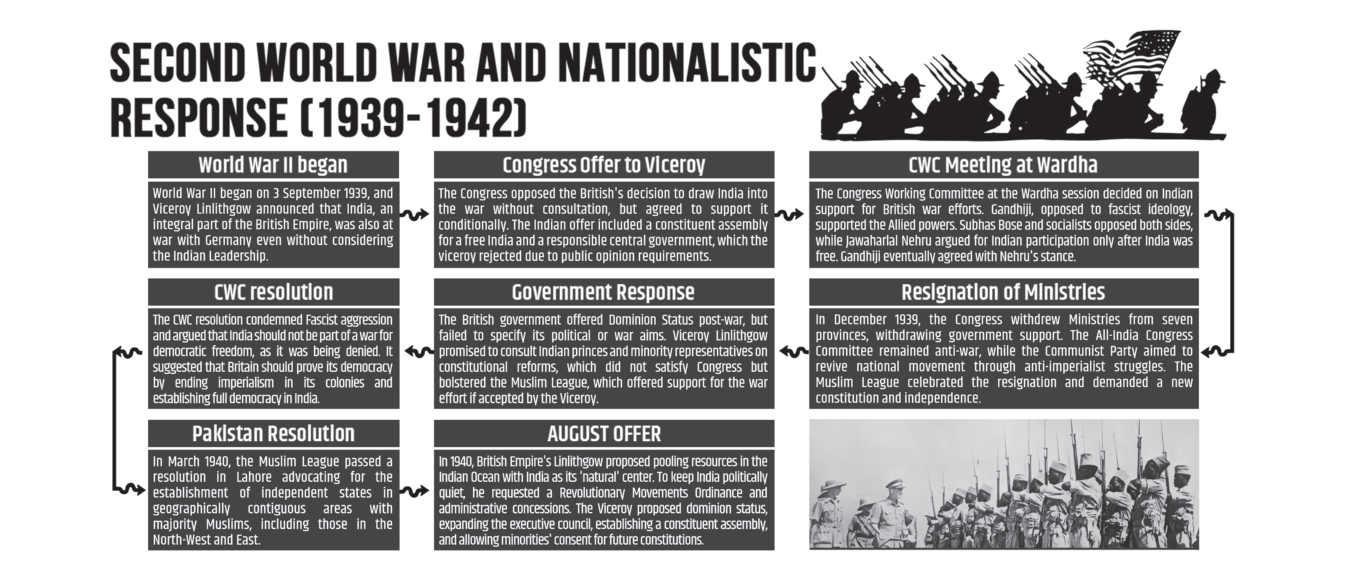
World War II began on 3 September 1939. In September 1939 itself, the Viceroy Linlithgow announced that following the beginning of the Second World War (between UK, France, and the USA, i.e., the Allies and Germany which headed the Axis powers) India, which was still an integral part of the British Empire, was also at war with Germany.
Many argued that Linlithgow’s declaration of war on India’s behalf without consulting the Indian leadership was an autocratic act.
CONGRESS OFFER TO VICEROY
Although the Congress opposed Britain’s unilateral decision to involve India in the war without consulting its people, it chose to extend conditional support to the war effort. The Indian proposal for cooperation was based on two key conditions:
A constituent assembly should be convened after the war to decide the political framework of a free India.
An immediate establishment of a truly responsible government at the Centre. However, the viceroy, Linlithgow, rejected these demands. The Congress maintained that these conditions were essential to secure public support for the war.
CWC MEETING AT WARDHA
The Congress's official stance on supporting British war efforts was finalized at the Wardha session of the Congress Working Committee, but various viewpoints were expressed beforehand:
Gandhiji, deeply opposed to fascism, sympathized with Britain during the war and advocated unconditional support for the Allied powers. He emphasized the distinction between democratic nations in Western Europe and totalitarian regimes like the Nazis and fascists. He was unwilling to create difficulties for the British government during the war.
Subhas Bose, along with socialists like Acharya Narendra Dev and Jayaprakash Narayan, who were invited to
the Wardha meeting to discuss differing opinions, opposed siding with either faction in the war. They viewed the conflict as an opportunity to initiate a civil disobedience movement and push for India's independence.
Jawaharlal Nehru rejected both Gandhiji's and the socialists' perspectives. While recognizing the distinction between democratic values and fascism, Nehru believed India should not participate in the war until it had achieved its own freedom.
Gandhiji, finding himself largely isolated in his position, ultimately aligned with Nehru’s viewpoint, which was adopted as the official resolution by the Congress Working Committee.
CWC RESOLUTION
The Congress condemned Fascist aggression and argued that:
India could not support a war being fought ostensibly for democratic freedom while denying that freedom to India itself;
If Britain was genuinely fighting for democracy and freedom, it needed to demonstrate this by ending imperialism in its colonies and establishing full democratic governance in India;
The government should clearly outline its war aims and specify how democratic principles would be applied to India after the war.
Government Response
On 18 October 1939, the British government reiterated its offer of Dominion Status after the war but failed to outline its political objectives or war aims.
Viceroy Linlithgow announced that the British government was willing to consult representatives from different communities, parties, and the Indian princes regarding constitutional reforms for India post-war.
He assured minority representatives that their views and interests would be given full consideration during discussions on the future of British rule in India.
This statement did not satisfy the Congress but strengthened the Muslim League’s position. The Muslim League Working Committee empowered M.A. Jinnah, its President, to assure Britain of Muslim support during the war.
In a resolution passed on 18 October 1939, the Muslim League offered its support for the war effort, provided the Viceroy recognized the League as the sole representative body of Indian Muslims.
Shortly after, the Congress Working Committee rejected the offer of Dominion Status after the War, deeming it a continuation of old imperialist policies and called for the resignation of Congress provincial ministries.
Resignation of Ministries
In December 1939, the Congress resigned from the ministries in the seven provinces where it held a majority, marking a significant move toward withdrawing support from the government.
These provinces, previously under Congress control, were then governed directly by the Governor, who exercised special powers granted under Section 93 of the Government of India Act, 1935.
Ministries not controlled by the Congress continued their cooperation with the government.
The All-India Congress Committee (AICC) took an anti-war stance, advising its members to participate in war committees only as individuals, not as representatives of the party.
The Forward Bloc, formed after Subhas Chandra Bose and his brother Sarat Chandra Bose left the Congress due to serious differences between Subhas Bose and Mahatma Gandhi at the 1939 Tripuri Congress, opposed the war and maintained its anti-British and anti-imperialist position throughout the conflict.
The Communist Party sought to revive the weakening national movement through anti-imperialist struggles during the war, maintaining this position until the USSR joined the Allies in the summer of 1941.
The Muslim League capitalized on the situation by celebrating the Congress ministries’ resignation. Jinnah declared December 22, 1939, as the ‘Day of Deliverance’ to mark this event.
Following the Congress ministries’ resignation, the party called for a new constitution and complete independence during the Ramgarh session held in March 1940, which was presided over by Maulana Abul Kalam Azad.
At the same session, the Congress also launched a fresh campaign of non-cooperation and civil disobedience.
PAKISTAN RESOLUTION—LAHORE (MARCH 1940)
The Muslim League passed a resolution advocating for the grouping of geographically connected regions where Muslims are in the majority (North-West, East) to form independent states. These states would be autonomous and sovereign, with adequate safeguards for Muslims in areas where they are in the minority.
AUGUST OFFER
On 7 June 1940, Viceroy Linlithgow proposed a plan to pool the resources and production of countries within the British Empire in the Indian Ocean, with India positioned as its ‘natural’ center. However, India’s material support alone was insufficient; maintaining political stability in India was equally crucial. By the end of May 1940, Linlithgow sought the enactment of a Revolutionary Movements Ordinance to grant the Government of India emergency
powers to suppress any acts of political resistance. Therefore, the imperial strategy at this stage involved being prepared to crush the Congress by preempting any civil disobedience campaigns, while also offering administrative concessions to avoid political unrest. As a result, in August 1940, the Viceroy introduced the ‘August Offer’.
Proposal
Dominion status as the goal for India.
Expansion of the viceroy’s executive council, which would include a majority of Indian members drawn from various political parties.
Establishment of a constituent assembly after the war, where Indians would determine the constitution according to their social, economic, and political ideals, subject to the government’s responsibilities regarding defense, minority rights, treaties with states, and all-India services.
No future constitution to be adopted without the consent of minority communities.
Responses
The Congress rejected the August Offer.
The Muslim League accepted the veto assurance given to them and continued to emphasize that partition was the only solution to resolve the deadlock.
Evaluation
For the first time, the right of Indians to frame their constitution was recognized, and the Congress' demand for a constituent assembly was accepted. Dominion status was explicitly offered.
In July 1941, the viceroy’s executive council was expanded to include 8 Indian members out of 12, giving them a majority for the first time. However, the British continued to oversee defence, finance, and home affairs. ➤ Additionally, a National Defence Council was established with purely advisory functions.