Whatsapp 88106-52225 For Details
Get Free IAS Booklet
Get Free IAS Booklet
CAUSES OF REFORM MOVEMENTS

Societal Conditions were conducive to Reforms
Religious and Social Ills Religious Superstitions: Hinduism had become entangled in superstitions, where priests held immense, often negative, influence over people’s minds. Idolatry and polytheism further fortified their dominance, distorting religious ideologies. Position of Women Women faced dire circumstances, from attempts to kill female infants to the practice of child marriage and polygamy. Sati, the expectation for widows to self-immolate, added to their misery and humiliation.
Indian Renaissance of thought
At the onset of the 19th century, enlightened sections within Indian society began envisioning a modern outlook. This movement, often termed the ‘Renaissance’, though not without its deviations, significantly influenced the course of events. However, along with its fruits, this awakening also led to undesirable by-products ingrained in the Indian subcontinent’s daily existence.
Impact of British Rule
The colonial presence played a multifaceted and decisive role in shaping modern Indian history. Unlike previous invaders, the British conquest occurred during a phase where India appeared stagnant, contrasting sharply with an enlightened Europe influenced by scientific progress. This contrast deepened the impact of British rule on Indian society and culture.
The Caste Problem The hierarchical and segregative caste system marginalized the untouchables, hindering social mobility, fostering divisions and undermining human dignity. It also impeded the growth of a unified national sentiment and democracy. Opposition to Western Culture Colonial rule sought to propagate its culture and ideologies, prompting a simultaneous attempt to revitalize traditional institutions in response.
New Awareness among Enlightened Indians Impact of Western Culture: The intrusion of Western culture and the subjugation by a foreign power spurred a reawakening. The realization that India had fallen behind in civilization led to varied reactions, including some embracing practices offensive to traditional beliefs. Rise of Nationalism and Democracy Growing nationalist sentiments, economic shifts, educational expansion, exposure to Western ideas, and a global awareness collectively reinforced the necessity for social and religious reform. Thus, the socio-cultural rejuvenation of 19th-century India was influenced by colonial presence but not solely shaped by it.
RAJA RAMMOHAN ROY AND BRAHMO SAMAJ
Raja Rammohan Roy was a pioneer of socio-religious reform movements in modern India.
He is considered as the first ‘modern man of India’. He learned several languages like English, Sanskrit, Persian, Arabic, French, Latin, Greek and Hebrew.
He studied the Bible as well as Hindu and Muslim religious texts. ➤ Rammohan Roy’s reform activities were accelerated after he settled down in Calcutta in 1814. In 1815, he established the Atmiya Sabha. ➤ It was a philosophical discussion circle in Calcutta. ➤ Its objective was to propagate the social and educational reforms amongst Bengalis. He denounced idolatry and advocated monotheism. He blamed the Brahman priests for perpetuating religious evils by keeping people ignorant about the true teachings of the indigenous scriptures.
TUHFAT-UL MUWAHHIDIN
Raja Ram Mohan Roy published his first philosophical work in the form of Tuhfat-ul-Muwahhidin (A Gift to Monotheists). In this treatise, he analysed the major religions of the world in the light of ‘reason’ and ‘social comfort’. It was written in Persian language with an introduction in Arabic. It is a frontal attack on the various ills that plagued the Hindu religion and Indian society in the eighteenth and nineteenth centuries. Roy protested against the idolatries and superstitions of Hinduism and tried to identify a common religious foundation based on the doctrine of the unity of God. He advocated for the supremacy of human reason and conscience over all outside authority whether of scripture, priest or prophet.
➤ To educate the people he published the Bengali translation of some of the scriptures and profusely wrote in defence of monotheism. ➤ His translations into and writings in the vernacular promoted the growth of Bengali language. ➤ In 1828 he established a new society, the Brahmo Sabha which later came to be known as the Brahmo Samaj. His primary purpose was to rid Hinduism of its evils and to preach monotheism. ➤ Rammohan was extremely pained at the prevailing social degeneration. He launched a crusade against the evil practice of Sati, the burning of a widow on her husband’s funeral pyre. ➤ His agitation bore fruit finally in 1829 when Lord William Bentinck, the Governor-General of India, enacted a law against that practice which declared the practice of Sati a punishable offence. ➤ He also protested against the child marriage and female infanticide. He favoured the remarriage of widows, female education and women’s right to property. He propagated the introduction and spread of modern education which could act as a major vehicle for the dissemination of modern ideas in the country.
For its promotion, he provided enthusiastic support to David Hare who, along with many Indian notables of Calcutta, founded the famous Hindu College in 1817.
He also ran an English School (Anglo-Hindu School) in Calcutta at his own cost. In 1825 he founded the Vedanta College which offered both Indian and Western learning.
In his Precepts of Jesus (1820), he tried to separate the moral and philosophical message of the New Testament, which he praised, from its miracle stories.
Rammohan took up not only social and religious problems but also political and economic issues of the times. He stood for the Indianization of services, trial by jury, separation of powers between the executive and the judiciary, freedom of the press, and judicial equality between Indians and Europeans.
Rammohan Roy started the first Bengali weekly “Samvad Kaumudi” and edited a Persian weekly “Mirat-ul-Akbar”.
Rammohan Roy was a forward-thinking internationalist who envisioned global cooperation in thought, action, and brotherhood among nations. He expressed support for the revolutions in Naples and Spanish America, strongly criticized the oppression of Ireland by absentee English landlords, and even warned of potential emigration from the empire if the reform bill was not enacted. Roy had David Hare, Alexander Duff, Debendranath Tagore, P.K. Tagore, Chandrashekhar Deb and Tarachand Chakraborty as his associates. Ram Mohan died in Bristol in England in 1833
DEBENDRANATH TAGORE AND BRAHMO SAMAJ
In the meanwhile, the impetus to reform given by Rammohan had lost much of its momentum. Debendranath Tagore, father of Rabindranath Tagore, again put life into it.
In 1839 he established the Tattvabodhini Sabha to carry on Rammohan’s ideals independent of the Brahmo Samaj. ➤ It aimed at counteracting the rapid progress of Christianity in India and advocated the development of “Vedantism”. ➤ Under the aegis of the Tattvabodhini Sabha emphasis on indigenous language and culture became much more pronounced. ➤ Tattvabodhini Press was established and in 1843 the “Tattvabodhini Patrika”, a journal of the organization was started for the propagation of ideas. Debendranath Tagore joined the Brahmo Samaj in 1842 and reorganized it. A new vitality and strength of membership came to be associated with the Brahmo Samaj due to the informal association of the two sabhas (Tattvabodhini and Brahmo). The rejuvenated Brahmo Samaj advocated for progressive social reforms, including the promotion of widow remarriage, women’s education, the abolition of polygamy, improving the condition of ryots, and encouraging temperance. Over time, it attracted notable individuals such as followers of Rammohan Roy, members of the Derozian movement, and independent reformers like Ishwar Chandra Vidyasagar and Ashwini Kumar Datta, thereby broadening its influence and support.
KESHAB CHANDRA SEN AND THE BRAHMO SAMAJ
Keshab Chandra Sen, a prominent intellectual associated with the Brahmo Samaj, became its acharya in 1858 under the guidance of Debendranath Tagore.
He significantly expanded the movement’s reach by establishing branches outside Bengal, including in the United Provinces, Punjab, Bombay, Madras, and other towns, while promoting female emancipation and universalism.
Keshab’s radical ideas, such as integrating teachings from various religions and advocating for inter-caste marriages, clashed with Debendranath's focus on national Hindu identity, leading to tensions within the Samaj.
In 1865, Keshab was dismissed as acharya, resulting in the formation of the Brahmo Samaj of India in 1866, while Debendranath’s faction became known as the Adi Brahmo Samaj. In 1878, Keshab Chandra Sen caused controversy within his Brahmo Samaj of India by marrying his thirteen-year-old daughter to the minor Hindu Maharaja of Cooch-Behar following orthodox Hindu rituals, leading to another split in the organization. Disillusioned followers of Keshab established the Sadharan Brahmo Samaj, led by Ananda Mohan Bose, Shibchandra Deb, and Umesh Chandra Datta, as a new reformist group. The Sadharan Brahmo Samaj upheld core Brahmo principles, including faith in a Supreme Being, belief in one God, rejection of infallibility in scriptures or individuals, and adherence to reason, truth, and morality.
Significance of the Brahmo Samaj
The Brahmo Samaj led a movement against entrenched dogmas and superstitions in society. It opposed the prevailing Hindu bias against traveling abroad and advocated for various social reforms:
Women’s Status and Rights:
Opposed Sati.
Advocated for ending the purdah system.
Discouraged child marriage and polygamy.
Supported widow remarriage.
Pushed for educational opportunities for women. Condemnation of Casteism and Untouchability: The Samaj criticized the caste system and untouchability, though success in abolishing these practices remained limited.
Limited Reach and Lasting Impact
Despite its efforts, the Brahmo Samaj primarily influenced Calcutta and Bengal, failing to have a substantial and lasting impact beyond these regions in shaping broader societal change
HENRY VIVIAN DEROZIO AND THE YOUNG BENGAL MOVEMENT
Henry Vivian Derozio, born in Calcutta in 1809, taught at Hindu College, Calcutta, where his followers became known as the Derozians, leading the Young Bengal Movement.
Influenced by the French Revolution, Derozio encouraged his students to think freely and rationally, question authority, value liberty and equality, and reject outdated customs and traditions.
The Derozians actively advocated for women’s rights and education, organized debates opposing idol worship, casteism, and superstitions, and founded associations to promote reform.
Derozio was recognized as the first nationalist poet of modern India but faced opposition, leading to his removal from Hindu College in 1831 due to his radical views.
The Derozians’ efforts had limited impact, primarily due to the unprepared social conditions of their time for accepting radical ideas.
Despite their limitations, the Derozians advanced Rammohan Roy's legacy by promoting public education on social, economic, and political issues.
Including advocating for Indians in higher services, protecting ryots, and demanding freedom of press and trial by jury Surendranath Banerjee later praised the Derozians as “pioneers of modern civilization in Bengal,” honoring their virtues while acknowledging their shortcomings with gentleness.
ISHWAR CHANDRA VIDYASAGAR
Pandit Ishwar Chandra was a great educator, humanist and social reformer. He was born in 1820 in a village in Midnapur, Bengal. He rose to be the Head Pandit of the Bengali Department of Fort William College.
He firmly believed that reform in Indian society could only come about through education.
A great Sanskrit scholar, Vidyasagar became the principal of the Sanskrit College in 1851. ➤ He introduced the study of western thought in the Sanskrit College and opened its gates to non- Brahmin students. ➤ As an academician, he evolved a new methodology to teach Sanskrit. He also devised a new Bengali primer and evolved a new prose style. ➤ Vidyasagar founded many schools for girls. He helped J.D. Bethune to establish the Bethune School in Calcutta for women’s education.
➤ As secretary of Bethune School (established in 1849), he was one of the pioneers of higher education for women in India. Note: For his great knowledge and reputation as a scholar in Sanskrit College, he was given the title of ‘VIDYASAGAR” (means ‘the ocean of knowledge’) by the Sanskrit College. Widow marriage was the specific social issue he devoted his entire life to. His agitation for legalizing the re-marriage of widows fetched support of the enlightened sections from various parts of the country and finally such a law (Hindu Widows’ Remarriage Act) was enacted. ➤ Under the supervision of Vidyasagar, the first legal Hindu widow-marriage among the upper castes in India was celebrated in 1856. Through his endeavour nearly 25 widow marriages were solemnized between 1855 and 1860.
BAL SHASTRI JAMBEKAR
Jambhekar was a pioneer of the intellectual movement in Maharashtra, laying its foundation in the early 1830s. ➤ He challenged Brahmanical orthodoxy and aimed to reform popular Hinduism. ➤ In 1832, he launched the newspaper “Darpan” to promote social reforms like widow remarriage and scientific awareness. ➤ He is regarded as the father of Marathi journalism for his impactful contributions through the press. ➤ In 1840, he started “Digdarshan,” a Marathi magazine publishing articles on science and history. ➤ He founded the Bombay Native General Library to encourage education and intellectual growth. ➤ He initiated the Native Improvement Society to promote societal progress. ➤ The Students Literary and Scientific Library was established as an offshoot of the Native Improvement Society.
DADOBA PANDURANG TARKHADKAR AND PARAMAHANSA SABHA
Dadoba Pandurang Tarkhadkar founded the Paramahansa Sabha in 1849, the first reform organization of the 19th century in Maharashtra
It began as a secret society aimed at reforming Hindu religion and society.
The ideology of the Sabha was closely aligned with that of the Manav Dharma Sabha, a Surat-based socio-religious group.
The Sabha promoted the worship of one God and emphasized that real religion is based on love and moral conduct.
It also advocated for widow remarriage and women’s education, and had branches in towns like Poona and Satara.
PRARTHANA SAMAJ
The Prarthana Samaj was founded in 1867 in Bombay by Dr. Atmaram Pandurang, with the help of Keshab Chandra Sen. It was inspired by Brahmo Samaj but took a more liberal stance on principles.
A precursor to the Prarthana Samaj was the Paramahansa Sabha, which worked as a secret society promoting liberal ideas and breaking down caste and communal barriers.
Justice Mahadev Govind Ranade and historian Ramkrishna Bhandarkar joined the Prarthana Samaj, contributing to its all-India character The focus of the Samaj was on monotheism, but social reforms were emphasized more than religious aspects.
The Samaj opposed the caste system and discrimination based on caste, promoting the upliftment of lower caste communities and inter-caste marriages. Additionally, Ranade, along with Dhondo Keshav Karve, co-founded the Widow Remarriage Movement and established Widow’s Home Associations to provide education and training for widows, enabling them to support themselves.
SATYASHODHAK SAMAJ, JYOTIBA/JYOTIRAO PHULE AND SAVITRIBAI PHULE
Jyotiba Phule, born in 1827 in Satara, Maharashtra, came from the Mali (gardener) community and led a significant movement against upper caste domination and Brahminical supremacy.They were the exceptions in a long list of Upper Caste, Western Educated reformers.
He also wrote a book named “GulamGiri”
He used to worship “Raja Bali” as opposed to “Raja Ram” whom he considered as God of brahmins.
The Satyashodhak Samaj (Truth Seekers Society) was established by Phule in 1873, as a part of his movement, with the leadership of the backward class community mainly from Malis, Telis, Kunbis, Saris and Dhangars.
Jyotiba Phule aimed for complete social transformation rather than limited social reforms. He strongly believed that in order to bring about mass awakening and a true social revolution, it was essential to educate the oppressed communities and the general population.
The core goal of his movement was to create awareness, offer social services, and promote education among the lower caste groups.
He introduced the concept of the Satyashodhak marriage ceremony marked by simplicity, low cost, and conducted without the need for a Brahmin priest.
Phule’s work under the banner of “Sarvajanik Satyadharma” gained wide acceptance among the people. His vision was to establish an ideal society, free from caste discrimination and socio-economic inequality. The movement focused on empowering the lower castes and instilling in them a sense of dignity and identity.
In recognition of his efforts, he was honored with the title "Mahatma" in 1888 by fellow reformer Vithalrao Krishnaji Vandekar.
Savitribai Phule was married to Jyotiba Phule at the age of nine. Firm in his belief in universal education, Jyotiba began teaching her at home. ➤ She later underwent teacher training and began educating women and children from marginalized communities. ➤ Together, the couple founded two educational institutions: the Native Female School in Pune and the Society for Promoting the Education of Mahars, Mangs, and other deprived communities. ➤ Savitribai also established the Mahila Seva Mandal to advocate for women's rights and raise awareness among them. ➤ She and her husband actively opposed the cruel treatment of widows and campaigned for their remarriage. ➤ Notably, Savitribai led a barbers’ strike to protest against the cruel tradition of shaving widows' heads. ➤ In 1863, the couple set up a shelter named Balhatya Pratibandhak Griha to offer safe childbirth facilities for unwed mothers and widows, protecting them from social ostracization and the risk of infanticide. ➤ They also took a strong stand against untouchability by allowing people from all castes access to their personal water reservoir. ➤ After Jyotiba’s death, Savitribai assumed leadership of the Satyashodhak Samaj. ➤ She was also a poet and authored two poetry collections - i.e. Kavyaphule and Bavankashi Subodh Ratnakar.
Phule played a significant role in promoting women’s education.
He and Savitribai founded the first school for girls in Poona in 1851.
He also championed the cause of widow remarriage, marking one of the pioneering reforms of his movement.
GOPAL HARI DESHMUKH
He was also better known as ‘Lokahitawadi’. In the Prabhakar, a Marathi Weekly, he wrote his hundred letters, the famous ‘Shatpatre’, between 1848 and 1850.
These letters taken together are all encompassing in dimension; there is hardly any aspect of the society which is left untouched.
He advocated a reorganisation of Indian society on rational principles and modern, humanistic, secular values. He attacked Hindu orthodoxy and supported social and religious equality
He said, “If religion does not sanction social reform, then change religion.”
He started a weekly, “Hitechhu”, and also played a leading role in founding the periodicals, “Gyan Prakash”, “Indu Prakash” and “Lokahitawadi”.
GOPAL GANESH AGARKAR
He was an educationist, freedom fighter, and social reformer. In his early years, Agarkar developed a close relationship with Tilak. Agarkar believed that education was a powerful weapon in the fight for independence, as it would give the Indians the confidence to question the British and thus strengthen the fight for freedom.
Agarkar established the New English School in Pune along with Tilak and Vishnu Chiplunkar.
In 1884, Agarkar and Tilak established the Deccan Education Society in Pune. The Society’s members had to devote themselves entirely to the cause of education and teaching, despite low pays.
Agarkar was also associated with the nationalist newspaper Kesari, first published in 1880. According to him India would not be able to rise and be free if casteism and religious superstitions were not eradicated. He felt that social reforms were necessary for political reforms.
He started his own newspaper “Sudharak (The Reformer)”, which challenged both untouchability and casteism.
SWAMI DAYANAND SARASWATI AND THE ARYA SAMAJ
Social reform movement in North India was led by Arya Samaj. It was founded by Swami Dayananda Saraswati in 1875 in Bombay.
Swami Dayanand Saraswati, one of the makers of modern India, expressed the need for modification of indigenous orientation and realized the importance of new social, religious and economic orders.
He was not a follower of western education or western culture and explained the significance of Hindutva. ➤ Swami Dayanand Saraswati was inspired by the Vedic values, wisdom and truth and at the same time wanted to change the evil practices under Hindu religion. ➤ He developed Arya Samaj with the principles of Veda as the ultimate source of truth. ➤ Opposition to dowry, caste system, idol worship, opposition to child marriage, polygamy and belief in female education were the various areas of work of Arya Samaj. ➤ Dayanand’s views were published in his famous work, “Satyarth Prakash (The True Exposition)”.
Dayanand strongly opposed the escapist Hindu idea that views maya as the pervasive illusion defining physical existence and sees human life as a quest for salvation by escaping this world to unite with God. Instead, he advocated the distinct and everlasting nature of God, soul, and matter (prakriti), stressing that each person must seek their salvation while following timeless principles guiding human behaviour. He criticized the widely accepted belief in destiny (niyati), which dictates an individual’s contributions and rewards in society. Dayananda upheld the concepts of karma and reincarnation but emphasized that altruistic deeds should prioritize benefiting others over self-interest.
His vision of India included a classless and casteless society, a united India (religiously, socially and nationally), and an India free from foreign rule, with Aryan religion being the common religion of all.
Dayananda adhered to the Vedic concept of the chaturvarna system, where individuals were categorized as brahmin, kshatriya, vaishya, or shudra not solely based on their birth but rather on their occupation and merit.
Dayananda launched a frontal attack on Hindu orthodoxy, caste rigidities, untouchability, idolatry, polytheism, belief in magic, charms and animal sacrifices, taboo on sea voyages, feeding the dead through shraddhas, etc ➤ He took inspiration from the Vedas and considered them to be ‘India’s Rock of Ages’, the infallible and the true original seed of Hinduism. ➤ He gave the slogan “Back to the Vedas”.
Swami Dayanand Saraswati noticed that lower caste people had no access to Vedas. ➤ Arya Samaj advocated that caste system should be removed and Veda should be accessible to everyone.
Arya Samaj also advocated for women rights and criticized the practice of Sati and Purdah system. It believed that women used to enjoy equal status with men during the Vedic period and later on their status in the society degraded. ➤ In order to encourage women’s education, Swami Dayananda Saraswati initially opened Kanya Pathshalas (schools for women) in 1870 and later on Arya Samaj established a number of such educational institutions like Gurukuls, Kanya Gurukuls, Schools and Colleges for the education of both males and females. ➤ The Arya Samaj fixed the minimum marriageable age at twenty-five years for boys and sixteen years for girls.
The nucleus for the Arya Samaj movement was provided by the establishment of Dayanand Anglo-Vedic (D.A.V.) schools, first set up in Lahore in 1886.
The social ideals of the Arya Samaj include the fatherhood of God and brotherhood of Man, equality of the sexes, absolute justice, and fair play between individuals and nations.
Dayananda Saraswati met other reformers like Keshab Chandra Sen, Ishwar Chandra Vidyasagar, Ranade and Deshmukh to discuss social and religious reforms.
After Swami Dayananda Saraswati’s death, leaders such as Lala Hansraj, Pandit Gurudutt, Lala Lajpat Rai, and Swami Shraddhanand continued his work. The Arya Samaj helped to instill self-respect and self-confidence among Hindus, challenging the myth of Western superiority and undermining colonial influence. ➤ In its efforts to protect Hindu society from the influences of Christianity and Islam, the Samaj initiated the Shuddhi (purification) movement to reconvert converts back to Hinduism. ➤ This movement led to an increasing communalization of social life and gradually evolved into communal political consciousness during the 1920s and beyond.
INDIAN SOCIAL CONFERENCE
Founded by M.G. Ranade and Raghunath Rao, the Indian Social Conference began in 1887 in Madras, meeting annually at the same time and venue as the Indian National Congress. ➤ The conference focused on addressing social issues and can be seen as the social reform arm of the Indian National Congress. ➤ It advocated for inter-caste marriages and opposed polygamy and kulinism.
The conference launched the ‘Pledge Movement’ to inspire individuals to take a stand against child marriage.
GOPAL KRISHNA GOKHALE AND THE SERVANTS OF INDIA SOCIETY
Gopal Krishna Gokhale, born on 9 May 1866 in Maharashtra, was an Indian liberal political leader and social reformer during the Indian Independence Movement.
In 1905, he founded the Servants of India Society with the assistance of M.G. Ranade.
The society aimed to train national missionaries for India’s service, promote the true interests of the Indian people through constitutional means, and prepare a cadre of selfless workers devoted to the country in a religious spirit.
The society began publishing the Hitavada in 1911 to articulate its views.
The Servants of India Society avoided political activities and organisations, including the Indian National Congress.
After Gokhale’s death in 1915, Srinivasa Shastri became president. ➤ The society continues its work, focusing on education through ashram-style schools for tribal girls and balwadis across India.
Note: Gokhale was famously a mentor to Mahatma Gandhi in the latter’s formative years. As a young barrister, Gandhiji returned from his struggles against the Empire in South Africa and received personal guidance from Gokhale, including a knowledge and understanding of India and the issues confronting common Indians.
SOCIAL SERVICE LEAGUE
Narayan Malhar Joshi, a follower of Gopal Krishna Gokhale, founded the Social Service League in Bombay to improve the living and working conditions of the masses.
The league organized schools, libraries, reading rooms, day nurseries, and cooperative societies. ➤ oms, day nurseries, and cooperative societies. They also provided services such as legal aid, excursions for slum dwellers, gymnasia, medical relief, and boys' clubs.
Joshi, along with Lala Lajpat Rai, founded the All-India Trade Union Congress (AITUC) in 1920 to address labour issues. ➤ He served as the AITUC's general secretary during 1925–1929 and 1940–1948. ➤ In 1931, he left the AITUC and established the All-India Trade Union Federation.
THE RAMAKRISHNA MOVEMENT AND SWAMI VIVEKANANDA
Gadadhar Chattopadhyaya (l836-86) was a poor Brahmin priest who later came to be known as Ramakrishna Paramhansa (1836-1886) highlighted the essential unity of religions and the need to lead a spiritual life.
He belief was that “Service of man is the service of God.”
He believed that the different religions of the world are only different ways to reach the same god. ➤ Hence, sectarianism had no place in his teachings. ➤ He realised the divinity in humanity and looked upon the service of mankind as a means to salvation.
The Ramakrishna movement had two main objectives: ➤ To establish a group of monks devoted to renunciation and practical spirituality, who would disseminate the universal message of Vedanta inspired by Ramakrishna’s life. ➤ To collaborate with lay disciples in preaching, philanthropic, and charitable activities, treating all individuals, irrespective of caste, creed, or color, as manifestations of the Divine.
Paramahamsa emphasized seeking salvation through traditional practices like renunciation, meditation, and bhakti amidst the rising influence of Westernization and modernization.
SWAMI VIVEKANANDA
Narendra Nath Datta (l863-1902) later known as Swami Vivekananda was his foremost disciple of Ramakrishna Paramahamsa who carried the message of his Guru Ramakrishna all over the world, especially in America and Europe.
Vivekananda was proud of India’s spiritual heritage, but he believed that no individual or nation can live by holding himself or itself apart from the community of others. ➤ He condemned the caste system, rigid rituals, century old superstitions and advocated liberty, free thinking and equality.
Vivekananda was indeed a patriot from the core of his heart. He had tremendous faith in the evolution of Indian culture and an intense zeal to revive all that was good and great in her culture so as to serve her in all possible ways for her onward march.
Swami Vivekananda laid stress on Ramakrishna’s teaching on the essential oneness of all religions. ➤ He promoted the Vedanta philosophy which he considered the most rational system.
The principal feature of Vivekananda’s social philosophy was his insistence on the upliftment of the masses. For him, service to the poor and downtrodden was the highest religion. ➤ To organize such service, he founded the Ramakrishna Mission in 1897. ➤ The headquarters of the Ramakrishna Math and Mission are at Belur near Calcutta. ➤ This Mission to date has played an important role in providing social service in times of national distress like famine, floods, and epidemic. ➤ Many schools, hospitals, orphanages are run by it.
In 1893 he participated in the All-World Religious Conference (Parliament of Religions) at Chicago in the United States of America. ➤ He argued that Vedanta was the religion of all and not of the Hindus alone. ➤ His address made a deep impression on the people of other countries and thus helped to raise the prestige of Indian culture in the eyes of the world.
Vivekananda emphasized the doctrine of service, asserting that serving all living beings (Jiva) is equivalent to worshiping the Divine (Siva), and that life itself is a form of religion. ➤ Through service, the presence of the Divine is realized within humanity. ➤ He encouraged the application of technology and modern science to benefit and uplift mankind.
Though his mission was mainly of religious nature, he was keenly interested in the improvement of all aspects of national life. ➤ He expressed his concern for the miserable and poor conditions of the people and said that neglect of the masses is a sin.
He urged his countrymen to work for their own salvation. For this purpose, bands of workers devoted to this cause were trained through the Ramakrishna Mission. ➤ Thus, Vivekananda emphasized social good or social services.
VAIKOM SATYAGRAHA
The Vaikom Satyagraha was a campaign in Travancore (Kerala) seeking oppressed people’s temple admission. Between 1924 and 1925, it occurred near the Shiva Temple in Vaikom, Kottayam district, Kerala.
Low-caste Hindus were not allowed to access temples in Kerala, as they were in the rest of India, because of the predominant class structure. ➤ They weren’t even allowed to drive on the road leading to the temples in Kerala.
T K Madhavan gave a report highlighting the discrimination that the depressed castes’ people faced in Kerala at a Congress Party meeting in Kakinada in 1923.
Following this meeting, anti-untouchability movements gained traction. ➤ In Kerala, a committee made up of people from diverse castes was formed to tackle untouchability. ➤ T K Madhavan, Velayudha Menon, K Neelakantan Namboothiri, and T R Krishnaswami Iyer served on the committee, which was chaired by K. Kelappan. Note: Behramji Malabari acquired and edited the “Indian Spectator” , an English-language daily.
The Vaikom Satyagraha, initiated by K.P. Kesava in 1924 in Kerala, sought to grant untouchables access to Hindu temples and roads. ➤ The movement was strengthened by processions (jathas) from Punjab and Madurai. ➤ Gandhi supported the cause by touring Kerala to bolster the satyagraha.
GURUVAYUR SATYAGRAHA
In 1931, during the suspension of the Civil Disobedience Movement, a temple entry movement was launched in Kerala.
Inspired by K. Kelappan, poet Subramaniyam Tirumambu, known as the "singing sword of Kerala," led a group of sixteen volunteers to Guruvayur.
Leaders like P. Krishna Pillai and A.K. Gopalan actively participated as satyagrahis. ➤ On November 12, 1936, the Maharaja of Travancore issued a proclamation opening all government-controlled temples to all Hindus. ➤ This marked a significant step towards temple entry rights for the oppressed communities.
SEVA SADAN
A Parsi social reformer, Behramji M. Malabari (1853- 1912), founded the Seva Sadan in 1908 along with a friend, Diwan Dayaram Gidumal. ➤ Malabari spoke vigorously against child marriage and for widow remarriage among Hindus.
It was his efforts that led to the Age of Consent Act regulating the age of consent for females.
Seva Sadan specialized in taking care of those women who were exploited and then discarded by society. ➤ It catered to all castes and provided the destitute women with education, and medical and welfare services.
DEV SAMAJ (DIVINE SOCIETY)
Founded in 1887 at Lahore by Shiv Narayan Agnihotri, a former Brahmo follower, Dev Sadan was a religious and social reform society aimed at promoting progressive ideas.
The society emphasized on the eternity of the soul, the supremacy of the guru, and the need for good action.
It called for ideal social behaviour such as not accepting bribes, avoiding intoxicants and non-vegetarian food, and keeping away from violent actions. ➤ Its teachings were compiled in a book, Deva Shastra. ➤ Agnihotri spoke against child marriage.
DHARMA SABHA
Radhakant Deb founded Dharma Sabha in 1830. An orthodox society, it stood for the preservation of the status quo in socio-religious matters, opposing even the abolition of sati. ➤ However, it favoured the promotion of Western education, even for girls.
BHARAT DHARMA MAHAMANDALA
An all-India organisation of the orthodox educated Hindus, it stood for a defence of orthodox Hinduism against the teachings of the Arya Samajists, the Theosophists, and the Ramakrishna Mission. ➤ Other organisations created to defend orthodox Hinduism were the Sanatana Dharma Sabha (1895), the Dharma Maha Parishad in South India, and Dharma Mahamandali in Bengal.
These organisations combined in 1902 to form the single organisation of Bharat Dharma Mahamandala, with headquarters at Varanasi. ➤ This organisation sought to introduce proper management of Hindu religious institutions, open Hindu educational institutions, etc. Pandit Madan Mohan Malaviya was a prominent figure in this movement.
RADHASWAMI MOVEMENT
Tulsi Ram, a banker from Agra, also known as Shiv Dayal Saheb, founded this movement in 1861.
The Radhaswamis believe in one supreme being, the supremacy of the guru, the importance of Satsang (a company of pious people), a simple social life, and spiritual attainment without renouncing worldly life.
They consider all religions to be true. While the sect has no belief in temples, shrines and sacred places, it considers as necessary duties, works of faith and charity, service and prayer.
VOKKALIGA SANGHA
The Vokkaligas comprised the largest community in the erstwhile princely state of Mysore. The Vokkaliga Sangha in Mysore launched an Anti-Brahmin movement in 1905.
JUSTICE MOVEMENT
This movement in Madras Presidency was started by C.N. Mudaliar, T.M. Nair and P. Tyagaraja to secure jobs and representation for the non-brahmins in the legislature.
In 1917, Madras Presidency Association was formed which demanded separate representation for the lower castes in the legislature.
SELF-RESPECT MOVEMENT
Periyar E.V. Ramaswamy was a great social reformer. In 1925, he started the “Self-Respect Movement”.
The aims of the ‘Self-Respect Movement’ were to uplift the Dravidians and to expose the Brahminical tyranny and deceptive methods by which they controlled all spheres of Hindu life.
He denounced the caste system, child marriage and enforced widowhood. He encouraged inter-caste marriages. He himself conducted many marriages without any rituals. Such a marriage was known as “Self- Respect Marriage.”
He attacked the laws of Manu, which he called the basis of the entire Hindu social fabric of caste. He founded the Tamil journals Kudiarasu, Puratchi and Viduthalai to propagate his ideals.
In 1938 at Tamil Nadu Women’s Conference appreciating the noble service rendered by E.V. Ramaswamy he was given the title “Periyar”. On 27th June 1970 by the UNESCO organisation praised and adorned with the title “Socrates of South Asia”.
SREE NARAYANA GURU DHARMA PARIPALANA (SNDP) MOVEMENT
The SNDP movement emerged as a regional initiative driven by the conflict between the depressed classes and the upper castes.
The movement was initiated by Sree Narayana Guru Swamy (1856–1928) among the Ezhavas of Kerala, a socially disadvantaged caste of toddy-tappers who were considered untouchable and denied access to education and temples. The Ezhavas made up about 26% of Kerala’s population, making them the largest caste group in the region.
Narayana Guru, belonging to the Ezhava community himself, picked up a stone from the Neyyar River and consecrated it as a Sivalinga at Aruvippuram on Sivaratri in 1888. This act symbolized that the privilege of idol consecration did not belong exclusively to the upper castes.
This symbolic act sparked a social revolution that significantly contributed to the dismantling of various discriminatory practices in Kerala. The movement, known as the Aruvippuram movement, also inspired the noted poet Kumaran Asan to become one of Narayana Guru’s followers.
In 1889, the Aruvippuram Kshetra Yogam was established with the aim of growing into a larger organization to support both the material and spiritual development of the Ezhavas.
Later, in 1903, the Aruvippuram Sree Narayana Guru Dharma Paripalana Yogam (commonly referred to as SNDP) was formally registered under the Indian Companies Act, with Sree Narayana Guru as its permanent chairman and Kumaran Asan as general secretary.
Sree Narayana Guru believed in the equality of all religions and strongly opposed animal sacrifices and social divisions based on caste, race, or religion.
He encouraged the Ezhavas to abandon the toddy-tapping trade and advocated for total abstinence from alcohol. The SNDP Yogam actively worked on various issues affecting the Ezhava community, including: ➤ Equal access to public education, ➤ Eligibility for government employment, ➤ The right to use public roads and enter temples, and ➤ Fair political representation.
Overall, the movement led to major social transformations, including enhanced upward mobility, a redistribution of traditional power structures, and the unification of backward castes into a broader collective movement.
THEOSOPHICAL SOCIETY
It was founded in the USA in 1875 by a Russian spiritualist Madame H.P. Blavatsky and an American Col. H.S. Olcott.
Its objective was to promote studies in ancient religions, philosophies and science, develop the divine powers latent in man and form a universal brotherhood of man.
The Society was introduced to India in 1879 and its headquarters were set up at Adyar near Madras in 1886. ➤ It accepted the Hindu beliefs in reincarnation and karma, and drew inspiration from the philosophy of the Upanishads and Samkhya, yoga and Vedanta schools of thought. Its influence spread under Annie Beasant in 1893 who played an important role in India’s struggle for freedom. ➤ She and her associates advocated the revival and strengthening of the ancient religions of Hinduism, Zoroastrianism and Buddhism. ➤ They recognized the doctrine of the transmigration of the soul.
The Theosophical Movement came to be allied with the Hindu renaissance. It opposed child marriage and advocated the abolition of caste discrimination, uplift of outcastes, improvement in the condition of widows.
In fact, the activities of Annie Besant in the field of education were more significant. ➤ She founded the Central Hindu College at Banaras which she later handed over to Madan Mohan Malaviya. He developed that college into Banaras Hindu University.
She contributed a great deal to the development of national spirit in Indians. The headquarters of the Theosophical Society at Adyar became a centre of knowledge with a library of rare Sanskrit books. ➤ Branches of the Theosophical Society were opened all over India and its Journal Theosophist had a wide circulation. The Society gave a helping hand in social and religious reform, especially in south India. ➤ Although the Theosophical Movement did not enjoy mass popularity, its work under the leadership of Annie Besant for the awakening of the Indians was remarkable
MUSLIM REFORM MOVEMENTS
WAHABI/WALIULLAH MOVEMENT
The Wahhabi Movement in India was inspired by the teachings of Abdul Wahab of Arabia (1703–1792) and the religious ideas of Shah Waliullah (1702–1762). ➤ It was primarily a revivalist reaction against Western influence and the moral and spiritual decline among Indian Muslims. ➤ The movement emphasized a return to the authentic principles of Islam.
Shah Waliullah was the first Muslim leader in 18th-century India who mobilized the Muslim community around two central goals of the movement: ➤ Promoting unity among the four major schools of Islamic jurisprudence by blending their best aspects, ➤ Advocating for the role of personal conscience in religious matters, especially in cases of differing interpretations of the Quran and Hadith.
Shah Waliullah’s ideas were further spread by his son Shah Abdul Aziz and later by Syed Ahmed Barelvi, who also infused the movement with political overtones. ➤ They worked to remove non-Islamic customs that had found their way into Muslim society. ➤ Syed Ahmed Barelvi urged a return to the pure form of Islam and aimed to recreate a society similar to that of the Prophet Muhammad’s era in Arabia.
The movement viewed India as Dar-ul-Harb (a land ruled by non-believers), which, according to them, needed to be transformed into Dar-ul-Islam (a land governed by Islamic principles). ➤ In its early phase, the movement was aimed at resisting Sikh rule in Punjab. However, after the British annexed Punjab in 1849, their opposition shifted towards British colonial rule.
The Wahhabis played a significant role in spreading anti-British sentiments during the Revolt of 1857. However, the movement eventually lost momentum and was suppressed by the British military during the 1870s.
TITU MIR ‘S MOVEMENT
Mir Nisar Ali, more widely known as Titu Mir, was a follower of Sayyid Ahmed Barelvi, the originator of the Wahhabi Movement. Titu Mir embraced Wahhabism and promoted adherence to Islamic Sharia law. ➤ He mobilized Muslim peasants in Bengal to rise against the predominantly Hindu landlords and British indigo planters.
Contrary to British reports, the movement led by Titu Mir was not initially violent; armed conflict only broke out during the final year of his life. ➤ Titu Mir was killed in battle in 1831..
FARAIZI MOVEMENT
The Faraizi Movement was initiated by Haji Shariatullah in 1818. Its primary objective was to oppose non-Islamic religious customs and revive the essence of Shia doctrines along with strict monotheism.
The movement mainly operated in East Bengal and sought to eliminate social and religious practices that were not aligned with Islamic teachings, urging Muslims to fulfill their religious obligations.
After 1840, under the leadership of Haji Shariatullah’s son, Dudu Mian, the movement took on a more radical and revolutionary tone.
Dudu Mian developed a structured organization that extended from the village level up to the provincial level, appointing a Khalifa or authorized representative at each tier.. ➤ He formed a paramilitary group equipped with clubs to challenge the zamindars, who were primarily Hindu, although some Muslim landlords and indigo planters were also targeted. ➤ He instructed his followers to stop paying rent, and the movement even set up its own judicial system with independent courts. ➤ Dudu Mian faced multiple arrests, and his imprisonment in 1847 significantly diminished the momentum of the movement. ➤ After his death in 1862, the Faraizi Movement continued, but only as a religious reform initiative, losing its earlier political and militant aspects.
AHMADIYYA MOVEMENT
It was founded by Mirza Ghulam Ahmad in 1889. It was based on liberal principles.
Under this movement, a number of schools and colleges were opened all over the country, imparting modern education. ➤ In the field of religion, the followers of this movement emphasized the universal and humanitarian character of Islam. ➤ They favoured the unity among Hindus and Muslims.
It described itself as the standard-bearer of Mohammedan Renaissance, and based itself, like the Brahmo Samaj, on the principles of universal religion of all humanity, opposing jihad (sacred war against non-Muslims). ➤ The movement spread Western liberal education among the Indian Muslims.
They believed in separating the mosque from the State as well as in human rights and tolerance. ➤ However, the Ahmadiyya Movement, like Baha’ism which flourished in the West Asian countries, suffered from mysticism.
MOHAMMEDAN LITERARY SOCIETY
The Muslim upper classes had tended to avoid contact with Western education and culture and it was only after the revolt of 1857 that modern ideas of religious reform began to appear. ➤ The beginning was made by the Muhammedan Literary Society founded in Calcutta in 1863 founded by Nawab Abdul Latif 1828-1893.
It promoted discussion of religious, social and political questions in the light of modern ideas and encouraged upper- and middle-class Muslims to adopt Western education. It also played an important role for Muslim Unity. ➤ The Muslim masses were also influenced by movements carried on by the Chishti Sufis who preached not only submission to God but also promoted the veneration of saints.
SIR SYED AHMED KHAN AND ALIGARH MOVEMENT
The most notable of the Muslim reformers was Sir Syed Ahmed Khan. He realised that unless the Muslims adapted themselves to the changed circumstances of British rule, they would be deprived of all new opportunities for status and prosperity. ➤ He was highly impressed by modern scientific thought and worked all his life to reconcile it with Islam.
He interpreted the Quran in the light of rationalism and science. He urged the people to develop a critical approach and freedom of thought. ➤ He also warned against fanaticism, narrow-mindedness and exclusiveness. He asked the people to be broadminded and tolerant.
Syed Ahmed Khan rightly felt that isolation would harm the Muslim community and to prevent that he did his best to create a link with the progressive cultural forces of the outside world. ➤ He worked hard to remove the hostility of the British rulers towards the Muslims whom they considered as their real enemies.
He felt that the religious and social life of the Muslims could be improved only with the help of modem Western scientific knowledge and culture. Therefore, promotion of modern education was the first task.
He started the Muhammedan Anglo-Oriental College in 1875 at Aligarh. It was meant to be a centre for spreading Western sciences and culture. ➤ Later, this college grew into the Aligarh Muslim University.
The liberal, social and cultural movement started by Sayyid Ahmad Khan among the Muslims is known as the Aligarh Movement as it originated in Aligarh. The Anglo-Oriental College was the centre of this movement. ➤ It aimed at promoting modern education among Muslims without weakening the ties with Islam. It became the central educational institution for Indian Muslims. ➤ It was largely responsible for the Muslim revival that followed. It provided a focal point for the scattered Muslim population in different parts of the country. It gave them a common fund of ideas and a common language - Urdu. A Muslim press was developed for the compilation of works in Urdu.
Sayyid Ahmad’s efforts extended to the social sphere as well. He worked for social reforms. He wanted women to be educated and advocated the removal of the purdah. He was also against polygamy. ➤ Syed’s progressive social ideas were propagated through his magazine Tahzib-ul-Akhlaq (Improvement of Manners and Morals).
THE DEOBAND SCHOOL (DARUL ULOOM)
The Deoband Movement was organised by the orthodox section among the Muslim ulema as a revivalist movement with the twin objectives of propagating pure teachings of the Quran and Hadis among Muslims and keeping alive the spirit of jihad against the foreign rulers. ➤ The Deoband Movement was begun at the Darul Uloom (or Islamic academic centre), Deoband, in Saharanpur district (United Provinces) in 1866 by Mohammad Qasim Nanotavi (1832-80) and Rashid Ahmed Gangohi (1828-1905) to train religious leaders for the Muslim community.
In contrast to the Aligarh Movement, which aimed at the welfare of Muslims through Western education and support of the British government, the aim of the Deoband Movement was moral and religious regeneration of the Muslim community. The instruction imparted at Deoband was in the original Islamic religion.
On the political front, the Deoband school welcomed the formation of the Indian National Congress and in 1888 issued a fatwa (religious decree) against Syed Ahmed Khan’s organisations, the United Patriotic Association and the Mohammaden Anglo-Oriental Association.
Mahmud-ul-Hasan, the new Deoband leader, gave a political and intellectual content to the religious ideas of the school. He worked out a synthesis of Islamic principles and nationalist aspirations. ➤ The Jamiat-ul-Ulema gave a concrete shape to Hasan’s ideas of protection of the religious and
SIKH REFORM MOVEMENTS
political rights of the Muslims in the overall context of Indian unity and national objectives.
Shibli Numani, a supporter of the Deoband school, favoured the inclusion of English language and European sciences in the system of education. ➤ He founded the Nadwatal Ulama and Darul Uloom in Lucknow in 1894-96. ➤ He believed in the idealism of the Congress and cooperation between the Muslims and the Hindus of India to create a state in which both could live amicably.
THE NIRANKARI MOVEMENT
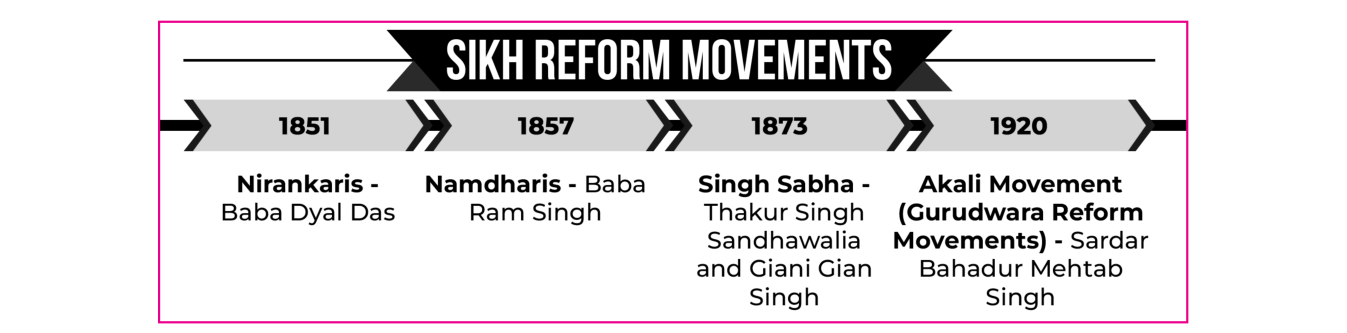
Baba Dayal Das, a saintly man and a contemporary of Maharaja Ranjit Singh, was the first among the reformers in Sikh religion, who had the courage to condemn the social evils that had gradually crept in Sikh Society. ➤ Baba Dayal disapproved of the worship of tombs and graves. ➤ He preached against idol worship of human gurus and expected his followers to believe in one formless God. ➤ The movement is popularly known as the Nirankari (Formless God).
THE NAMDHARI MOVEMENT
The Namdhari movement, popularly known as the Kuka movement because of the followers resorting to shrieks (Kukan) while in ecstasy. ➤ Started by Bhagat Jawahar Mal and Baba Balak Singh, the movement became a powerful instrument of socio-religious awakening among the Sikhs under Baba Ram Singh. ➤ Ram Singh enjoined upon his followers the worship of one God through prayer and meditation. He also preached against social evils such as the caste system. female infanticide, early marriage and barter of daughters in marriage.
Though Baba Ram Singh’s mission was specially marked for its teachings of righteous living, toleration and mercy, some of his followers got out of control and, in a fit of religious frenzy, committed excesses which resulted in a clash with the Government. ➤ There is a difference of opinion among the scholars as to whether the movement was social or political, but the official action against the Kukas definitely created great hatred for British rule in the minds of the people in Punjab. ➤ This helped in preparing the ground for the subsequent struggle of the Akalis in the early twentieth century.
THE SINGH SABHA MOVEMENT
The year following the persecution of the Kukas and the suppression of their movement saw the birth of the Singh Sabha (1873 A.D). ➤ The Singh Sabha movement and its activities had a much wider appeal among the Sikh masses and, consequently, made a far greater impact.
The Singh Sabha aimed mainly at social and religious reform through the spread of education and consciously refrained from discussing political questions or in any way incurring the displeasure of the British rulers.
➤ Another aim was to counter the proselytising activities of Christian missionaries as well as the Brahmo Samajists, Arya Samajists and Muslim maulvis. ➤ However, the major contribution of the Singh Sabha leadership lay in the creation of a network of Khalsa schools, colleges and other centres of learning.
AKALI MOVEMENT
The Akali movement (also known as Gurudwara Reform Movement) was an offshoot of the Singh Sabha Movement. ➤ The Akali movement was started by the Sikh reformers to purify their religious places by removal of the evil social practices that had slowly crept into them.
The property and privileges attached to the religious places led to the introduction of complicated rites and rituals and emergence of rich and powerful Mahants. ➤ They began to convert the trust property of the Gurdwara into their personal possessions.
Followers of Sikhism tried to check the evil practices of these Mahants by social protest and organised a movement of liberation of Sikh shrines from the control of the hereditary Mahants. ➤ This movement is popularly known as the Akali movement because of the Akali Jathas (bands of volunteers) leading this movement of reform. NOTE: The outcome of Akali agitation was the passing of a Bill in July 1925 which gave the Sikh community a legal right to elect functionaries to manage their Gurdwaras through Shiromani Gurudwara Prabandhak Committee (SGPC) as the apex body. This legislation put an end to the hereditary control of the Mahants and introduced democratic control in the gurdwara management.
PARSI REFORM MOVEMENTS
Religious reform began among the Parsis in Mumbai in the middle of the 19th century. ➤ The Rahnumai Mazdayasnan Sabha (Religious Reform Association) was founded in 1851 by a group of English- educated Parsis for the “regeneration of the social conditions of the Parsis and the restoration of the Zoroastrian religion to its pristine purity”. ➤ The movement had Naoroji Furdonji, Dadabhai Naoroji, K.R. Dadabhai Naoroji Cama and S.S. Bengalee as its leaders. ➤ The message of reform was spread by the newspaper Rast Goftar (Truth-Teller).
They also played an important role in the spread of education, especially among girls. They campaigned against the entrenched orthodoxy in the religious field and initiated the modernization of Parsi social customs regarding the education of girl’s marriage and the social position of women in general. In course of time, the Parsis became socially the most westernized section of Indian society.
Significance of Reform Movements
In the evolution of modern India, the reform movements of the nineteenth century have made very significant contributions. They stood for the democratization of society, removal of superstition and abhorrent customs, spread of enlightenment and the development of a rational and modern outlook.
The reform movements gave the rising middle classes the much-needed cultural roots to cling to, and served the purpose of reducing the sense of humiliation which the conquest by a foreign power had produced.
Among the Muslims, the Aligarh and Ahmadiyya movements were the torch bearers of these ideas. ➤ Ahmadiyya movement which took a definite shape in 1890 due to the inspiration of Mirza Ghulam Ahmad of Qadian, opposed jihad, advocated fraternal relations among the people and championed Western liberal education. ➤ The Aligarh movement tried to create a new social ethos among the Muslims by opposing polygamy and by advocating widow marriage. It stood for a liberal interpretation of the Quran and propagation of Western education.
The reform movements within the Hindu community attacked a number of social and religious evils. Polytheism and idolatry which negated the development of individuality or supernaturalism and the authority of religious leaders which induced the habit of conformity were subjected to strong criticism by these movements.
The opposition to caste was not only on moral and ethical principles but also because it fostered social division. Anti-casteism existed only at a theoretical and limited level in early Brahmo movement, but movements like the Arya Samaj, Prarthana Samaj and Rama Krishna Mission became uncompromising critics of the caste system; more trenchant criticism of the caste system was made by movements which emerged among the lower castes. ➤ They unambiguously advocated the abolition of the caste system, as evident from the movements initiated by Jyotiba Phule and Narayana Guru. The latter gave the call– only one God and one caste for mankind.
➤ The urge to improve the condition of women was not purely humanitarian; it was part of the quest to bring about the progress of society. Keshub Chandra Sen had voiced this concern: “no country on earth ever made sufficient progress in civilization whose females were sunk in ignorance”. An attempt to change the then prevalent values of the society is evident in all these movements.
Weakness and Limitations
Though the nineteenth century reform movements aimed at ameliorating the social, educational and moral conditions and habits of the people of India in different parts of the country, they suffered from several weaknesses and limitations.
The tendency of reformers to appeal to the greatness of the past and to rely on scriptural authority encouraged mysticism in new garbs and fostered pseudo-scientific thinking.
They were primarily urban phenomena. With the exception of Arya Samaj, the lower caste movements which had a broader influence, on the whole the reform movements were limited to upper castes and classes. ➤ For instance, the Brahmo Samaj in Bengal was concerned with the problems of the bhadralok and the Aligarh movement with those of the Muslim upper classes. The masses generally remained unaffected.
Another limitation lay in the reformers’ perception of the nature of British rule and its role toward India. They believed quite erroneously, that the British rule was God-sent and would lead India to the path of modernity. ➤ Although they perceived the socio-religious aspects of Indian society very accurately, its political aspect that of a basically exploitative British rule was missed by the reformers.
Many other factors were certainly responsible for the birth of communalism in modern times, but undoubtedly the nature of religious reform movements also contributed to it. ➤ The emphasis on religious and philosophical aspects of the cultural heritage got somewhat magnified by an insufficient emphasis on other aspects of culture, art, architecture, literature, music, science and technology. On the whole, however, whatever the net outcome of these reform movements be , it was out of this struggle that a new society evolved in India.
THE IDEOLOGICAL BASE OF REFORM MOVEMENTS
Two important ideas which influenced the leaders and movements were rationalism and religious universalism.
Rationalism
A rationalist critique of socio-religious reality generally characterized the nineteenth century reforms. ➤ The early Brahmo reformers and members of ‘Young Bengal’ had taken a highly rational attitude towards socio-religious issues.
Faith was sought to be replaced by rationality and socio-religious practices were evaluated from the standpoint of social utility.
Although reformers drew upon scriptural sanction, e.g., Rammohan’s argument for the abolition of sati and Vidyasagar’s for widow marriage, social reforms were not always subjected to religious considerations. ➤ A rational and secular outlook was very much evident in positing an alternative to the then prevalent social practices.
Universalism
An important religious idea in the nineteenth century was universalism, a belief in the unity of godhead and an emphasis on religions being essentially the same. ➤ Rammohan considered different religions as national embodiments of universal theism and he had initially conceived Brahmo Samaj as a Universalist Church.
However, faced with the challenge of colonial culture and ideology, universalism, instead of providing the basis for the development of a broader secular ethos, retreated into religious particularism.
Categories of Reform Movements
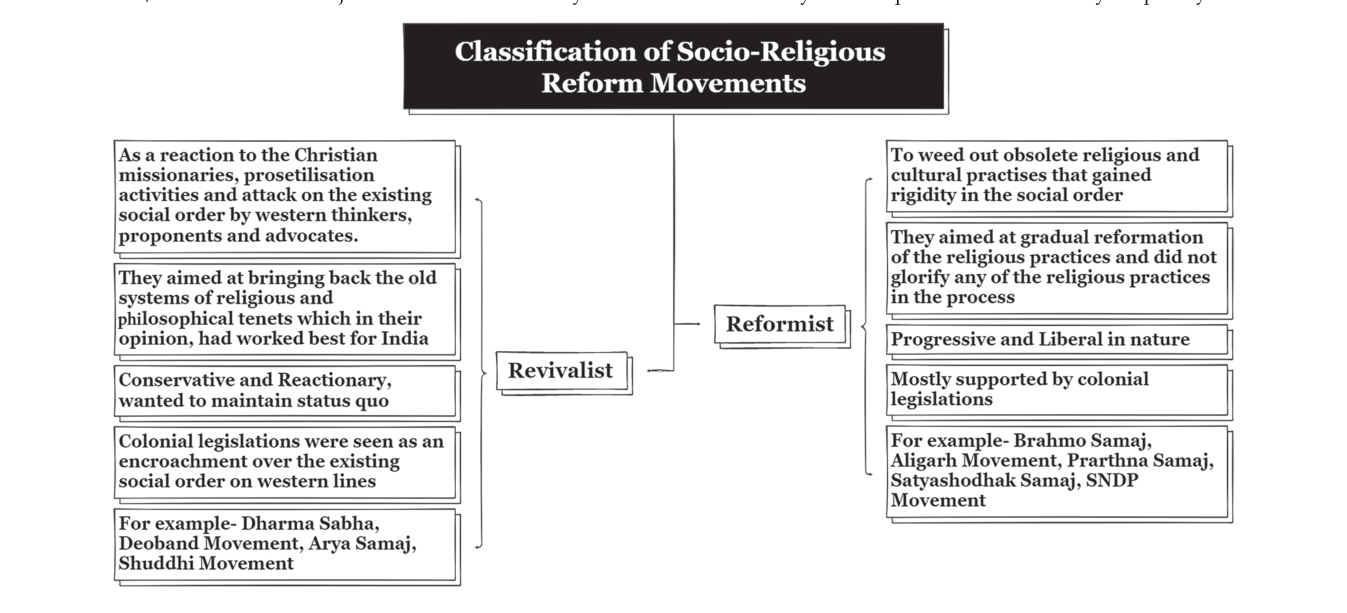
The reform movements could broadly be classified into two categories—the Reformist Movements like the Brahmo Samaj, the Prarthana Samaj, the Aligarh Movement, and the Revivalist Movements like Arya Samaj and the Deoband movement. ➤ The reformist as well as the revivalist movement depended, to varying degrees, on an appeal to the lost purity of the religion they sought to reform. ➤ The only difference between one reform movement and the other lay in the degree to which it relied on tradition or on reason and conscience.
Scope of Reforms
The major social problems which came within the purview of the reform movements were:
Emancipation of women in which sati, infanticide, child and widow marriage were taken up
Casteism and untouchability
Women and their Role
Because of the determined efforts of the reformers, a number of administrative measures were adopted by the government to improve the condition of women.
Abolition of Sati
Rammohan launched a crusade against the evil practice of Sati, the burning of a widow on her husband’s funeral pyre. His agitation bore fruit finally in 1829 when Lord William Bentinck, the Governor-General of India, enacted a law against that practice. ➤ The regulation of 1829 (Regulation XVII, A.D. 1829 of the Bengal Code) was applicable in the first instance to the Bengal Presidency alone, but was extended in slightly modified forms to Madras and Bombay Presidencies in 1830.
Preventing Female Infanticide
The practice of murdering female infants immediately after their birth was a common practice among upper class Bengalis and Rajputs. ➤ The Bengal regulations of 1795 and 1804 declared infanticide illegal and equivalent to murder.
An Act passed in 1870 made it compulsory for parents to register the birth of all babies and provided for verification of female children for some years after birth, particularly in areas where the custom was resorted to in utmost secrecy.
Widow Remarriage
The Brahmo Samaj had the issue of widow remarriage high on its agenda and did much to popularise it. ➤ It was mainly due to the efforts of Ishwar Chandra Vidyasagar (1820-91), the principal of Sanskrit College, Calcutta, that the Hindu Widows’ Remarriage Act, 1856, was passed. ➤ The act legalized marriage of widows and declared issues from such marriages as legitimate.
Vishnu Shastri Pandit founded the Widow Remarriage Association in the 1850s. ➤ Another prominent worker in this field was Karsandas Mulji who started the Satya Prakash in Gujarati in 1852 to advocate widow remarriage.
D.K. Karve in western India dedicated his life to the upliftment of Hindu widows and became the secretary of the Widow Remarriage Association.
➤ Karve himself married a widow in 1893. ➤ He opened a widows’ home in Poona to give the high caste widows an interest in life by providing them with facilities for vocational training.
The right of widows to remarriage was also advocated by B.M. Malabari, Narmad (Narmadashankar Labhshankar Dave), Justice Govind Mahadeo Ranade and K. Natarajan among others.
Controlling Child Marriage
The Native Marriage Act (or Civil Marriage Act), 1872 signified legislative action in prohibiting child marriage. ➤ It had a limited impact as the Act was not applicable to Hindus, Muslims and other recognised faiths.
The relentless efforts of a Parsi reformer, B.M. Malabari, were rewarded by the enactment of the Age of Consent Act (1891) which forbade the marriage of girls below the age of 12.
The Child Marriage Restraint Act, 1929 (Sarda Act) further pushed up the marriage age to 18 and 14 for boys and girls, respectively. ➤ In free India, the Child Marriage Restraint (Amendment) Act, 1978 raised the age of marriage for girls from 15 to 18 years and for boys from 18 to 21.
Education of Women
The Christian missionaries were the first to set up the Calcutta Female Juvenile Society in 1819.
The Bethune School, founded by J.E.D. Bethune, president of the Council of Education in Calcutta in 1849 was the first fruit of the powerful movement for women’s education that arose in the 1840s and 1850s.
Pandit Ishwar Chandra Vidyasagar was associated with no less than 35 girls’ schools in Bengal and is considered one of the pioneers of women’s education. ➤ Charles Wood’s Despatch on Education (1854) laid great stress on the need for female education. ➤ In 1914, the Women’s Medical Service did a lot of work in training nurses and mid-wives. ➤ The Indian Women’s University set up by Professor D.K. Karve in 1916 was one of the outstanding institutions imparting education to women. ➤ In the same year, Lady Hardinge Medical College was opened in Delhi. ➤ After 1920, aware and self-confident women led a women’s movement.
Pandita Ramabai is considered the first Indian Feminist to address other women directly about emancipation. ➤ She started a school for child widows in 1882 in Bombay. ➤ She founded the Arya Mahila Sabha, which is known as the first feminist organisation in India. ➤ She set up Mukti Mission for young widows, and Krupa Sadan and Sharda Sadan in 1889 for destitute women. ➤ Ramabai Ranade founded the Ladies Social Conference (Bharat Mahila Parishad), under the parent organisation National Social Conference, in 1904 in Bombay. ➤ Later Ramabai Ranade established a branch of Arya Mahila Samaj in Bombay.
Saraladevi Choudhurani, a well-educated woman and radical nationalist, used the Ladies Conference of the National Social Conference to propose that women form their own organization. ➤ She formed Bharat Stree Mandal (The Great Circle of India Women) in 1910 with the aim of bringing together women of all castes and classes to promote women’s education. ➤ She is remembered for her speeches at the Indian National Congress meetings in favour of women’s right to vote. ➤ She was involved in not only petitioning the government to give women the right to vote but also in bringing about changes in laws pertaining to marriage, divorce and property rights.
Women’s India Association (WIA) in 1917 was “the first purely feminist organisation” to arise in India. Annie Besant was chosen as the first WIA president.
➤ The honorary secretaries were Margaret Cousins, a teacher and Irish suffragist; Dorothy Jinarajadasa, the Irish wife of a Sri Lankan Theosophist; Ammu Swaminathan and Malathi Patwardhan. ➤ Its objectives were to guide the nation; serve the poor, promote women’s education and compulsory universal primary education, abolish child marriage, raise the age of sexual consent to sixteen for women, win female suffrage and attain the female right to elected office. ➤ It published a monthly journal Stri Dharma in English.
The National Council of Women in India was formally founded in 1925. It came to be accepted as the national ‘branch’ of the International Council of Women and was the first all-India women’s organization intimately associated with an international organizatiowvbn. ➤ Some of the important women associated with this organization were, Margaret Cousins, Dorothy Jinarajadasa, Annie Besant, Mrs. Ambujammal, Mrs. Malati Patwardhan, Kanuben C. Mehta. ➤ It was basically an elitist organisation and did not become broad based.
All India Women’s Conference was founded by Margaret Cousins in 1927. Its first conference was held at Ferguson College, Pune. ➤ Important founding members included Maharani Chimnabai Gaekwad, Rani Sahiba of Sangli, Sarojini Naidu, Kamla Devi Chattopadhyaya and Lady Dorab Tata. ➤ Its objectives were to work for a society based on principles of social justice, integrity, equal rights and opportunities; and to secure for every human being, the essentials of life, not determined by accident of birth or sex but by planned social distribution.
STRUGGLE AGAINST CASTE-BASED EXPLOITATION
From the mid-19th century onwards, numerous organisations and groups such as the Brahmo Samaj, Prarthana Samaj, Arya Samaj, Ramakrishna Mission, the Theosophists, the Social Conference and individuals worked to spread education among the untouchables and remove restrictions imposed on them from entering temples or using ponds, tanks, etc.
Gandhiji always had in mind the objective of eradicating untouchability by root and branch. In 1932, he founded the All-India Harijan Sangh.
In Maharashtra, Jyotiba Phule, born in a low caste Mali family, led a movement against the Brahmanical domination of Hindu society.
Dr Bhimrao Ambedkar led the Mahad Satyagraha in March 1927 to challenge the regressive customs of the caste Hindus. ➤ He established the Bahishkrit Hitakarini Sabha in 1924 to highlight the difficulties and grievances of the Dalits before the government. ➤ Its motto was: ‘Educate, Agitate and Organise’.
Babasaheb Ambedkar fought against upper caste tyranny throughout his life. ➤ He organised the All India Scheduled Castes Federation, while several other leaders of the depressed classes founded the All-India Depressed Classes Association. ➤ The struggle of the depressed classes led to the provision of special representation for these classes in the Government of India Act, 1935.