Whatsapp 88106-52225 For Details
Get Free IAS Booklet
Get Free IAS Booklet
We will examine the significant uprising of 1857. We will explore its causes, leaders, and the complex nature of the revolt. Additionally, we will analyse the administrative and legislative changes that ensued, investigating reasons behind the revolt's emergence and eventual failure. The revolt of 1857 forms one of the most important chapters in the history of the struggle of the Indian people for liberation from British rule. It shook the foundations of the British Empire in India and at some points it seemed as though British rule would end for all time to come. What started merely as a sepoy mutiny soon engulfed the peasantry and other civilian population over wide areas in northern India. The upsurge was so widespread that some of the contemporary observers called it a “national revolt”.
CAUSES OF THE REVOLT OF 1857
Political Causes
The nature of colonial expansion through annexation became a major source of discontent among the Indian rulers.
Their policy of annexation called Effective Control, Doctrine of Lapse and Subsidiary Alliance led to a number of independent kingdoms being annexed to the British Empire.
The policy of annexation affected not only the rulers but affected all those who were dependent upon them namely, soldiers, crafts people and even the nobles.
Even the traditional scholarly and priestly classes lost the patronage which they were getting from these rulers. Thousands of zamindars, nobles and poligars lost control over their land and its revenues.
The annexation of Awadh on grounds of misgovernance was also resented by the Nawab who was loyal to the British. No alternative jobs were provided to the people who lost their jobs when the British took over Awadh.
The continuous interference of the British in the basic way of living, traditional beliefs, values and norms was seen by the masses as a threat to their religion. The British administrators gradually became arrogant and the gulf between them and the people widened.
Economic Causes
Another important cause of the Revolt was the disruption of the traditional Indian economy and its subordination to the British economy.
The British had come to trade with India but soon decided to exploit and impoverish the country. They tried to take away as much wealth and raw material from here as they could.
Since they worked against the interests of Indian trade and industry, Indian handicrafts completely collapsed. The craftsmen who received royal patronage were impoverished when the states were annexed. They could not compete with the British factory-made products where machines were used. ➤ It made India into an excellent consumer of British goods and a rich supplier of raw materials for the industries in England. The British sold cheap, machine-made clothes in India which destroyed the Indian cottage industry. It also left millions of craftsmen unemployed.
The Britishers also imposed heavy duties on Indian made goods. Now they could reap huge profits as there was no competition for their goods. Thus, the British drained India of her wealth and her natural resources.
To buy raw materials and sell their finished goods they introduced steamships and railways. The railways opened a vast market to the British and facilitated export of Indian raw materials abroad.
The railways connected the raw material producing areas with the exporting ports. As a result, British goods flooded the Indian market. “Absentee sovereignty”
The colonial policy typically refers to a situation of intensifying land where a state or government revenue demand led to a holds formal authority or large number of peasants sovereignty over a territory losing their land to but is unable or unwilling revenue farmers, traders to exercise that authority. and moneylenders. This can occur for various
This was done through reasons, such as a lack of the Ryotwari and control over remote regions, Mahalwari systems. The limited resources, or Permanent Settlement challenges in enforcing laws of Bengal, Bihar and and policies. Orissa did not recognise The term is often used to the hereditary rights of describe instances where a the peasants on land. government’s sovereignty
The peasants often is nominal, and it struggles borrowed money from to exert practical control the moneylenders at over certain areas within a high rate of interest. its recognized borders. Sometimes they even This concept highlights a sold their property to the distinction between legal moneylenders. or formal sovereignty and
The new class of the actual ability to govern zamindars that were and enforce authority on the created by the British ground. became their political allies. They supported them in times of need and acted as buffers between the British and the people.
The economic decline of peasantry and artisans was reflected in 12 major and numerous minor famines from 1770 to 1857. All these factors helped to spread an anti-British feeling which ultimately culminated in the revolt of 1857.
Administrative Causes
Rampant corruption in the Company’s administration, especially among the police, petty officials and lower law courts, was a major cause of discontent.
Also, the character of British rule imparted a foreign and alien look to it in the eyes of Indians: a kind of “absentee sovereignty”.
Social and Religious Causes
The British were not very sensitive to the feelings of the vast mass of Indian people. Social reforms against sati, female infanticide, widow re-marriage and education of woman, made many people unhappy.
With an objective to convert people, the Christian missionaries opened schools and colleges. They also needed a population which was educated and modern enough to buy their goods, but not enough to prove detrimental to British interests.
It made the people believe that the Government was in collusion with the missionaries to eradicate their religion and convert them to Christianity. The passing of Act XXI of 1850 enabled converts to Christianity inherit ancestral property. The new law was naturally interpreted as a concession to Christian converts which further created anxiety and fear among the people.
The government decided to impose taxes on lands belonging to mosques and temples. Additionally, it enacted laws like the Religious Disabilities Act of 1856, which altered Hindu traditions, such as stipulating that converting to another religion would not disqualify a son from inheriting the property of his non-Christian father.
Influence of Outside Events
The revolt of 1857 coincided with certain outside events in which the British suffered serious losses—the First Afghan War (1838-42), Punjab Wars (1845-49), and the Crimean Wars (1854-56).
These had obvious psychological repercussions. The British were seen to be not so strong and it was felt that they could be defeated.
Discontent in the Army:
The soldiers in the East India Company’s army were primarily from peasant backgrounds, and their lives were significantly impacted by the government’s policies.
Indian soldiers were restricted from rising above the rank of ‘subedar.’ Many sepoys demanded special allowances (Bhatta) for overseas duties; while sometimes granted, they were often denied.
For devout Hindus, traveling across the seas meant a loss of caste. In 1856, Lord Canning’s government introduced the General Service Enlistment Act, requiring new recruits in the Bengal Army to agree to serve anywhere, leading to widespread dissatisfaction.
Additional grievances among the soldiers included lower salaries compared to their British counterparts. As peasants in uniform, their concerns were closely tied to the struggles of the rural population.
These issues collectively fueled the growing discontent, contributing significantly to the outbreak of the Revolt of 1857.
Immediate Cause
Strong resentment was rising among the Indians and they were waiting only for an occasion to revolt. The stage was all set. Only a spark was needed to set it on fire.
Introduction of greased cartridge in 1856 provided that fire. The government decided to replace the old-fashioned musket, ‘Brown Bags’ by the ‘Enfield rifle’.
The loading process of the Enfield rifle involved bringing the cartridge to the mouth and biting off the top.
There was a rumour among the Sepoys in January 1857 that the greased cartridge contained the fat of cow and pig. The cow is sacred to the Hindus and the pig is forbidden (Haram) to the Muslims.
The sepoys were now convinced that the introduction of greased cartridges was a deliberate attempt to defile Hindu and Muslim religion and their religious feelings. This sparked off the revolt of sepoys on 29th March 1857.
THE REBELLION
On 29th March, 1857, a young soldier, Mangal Pandey, stationed at Barrackpore, revolted single-handedly attacking his British officers. He was hanged.
Less than a month later, on 24th April, ninety men of the Third Native Cavalry, stationed at Meerut, refused to use the greased cartridges. Eighty-five of them were dismissed and sentenced to ten years imprisonment on 9th May.
The rest of the Indian sepoys reacted strongly to this, and the next day, on 10th May, the entire Indian garrison revolted. After freeing their comrades and killing the British officers, they decided to march on to Delhi.
As soon as the sepoys from Meerut reached Delhi, the Indian garrison also revolted and joined the rebels. They now proclaimed the old Bahadur Shah, as the Emperor of India. Thus, in twenty-four hours, what began as a simple mutiny had swelled into full-scale political rebellion.
In the next one month the entire Bengal Army rose in revolt. Whole of North and North West India was up in arms against the British. In Aligarh, Mainpuri, Bulandshahr, Etwah, Mathura. Agra. Lucknow, Allahabad, Banaras, Shahabad, Danapur and East Punjab, wherever there were Indian troops, they revolted.
With the revolt in the army, the police and local administration also collapsed. These revolts were also immediately followed by a rebellion in the city and countryside. But in several places the people rose in revolt even before the sepoys.
Wherever revolt broke out, the government treasury was plundered, the magazine sacked, barracks and court houses were burnt and prison gates flung open.
In the countryside, the peasants and dispossessed zamindars attacked the money lenders and new zamindars that had displaced them from the land. They destroyed the government records and money lenders’ account books.
They attacked the British established law courts, revenue offices, revenue records and thanas (police stations). Thus, the rebels tried to destroy all the symbols of colonial power.
LEADERS OF THE REVOLT
The storm-centres of the revolt were Delhi, Kanpur, Lucknow, Bareilly, Jhansi and Arrah. All these places threw up their own leaders for all practical purposes, remained independent, even though they accepted the suzerainty of Emperor Bahadur Shah.
Bakht Khan
In Delhi Bahadur Shah was the leader. But the real power lay with the soldiers. Bakht Khan, who had led the revolt of the soldiers at Bareilly, arrived in Delhi on 3rd July, 1857.
He formed a Court of soldiers composed of both Hindu and Muslim rebels. But even before that the soldiers showed little regard for the authority of the emperor.
Bahadur Shah deplored the army officers for their “practice of coming into the Court carelessly dressed and in utter disregard to the forms of respect to the royalty”.
Nana Saheb and Tantia Tope
At Kanpur the revolt was led by Nana Saheb, the adopted son of Peshwa Baji Rao II. The rebellious sepoys also supported Nana Saheb and under his leadership both the military and civilian elements were united.
They expelled the British from Kanpur and declared Nana Saheb as Peshwa who acknowledged Bahadur Shah as the Emperor of India and declared himself to be his governor.
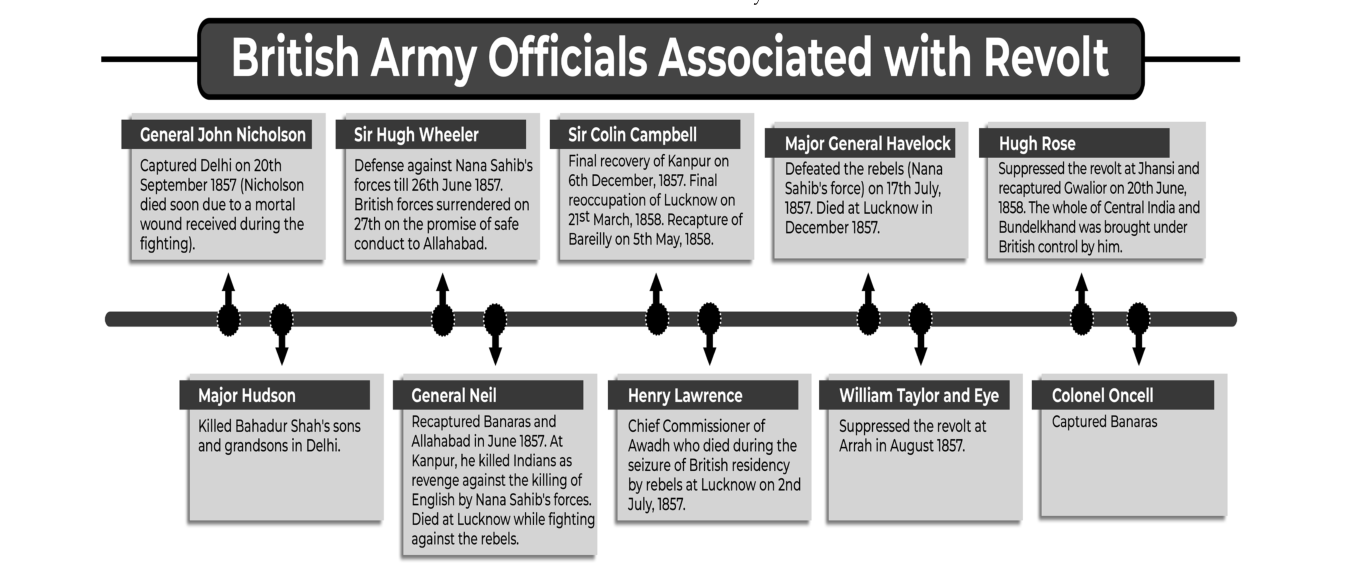
Sir Hugh Wheeler, commanding the station, surrendered on June 27, 1857 and was killed on the same day.
Most of the fighting was, however, carried on by Tantia Tope on his behalf, and it was Tantia Tope who passed into the popular legend as a great patriot and anti-British leader.
The Begum of Awadh
In Lucknow, the Begum of Awadh took charge of the rebellion and declared her son, Birjis Kadr, as the Nawab of Awadh.
British Resident Henry Lawrence, along with European residents and a few loyal sepoys, sought refuge in the residency, which came under siege by Indian rebels. During the siege, Sir Henry was killed, and Brigadier Inglis assumed command, holding out despite immense challenges.
Early efforts by Sir Henry Havelock and Sir James Outram to reclaim Lucknow were unsuccessful.
Eventually, Sir Colin Campbell, the new commander-in-chief, successfully evacuated the Europeans with the assistance of Gorkha regiments.
By March 1858, the British regained control of Lucknow, though guerrilla resistance persisted until September of the same year.
Maulvi Ahmadullah
Maulvi Ahmadullah of Faizabad, originally from Madras, became a prominent leader in the revolt against the British. He led a strong resistance against British troops in Awadh.
Recognized as one of the key leaders during the uprising that began in Awadh in May 1857.
Rani Lakshmi Bai
Rani Lakshmi Bai of Jhansi fought for her right to the throne, which was denied by Lord Dalhousie using the ‘Doctrine of Lapse’.
After the death of her husband, Raja Gangadhar Rao, Dalhousie annexed Jhansi, refusing to recognize her adopted son as heir.
Rani Lakshmi Bai was joined by Tantia Tope, marching towards Gwalior where they were supported by Indian soldiers.
Despite their efforts, Gwalior was recaptured by the British in June 1858, with Sindhia siding with the English.
Kunwar Singh
The most representative and outstanding leader was Kunwar Singh of Arrah. Under his leadership the military and civil rebellion was so completely fused that the British dreaded him most.
With a war band of about 5,000, including about 600 Danapur sepoys and the rebellious Ramgarh state battalion he marched across hundreds of miles to reach Mirzapur, Banda and the vicinity of Kanpur.
He reached up to Rewa state and it was thought that as soon as Rewa fell to the rebels, the British would be forced to move to the south.
But, for some reasons, Kunwar Singh did not move southwards. He returned to Banda and then back to Arrah where he engaged and defeated the British troops. He was seriously injured and died on 27th April, 1858 in his ancestral house in the village of Jagdishpur.
Shah Mal
Shah Mal, a local villager from Pargana Baraut, Uttar Pradesh, became a significant figure during the revolt of 1857.
He mobilized headmen and peasants from 84 villages (chaurasi desh) to rise against British rule.
Shah Mal led night marches from village to village, urging people to rebel and disrupt British control.
The villagers attacked government buildings, destroyed bridges, and dug up roads to prevent British forces from entering the region.
Shah Mal sent supplies to mutineers in Delhi and cut off official communication between British headquarters and Meerut.
His headquarters were established at a bungalow on the banks of the Yamuna River, where he managed his operations.
The bungalow became a center for justice, resolving disputes and giving judgments.
Shah Mal’s leadership ended when he was killed by English officer Dunlap in July 1857, and his body was mutilated and displayed to terrorize the public.
SUPPRESSION OF THE REVOLT
The British captured Delhi on 20 September 1857. Prior to this, the rebels had faced defeats in Kanpur, Agra, Lucknow, and other regions.
The fall of Delhi dealt a severe blow to the rebels, as it became evident why the British fought to retain the city at any cost, enduring significant losses in both manpower and resources.
Emperor Bahadur Shah was taken prisoner, and his royal sons were captured and publicly executed by Lieutenant Hudson. Bahadur Shah was later exiled to Rangoon, where he died in 1862.
Nana Saheb was defeated at Kanpur and fled to Nepal in early 1859, never heard from again. Kanpur was occupied by Sir Colin Campbell on December 6, 1857.
Tatya Tope continued guerrilla warfare in central India until he was betrayed by a zamindar friend and captured in April 1859. He was swiftly tried and executed on 15 April 1859.
By the end of 1859, other major leaders of the revolt, including Rani of Jhansi, Kunwar Singh, Bakht Khan, Maulavi Ahmadullah, and the Begum of Awadh, had either died or escaped to Nepal, and British authority was fully reestablished across India.
CAUSES OF FAILURE Lack of a Unified Programme and Ideology
The rebellion swept off the British system of government and administration in India. But the rebels did not know what to create in its place. They had no forward-looking plan in mind.
This made them rely on the outmoded feudal system with Bahadur Shah at its head. The other prominent leaders of rebellion like Nana Saheb, Begum of Awadh, Rani of Jhansi, etc. were also representatives of the old feudal world.
This system had lost its vitality and was unable to withstand the onslaught of the British. It was because of the failure of these rulers, that the British had earlier been able to conquer almost the whole of India.
Lack of Unity Among Indians
There is no broad-based unity among the Indian people. While sepoys of the Bengal army were revolting, some soldiers in Punjab and south India fought on the side of the British to crush these rebellions.
Similarly, there were no accompanying rebellions in most of eastern and southern India. The Sikhs also did not support the rebels. All these groups had their reasons to do so.
The possibility of the revival of Mughal authority created a fear among the Sikhs who had faced so much oppression at the hands of the Mughals.
Similarly, the Rajput chieftains in Rajasthan and Nizam in Hyderabad were so much harassed by the Marathas that they dreaded the revival of Maratha power.
Besides this, there were some elements of the peasantry that had profited from British rule. They supported the British during the revolt.
The zamindars of Bengal Presidency were the creation of the British; and had all the reasons to support them. The same applied to the big merchants of Calcutta, Bombay and Madras who did not go over to the rebels but supported the British.
Most Indian rulers chose not to join the rebellion and instead provided active support to the British.
According to estimates, only about one-fourth of the total area and one-tenth of the population were affected by the uprising.
Lack of support from the Educated Indians
The modern educated Indians also did not support the revolt because, in their view, the revolt was backward-looking.
This educated middle class was the product of the British system of education and they believed mistakenly that the British would lead the country towards modernisation.
Disunity Among the Leaders
The main issue was the lack of unity among the rebel leaders, who were often suspicious and jealous of each other.
For example, the Begum of Awadh had conflicts with Maulavi Ahmadullah, and Mughal princes had disagreements with sepoy-generals.
The political advisor of Nana saheb , Azimullah asked him not to visit Delhi .This selfishness and narrow-minded approach weakened the strength of the revolt and hindered its consolidation.
Military Superiority of the British
Another major factor for the defeat of the rebels was the British superiority in arms.
The Indian soldiers were poorly equipped materially, fighting generally with swords and spears and very few guns and muskets.
On the other hand, the European soldiers were equipped with the latest weapons of war like the Enfield rifle. The electric telegraph kept the commander-in-chief informed about the movements and strategy of the rebels.
Nature of the Revolt
Different Views on the nature of the 1857 revolt
Dr. K. Datta views the Revolt of 1857 as primarily a military uprising, with discontented princes and landlords taking advantage of the situation.
Dr. S.N. Sen describes the revolt as starting as a religious fight and evolving into a struggle for independence in his book " Eighteen Fifty"
Dr. R.C. Majumdar sees it neither as the first nor as a national war of independence, highlighting that large areas and sections of people remained uninvolved.
Marxist historians interpret the 1857 revolt as a movement of soldier-peasants fighting against both foreign and feudal oppression.
Jawaharlal Nehru regards the revolt as largely a feudal uprising, though it had some nationalistic aspects.
M.N. Roy considers it the last attempt of feudalism to resist the rise of commercial capitalism.
Vinayak Damodar Savarkar: The First War of Independence in 1857 was the rising of the masses to shake off the foreign domination.
Rudrangshu Mukherjee: “The 1857 revolt was a reaction to the high-handedness, the oppressive revenue policies,
the annexations, and the attempts to transform Indian society through cultural assimilation.”
Khushwant Singh: “The leaders of 1857 were the first to articulate the concept of a united national struggle for freedom. They fought for a vision of India free from foreign domination.”
William Dalrymple: “The revolt of 1857 was a moment of doomed heroism, and the betrayal and failure of the rebellion marked the end of an older India.”
Uma Chakravarti: “The 1857 uprising has been the subject of much creative writing, especially by women writers who have used it as a canvas for exploring the experiences of women in that period.”
British Historian’s View (Kaye, Malleson, Trevelyan, Lawrence, and Holmes): They portrayed it as a rebellion primarily within the army and did not believe it had widespread support from the general population.
Contemporary Indian Perspectives (Munshi Jiwan Lai, Moinuddin, Durgadas Bandyopadhyay, and Sir Syed Ahmad Khan): They viewed the events as a ‘mutiny’ and didn’t see it as a movement with broad-based popular support.
View of a Religious War Against Christians or Racial Struggle: Some interpretations considered the events of 1857 as a religious war against Christians or a racial struggle for supremacy between the Black and the White.
View of Laurence Rees: He characterized the Revolt of 1857 as a war of fanatic religionists against Christians.
View of a Struggle between Oriental and Occidental Civilization: This view suggests a clash between traditional Eastern values and Western influences.
Notion of a Hindu-Muslim Conspiracy: This perspective highlights the perceived collaboration between Hindus and Muslims against the British.
Indian Nationalists View: Some Indian nationalists referred to the events of 1857 as a well-planned national struggle and the first war of Indian independence.
View of Sir John Lawrence and Seeley: They characterized the events of 1857 as a Sepoy Mutiny; and nothing more.
View Popularized by T. R. Holmes: It was a conflict between civilization and barbarism.
Sir James Outram and W. Tayler’s View: They believed that the outbreak of the 1857 rebellion was the result of a Hindu-Muslim conspiracy.
Benjamin Disraeli’s View: He described the 1857 outbreak as a national rising.
Significance of the Revolt of 1857
The Revolt of 1857 highlighted significant weaknesses in the British administration and military, prompting immediate reforms.
For Indians, the revolt played a crucial role in shaping the struggle for independence, bringing forth genuine grievances of the people and sepoys.
The Indians' lack of advanced weaponry made them inferior to the British, whose superior arms were a significant advantage.
The atrocities committed by both sides during the revolt shocked Indian intellectuals, reinforcing the belief that non-violent resistance was necessary for a successful freedom movement.
The educated middle class rejected violence and preferred a more structured and orderly approach to the fight for independence.
Despite its shortcomings and criticism by some historians, the Revolt of 1857 significantly influenced future generations of freedom fighters and established a foundation for local resistance against British rule. WHITE MUTINY After the transfer of power from the British East India Company to the British Crown, a segment of European forces employed by the Company opposed the shift that required the three Presidency Armies to pledge their allegiance from the defunct Company to the Queen, similar to the British Army. This discontent led to unrest known as the White Mutiny.
Prior to 1861, India had two distinct military forces under British rule—the Queen’s army and the units of the East India Company. Company troops received batta, extra allowances to cover expenses related to operations outside of home territories. With the transfer of power, the payment of batta was discontinued. Lord Canning’s strict legal interpretation of the transfer further angered the affected European soldiers.
ADMINISTRATIVE AND LEGISLATIVE CHANGES AFTER 1858
The Revolt of 1857 gave a severe jolt to the British administration in India and made its reorganisation inevitable. In fact, Indian society, the Indian Government and the Indian economy all underwent significant changes in the decades following the Revolt.
Administration
In 1858, the British Parliament passed an Act transferring power from the East India Company to the British Crown.
The authority over India was now exercised by a Secretary of State for India, who was responsible to Parliament.
The India Council advised the Secretary of State but decisions could be overruled.
Financial matters required the Council’s approval, though by 1869, the Council was subordinated to the Secretary of State.
The Governor-General, now also known as the Viceroy, continued to act as the Crown’s personal representative in India.
Over time, the Viceroy’s role became more subordinate to the British Government in terms of policy execution.
Indians had no voice in the India Council or the British Cabinet and could hardly approach the distant rulers.
British industrialists, merchants, and bankers gained substantial influence over Indian administration.
The administration became increasingly reactionary, with the abandonment of earlier liberal pretenses.
The Governor-General’s Executive Council consisted of departmental heads who acted as official advisers.
Decisions were made through majority vote, with the Governor-General holding the power to override significant decisions.
Gradually, all power was concentrated in the Governor-General’s hands.
The Indian Councils Act of 1861 expanded the Governor-General’s Council to create an Imperial Legislative Council for legislative purposes.
The Imperial Legislative Council included between six and twelve members, with at least half being non-officials, either Indian or British.
Despite its expansion, the Legislative Council possessed limited powers and served primarily as an advisory body.
It could not discuss financial matters or pass bills without prior government approval, and no bill could become an act without the Governor-General’s approval.
The primary function of the Council was to provide an appearance of legislative input for official measures.
Non-official Indian members were nominated by the Governor-General, often comprising princes, their ministers, big zamindars, influential merchants, or retired senior government officials.
Provincial Administration
India was divided for administrative convenience into provinces, with Bengal, Madras, and Bombay being known as Presidencies.
Each Presidency was administered by a Governor and an Executive Council of three appointed by the Crown.
Presidency Governments had more rights and powers than other provinces, which were administered by Lieutenant Governors and Chief Commissioners appointed by the Governor-General.
Before 1833, provincial governments had significant autonomy, including the ability to pass laws, which was later removed, subjecting their expenditure to strict central control.
The Act of 1861 marked a shift towards centralisation, establishing legislative councils similar to the central body first in Bombay, Madras, and Bengal, and then in other provinces.
These provincial legislative councils were purely advisory, consisting of both officials and four to eight non-official Indians and Englishmen, and lacked powers akin to a democratic parliament.
The Central Government exercised strict control over even the smallest details of provincial expenditure.
In 1870, Lord Mayo took a step towards separating central and provincial finances by granting fixed sums to provinces for certain services like Police, Jails, Education, Medical Services, and Roads.
Lord Lytton expanded this scheme in 1877 by transferring more heads of expenditure to the provinces, including Land Revenue, Excise, General Administration, and Law and Justice.
To meet the additional expenditure, provinces were allocated a fixed share of the income realised from sources such as Stamps, Excise Taxes, and Income Tax.
The previous system of providing fixed grants was replaced, and provinces were allowed to retain the entire income from certain revenue sources and receive a fixed share from others.
Thus, all sources of revenue were categorised into three—general, provincial, and those shared between the centre and the provinces.
Despite these changes, the Central Government remained supreme and continued to exercise detailed control over provincial governments.
Local Bodies
Due to financial constraints, the Government moved towards greater administrative decentralization by encouraging the formation of local governing bodies such as municipalities and district boards.
Additionally, the growing Indian nationalist movement began to press for modernization in civic life, highlighting the urgent need for mass education, sanitation, clean water, improved roads, and other public services.
The Government chose to delegate responsibilities for services like education, health, sanitation, and water supply to local bodies, which were expected to fund these services through local taxation.
The first local bodies were established between 1864 and 1868, but most of them consisted entirely of nominated members and were led by District Magistrates.
A major advancement came in 1882 under the administration of Lord Ripon, who is often referred to as the father of local self-government in India. The key features of his resolution included: ➤ Promoting local institutions to improve governance and serve as a tool for political and civic education; ➤ Managing local affairs through urban and rural bodies with defined responsibilities and corresponding revenue sources; ➤ Ensuring a majority of non-official members in these bodies, with elections to be introduced where considered feasible by officials; ➤ Allowing non-official members to serve as chairpersons of these bodies; ➤ Minimizing official interference, which was to be limited to review and oversight rather than policy control; ➤ Requiring official approval in specific matters, such as taking loans, disposing of municipal property, imposing new taxes, initiating high-cost projects, and formulating rules and by-laws.
Although district officials continued to preside over district boards, over time, non-officials began to take on the role of chairpersons in municipal committees.
However, the Government retained the authority to tightly regulate the functions of these local bodies, including the power to suspend or dissolve them at its discretion.
Indians responded positively to Ripon's resolution and actively participated in local governance, hoping these institutions would eventually evolve into genuine instruments of self-rule.
Royal Commission on Decentralisation (1908)
Its recommendations are:
The recommendations emphasised increasing the powers of village panchayats, including judicial jurisdiction in minor cases and responsibility for small village works, schools, and fuel and fodder reserves.
Panchayats should be provided with sufficient sources of income.
Sub-district boards should be established in each taluka or tehsil with distinct duties and separate revenue sources from district boards.
Existing restrictions on taxation powers should be lifted, and regular grants-in-aid from provincial governments should be limited to large projects.
Municipalities should take responsibility for primary education and, if willing, for middle vernacular schools, while the government should manage secondary education, hospitals, relief, police, and veterinary works if municipalities choose not to handle these responsibilities.
The Government of India Resolution of 1915
This resolution contained the official views on the recommendations of the Decentralisation Commission.
Most of the recommendations remained on paper and the condition of local bodies continued to be as it was left by Lord Ripon.
The Resolution of May 1918
This resolution reviewed the entire question of local self- government in the light of the announcement of August 20, 1917.
The resolution suggested that the local bodies be made as representative as possible of the people with real and not nominal authority vested in them.
Under Dyarchy
Local self-government was made a ‘transferred’ subject under popular ministerial control by Government of India Act, 1919, and each province was allowed to develop local self- institutions according to provincial needs and requirements.
The Government of India Act, 1935
The provincial autonomy ushered in by the Government of India Act, 1935 gave further impetus to the development of local self-governing institutions in India.
Portfolio finance being under the control of popular ministries, now the funds could be made available for development of local bodies.
Further, the demarcation of taxation between provincial and local finance which prevailed since the reforms of 1919 was scrapped.
Changes in the Army
After 1858, the Indian army underwent careful reorganization, driven by the transfer of power to the British Crown and the need to prevent future revolts.
The East India Company’s European forces were merged with Crown troops to create a more controlled and stable military force.
To minimize Indian capacity for rebellion, the army maintained strict European dominance. The proportion of Europeans to Indians was raised to 1:2 in the Bengal Army and 2:5 in the Madras and Bombay armies. Additionally, European troops were strategically placed in key geographical and military positions.
The crucial branches of the army, such as artillery and, later, tanks and armoured corps, were exclusively controlled by Europeans.
The older policy of excluding Indians from officer ranks was rigorously enforced. Until 1914, no Indian could rise above the rank of subedar.
The Indian section of the army was organized based on the policy of “balance and counterpoise,” or “divide and rule,” to prevent unity and potential anti-British uprisings.
Discrimination was practiced in recruitment, dividing Indians into “martial” and “non-martial” classes. Soldiers from regions like Avadh, Bihar, Central India, and South India—who had initially aided the British but later participated in the Revolt of 1857—were classified as non-martial and excluded from large-scale recruitment.
Conversely, Sikh, Gurkha and Pathan soldiers, who supported the suppression of the Revolt, were regarded as martial and recruited extensively.
Indian regiments were composed of a mixture of castes and groups to maintain balance and prevent unity. This encouraged communal, caste, tribal, and regional loyalties among soldiers to discourage nationalist sentiments.
The Indian army evolved into a highly costly military force, absorbing nearly 52% of Indian revenues in 1904. This was due to its dual purpose—defending India against external threats and supporting British imperial expansion in Asia and Africa.
The British army served as an army of occupation, ensuring British dominance over India. However, its expenses were covered by Indian revenues, placing a heavy financial burden on India.
The Revolt of 1857 led the British to change their policy regarding princely states. Prior to 1857, British officials frequently annexed princely states, but this policy was abandoned afterward.
Most Indian princes had remained loyal to the British and played a key role in suppressing the Revolt, earning them guaranteed territorial integrity and respect for their right to adopt heirs.
Lord Canning referred to the princes as acknowledging their loyalty.
Recognizing the value of princely states as allies, the British refrained from annexing them and sought their cooperation.
Queen Victoria’s proclamation of becoming the Empress of India in 1876 symbolized the assertion of British sovereignty over the entire Indian subcontinent.
Lord Curzon later clarified that the princely states were ruled as agents of the British Crown, ensuring their loyalty through subordinate roles in the Empire.
British interference in princely states became systematic, with the appointment and dismissal of ministers and high officials at the discretion of the British.
The British sought to modernize princely states by establishing modern administrative systems, ensuring their complete integration with British India.
The development of unified systems such as railways, postal and telegraph services, and a common economic framework further facilitated this integration.
Additionally, nationalist movements within princely states provided a rationale for increased British control, as these movements were seen as threats to British authority.
Administrative Policies
After the Revolt of 1857, the British attitude towards India became more negative, and their policies shifted towards reactionary measures.
Prior to 1857, there had been attempts, though half-hearted, to modernize India with some belief in preparing Indians for self-governance. However, following the revolt, this perspective changed dramatically.
The notion that Indians were unfit for self-rule became more prominent, with a focus on indefinite British control and domination over India.
Divide and Rule
The British initially conquered India by exploiting the disunity among Indian powers and encouraging rivalries.
Post-1858, they continued the divide and rule strategy by fostering divisions among different groups—princes against people, provinces against each other, castes against one another, and Hindus against Muslims.
The unity displayed by Hindus and Muslims during the Revolt of 1857 deeply disturbed the British rulers, who sought to break this unity to weaken the rising nationalist movement.
Immediately after the Revolt, the British repressed Muslims, confiscated their lands, and declared Hindus as their preferred group.
By 1870, this policy shifted to creating divisions between upper and middle-class Muslims and the nationalist movement.
The British government exploited the limited social services and industrial backwardness, encouraging educated Indians to rely heavily on government jobs for advancement.
This competition for government posts led to communal rivalry, as the government offered official favours based on communal loyalties in exchange for support and loyalty.
The educated Muslims were often pitted against educated Hindus, fostering division and weakening the nationalist movement.
Hostility to Educated Indians
After 1833, the Government of India actively encouraged modern education, starting universities in Calcutta, Bombay and Madras in 1857, which led to the rapid spread of higher education.
Initially, British officials praised educated Indians for not participating in the Revolt of 1857. However, this attitude soon changed as some educated Indians began using their knowledge to critique British imperialism and demand greater involvement in administration.
With the rise of the Indian National Congress in 1885, the British officials became increasingly hostile to higher education and the educated Indians.
The British took active measures to restrict higher education, mocking educated Indians, whom they often referred to as ‘babus’.
This opposition was aimed at the group of Indians who embraced modern Western knowledge and advocated for progress in alignment with modern values.
British imperialism, however, clashed with the ideas of modern progress, leading to official resistance against educated Indians.
The opposition to higher education and the educated class highlights how British rule in India had begun to stagnate in terms of promoting progress and reform.
This shows that British imperialism in India was no longer capable of facilitating genuine advancements for the people it ruled.
Attitude Towards the Zamindars
The British shifted their focus from supporting forward-thinking educated Indians to forming alliances with reactionary groups such as princes, zamindars, and landlords.
Zamindars and landlords were now considered the 'natural' and 'traditional' leaders of the Indian people, with their lands and privileges protected at the cost of peasants.
This alliance ensured that the interests of zamindars and landlords were secured, serving as counterweights against the nationalist intelligentsia.
In return, zamindars and landlords recognized the importance of maintaining British rule and became firm supporters of colonial authority.
Attitude towards Social Reforms
The British abandoned their previous policy of supporting social reformers as part of their alliance with conservative classes.
They believed that their measures of social reform, such as the abolition of Sati and permission for widows to remarry, were major contributors to the Revolt of 1857.
Consequently, the British began to side with orthodox opinions and stopped supporting social reformers.
Jawaharlal Nehru, in The Discovery of India, highlights this shift by stating that the British became the guardians of many traditional and oppressive customs.
The British found themselves in a dilemma: supporting social reform led to opposition from orthodox Indians who argued that foreign rule should not interfere in Indian social affairs.
On the other hand, not supporting social reform helped perpetuate social evils and drew criticism from socially progressive Indians.
By supporting the status quo and encouraging casteism and communalism for political gain, the British actively reinforced social reaction.
Extreme Backwardness of Social Services
In contrast to rapid progress in social services like education and sanitation in Europe, India lagged behind with underdeveloped services.
The Government of India allocated most of its resources towards the army, wars, and administrative services, neglecting social services.
Efforts to provide basic services such as sanitation, water supply, and public health were largely limited to urban areas, primarily serving European and upper-class Indian residents.
These services were concentrated in civil lines or modern sections of cities, leaving the majority of the population underserved.
LEGISLATIVE CHANGES AFTER 1858
Labour Legislation
The working conditions in modern factories and plantations during the 19th century were poor and harsh.
The Government of India, primarily pro-capitalist, took inadequate steps to address these issues in modern factories, many of which were owned by Indians.
The first Indian Factory Act was passed in 1881, focusing
mainly on child labour. It prohibited children below 7 from working and limited the work hours for children between 7 and 12 to 9 hours per day with four holidays a month, along with fencing dangerous machinery.
The second Indian Factory Act was passed in 1891, introducing a weekly holiday for all workers. Women were allowed to work for up to 11 hours per day, and children’s daily working hours were reduced to 7. However, men’s working hours remained unregulated.
Neither of these Acts applied to British-owned tea and coffee plantations, where the Government facilitated the exploitation of workers.
Penal laws were passed by the Government in 1863, 1865, 1870, 1873, and 1882 to support foreign planters in their ruthless exploitation of workers.
Despite some improvements in the 20th century due to the rising trade union movement, the condition of the Indian working class continued to be extremely poor and deplorable.
Racial Antagonism
The British in India maintained a sense of racial superiority and remained aloof from Indians.
The Revolt of 1857 and the subsequent violence deepened the divide between Indians and the British, who began openly asserting racial supremacy and practicing racial arrogance.
Facilities such as railway compartments, waiting rooms, parks, hotels, swimming pools, and clubs were reserved exclusively for Europeans.