![THE ROWLATT ACT [1919]](https://chahalacademy.com/uploads/note-chapters/the-rowlatt-act-1919-1790059248.webp)
Whatsapp 88106-52225 For Details
Get Free IAS Booklet
Get Free IAS Booklet
THE ROWLATT ACT [1919]
In this unit
We will discuss the introduction of the draconian Rowlatt Act and the ensuing protests. We will transition to events leading to the Jallianwala Bagh Massacre under General Dyer. Finally, we will analyse the Hunter Committee and the Congress’ response to its report after the massacre. The government presented constitutional reforms that were perceived as unsatisfactory while simultaneously seeking extraordinary powers to suppress opposition.
Just six months before the implementation of the Montford Reforms, two bills were introduced in the Imperial Legislative Council.
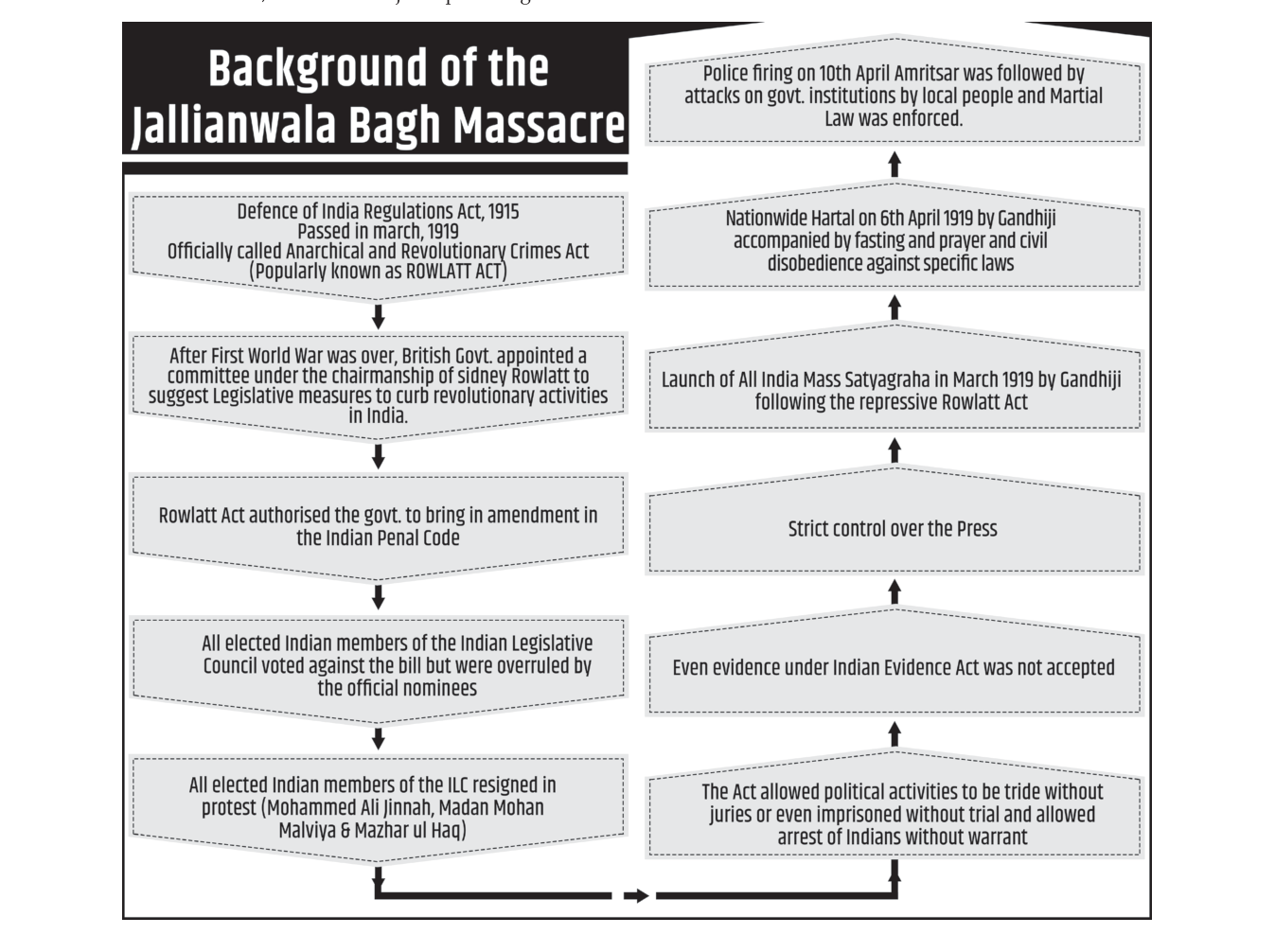
One bill was withdrawn, while the other—an extension to the Defence of India Regulations Act 1915—was passed in March 1919.
This act became popularly known as the Rowlatt Act and officially titled the Anarchical and Revolutionary Crimes Act.
Following the end of the First World War, the British government appointed a committee chaired by Sidney Rowlatt to suggest measures to curb revolutionary activities in India.
Based on the committee’s recommendations, the government drafted two bills to grant discretionary powers for dealing with political crimes.
The Rowlatt Act allowed for the deportation or imprisonment of activists without trial for up to two years, and even the mere possession of seditious newspapers was sufficient evidence of guilt.
The act empowered the government to amend the Indian Penal Code to ensure state security and to bypass legal processes for handling revolutionary crimes.
Indian elected members of the Imperial Legislative Council, including Mohammed Ali Jinnah, Madan Mohan Malaviya, and Mazhar Ul Haq, opposed the bill and resigned in protest, as they were in the minority.
The act permitted the trial of political activists without juries and allowed imprisonment without trial.
Suspects could be arrested without warrants based on mere suspicion of ‘treason’.
Trials were conducted in secrecy, with a special cell consisting of three high court judges handling such cases, and there was no higher court for appeal.
The panel could accept evidence not admissible under the Indian Evidence Act, and the law of habeas corpus was suspended, undermining civil liberties.
The Rowlatt Act was intended to replace the wartime Defence of India Act (1915), permanently imposing restrictions on freedom of speech and assembly.
The government exercised strict control over the press and gained broad powers to manage anything deemed as terrorism or revolutionary activities.
SATYAGRAHA AGAINST THE ROWLATT ACT— FIRST MASS STRIKE
Gandhiji launched his first all-India mass Satyagraha in March 1919 in response to the repressive Rowlatt Act passed by the British government.
He referred to the Rowlatt Act as the “Black Act” and argued that punishment should not be extended to everyone for isolated political crimes.
The two Home Rule Leagues led by Mrs. Annie Besant and Bal Gangadhar Tilak, along with Indian Muslim associations, provided Gandhiji with essential support.
Gandhiji also established his own organization, the Satyagraha Sabha, to lead the movement.
In February 1919, members of the Bombay Home Rule movement first approached Gandhiji regarding the Rowlatt Bills while he was in Bombay.
Key newspapers such as Young India, Bombay’s Navajivan, the Bombay Chronicle, the Independent of Allahabad, Muslim Akhuwat of Lucknow, and Waqt of Amritsar played significant roles in mobilizing public opinion against the Bills.
Leaders like Rajendra Prasad, J.B. Kripalani, Vallabhbhai Patel, Rajagopalachari, Jawaharlal Nehru, Hakim Ajmal Khan, Dr. M. A. Ansari, Dr. Saifuddin Kitchlu, Dr. Satyapal, and Swami Shraddhanand actively supported and helped organize the Satyagraha movement.
Despite his doubts about the success and consequences, Gandhiji decided to launch the movement with a nationwide hartal on 6 April 1919, accompanied by fasting, prayer, civil disobedience against specific laws and voluntary arrests.
The movement marked a radical shift in the national struggle: ➤ The masses found direction and began taking action. ➤ Peasants, artisans, and the urban poor became increasingly involved in the struggle. ➤ The national movement became oriented towards the masses, with Gandhiji emphasizing that true salvation would come when the masses were awakened and engaged in politics.
Before the Satyagraha was launched, violent anti-British demonstrations erupted in cities like Calcutta, Bombay, Delhi, and Ahmedabad.
In Punjab, the situation worsened due to wartime repression, forcible recruitment, and outbreaks of disease, leading to the deployment of the Army.
By April 1919, the largest and most violent anti-British uprising since 1857 occurred, with Sir Michael O’Dwyer, the Lieutenant Governor of Punjab, reportedly using aircraft strafing against the protestors.
JALLIANWALA BAGH MASSACRE (APRIL 13, 1919)
There was widespread discontent among the people of Punjab, especially the Sikhs, due to the actions of the British government and the trials of the Ghadrites.
On 6 April 1919, Amritsar saw a hartal in protest against the Rowlatt legislation.
The British government's decision to deport local leaders, Saifuddin Kitchlew and Dr. Satyapal, and the ban on Gandhiji’s entry into Punjab exacerbated the situation.
In response, a protest march was organized in Amritsar against the deportation of the two leaders.
The marchers were stopped near the railway foot-bridge, where police opened fire, killing several protesters.
The police firing on 10 April led to attacks on government institutions by the people. To manage the situation, martial law was imposed by General Dyer.
After a brief period of quiet, on 13 April, the annual Baisakhi festival saw thousands of peasants gathering near the Golden Temple in Amritsar. A public meeting was held in Jallianwala Bagh, which was banned by the government.
General Dyer opened fire on the unsuspecting crowd, resulting in 379 deaths and 1,200 injuries according to government reports.
The following day, martial law was extended to other towns in Punjab.
In response to the atrocities, Rabindranath Tagore renounced the ‘Knighthood’ awarded to him by the British, while Gandhiji gave up the title of Kaiser-i-Hind.
Gandhiji was deeply affected by the violence and withdrew the Satyagraha movement on 18 April 1919.
The Congress held its next annual session at Amritsar to express solidarity with the people of Punjab.
A resolution was passed calling for the immediate removal of General Dyer and the recall of Viceroy Lord Chelmsford.
Additionally, it was decided to acquire the site of Jallianwala Bagh and build a memorial to honor those killed during the massacre.
Udham Singh, originally named Ram Mohammad Singh Azad, later assassinated Michael O’Dwyer, the Lieutenant-Governor responsible for overseeing the brutal British suppression of the 1919 protests in Punjab.
Udham Singh was hanged in 1940 for his actions.
THE HUNTER COMMITTEE OF INQUIRY
Edwin Montagu ordered the formation of a committee of inquiry to investigate the recent disturbances in India.
On October 14, 1919, the Government of India announced the formation of the Disorders Inquiry Committee, commonly known as the Hunter Committee after its chairman, Lord William Hunter, a former Solicitor-General for Scotland and Senator of the College of Justice in Scotland.
The purpose of the committee was to examine the causes of disturbances in Bombay, Delhi, and Punjab, and the measures taken to address them.
Among the members of the committee were three Indians: Sir Chimanlal Harilal Setalvad, Vice-Chancellor of Bombay University and advocate of the Bombay High Court; Pandit Jagat Narayan, a lawyer and Member of the Legislative Council of the United Provinces; and Sardar Sahibzada Sultan Ahmad Khan, a lawyer from Gwalior State.
In November, the committee arrived in Lahore and examined witnesses, including General Dyer.
The final report, released in March 1920, unanimously condemned Dyer’s actions.
The report criticized Dyer for his lack of notice to disperse from Jallianwala Bagh, the excessive length of his firing, his motive to produce a moral effect, and his overstepping of authority. It concluded that there was no conspiracy to overthrow British rule in Punjab.
The Hunter Committee did not impose any penal or disciplinary action on Dyer as his actions were condoned by his superiors.
Prior to the committee’s proceedings, the government had passed an Indemnity Act to protect its officers, which was widely criticized as a “whitewashing bill” by figures like Motilal Nehru.
Winston Churchill, then Secretary of State for War in England, reviewed the committee’s report.
The cabinet, agreeing with Churchill’s view, decided that Dyer was a dangerous figure who could not continue in his post.
Dyer was dismissed and relieved of his command in March 1920, being recalled to England. He faced no legal action, receiving half pay and his army pension.
However, Dyer was not universally condemned. In the House of Lords, most peers supported him, passing a motion in his favor.
The Morning Post raised a fund of 26,000 pounds for Dyer, with notable contributors including Rudyard Kipling.
Surprisingly, the clergy of the Golden Temple, led by Arur Singh, honoured Dyer by declaring him a Sikh.
Dyer’s honouring by the priests of Sri Darbar Sahib intensified demands for reforming the management of Sikh shrines.
This led to the launch of the Gurudwara Reform movement, advocating for changes in the administration of Sikh religious institutions.
CONGRESS VIEW
The Indian National Congress appointed its own non-official committee comprising Motilal Nehru, C.R. Das, Abbas Tyabji, M.R. Jayakar, and Gandhiji.
The committee criticized Dyer’s actions as inhumane and condemned the imposition of martial law in Punjab as unjustifiable.