Whatsapp 88106-52225 For Details
Get Free IAS Booklet
Get Free IAS Booklet
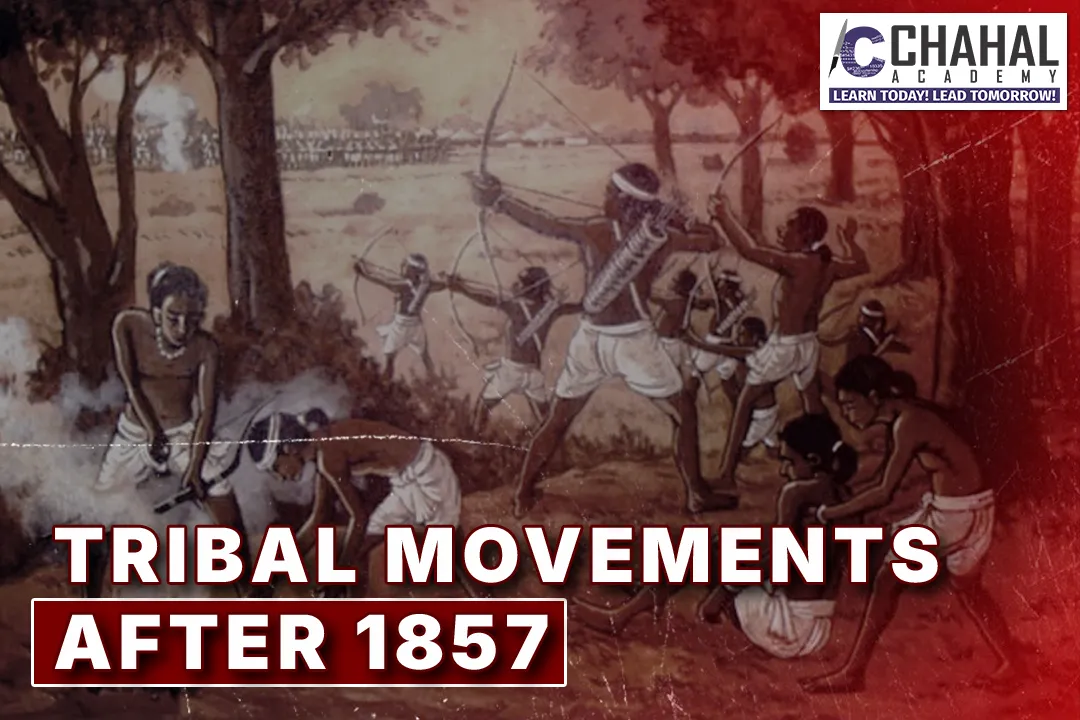
TRIBAL MOVEMENTS AFTER 1857
In this unit
We will discuss major Tribal Revolts after the 1857 Revolt under British Rule.
MUNDA REBELLION (1899-1900)
Munda tribes revolted against the transformation of Munda agrarian system into a feudal state in Chotanagpur area.
This revolt, like the earlier ones, was against the zamindars, traders and the government officers under the British regime.
Munda tribe had a traditional system of land called “Khuntkari system” according to which tribes enjoyed long established claims over the land.
However, in 1874, the British changed land policies and thus implemented the zamindari system thereby forming two classes of landlords and tenants. The tenants comprising tribals were made to pay rent for their own land and their right over the land was sealed if they failed to pay the rent.
In addition, the tenants were exploited in a number of ways such as eviction from land, harassment, land encroachment, increased rent, and so on. This pushed tribals to depend on money-lenders who would add high interest on the loans.
As a result of this oppression, the tribals started rejecting the operation of outsiders to establish their own independent territory.
The most prominent leader of this rebellion was Birsa Munda who was more aware than the others as he had received some education from the missionaries.
He encouraged his tribe people to keep the tradition of worshipping of the sacred groves alive. This move was very important to prevent the Britishers from taking over their wastelands.
Unfortunately, the rebels were defeated and Munda died in prison soon after in 1900.
The movement had its impact on the government attitude towards their problems. It decided to abolish the compulsory begar system and passed the Tenancy Act of 1903 which recognised the Mundari Khuntkatti system. The ‘Government ‘also passed the Chotanagpur Tenancy Act in 1908.
This rebellion is also known as “Ulgulan or the Great Tumult”.
KOYA REVOLTS
In 1879-1880 there occurred the Koya rebellion in the eastern Godavari tract of present-day Andhra Pradesh which also affected some portions of the Malkangiri region of Koraput district in Orissa.
It was led by Tomma Dora, the Koya leader. The movement reflected the problems faced by the tribals like the erosion of customary rights over forests, the exploitation by moneylenders who began to control the life of the Koyas through loans and land transfers.
After the death of Tomma Dora, another rebellion was organised in 1886 by Raja Anantayyar.
BHIL REVOLTS
The Bhils, who inhabited the Western Ghats, controlled vital mountain passes between northern India and the Deccan.
They revolted against British rule in 1817–1819 due to famine, economic hardships, and misgovernance.
The British used a combination of force and conciliatory measures to suppress the rebellion, but the Bhils rose again in 1825, 1831, and 1846.
In 1913, reformer Govind Guru organized the Bhils in southern Rajasthan (Banswara and Sunth states) to fight for a Bhil Raj.
BHUYAN AND JUANG REBELLIONS
The movement was led by the Bhuyans, Juangs, and Kals.
The first revolt was led by Ratna Nayak, while the second uprising (1867–1868 and 1891–1893 in Keonjhar, Odisha) was led by Dharni Dhar Nayak, opposing the installation of a British-backed ruler after the death of their king in 1867.
TANA BHAGAT MOVEMENT (1914-1915; CHOTA NAGPUR)
It was led by Jatra Bhagat, Balram Bhagat among the Mundas and Oraon tribes, who preached that God’s benevolent delegate would arrive to free the tribals.
It was against the policies of the local British authorities and exploitative business practices of local zamindars.
RAMPA REVOLT
Alluri Sitarama Raju was an Indian revolutionary involved in the Indian independence movement.
He led the ill-fated “Rampa Rebellion” of 1922–24, during which a band of tribal leaders and other sympathizers fought against the British Raj.
He was referred to as “Manyam Veerudu” (Hero of the Jungles) by the local people.
He took up the cause of the tribal people in the Agency areas, who were being harassed by British officials under the Forest Act, and led an armed rebellion against the British forces.
OTHER REVOLTS
Kukis' Revolt (1917–1919, Manipur): Protested against British labor recruitment policies during World War I.
Revolts in Tripura: ➤ Parikshit Jamatia led a movement in 1863 opposing increased house tax rates and the settlement of outsiders. ➤ Ratnamani led the Reangs' revolt during 1942–1943. ➤ Bharti Singh spearheaded a revolt in the 1920s.
Zeliangsong Movement (1920s, Manipur): Initiated by the Zemi, Liangmei, and Rongmei tribes to protest the British government's inaction during the Kuki violence of 1917–1919.
Naga Movement (1905–1931, Manipur): Led by Jadonang, it aimed at resisting British rule and establishing a Naga Raj.
Heraka Cult (1930s, Manipur): Led by Gaidinliu, this movement was suppressed, but it laid the foundation for the formation of the Kabui Naga Association in 1946.