Concepts of Cosmology
CONCEPTS OF COSMOLOGY
The universe can be defined as encompassing all celestial bodies or physical entities, such as planets, stars, galaxies, intergalactic space, and various forms of energy. In essence, it denotes the totality of existence, including both observable and hypothesized phenomena. The scientfic study of these heavenly celestial bodies is referred to as astronomy, and individuals engaged in this field are known as astronomers.
• The field of study which focuses on understanding the universe as a whole is called cosmology. Cosmology explores and seeks to answer the questions about the origin, evolution, structure, and eventual fate of the universe.
MILKY WAY
The Universe consists of billions of galaxies. A galaxy is a massive collection of stars, planets, gases, and dust all held together by gravity.
Our galaxy, the Milky Way, contains around 300 billion stars, including our Sun. Planets and other celestial objects orbit around stars, forming solar systems like our own with the Sun at the center.
• The closest major galaxy to the Milky Way is Andromeda.
Note: A significant part of the universe is composed of a mysterious substance called “dark matter”. Unlike the visible matter we can see with our eyes or telescopes, which is called “bright matter,” dark matter cannot be seen directly because it does not emit or reflect light.
SOLAR SYSTEM
The Solar System is made up of the Sun, eight planets (Mercury, Venus, Earth, Mars, Jupiter, Saturn, Uranus, and Neptune), dwarf planets like Pluto, numerous moons, and millions of smaller objects like asteroids, comets, and meteoroids. Beyond our Solar System, we’ve found thousands of other star systems with planets orbiting them within our galaxy, the Milky Way.
Our Solar System extends beyond the eight planets. It includes the Kuiper Belt, a region of icy bodies beyond Neptune, where Pluto is located. Further out is the Oort Cloud, a vast spherical shell made of icy debris. We haven’t directly seen the Oort Cloud, but we believe its existence, based on mathematical models and observations of comets that likely to come from there.
Sun’s Internal Structure
Sun is a large, bright sphere, made mostly of two gases: hydrogen (92.1%) and helium (7.9%). It also contains small amounts of other elements like oxygen, carbon, nitrogen, silicon, magnesium, neon, iron, and sulfur (0.1%).
Due to the Sun’s intense heat, most of its gas exists as plasma. Plasma is a state of matter where gas becomes electrically charged because atoms collide at very high speeds, knocking off electrons.
Note: In fact, the majority of matter (almost 99%) in the visible universe is believed to be in the form of plasma, more than in the form of liquids, solids, or regular gases.
The Sun has different layers inside and outside. Inside, there’s the core, where energy is produced, then the radiative zone and the convective zone where this energy moves outward.
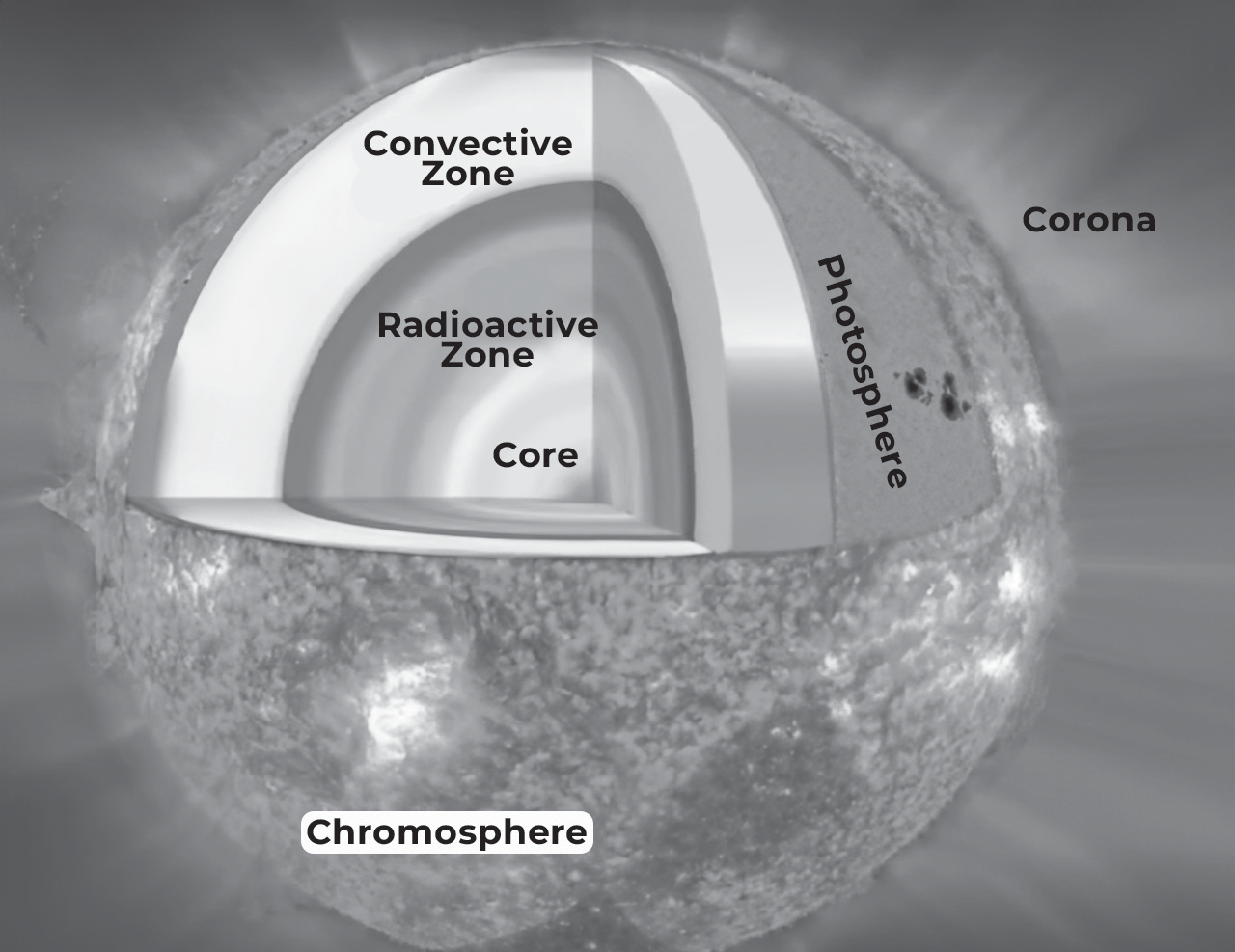
• Outside, there’s the surface layer called the photosphere. Beyond that, there’s the solar atmosphere which includes the chromosphere and the corona.
DWARF PLANETS
Dwarf planets are celestial objects that:
•orbit a star
•are roughly spherical
•often have many other large bodies such as comets, asteroids, or other dwarf planets near them
As their name suggests, the main difference between a dwarf planet and a planet is size. Because they are smaller, dwarf planets lack the gravitational forces needed to pull in and accumulate all of the material found in their orbits. Each known dwarf planet in our Solar System is actually smaller than Earth’s Moon.
The International Astronomical Union (IAU), which is responsible for naming and categorizing celestial objects, officially acknowledges five dwarf planets in our Solar System.
• These are Pluto, Eris, Ceres, Makemake, and Haumea.
• In 2006, during a meeting in Prague, the IAU decided to classify Pluto as a “dwarf planet,” changing its status from being considered a full-fledged planet.
CONSTELLATION
A constellation is a group of stars that seem to make a recognizable shape or figure, like a hunter, a lion, or a bull. People use these patterns in the sky to help them find their way or recognize different parts of the night sky.
There are 88 constellations that have been officially recognized.
About Zodiac:
Earth moves around the Sun once every year. From our perspective on Earth, the Sun seems to travel in a circular path in the sky, known as the plane of the ecliptic.
The zodiac is a group of constellations that lie along this path.
Throughout the year, the Sun appears to pass through these constellations. There are 12 astrological zodiac constellations, but astronomically, there are 13, including Capricornus, Aquarius, Pisces, Aries, Taurus, Gemini, Cancer, Leo, Virgo, Libra, Scorpius, Sagittarius, and Ophiuchus. Ancient cultures used this cycle of the zodiac to track time and seasons.
Why Do Most Stars and Constellations Move? Stars are extremely far away from us. The closest star to us, other than the Sun, is Proxima Centauri, which is more than 4 light-years away. As the Earth rotates, we, as observers on Earth, move past this backdrop of distant stars. This movement makes the stars appear to move across our night sky from east to west, similar to how the Sun seems to “rise” in the east and “set” in the west.
Stars near the celestial poles, where Earth’s north and south axes point into space, appear to move in small circles as the Earth rotates.
If you find Polaris, also known as the north “pole star,” you’ll notice it moves slightly in the night sky. The farther you are from Polaris, the wider the circle stars appear to trace. Some stars, like those in the Big and Little Dippers in the northern hemisphere, make a full circle around a celestial pole. These stars are called “circumpolar stars” because they remain in the night sky and never set. However, at the equator, there are no circumpolar stars because the celestial poles are located at the horizon. All stars observed at the equator rise in the east and set in the west.
OBJECTS IN SPACE
North Star
The North Star, also known as Polaris or the Pole Star, always shows the direction towards the north. It remains fixed in the sky and serves as a guide for navigation. While Polaris is visible to the naked eye, it’s not very bright compared to other stars. It’s the brightest star in the Ursa Minor constellation but ranks only 48th in brightness overall.
Despite appearing faint, Polaris is actually a massive yellow supergiant star. Its distance from Earth makes it seem dimmer.
Asteroids
Asteroids are smaller rocky objects in space, smaller than planets or dwarf planets. Many of them are located in the main asteroid belt, which is between Mars and Jupiter. There are over a million asteroids in this belt, with some being over half a mile wide, and many smaller ones.
Asteroids can also be found in other places in the Solar System. Some of them have orbits that bring them close to Earth, while others orbit other planets. Those that share an orbit with a planet are called Trojans.
Meteoroids
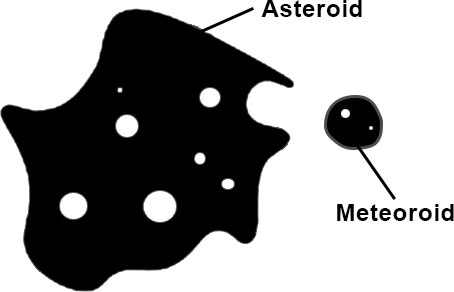
Sometimes asteroids collide with each other, causing small pieces to break off. These pieces are called meteoroids. Meteoroids can also come from comets.
Meteors
When a meteoroid gets near Earth and enters our atmosphere, it burns up and creates a streak of light in the sky called a meteor, often referred to as a “shooting star.”
But remember, meteors aren’t stars at all. While they may look similar, meteors and comets are actually very different types of objects.
Comets
Comets and asteroids both orbit the Sun, but comets are made of ice and dust, not rock like asteroids. As a comet gets closer to the Sun, the heat causes its ice and dust to vaporize, creating a glowing tail. Comets can be seen from Earth even when they’re far away. Unlike meteors, which we see when they enter our atmosphere, comets are visible from afar.
Meteorites
Sometimes meteoroids don’t completely burn up in the atmosphere. Instead, they make it through and land on Earth’s surface. When this happens, we call them meteorites.
Near-Earth Objects (NEOs)
Near-Earth Objects are asteroids or comets that come close to our planet, within a certain distance from the Sun. Specifically, NEOs come within less than 1.3 times the distance between Earth and the Sun.
Some of these objects are called Potentially Hazardous Asteroids (PHAs) because they come even closer, within less than half the distance between Earth and the Sun.
Comparing the Atmospheric Compositions of All Planets
COMPARING THE ATMOSPHERIC COMPOSITIONS OF ALL PLANETS
The Solar System consists of the Sun, eight planets (including Earth, Mercury, Venus, Mars, Jupiter, Saturn, Uranus, and Neptune), and five dwarf planets (such as Ceres, Pluto, Haumea, Makemake, and Eris).
The first four planets, Earth, Mercury, Venus, and Mars, are rocky planets called the inner planets because they orbit closer to the Sun. The other planets are giant gas planets and are known as the outer planets.
In addition to the planets, some large moons in our Solar System also have atmospheres. The composition of these atmospheres varies greatly. For example, Mercury’s atmosphere mainly consists of particles from the Sun. In contrast, Earth’s atmosphere is dense and contains a variety of gases.
Note: Oxygen is rare in the atmospheres of celestial bodies other than Earth because it readily reacts with other elements. However, Mars and Venus have significant amounts of hot oxygen in their upper atmospheres.
DISTRIBUTION OF GASES IN THE ATMOSPHERE OF THE PLANETS
Hydrogen- Probable source for existing hydrogen in the atmosphere of the planets is the solar wind. It can be noticed that the atmosphere of Saturn contains the maximum amount of hydrogen than the other planets by the amount of 88% of total amount of its atmosphere, while Jupiter’s atmosphere covered 86.4% of its atmosphere with hydrogen. 82.5% of Uranus’s atmosphere is hydrogen and 80% of Neptune’s atmosphere while Mercury’s atmosphere has only 22% and Earth’s atmosphere has the lowest value among the planets which is 6 x 10⁻⁵ % of its atmosphere.
Helium- The atmosphere of Neptune contains the maximum amount of helium than the other planets, by the amount of 19% of total amount of its atmosphere, while 15% of Uranus’s atmosphere is helium and 13.6% of Jupiter’s atmosphere and 12% for Saturn’s atmosphere. Earth has very low helium in its atmosphere which is only 5.24 x 10⁻⁴ % of the total amount of the gases and Venus’s atmosphere has (12 ppm) helium in its atmosphere.
Methane- The atmosphere of dwarf planet such as Pluto contains the maximum amount of Methane than the other planets by the amount of 2.5% of total amount of its atmosphere. Uranus’s atmosphere has Methane of about 2.3% of its atmosphere and 2% of Neptune’s atmosphere. Other planets have less methane in their atmosphere such as Saturn’s atmosphere which contains 0.0047% methane and 0.00181% of Jupiter’s atmosphere is covered by Methane while Earth’s atmosphere has 0.00018% Methane of the total amount of the gases and 10-250 ppb for Mars. (Note: ppb means parts per billion).
Ammonia- The atmosphere of Jupiter contains the maximum amount of Ammonia than the other planets by the amount of 0.0006% while 0.00016% of Saturn’s atmosphere covered by Ammonia and only <100 ppb of Uranus’s atmosphere is Ammonia and <600 ppb of Neptune’s atmosphere.
Water- Certainly the atmosphere of Earth contains the maximum amount of H2O than the other planets by the amount of 0.0001% of total amount of its atmosphere. Jupiter’s atmosphere has only 520 ppm H2O and <100 ppm of Mars’s atmosphere is H2O while Venus’s atmosphere contains 2 ppm H2O and 2-20 ppb of Saturn’s atmosphere.
Carbon dioxide- The atmosphere of Venus contains the maximum amount of CO2 than the other planets, by the amount of 96.5% of total amount of its atmosphere and the reason for having such amount of CO2 has been clarified above. And Mars’s atmosphere has 96% ppm of CO2 whereas 0.04% of Earth’s atmosphere is covered by CO2. The amount of CO2 for Jupiter’s atmosphere is about 5-35 ppb and for Saturn’s atmosphere is 0.3 ppb and this amount is 40 ± 5 ppt for Neptune’s atmosphere.
Nitrogen- The atmosphere of Pluto contains the maximum amount of N2 than the other planets by the amount of 97% of total amount of its atmosphere while Earth’s atmosphere contains 78% N2. Also 3.5% of Venus’s atmosphere is N2 and 1.9% of Mars’s atmosphere.
Oxygen- Amount of O2 in the atmosphere of each of the planets given as follows. The atmosphere of Mercury contains the maximum amount of O2 than the other planets by the amount of 42% of total amount of its atmosphere while 20.946% of Earth’s atmosphere is covered by O2 and 0.15% of Mars’s atmosphere is O2.
The planets of the modern Solar System are grouped into several different and sometimes overlapping classifications, these are: -
1.The planets inside the orbit of the earth are called the Inferior Planets: Mercury and Venus.
2.The planets outside the orbit of the earth are called the Superior Planets: Mars, Jupiter, Saturn, Uranus, Neptune, and Pluto.
3.The planets inside the asteroid belt are termed the Inner Planets (or the Terrestrial Planets): Mercury, Venus, Earth, and Mars.
4.The planets outside the asteroid belt are termed the Outer Planets: Jupiter, Saturn, Uranus, Neptune, and Pluto.
5.The planets sharing the gaseous structure of Jupiter are termed the Gas Giant (or Jovian) Planets: Jupiter, Saturn, Uranus, and Neptune.