Whatsapp 88106-52225 For Details
Get Free IAS Booklet
Get Free IAS Booklet
EARTH’S ATMOSPHERE
INTRODUCTION
Earth’s atmosphere is a unique combination of gases that envelops the planet. It serves several crucial functions such as providing breathable air, protecting from harmful UV radiation, regulating temperature by trapping heat and maintaining relatively stable temperature levels between day and night. While all planets in the Solar System have atmospheres, each has its own distinct composition and structure, with none being identical to Earth’s atmosphere.
These major characteristics outline the essential functions and roles of Earth’s atmosphere
• Thermal Regulation: The atmosphere acts as a thermal blanket, distributing solar heat across the planet and preventing excessive heat loss into space. This is achieved through diffusion of sunlight by gas molecules and suspended particles.
• Protection from UV Radiation and Temperature Regulation: It shields the Earth from harmful ultraviolet radiation, maintains warmth through insulation and moderates temperature extremes between day and night.
• Creation of Pressure and Habitability: The atmosphere creates pressure necessary for the existence of liquid water on the planet’s surface. It also contributes in maintaining habitable temperatures for life.
• Geological Influence: Atmosphere interacts with rocks, leading to chemical reactions that form new minerals and break down rocks into smaller fragments through oxidation and disintegration.
• Support for Life and Ecosystems: Essential for sustaining various forms of life, the atmosphere acts
as an interface between the lithosphere (Earth’s rocky crust), hydrosphere (water bodies) and biosphere (living organisms).
Water Cycle Regulation: The atmosphere serves as a medium for the transfer of water through processes like evaporation, precipitation and condensation, crucial for maintaining the water cycle, erosion of rocks and transportation of sediments.
COMPOSITION OF THE EARTH’S ATMOSPHERE
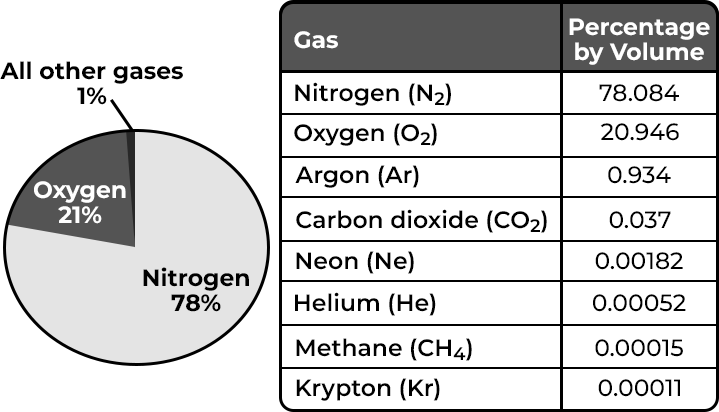
Nitrogen and Oxygen: These two gases make up the majority of Earth’s atmosphere. Nitrogen comprises about 78% while oxygen makes up about 21% of dry air.
Other Gases: The remaining less than 1% consists of gases like argon and carbon dioxide. Argon is present in small amounts, while carbon dioxide, although a minor component, plays a crucial role in the greenhouse effect and climate regulation.
Water Vapor: The atmosphere also contains varying amounts of water vapor, typically around 1%. This variable component plays a significant role in weather and climate processes.
Aerosols: Additionally, the atmosphere contains numerous tiny solid or liquid particles known as aerosols. These aerosols can be composed of various substances such as dust, spores, pollen, sea salt, volcanic ash, smoke and pollutants emitted from human activities. Aerosols have important effects on air quality, visibility and can influence climate by interacting with radiation and cloud formation.
Water Vapour
• Composition and Properties: Water vapor is the gaseous form of water and is both invisible and odorless. It constitutes approximately 0.035% of Earth’s atmosphere.
• Cycle of Addition and Removal: Water vapor undergoes continuous cycles of addition and removal from the atmosphere through processes like evaporation and condensation.
• Variation with Altitude: The presence of water vapor varies significantly with altitude. At higher altitudes, water vapor concentration decreases due to weaker mixing and turbulence in the atmosphere.
• Relationship with Temperature and Moisture: The capacity of air to hold moisture in the form of water vapor is directly linked to its temperature. Warmer air can hold more water vapor than cooler air.
• Therefore, regions over oceans, which tend to have higher temperatures, generally exhibit higher humidity levels compared to especially for continental regions in temperate and polar zones.
• This relationship between temperature and moisture content contributes to the complexity of climate and weather patterns.
Energy Release during Condensation: When water vapor undergoes condensation to form liquid droplets, a significant amount of energy is released. This release of latent heat is a fundamental factor in the formation and intensification of storms. The energy released during condensation fuels the atmospheric processes that drive thunderstorms, hurricanes, and other severe weather events.
Humidity
Humidity refers to the amount of water vapor present in the air. There are two main types of humidity: absolute humidity and relative humidity.
Absolute Humidity: This is the actual quantity of water vapor present in a given volume of air, typically measured in grams per cubic meter. Absolute humidity directly indicates the moisture content of the air.
Relative Humidity: Relative humidity is the ratio of the actual amount of water vapor present in the air to the maximum amount it could hold at a given temperature, expressed as a percentage. It indicates how close the air is to saturation with water vapor.
High relative humidity values suggest that the air is nearly saturated with moisture, while lower values indicate drier air.
• Temperature Regulation: Water vapor serves as a dynamic temperature regulator by absorbing heat. This absorption helps to prevent the Earth from experiencing extreme temperatures, acting as a buffer against both excessive heat and cold.
• Importance in Weather Processes: Beyond temperature regulation, water vapor is crucial for various weather phenomena, particularly those related to precipitation. The presence of water vapor in the atmosphere is a prerequisite for the formation of clouds and ultimately, precipitation events such as rain, snow, or hail.
STRUCTURE OF THE ATMOSPHERE
Earth’s atmosphere is divided into five distinct layers (Troposphere, Stratosphere, Mesosphere, Thermosphere and Exosphere), each characterized by specific features such as temperature and pressure.
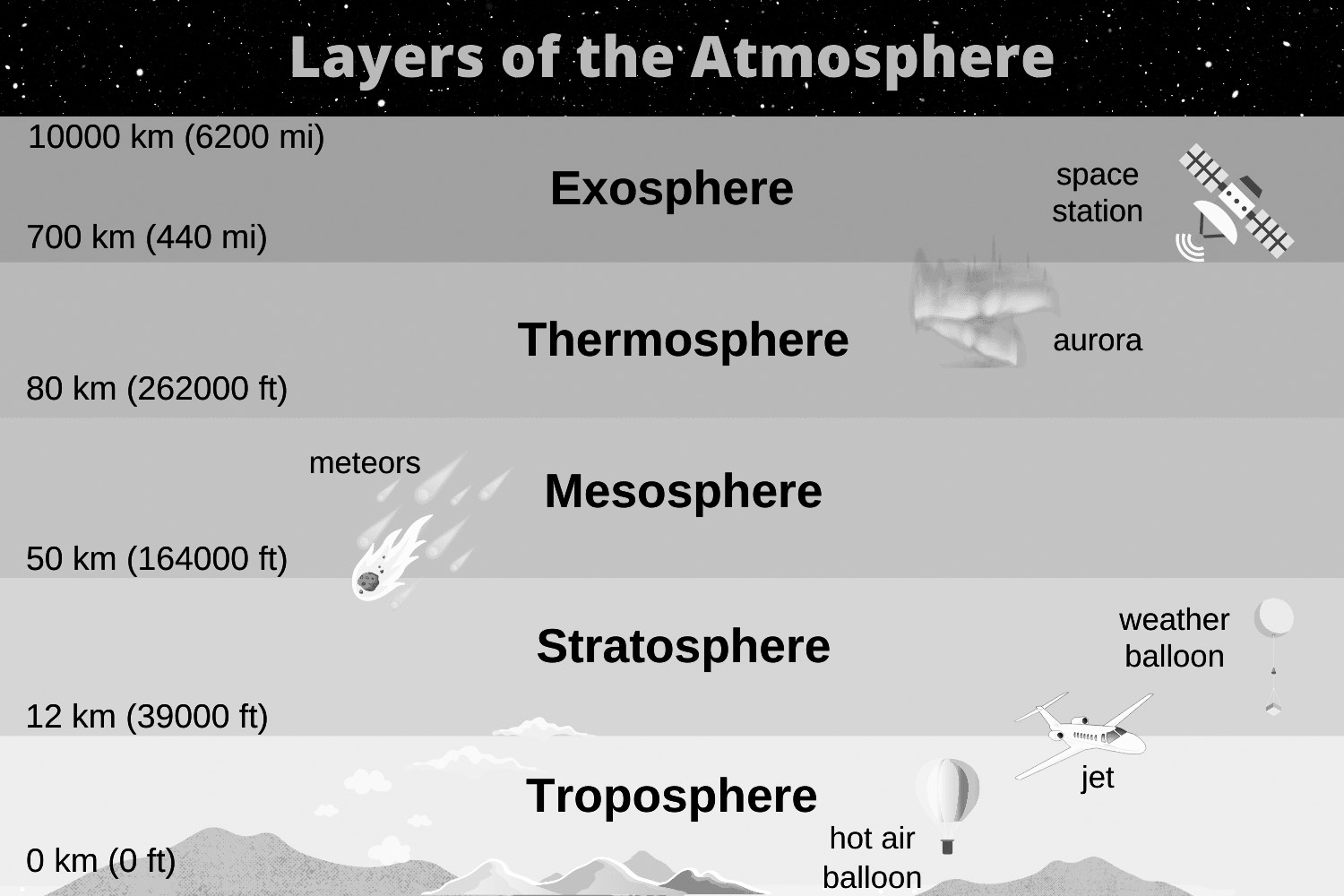
(Fig- Earth’s Atmosphere Layers)
The Troposphere
The troposphere is the lowest layer of Earth’s atmosphere.
• Height and Thickness: It starts from the ground and goes up about 8 kilometers near the poles and about 18 kilometers at the equator. It’s thickest at the equator because hot air rises high.
• Composition: The troposphere has dust particles and water vapor in it.
• Role in Climate and Weather: All the changes in weather happen here, from short-term weather events to long- term climate changes.
• Temperature and Biological Activity: As you go higher, the temperature drops by about 1 degree Celsius for every 165 meters you climb. This layer is crucial for life on Earth.
• Mass and Moisture: Most of the air mass (about 75-80%) is in the troposphere, and it’s the wettest layer, containing a lot of moisture.
• Clouds and Weather Events: Almost all clouds and weather events like rain, storms and snow happen in this layer.
• Boundary with Stratosphere: Above the troposphere is the stratosphere. The boundary between them is called the tropopause.
The Stratosphere
Location and Height: It’s above the troposphere, starting from where the tropopause ends and going up to about 50 kilometers.
Ozone Layer: One important thing about the stratosphere is that it has something called the ozone layer. This layer absorbs harmful ultraviolet radiation from the sun, protecting life on Earth.
Temperature and Stability: Unlike the troposphere where temperature decreases as you go up, in the stratosphere, temperatures actually rise. This temperature increase creates stability, meaning there’s not much mixing or turbulence.
Aircraft Flight: Commercial airplanes fly in the lower stratosphere to avoid the turbulence found in the troposphere below.
The Mesosphere
Location and Height: It’s above the stratosphere and goes up to about 80 kilometers above the Earth’s surface.
Temperature: In the mesosphere, temperature starts to drop again as you go higher up. At around 80 kilometers high, it can get as cold as minus 100 degrees Celsius.
Mesopause: The top boundary of the mesosphere is called the mesopause.
Noctilucent Clouds: These are thin, glowing clouds that form in the mesosphere. They’re the highest clouds in the sky.
• Meteor Burn-Up: This layer is where meteors burn up as they enter Earth’s atmosphere. The mesosphere has enough air to cause friction, creating heat that burns up meteors.
The mesosphere plays a superhero role by protecting Earth from potentially dangerous meteors, and it’s where you find some of the highest clouds in the sky.
The Ionosphere
The ionosphere is a layer of the Earth’s atmosphere located between 80 and 400 kilometers above the mesopause.
• Electrically Charged Particles: The ionosphere gets its name because it contains electrically charged particles called ions. It’s divided into two layers: the thermosphere and the exosphere.
• Radio Wave Reflection: This layer reflects radio waves transmitted from Earth back to the surface, allowing for long-distance communication.
• Temperature Increase: As you go higher in the ionosphere, temperature actually starts to increase.
• The exosphere is the highest layer of the atmosphere, extending beyond the thermosphere. It’s not well understood, but it’s extremely thin and gradually merges with outer space.
Similar to the movement of waves and tides in the ocean, Earth’s atmosphere also has waves and tides that help distribute energy. In the thermosphere, these movements influence wind patterns and circulation.
Auroras, such as the Northern and Southern Lights, occur primarily in the thermosphere. This happens when charged particles from space collide with gases in the thermosphere, creating colorful displays of light.