Ocean Heat
OCEAN HEAT
The sun is the primary source of energy for Earth’s oceans, providing radiation that warms the water. Additionally, the ocean itself generates heat internally.
There are three main processes through which ocean water is heated:
Ocean water absorbs solar radiation, with maximum absorption occurring in low-latitude regions due to vertical insolation and longer daylight duration. Solar insolation decreases steadily towards the poles. Factors such as ocean currents and cloud cover also influence the amount of solar radiation received by the ocean, even at the same latitude.
Convectional currents within the water body contribute to heating. As the temperature of the Earth increases with depth, water at greater depths tends to be heated more slowly than surface layers. This temperature difference drives convection currents, circulating heat throughout the ocean.
While friction does generate kinetic energy, it does not directly cause significant heating in the water. The energy from wind and tidal currents primarily causes mechanical motion and turbulence in the water, leading to mixing of water masses. This mixing can bring warmer water from the surface down to deeper layers (or vice versa), but it doesn't directly cause a rise in the water's temperature.
Studying ocean temperatures is crucial for understanding various aspects of ocean dynamics, including the movement and characteristics of water masses, the distribution of marine organisms at different depths, and the influence of oceans on coastal climates.
DETERMINANTS AND DISTRIBUTION OF OCEAN TEMPERATURE FACTORS
The temperature of ocean water plays a critical role in the survival and distribution of marine organisms, including phytoplankton and zooplankton. These organisms are highly sensitive to changes in water temperature, as it directly affects their metabolism, growth, reproduction, and overall ecological functions. Phytoplankton, for example, thrive in specific temperature ranges, and variations in sea surface temperature can influence their abundance and distribution, impacting marine food webs and ecosystems. Furthermore, ocean water temperature has significant implications for the climate of coastal lands.
The study of both surface and subsurface temperatures of seawater is essential for understanding these complex interactions and their impacts on marine ecosystems and coastal environments.
The distribution of temperature in ocean water is influenced by several factors:
• Latitudes
As one moves away from the equator toward the poles, the temperature of surface water decreases due to the slanting angle of the sun’s rays, resulting in decreased insolation.
Surface water temperatures between 40 N and 40 S are generally lower than air temperatures, but they become higher than air temperatures between 40 latitude and the poles in both hemispheres.
• Unequal distribution of land and water
The dominance of land in the northern hemisphere and water in the southern hemisphere leads to variations in ocean water temperature.
Oceans in the northern hemisphere receive more heat due to their contact with larger landmasses, resulting in comparatively higher surface water temperatures.
Isotherms in the northern hemisphere are irregular due to the presence of both warm and cold land masses, while they are more regular in the southern hemisphere.
Enclosed seas in low latitudes tend to have higher temperatures due to the influence of surrounding land areas.
• Prevailing winds
Wind direction significantly affects ocean water temperature distribution.
Offshore winds drive warm surface water away from the coast, resulting in upwelling of cold bottom water, which introduces longitudinal variation in temperature.
Onshore winds pile up warm water near the coast, raising the temperature.
• Ocean currents
Warm currents raise the temperature of affected areas, while cold currents lower it.
• Location and Shape of area
Latitudinally extensive seas in low latitude regions tend to have warmer surface water than longitudinally extensive seas.
Enclosed seas in low latitudes generally have higher temperatures than open seas, while enclosed seas in high latitudes have lower temperatures.
• Other Factors
Local weather conditions such as storms, cyclones, hurricanes, fog, cloudiness, evaporation, and condensation also impact ocean temperature distribution.
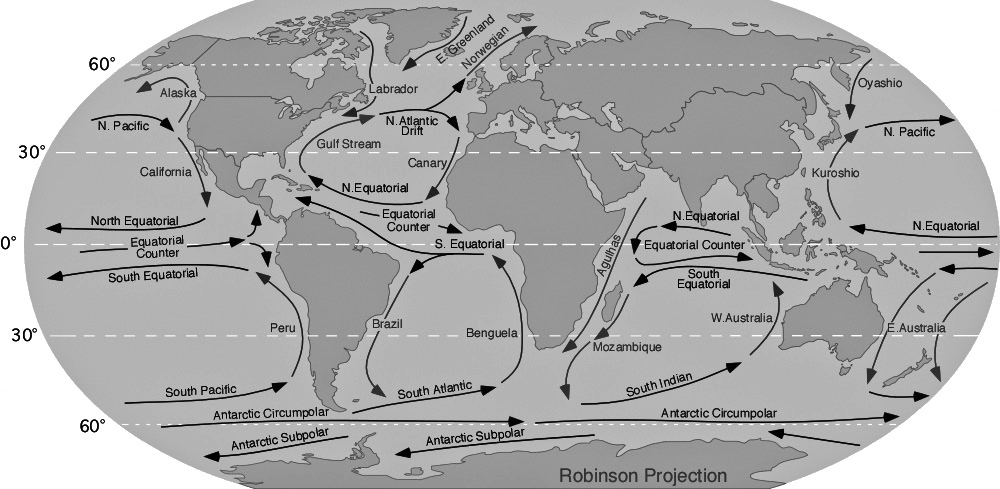
(Fig- Oceanic currents)
DISTRIBUTION OF OCEAN TEMPERATURE
The distribution of ocean temperature is heterogeneous (non-uniform), varying across latitudes and from the surface to the ocean bottom. Given the three-dimensional nature of the ocean, depth is also a crucial factor in understanding temperature distribution. The study of ocean temperature distribution involves two main approaches:
• Horizontal distribution (temperature of surface water) and
• Vertical distribution (from surface water to the bottom).
Horizontal Distribution of Ocean Temperature
The average surface water temperature of the oceans is approximately 26.7 C, with a gradual decrease from the equator towards the poles. The rate of temperature decrease with increasing latitude is typically around
0.5 C per latitude. For instance, the average temperature is around 22 C at 20 N and S latitudes, 14 C at 40 N and S latitudes, 1 C at 60 latitude, and 0 C near the poles.
The oceans in the northern hemisphere generally have higher average temperatures compared to those in the southern hemisphere. Interestingly, the highest temperatures are often found slightly north of the equator.
The average annual temperature for all oceans combined is approximately 17.2 C. The northern hemisphere averages around 19.4 C annually, while the southern hemisphere averages around 16.1 C annually. This disparity is due to the greater proportion of landmass in the northern hemisphere, as the ocean’s heat capacity is significantly higher than that of the atmosphere or land.
In the Northern Atlantic, the temperature decrease with increasing latitude towards the north is minimal due to the presence of warm Gulf Stream currents. On the other hand, in the southern Atlantic, the temperature decrease with latitude is more pronounced.
The average annual temperature of the Pacific Ocean is slightly higher than that of the Atlantic Ocean (approximately
16.91 C) and the Indian Ocean (approximately 17 C).
The lowest recorded ocean temperature (3.3 C) is near New Scotland, while the highest recorded temperature (32.2 C) is
in the western Pacific Ocean.
Within the Indian Ocean, the highest temperatures (25 C) are typically recorded in the Arabian Sea and Bay of Bengal. However, enclosed seas within the Indian Ocean, such as the Red Sea (32.2 C) and the Persian Gulf (34.4 C), often record even higher temperatures.
Vertical Distribution of Ocean Temperature:
The maximum temperature of ocean water is typically found at the surface because it directly absorbs solar radiation. This heat is then transmitted to deeper layers through conduction.
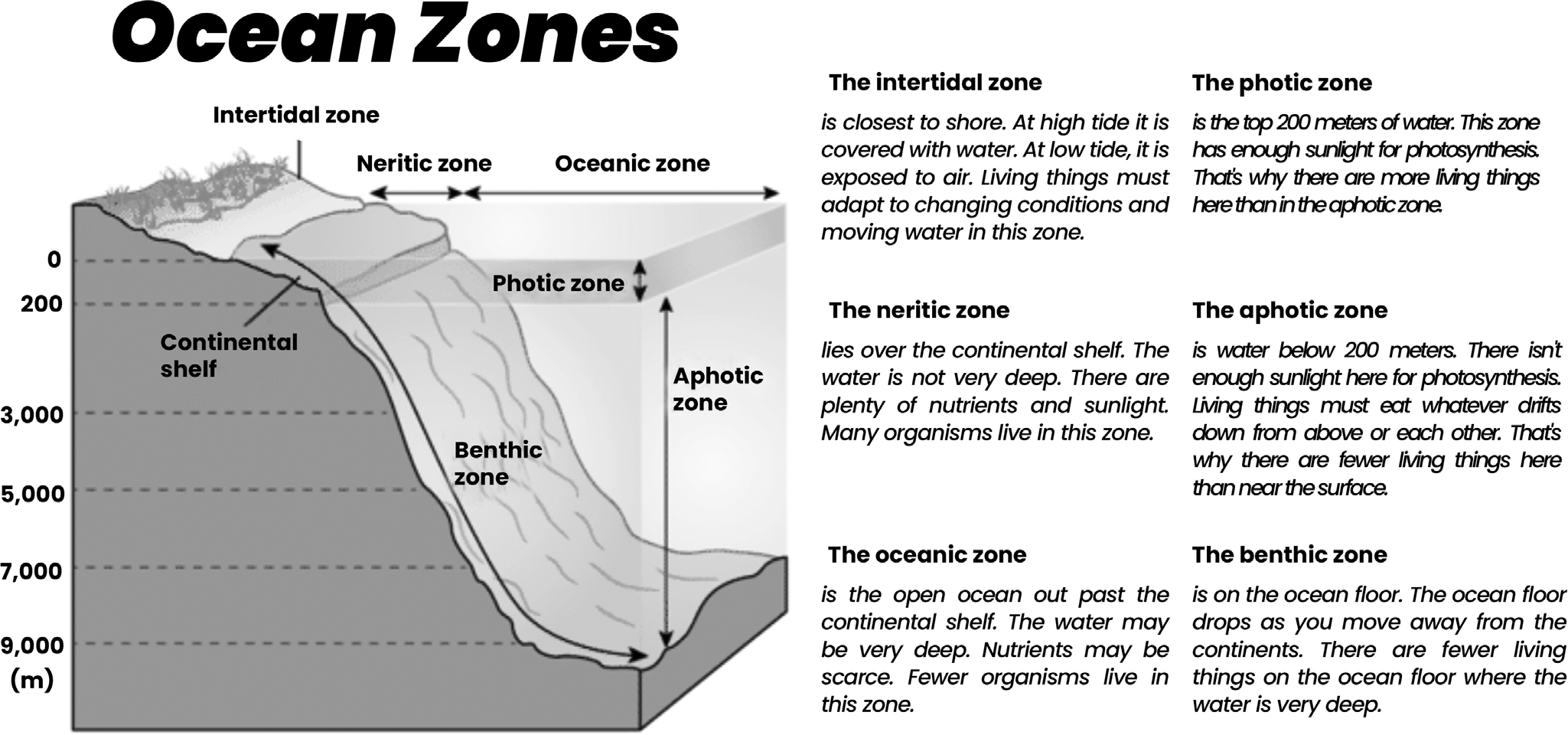
Solar radiation can effectively penetrate up to 200 meters deep into the ocean, with rare penetration beyond 200 meters. As a result, the temperature decreases with increasing depth, but the rate of decrease is not uniform.
Below the surface, the ocean is vertically divided into three zones:
Photic zone: This upper layer extends up to 200 meters and receives direct sunlight, heating it directly.
Aphotic zone: Below 200 meters and extending to the ocean floor, this zone does not receive direct sunlight.
Benthic zone: This refers to the ocean floor, where some organisms live. It includes both the continental shelf within the photic zone and the deep ocean floor within the aphotic zone.
Although sea temperature decreases with depth, the rate of decrease is not uniform. Below 2000 meters, the change in temperature becomes negligible.
The rate of temperature decrease with depth varies from
the equator to the poles, with more rapid decreases near the equator compared to poles.
Offshore winds drive warm surface water away, causing upwelling of cold water from below, resulting in lower sea surface temperatures and slower rates of temperature decrease with depth. However, onshore winds pile up warm water near the coast, leading to higher sea surface temperatures and more rapid temperature decreases with depth.
In terms of thermal conditions, the oceans are vertically divided into three layers in lower and middle latitudes:
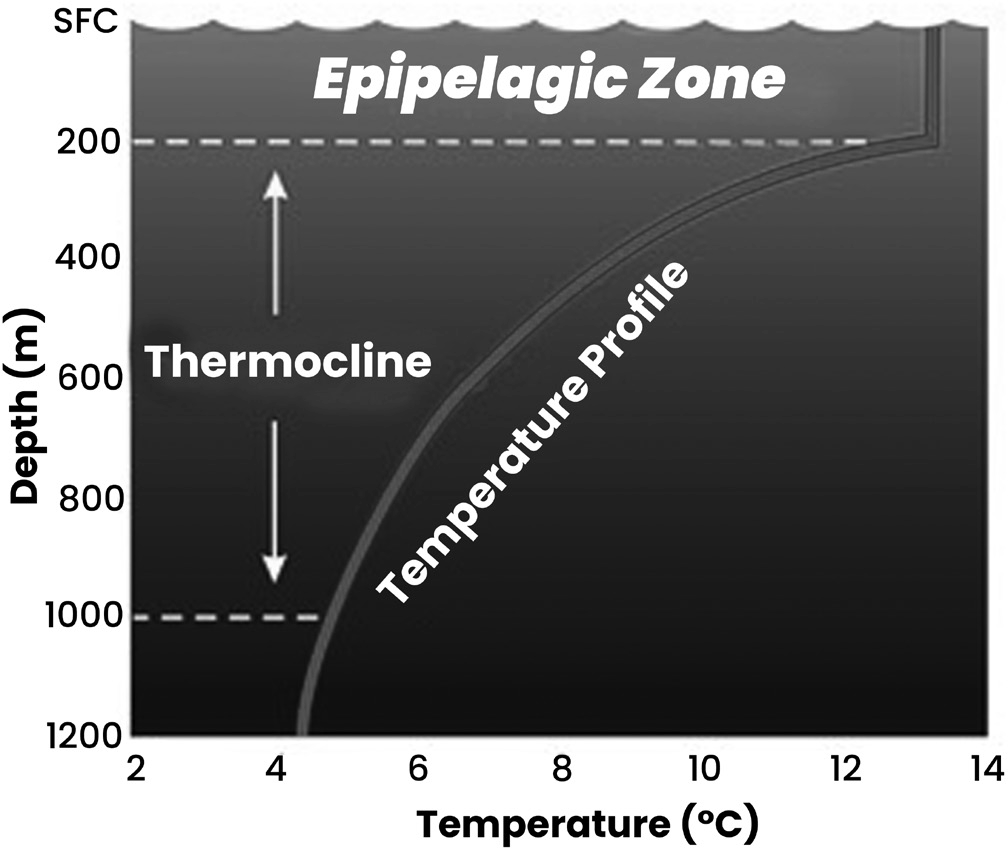
The upper layer, with an average thickness of 500 meters and temperatures ranging between 20 C to 25 C, represents the top layer of warm water mass. This layer is present year-round in the tropics but develops only during summer in middle latitudes.
The lower layer extends beyond 1000 meters to the ocean floor and consists of cold, dense ocean water.
The upper and lower ocean water masses are separated by a transitional zone called the thermocline, extending between 300 meters to 1000 meters depth, where water temperature decreases rapidly with depth.
RANGE OF OCEAN TEMPERATURE
Our planet is primarily heated by solar radiation, which comes from the sun. However, due to the Earth’s spherical shape, the angle at which sunlight strikes the surface varies with latitude. Near the equator, sunlight is almost directly overhead throughout the year, leading to warmer surface waters. In contrast, at high latitudes, such as the poles, sunlight strikes the surface at a more oblique angle, resulting in less heating. In fact, the poles receive only about 40 percent of the solar heat that the equator does. Consequently, ocean surface temperatures can range from a warm 30 C in the tropics to a very cold
-2 C near the poles. Additionally, surface temperatures may remain relatively stable in some areas but fluctuate seasonally in others, depending on the amount of sunlight received.
The temperature of ocean water also varies with depth. Solar energy either penetrates the upper surface of the ocean or is absorbed with depth, meaning that deeper regions receive less sunlight and therefore experience less warming. Consequently, the deep ocean, below approximately 200 meters depth, tends to be cold, with an average temperature of around 4 C. Cold water is denser and heavier than warm water, causing it to sink below the warmer surface water. This process contributes to the overall coldness of the deep ocean.
The vertical variation in ocean temperature has significant implications for the distribution of life in the ocean. Different organisms have adapted to specific temperature ranges, so temperature variations at different depths influence where certain species can thrive.
Daily Range (diurnal) of Temperature
The daily range of temperature, or diurnal temperature range, refers to the difference between the maximum and minimum temperatures observed within a single day.
For surface water of the oceans
• The daily range of temperature is generally minimal,
typically around 1 C.
• In low latitudes, where sunlight is more intense, the diurnal range tends to be slightly higher, typically around 0.3 C.
• In high latitudes, where sunlight is less intense, the diurnal range is even smaller, usually ranging from
0.2 C to 0.3 C.
Several factors influence the diurnal temperature range of ocean water
• Sky Conditions: Clear skies allow for more direct heating of the ocean surface by sunlight, leading to a slightly higher diurnal range compared to overcast conditions.
• Atmospheric Stability: Stable atmospheric conditions result in more gradual heating and cooling of ocean water, contributing to a smaller diurnal range. However, unstable air masses with strong circulation patterns may cause more rapid temperature fluctuations.
• Seawater Stratification: The density variations between surface water and deeper water layers restrict the transfer of heat through conduction. This stratification limits significant temperature changes within the water column, resulting in a low diurnal range.
Annual Range of Temperature
The annual range of temperature refers to the difference between the maximum and minimum temperatures observed over the course of a year.
In the northern hemisphere, the maximum annual temperature of ocean water is typically recorded in August, while the minimum is recorded in February.
"On average, the annual range of ocean water temperatures is relatively small, typically a few degrees Celsius, but it can vary significantly depending on regional factors such as solar radiation (insolation), sea characteristics, prevailing winds and geographic location."
Enclosed seas tend to experience higher annual temperature ranges compared to open seas. For example, the Baltic Sea records an annual temperature range of
• C.
The size of oceans and seas also influences the annual temperature range. Generally, larger bodies of water exhibit lower annual temperature ranges, while smaller bodies of water may experience more significant fluctuations. For instance, the Atlantic Ocean tends to have a relatively higher annual temperature range compared to the Pacific Ocean.