Ozone Layer
INTRODUCTION
The Earth’s atmosphere consists of several distinct layers, each with its own characteristics and properties. The two main layers relevant to human activities are the troposphere and the stratosphere.
The troposphere is the lowest layer of the Earth’s atmosphere, extending from the surface up to approximately 13 kilometers (about 8 miles) in altitude. Nearly all of Earth’s weather occurs in the troposphere, including the formation of clouds, precipitation and the movement of air masses. Human activities such as aviation, weather monitoring, and pollution emissions primarily occur within the troposphere.
The stratosphere lies above the troposphere and extends from about 13 kilometers to approximately 50 kilometers (about 30 miles) in altitude. Most commercial airplanes fly in the lower part of the stratosphere, where air travel is smoother and more stable compared to the turbulent conditions in the troposphere. One significant feature of the stratosphere is the presence of the Ozone Layer which is located between about 15 to 30 kilometers above the Earth’s surface.
Scientists have gathered extensive data over several decades to monitor ozone levels in the atmosphere during natural cycles. Ozone concentrations naturally fluctuate due to factors such as sunspot activity, seasonal changes and geographic location. These natural processes are well-documented and predictable.
Despite these natural fluctuations, scientists have observed a pattern of ozone recovery following periods of reduced ozone levels. This indicates that the ozone layer has the capacity to heal itself over time.
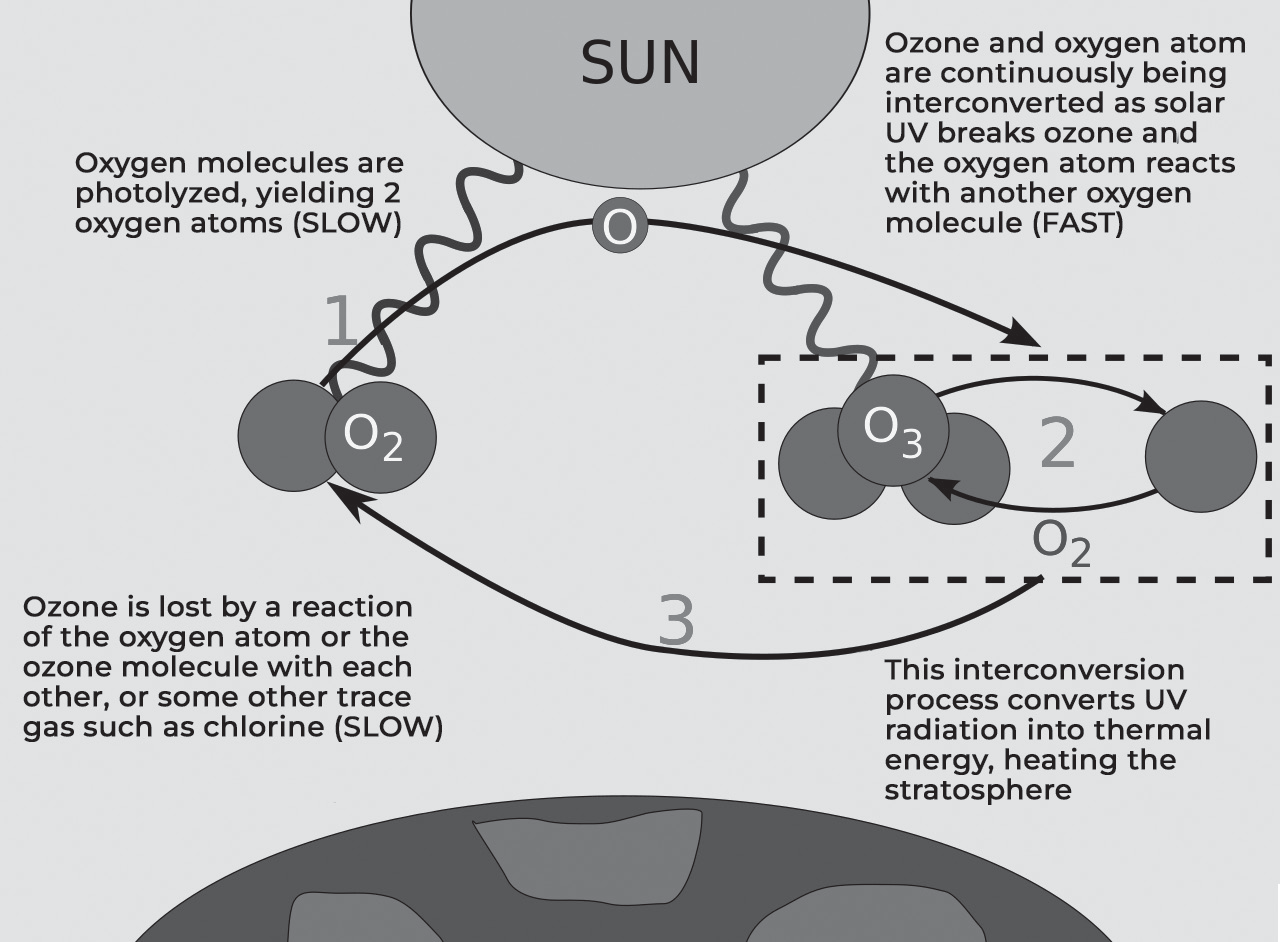
The Ozone Cycle
Ozone Depletion
When chlorine and bromine atoms encounter ozone molecules in the stratosphere, they initiate a chain reaction that leads to the destruction of ozone. Remarkably, a single chlorine atom has the potential to dismantle more than 100,000 ozone molecules before it exits the stratosphere. This means that ozone can be depleted at a much faster rate than it can naturally regenerate.
Certain chemical compounds have the capability to release chlorine or bromine atoms when exposed to intense ultraviolet (UV) light in the stratosphere. These compounds are categorized as ozone-depleting substances (ODS) because of their detrimental impact on the ozone layer.
Among ODS, chlorine-releasing compounds are significant contributors to ozone depletion. Examples of these compounds include chlorofluorocarbons (CFCs), hydrochlorofluorocarbons (HCFCs), carbon tetrachloride and methyl chloroform. These substances were widely used in various applications such as refrigeration, fire suppression, foam insulation and more.
Some natural phenomena, like significant volcanic eruptions, can indirectly affect ozone levels. For instance, the eruption of Mt. Pinatubo in 1991 didn’t directly increase stratospheric chlorine concentrations. However, it did release substantial amounts of aerosols, which are tiny particles distinct from consumer aerosol products.
These aerosols enhance chlorine’s ability to destroy ozone by providing a surface on which CFC-based chlorine can react. Nevertheless, the impact of volcanic aerosols on ozone depletion is short-lived.
It’s essential to note that not all sources of chlorine and bromine contribute to ozone layer depletion. For instance, chlorine from sources like swimming pools, industrial plants, sea salt, and volcanoes doesn’t reach the stratosphere. In contrast, ozone-depleting substances (ODS) are highly stable and don’t dissolve in rainwater. Consequently, there are no natural processes that effectively remove ODS from the lower atmosphere.
One of the most well-known examples of ozone depletion is the “hole” over Antarctica that has emerged during the Antarctic spring since the early 1980s. Technically, it’s not a hole through the ozone layer but rather a large area in the stratosphere with exceptionally low ozone levels. It’s important to recognize that ozone depletion isn’t confined to the area over the South Pole. Research indicates that ozone depletion occurs across latitudes encompassing North America, Europe, Asia, and much of Africa, Australia and South America.
International Treaties and Cooperation about the Protection of the Stratospheric Ozone Layer
During the 1970s and 1980s, global apprehensions escalated regarding the detrimental impact of ozone-depleting substances (ODS) on the ozone layer. In response to these concerns, the Vienna Convention for the Protection of the Ozone Layer was established in 1985 to formalize international collaboration on addressing this issue. This convention served as a foundational framework for subsequent endeavors aimed at ozone layer protection. As a culmination of international cooperation under the Vienna Convention, the Montreal Protocol on Substances that Deplete the Ozone Layer was signed in 1987.
The Vienna Convention for the Protection of the Ozone Layer, adopted in 1985, is considered the precursor to the Montreal Protocol. Often referred to as a framework convention, its primary function was to provide a framework for international efforts aimed at protecting
the ozone layer worldwide. Unlike the Montreal Protocol, the Vienna Convention did not mandate specific actions from countries to control ozone-depleting substances (ODS). Instead, it laid the groundwork for future agreements and initiatives in ozone protection.
Under the Vienna Convention, countries agreed to address the issue of ozone depletion collectively. This paved the way for the subsequent negotiation and adoption of the Montreal Protocol in 1987.
The Montreal Protocol
The Montreal Protocol on Substances that Deplete the Ozone Layer is a crucial global agreement aimed at safeguarding the Earth’s ozone layer by phasing out substances that contribute to its depletion.
Adopted in 1987 and coming into force in 1989, this landmark agreement addresses both the production and consumption of ozone-depleting substances (ODS).
Key aspects of the Montreal Protocol include
Annual Meetings: Parties to the Protocol convene annually to make decisions ensuring the effective implementation of the agreement. These decisions may involve adjustments or amendments to the Protocol, with six amendments made since its inception.
The Kigali Amendment: The most recent amendment, adopted in 2016, focuses on the phase-down of hydrofluorocarbons (HFCs). HFCs were introduced as alternatives to ozone-depleting substances eliminated by the original Montreal Protocol. While they do not deplete the ozone layer, HFCs are potent greenhouse gases contributing to climate change.
Practical Measures: The Montreal Protocol outlines practical and universally agreed-upon tasks for addressing ozone depletion. These measures include the gradual elimination of ODS and the promotion of ozone- friendly alternatives.
Success and Continued Efforts: The Protocol has successfully achieved its objectives and continues to play a crucial role in protecting the ozone layer. Thanks to the collaborative efforts of nations worldwide, significant