Whatsapp 88106-52225 For Details
Get Free IAS Booklet
Get Free IAS Booklet
ROCKS
INTRODUCTION
Rocks are the solid material forming the surface layers of the Earth. They are composed of minerals, which are natural substances with a specific chemical composition and structure. Minerals, in turn, are made up of elements, which are the basic building blocks of all matter. The Earth’s crust is made up of three main types of rocks, each formed through different processes: Igneous, Sedimentary and Metamorphic.
Igneous Rock
Formation of Igneous Rocks: Igneous rocks are formed from the cooling and solidification of magma (molten rock beneath the Earth’s surface) or lava (magma that has reached the Earth’s surface through volcanic activity). Examples of igneous rocks include basalt and granite. They are often very hard and can form some of the most striking rock formations on Earth.
Types of Igneous Rocks: Igneous rocks can be classified into two main types based on where they are formed:
• Intrusive (Plutonic) Igneous Rocks: These rocks form inside the Earth’s crust from slowly cooling magma. Examples include granite and diorite. They typically have a coarse texture with large mineral grains, indicating a longer cooling period that allows for the growth of large crystals.
• Extrusive (Volcanic) Igneous Rocks: These rocks form on the Earth’s surface from rapidly cooling lava. Examples include basalt. They often have a fine- grained texture due to the quick cooling process.
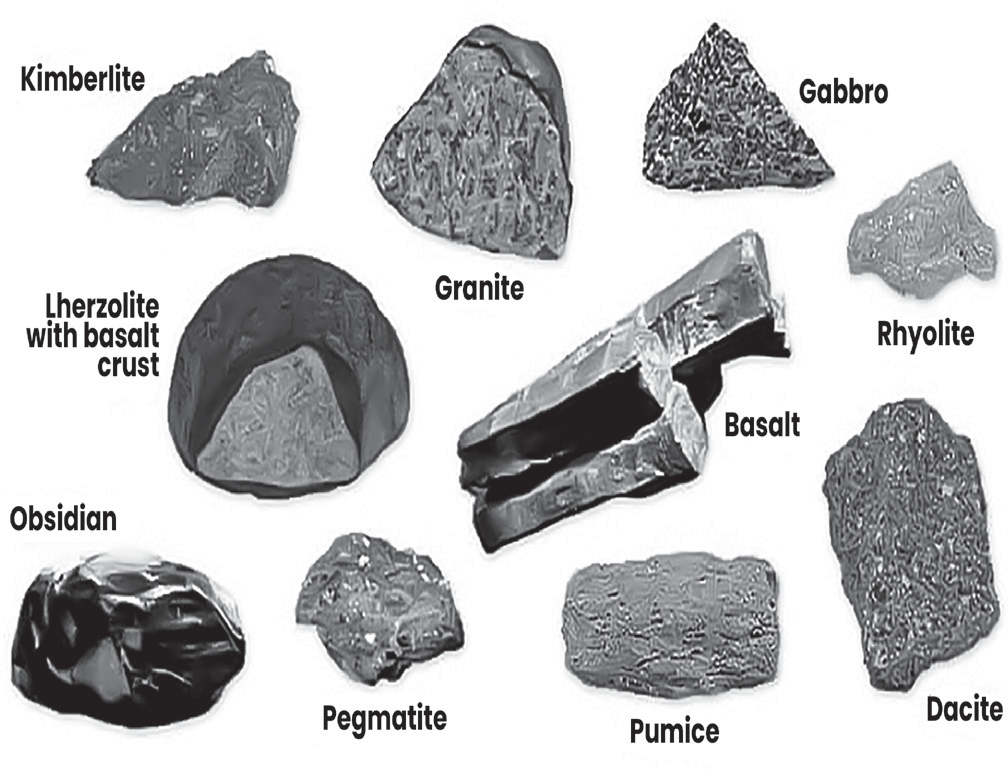
(Fig- Igneous rocks)
Sedimentary Rocks
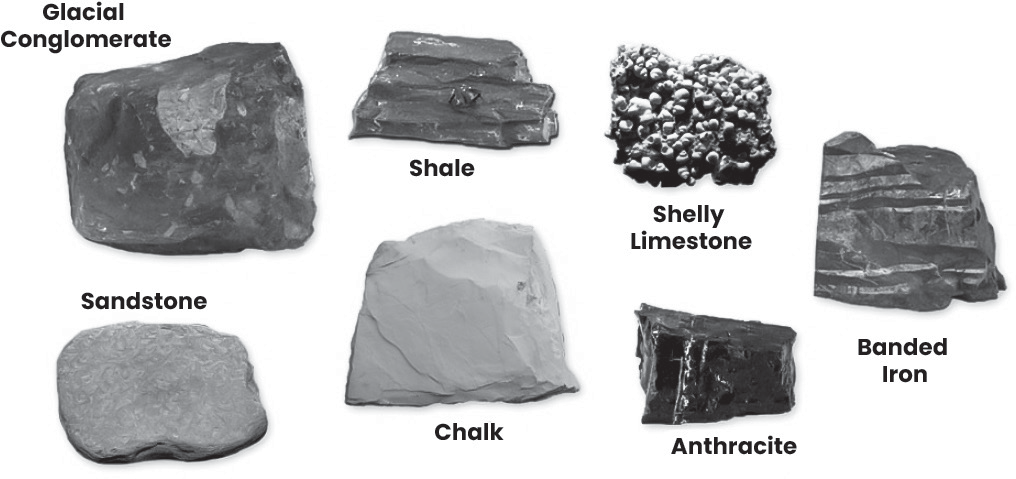
Formation of Sedimentary Rocks: Sedimentary rocks are formed over long periods, often millions of years, through the accumulation and compression of sediments at the bottom of seas, rivers, lakes and other bodies of water. These sediments consist of tiny particles of rocks, minerals, and organic material such as animal skeletons. Examples of sedimentary rocks include sandstone, coal and chalk.
Types of Sedimentary Rocks: Sedimentary rocks can be classified into different types based on their origins
• Detrital Sedimentary Rocks: These rocks form from the accumulation and lithification (compaction and cementation) of particles derived from pre-existing rocks. Examples include sandstone and shale.
• Chemical Sedimentary Rocks: These rocks form from the precipitation of minerals dissolved in water. Examples include limestone and rock salt.
• Organic Sedimentary Rocks: These rocks form from the accumulation and lithification of organic remains, such as plant matter and animal skeletons. Examples include coal and some types of limestone.
Fossils in Sedimentary Rocks: Sedimentary rocks often contain fossils, which are the preserved remains or impressions of plants and animals that lived long ago. These fossils provide valuable information about past environments and life forms, making sedimentary rocks akin to “nature’s history books.”
Metamorphic rocks
Formation of Metamorphic Rocks: Metamorphic rocks are formed when pre-existing rocks undergo changes in their mineral composition, texture, or structure due to heat and/ or pressure. Examples of metamorphic rocks include slate and marble. These rocks are often very hard but can be susceptible to damage from acids like acid rain, particularly in architectural applications.
Types of Metamorphic Rocks: Metamorphic rocks encompass a variety of types, including gneiss, quartzite, marble, schist, soapstone and phyllite. These rocks exhibit diverse textures and compositions depending on the specific geological conditions under which they formed.
Classes of Metamorphic Rocks: Metamorphic rocks can be categorized into two main classes based on their texture:
• Foliated Metamorphic Rocks: These rocks exhibit a layered or banded appearance due to the alignment of flat or elongated minerals under pressure. Foliation occurs when minerals like hornblende or mica align perpendicular to the direction of pressure. An example is seen in the transformation of granite an igneous rock, into gneiss.
• Non-foliated Metamorphic Rocks: Unlike foliated rocks, non-foliated metamorphic rocks do not display layering or banding. This occurs when the original rock lacks minerals that tend to align under pressure. Examples include anthracite coal (derived from bituminous coal), marble (from limestone) and quartzite (from sandstone).
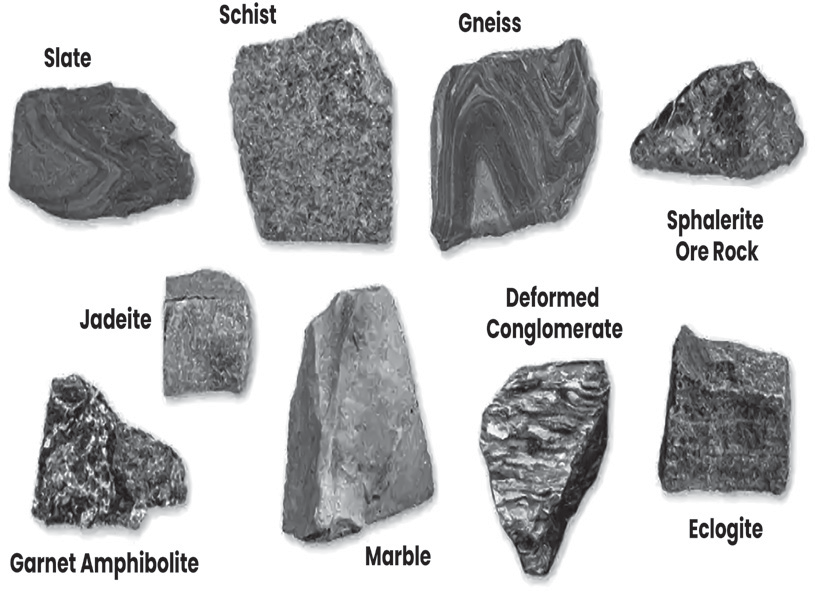
(Fig- Metamorphic rocks)
ROCK CYCLE
• The rock cycle describes how each of the main types of rocks, igneous, sedimentary and metamorphic change their form to each other.
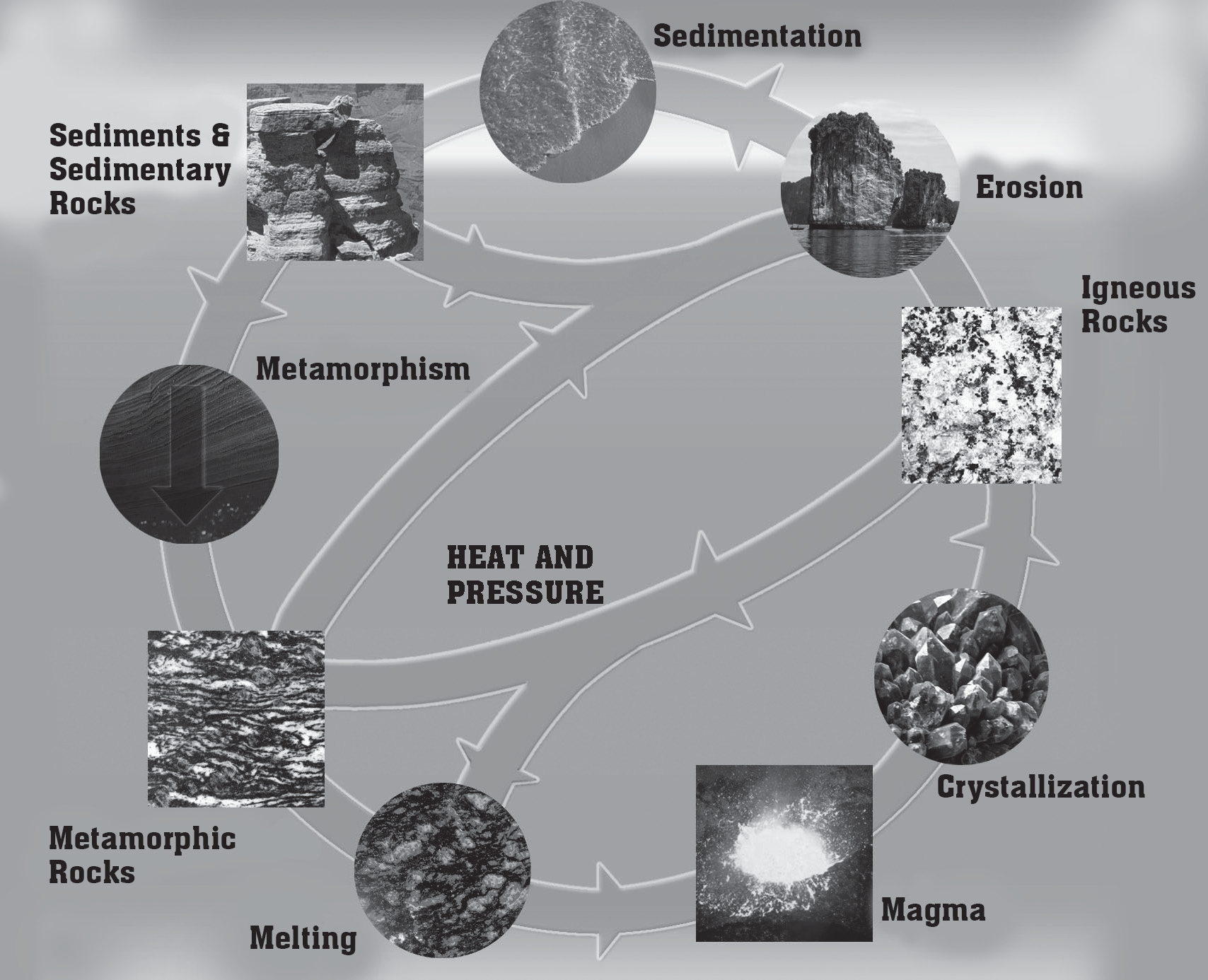
• Deep within the Earth, temperatures can get hot enough to create magma. As magma cools, crystals grow, forming an Intrusive (Plutonic) Igneous Rocks. However, due to volcanism, the magma erupts and flows out on the surface of the Earth, rapidly cooling to form Extrusive (Volcanic) Igneous Rocks.
• Moving water, wind, glaciers and even plants and animals all act to break down larger igneous rocks into sediments. This process is called Weathering. These sediments are eventually deposited by the process called sedimentation. The sediments may then be compacted and cemented together over hundreds and thousands of years to form a sedimentary rock.
• Any rock like igneous or sedimentary, undergoes metamorphism, which literally means ‘to change form’, when exposed to extreme heat and pressure within the crust. As a result of metamorphism, the rock changes its mineral composition and texture to form metamorphic rocks. It should be noted that metamorphism does not lead to melting of the rock.
• Like igneous rocks, metamorphic rocks can also weather down to sediments and eventually get converted into sedimentary rocks. Similarly, metamorphic rocks can melt under the crust to form igneous rocks.
• However, sedimentary rocks cannot be converted into igneous rocks.
• Igneous Rocks can also be classified based on their composition as follows:
Ultramafic refers to extreme degree of mafic rocks composed of mostly olivine (Iron and Magnesium rich mineral). Such rocks are rarely found on Earth’s surface. Their silica content is less than 40%.
Mafic refers to igneous compositions with an abundance of dark coloured ferromagnesian minerals of olivine along with light coloured calcium-rich plagioclase feldspar. The oceanic crust is primarily mafic rock. Mafic rock is low in silica, in the 45-50% range.
Intermediate is a composition between felsic and mafic. This rock type contains roughly equal amounts of light-coloured plagioclase feldspar and dark coloured minerals like hornblende. The silica content in rock of intermediate composition is in the 55-60% range.
Felsic refers to a composition with most of the light- coloured minerals feldspar and quartz. Such Rocks majorly found in the continental crust. Felsic igneous rock is rich in silica (in the 65-75% range) and poor in iron and magnesium.
MINERALS
• Minerals are solid crystalline naturally occurring inorganic substances which do not have carbon compounds and have definite arrangement of atoms within it.
• By weight, 99.5 per cent of minerals are formed from only 12 of the natural elements. Clearly, some elements are far more common than others. The same goes for minerals. Of the 5800 or so known minerals, only 10 make up 95 per cent of the Earth’s crust.
• Some minerals are only made up of one element, known as ‘native elements’. For example, Gemstones like Cobalt or Nickle and metals like Gold, or Mercury.
• While other minerals are present in combination with other elements, such Silica, Iron ores, Bauxite ores of Aluminium.
• Hardness of a mineral is measured using Mohs Hardness Scale in which hardness is measured by scratching a mineral against ten standard minerals and other common objects.
• The table below indicates the accepted standard of the comparative hardness of minerals, ranging from the softest (talc) to the hardest (diamond).
• Many minerals can be present within one rock. Many elements may or may not be present within one mineral.
ROCK FORMATIONS
A rock formation is an independent and attractive surface rock structure which is formed as the result of weathering and erosion of existing rocks leading to formation of sculptures like figures.
Some examples of rock formations are Cliff, Gorges, Peak, Sea Stack, Butte, etc. In India, following are few famous rock formations which attract tourists all around the world;
• Orvakal Rock Garden, Kurnool
• Natural Arch, Tirumala Hills
• Toad Rock, Mount Abu
• Yana Rocks, Karnataka
• Jabalpur Marble Rocks Madhya Pradesh
• Gilbert Hill, Mumbai
• Khoh Ramhah Rock, Cherrapunjee
• Pillar Rocks, Kodaikanal