Whatsapp 88106-52225 For Details
Get Free IAS Booklet
Get Free IAS Booklet
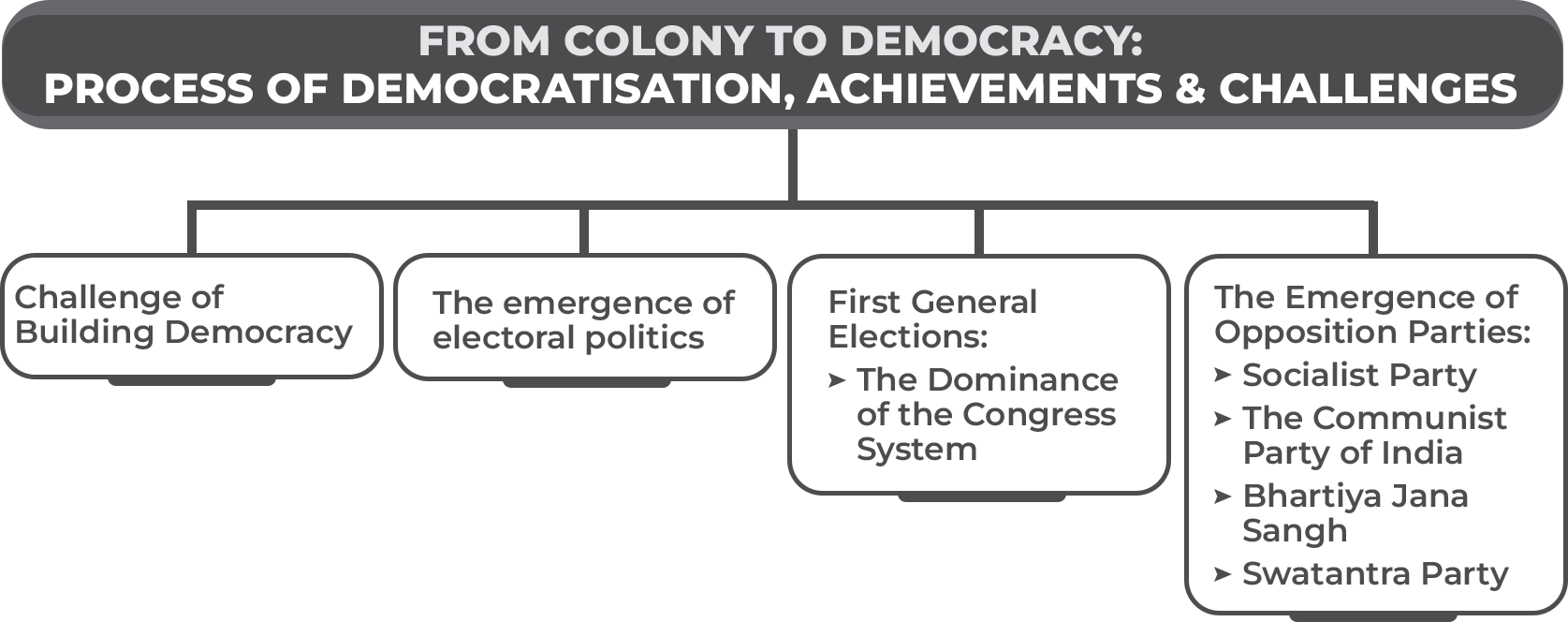
Challenges of Building Democracy
Many of the countries that gained freedom from colonialism experienced non-democratic rule. It took various forms, such as nominal democracy but effective control by one leader, one-party rule, or direct army rule. Non-democratic regimes always started with a promise of restoring democracy very soon. But once they established themselves, it was very difficult to dislodge them.
The conditions in India were not very different. However, the leaders of the newly independent India decided to take the more difficult path. Any other path would have been surprising, for our freedom struggle was deeply committed to the idea of democracy. Our leaders were conscious of the critical role of politics in any democracy. They did not see politics as a problem; they saw it as a way of solving the problems.
Every society needs to decide how it will govern and regulate itself. There are always different policy alternatives to choose from. There are different groups with different and conflicting aspirations. While competition and power are the two most visible things about politics, the purpose of political activity is and should be deciding and pursuing the public interest. This is the route our leaders decided to take.
The Emergence of Electoral Politics
One of the most important achievements of India in the years since independence is the adoption of democratic polity and adhering to it despite the odds. As political scientist Samuel Huntington observed India in this context “is a dramatic exception”.
India defied many predictions and social-scientific generalizations when, in the face of all odds, it affirmed its faith in opting for democracy at the inception of independence. The provision of a universal adult franchise at the very outset was all the more remarkable given the prevailing challenges. These challenges, as observed by many, were:
• Largely poor and illiterate population
• Immense geographic, social and economic diversity
Never in history was such an experiment undertaken. The success of India in this context over the years has become an example to be emulated by other countries across the globe.
Challenges before ECI and the conduction of the first General Election
The Constitution was adopted on 26 November 1949 and signed on 24 January 1950, and it came into effect on 26 January 1950. At that time the country was being ruled by an interim government. It was now necessary to install the first democratically elected government of the country. The constitution had laid down the rules, now the machine had to be put in place.
The Election Commission of India was set up in January 1950. Sukumar Sen became the first Chief Election Commissioner. The country’s first general elections were expected sometime in 1950 itself.
India has adopted a universal adult franchise model of democracy where any person with a prescribed condition of age could vote without any form of discrimination.
The election commission soon realized that it was an uphill task to conduct a free and fair election in a country of India’s size. Holding an election required delimitation or drawing the boundaries of constituencies and preparation of electoral rolls. Nearly 40 lakh women registered themselves as wives or daughters of somebody, rather than registering themselves by their names. The election commission refused to accept these entries and ordered a revision if possible and deletion if necessary.
First General Elections
• The preparations for India’s first general election were nothing short of monumental, as no election of this scale had ever been conducted globally.
• With 17 crore eligible voters, the task was to elect 489 Members of Parliament and around 3,200 state assembly representatives.
• At the time, only 15% of voters were literate, which prompted the Election Commission to devise a special voting method. Candidates were identified by symbols, each major party and independent candidate being assigned a unique one, which was painted on the ballot papers in a designated box to maintain the secrecy of the vote.
• To manage this vast operation, the Election Commission trained over 3 lakh officers and polling staff.
• The challenge of holding the first elections in a nation with a caste-driven, multi-religious, illiterate population seemed daunting to many. Yet, democracy took a giant step forward with this bold experiment. The electorate, mostly poor, illiterate, and rural, had never experienced an election before, leaving many to wonder how they would respond.
• There were over 173 million voters, most of them poor, illiterate and rural and had no experience in elections . The big question at the time was how would the people respond to this opportunity.
• To accommodate this massive turnout, over 224,000 polling booths were set up, each serving roughly 1,000 voters, and equipped with 2.5 million steel ballot boxes.
In a first-past-the-post system, the candidate with the most votes would win.
• Over 17,500 candidates, from more than 14 national parties, 63 regional parties, and numerous independents, contested the election for the Lok Sabha and state assemblies. Of these, 98 Lok Sabha seats and 669 state seats were reserved for Scheduled Castes and Scheduled Tribes. The elections stretched from October 25, 1951, to February 21, 1952.
• The response from the people was overwhelming. Despite their lack of experience and education, voters took to the polls with enthusiasm, treating it as a celebration.
• Remarkably, the percentage of invalid votes was only 3 to 4%. Voter turnout was high, with significant participation from rural areas and Scheduled Castes and Tribes.
• Women, too, made up around 40% of the voters, marking a significant milestone. When the results came in, it was revealed that nearly 46% of eligible voters had cast their votes, demonstrating the people’s commitment to their new democratic rights.
• Various political parties, ranging from the Indian National Congress to the Socialist Party, Communist allies, Kisan Mazdoor Praja Party, Jan Singh, and Hindu Mahasabha, along with numerous local parties and independents, took part in this historic event.
Results of First General Elections
• In the first general election, the Congress emerged as the dominant party, securing 364 seats, which amounted to 45% of the total votes cast for the Lok Sabha. It successfully formed the government at both the national level and in most states. Although Congress didn’t secure an outright majority in four states—Madras, Travancore- Cochin, Orissa, and PEPSU—it still managed to establish governments there with the support of independents and smaller local parties, which later merged with it.
• The Communist Party’s performance came as a surprise, as it became the second-largest group in the Lok Sabha. In certain regions, the influence of princes and large landowners remained strong. Their party, Gantantra Parishad, won 31 seats in the Orissa Assembly.
• Despite Congress’s clear numerical dominance, the opposition proved to be quite effective in Parliament. For many, political engagement wasn’t limited to elections alone; unions, farmers’ organizations, strikes, hartals, and demonstrations played a major role in political participation for the middle and working classes, along with wealthier sections of rural society. For the vast majority of the rural and urban poor, elections remained the most direct means of political expression.
• Under Nehru’s leadership, two more general elections were held in 1957 and 1962. Voter turnout increased, reaching 47% in 1957 and 54% in 1962. Congress
continued to dominate, emerging as the largest party at both the national and state levels. However, in 1957, the Communists achieved a significant milestone by forming the first democratically elected communist government in Kerala, which was first in the world.
• Elections during this period were used not only as a tool for political engagement but also to promote national unity and legitimize the government’s integration policies. As Ashok Mehta put it, “The parliament acted as a great unifier of the nation.”
Contributions of Maulana Abul Kalam Azad
Maulana Abul Kalam Azad was a prominent freedom fighter, scholar, and leader who made significant contributions to both pre- and post-independent India. His life and work spanned various aspects of India’s struggle for freedom and the nation’s early years after gaining independence. Here is a discussion of his contributions to India during these crucial periods:
Pre-Independent India Contributions
Freedom Struggle and the Khilafat Movement: Maulana Azad played a crucial role in the Khilafat Movement, which aimed to support the Ottoman Caliphate and promote the cause of Indian Muslims. He worked alongside Mahatma Gandhi and other leaders, emphasizing Hindu-Muslim unity as a means to achieve India’s independence.
Non-Cooperation Movement: Azad was an ardent advocate of non-violent resistance and played a significant role in the Non-Cooperation Movement launched by Mahatma Gandhi. He urged Indians to boycott British institutions, schools, and foreign goods, thereby weakening British authority in India.
Promotion of Education: Azad was a strong proponent of education as a means to uplift society. He founded the Jamia Millia Islamia in Delhi, an institution that aimed to provide modern education with an Islamic perspective. His emphasis on education for all, regardless of caste or religion, contributed to the nation’s educational development.
Leader of the Indian National Congress: Maulana Azad served as the President of the Indian National Congress in 1923, becoming the youngest president at that time. His leadership skills and commitment to the cause of independence played a significant role in galvanizing the freedom movement.
Opposition to Partition: Azad vehemently opposed the idea of partitioning India along religious lines, arguing for a united and secular India. He saw partition as a setback for the nation’s unity and a potential source of communal tension.
Post-Independent India Contributions
First Education Minister: After India gained independence in 1947, Maulana Azad was appointed as the country’s first Minister of Education. He played a pivotal role in
shaping the educational policies of independent India. He advocated for a free and compulsory education system and the promotion of scientific and technical education.
Promotion of Secularism: Azad continued to emphasize the importance of secularism and religious harmony in post-independence India. His vision for a secular nation was reflected in his work as both a freedom fighter and a post-independence leader.
Literary Contributions: Azad was a prolific writer and thinker. He wrote extensively in Urdu and English, producing literary works, essays, and speeches that continue to be influential. His autobiography, “India Wins Freedom,” provides valuable insights into the struggle for independence.
Advocacy for Minority Rights: As an advocate for the rights of religious and linguistic minorities, Azad worked to protect and promote the interests of India’s diverse communities.
Legacy: Maulana Azad’s legacy continues to influence Indian politics, education, and the promotion of secularism. The Maulana Azad National Institute of Technology and the Maulana Azad Medical College are named in his honor.
Maulana Abul Kalam Azad’s contributions to India, both before and after independence, were marked by his unwavering commitment to freedom, secularism, education, and national unity. His leadership and vision continue to inspire generations of Indians.
The Dominance of the Congress System
The Congress Party’s dominant role in India’s early political landscape led many to refer to the initial years of the republic as the “Congress System”. This dominance was attributed not only to Congress’s electoral success but also to the weakness of the opposition during this period.
In the three general elections following independence, Congress consistently secured overwhelming majorities. Despite not always winning a majority of the total votes, it claimed a disproportionate share of seats. In 1952, for instance, Congress garnered 45% of the vote but took 74% of the seats. In the subsequent elections of 1957 and 1962, it secured 371 and 361 seats respectively out of 494, maintaining a presence in state governments nationwide, except for Kerala in 1957
Nature of Congress Dominance
While India’s experience of one-party dominance is not unique globally, there is a significant distinction. In many countries, the dominance of a single party is ensured through undemocratic means. The Constitutions of countries like China, Cuba, and Syria only allow a single party to rule, while others such as Myanmar, Egypt, and Belarus effectively operate as one-party states due to legal and military control.
What set Congress apart was that its dominance unfolded within a democratic framework. Multiple parties contested elections, yet Congress won election after election under free and fair conditions—similar to the African National Congress’s dominance in post- apartheid South Africa.
Congress’s success can be traced back to its association with the independence movement. As the inheritor of the national struggle, Congress maintained its ability to reconcile and integrate the diverse interests of different social, economic, and regional groups. Many leaders from the freedom movement contested elections as Congress candidates, giving the party a strong, established network. By the time other parties could organize, Congress had already launched its campaigns.
The Congress party also functioned as an ideological coalition, balancing revolutionary and conservative, radical and pacifist, left and right factions. Far from being a weakness, this internal factionalism became a strength, serving as a balancing mechanism within the party.
The party’s widespread organization, which spanned across the country and reached down to the local level, provided a significant advantage. Its inclusive nature, rooted in the legacy of the national movement, helped solidify its dominance.
In this unique period, Congress effectively acted as both the ruling party and the opposition, a dynamic that political scientist Rajni Kothari described as “The Congress System.”
In the beginning, reflecting a true sense of democracy in India, there was a high degree of mutual respect between the Congress and opposition leaders. Non-Congress political leaders such as Dr B.R Ambedkar and Dr Shyama Prasad Mukherjee were made part of the first cabinet of Independent India.
However, the positive rapport between the Congress and opposition leaders gradually declined when these parties in an intense competition to achieve power did not cooperate. As the ability of Congress to accommodate all interests and all aspirants for political power steadily declined, other political parties started gaining greater significance.
The Emergence of Opposition Parties
The role of opposition parties in India’s early years was crucial in preserving the democratic fabric of the country. These parties consistently offered critical and principled opposition to the policies and practices of the Congress Party. By ensuring that a democratic alternative remained active, the opposition prevented any simmering discontent from escalating into anti-democratic sentiments.
From the very first elections, the presence of several
political parties—including the Bhartiya Jan Sangh, the Socialist Party, the Communist Party, and the Kisan Mazdoor Praja Party (KMPP)—was vital for the development of parliamentary democracy. Their engagement and participation laid the foundation for a more inclusive political system. In this context, it’s important to highlight the significant contributions of these parties to the democratic consolidation process in the early years of the Republic.
Various opposition parties
Socialist Party:
• The roots of the Socialist Party in India can be traced back to the mass movement phase within the Indian National Congress during the pre-independence period. In 1934, a group of young, more radical leaders formed the Congress Socialist Party (CSP) within Congress, seeking a more progressive and egalitarian direction for the party.
• In 1948, the Congress amended its constitution to bar members from holding dual-party memberships, prompting the Socialists to form their own party. This new Socialist Party went through several splits and reunions, leading to the formation of different factions, such as the Kisan Mazdoor Praja Party, the Praja Socialist Party, and the Samyukta Socialist Party.
• The socialists were guided by the ideology of democratic socialism, which set them apart from both Congress and the Communists. They criticized Congress for aligning with capitalists and landlords, accusing it of neglecting the needs of workers and peasants.
• However, the socialists faced a challenge in 1955 when Congress adopted the goal of establishing a socialist society. This shift made it harder for the socialists to position themselves as a distinct alternative to Congress. In response, some, led by Rammanohar Lohia, distanced themselves further from Congress, while others, like Asoka Mehta, supported limited cooperation.
• Key figures in the Socialist Party included leaders like Jayaprakash Narayan, Achyut Patwardhan, Asoka Mehta, Acharya Narendra Dev, Rammanohar Lohia, and S.M. Joshi.
• Many contemporary Indian political parties, such as the Samajwadi Party, Rashtriya Janata Dal, Janata Dal (United), and Janata Dal (Secular), trace their origins back to the Socialist Party.
The Communist Party of India
• In the early 1920s, communist groups emerged in different parts of India, taking inspiration from the Bolshevik revolution in Russia and advocating socialism as the solution to problems affecting the country.
• From 1935, the Communists worked mainly from within the fold of the Indian National Congress. A parting of ways took place in December 1941, when the Communists decided to support the British in their war against Nazi Germany.
• Unlike other non-Congress parties, the CPI had a well- oiled party machinery and dedicated cadre at the time of Independence. However, Independence raised different voices in the party. The basic question that troubled the party was the nature of Indian independence. Was India free or was freedom a sham?
• Soon after Independence, the party thought that the transfer of power in 1947 was not true independence and encouraged violent uprisings in Telangana. The Communists failed to generate popular support for their position and were crushed by the armed forces. This forced them to rethink their position.
• In 1951, the Communist Party abandoned the path of violent revolution and decided to participate in the approaching general elections. In the first general election, CPI won 16 seats and emerged as the largest opposition party. The party’s support was more concentrated in Andhra Pradesh, West Bengal, Bihar and Kerala.
• K. Gopalan, S.A. Dange, E.M.S. Namboodiripad, P.C. Joshi, Ajay Ghosh and P. Sundarraya were among the notable leaders of the CPI.
• The Party went through a major split in 1964 following the ideological rift between the Soviet Union and China. The pro-Soviet faction remained as the CPI, while the opponents formed the CPI (Marxist). Both these parties continue to exist to this day.
Bhartiya Jana Sangh
• The Bharatiya Jana Sangh was formed in 1951 with Shyama Prasad Mukherjee as its founder-President. Its lineage, however, can be traced back to the Rashtriya Swayamsevak Sangh (R.S.S.) and the Hindu Mahasabha before Independence.
• The Jana Sangh was different from other parties in terms of ideology and programmes. It emphasised the idea of one country, one culture and one nation and believed that the country could become modern, progressive and strong on the basis of Indian culture and traditions.
• The party called for a reunion of India and Pakistan in Akhand Bharat. The party was at the forefront of the agitation to replace English with Hindi as the official language of India and was also opposed to the granting of concessions to religious and cultural minorities.
• The party was a consistent advocate of India developing nuclear weapons, especially after China carried out its atomic tests in 1964.
• In the 1950s, Jana Sangh remained on the margins of electoral politics and was able to secure only 3 Lok Sabha seats in the 1952 elections and 4 seats in the 1957 general elections to Lok Sabha.
• In the early years, its support came mainly from the urban areas in Hindi-speaking states like Rajasthan, Madhya Pradesh, Delhi and Uttar Pradesh.
• The party’s leaders included Shyama Prasad Mukherjee, Deen Dayal Upadhyaya, and Balraj Madhok.
• The Bharatiya Janata Party (BJP) traces its roots to the Bharatiya Jana Sangh.
Swatantra Party
• Swatantra Party was formed in August 1959 after the Nagpur resolution of the Congress, which called for land ceilings, the takeover of food grain trade by the state, and the adoption of cooperative farming.
• The party was led by old Congressmen like C. Rajagopalachari, K.M. Munshi, N.G.Ranga and Minoo Masani.
• The party stood out from the others in terms of its position on economic issues. The Swatantra Party wanted the government to be less and less involved in controlling the economy. It believed that prosperity could come only through individual freedom.
• It was critical of the development strategy of state intervention in the economy, centralised planning, nationalisation, and the public sector. It instead favoured the expansion of a free private sector. The Swatantra Party was against land ceilings in agriculture and opposed cooperative farming and state trading.
• It was also opposed to the progressive tax regime and demanded the dismantling of the licensing regime. It was critical of the policy of non-alignment and maintaining friendly relations with the Soviet Union and advocated closer ties with the United States.
• The Swatantra Party gained strength in different parts of the country by way of a merger with numerous regional parties and interests.
• It attracted the landlords and princes who wanted to protect their land and the status that was being threatened by the land reforms legislation.
• The industrialists and business class who were against nationalisation and the licensing policies also supported the party.
• Its narrow social base and the lack of a dedicated cadre of party members did not allow it to build a strong organisational network.
| Party | Founded Yea | Leaders |
| Bhartiya Jan Sangh | 1951 | Shyama Prasad Mukherjee |
| Socialist Party | 1934 | Jayaprakash Narayan, Achyut Patwardhan, Asoka Mehta, Rammanohar Lohia, and S.M. Joshi |
| Communist Party | Early 1920s | K. Gopalan, S.A. Dange, E.M.S. Namboodiripad, P.C. Joshi, Ajay Ghosh and P. Sundarraya |
| Swatantra Party | August 1959 | C. Rajagopalachari, K.M. Munshi, N.G.Ranga and Minoo Masani. |
Points To Remember
Challenge of Building Democracy: Many of the countries that gained freedom from colonialism experienced non democratic rule. The challenge thus, was to establish democracy in a newly independent India.
The emergence of electoral politics: One of the most important achievements of India in the years since independence is the adoption of democratic polity and adhering to it despite the odds. However, the challenges of largely poor, illiterate population and Immense geographic, social and economic diversity
Challenges before ECI and the conduction of the first general election:
• The Election Commission of India was set up in January 1950. Sukumar Sen became the first Chief Election Commissioner. India has adopted a universal adult franchise model of democracy where any person with a prescribed condition of age could vote without any form of discrimination.
The Dominance of the Congress System: In the three general elections following independence, the Congress gained an overwhelming majority. What distinguished the dominance of the Congress party in India from all other countries cases was it happened under democratic conditions.
Nature of Congress Dominance:
• Congress was an ideological coalition. It accommodated the revolutionary and pacifist, conservative and radical, extremist and moderate and the right, left and all shades of the centre.
• The Congress had the ‘first off, the blocks’ advantage.
• Congress was seen as an inheritor of the national movement.
• The Emergence of Opposition Parties:
• By keeping the democratic political alternative alive, the opposition parties prevented the resentment within the system from turning into anti-democratic.
• Right from the first elections, the existence of several political parties was crucial for the development of parliamentary democracy in India.