Whatsapp 88106-52225 For Details
Get Free IAS Booklet
Get Free IAS Booklet
Introduction
The period between the 1780s and the 1850s in Britain is often referred to as the “first industrial revolution.” During this time, the country underwent significant changes in both its social and economic structures. The rise of new inventions and technologies led to the development of the factory system, where large-scale machine production became the norm, and economic specialization increased. As a result, a workforce that was once primarily employed in agriculture began to move into urban factories, marking a dramatic shift in how people lived and worked.
Why Britain?
Britain was the first nation to experience modern industrialization, thanks to its political stability, which had been in place since the seventeenth century. The union of England, Wales, and Scotland under a single monarchy created a unified kingdom with shared laws, a common currency, and a market that wasn’t burdened by fragmented local taxes on goods. This allowed goods to flow more easily and kept prices lower.
By the late seventeenth century, money had become the dominant medium of exchange. Wages and salaries had largely replaced payments in kind, giving people more flexibility in how they spent their earnings. This also led to the growth of a broader market for goods, as people now had more purchasing power.
In the eighteenth century, England underwent a major economic shift known as the “agricultural revolution.” Larger landowners consolidated small farms and enclosed common lands, creating vast estates and boosting food production. This left many landless farmers without work and forced them to seek employment in towns, contributing to the growth of urban populations.
Geographically, England was well-positioned for industrialization. Its island location made it naturally secure, while its proximity to the sea facilitated trade. At the same time, being isolated from mainland Europe allowed it to develop largely without external interference. Waterways like canals, rivers, and seas further enabled the growth of free trade across the country, all of which made England an ideal setting for the Industrial Revolution.
Factors that Encouraged British Industrialization
• Development of Towns, Trade and Finances
Urban Expansion:
From the eighteenth century onward, many European towns experienced significant growth in both area and population. Among the 19 cities in Europe whose populations doubled between 1750 and 1800, 11 were located in Britain. London was the largest and most prominent of these expanding urban centers.
• Trade and Commerce:
London emerged as the primary hub of national markets, with other major trading centers located in close proximity. By the eighteenth century, London had also gained global commercial importance. The center of international trade had shifted away from the Mediterranean ports of Italy and France to the Atlantic ports of Holland and Britain. In England, the transportation of goods was facilitated by a well-developed network of rivers and a deeply indented coastline offering natural harbor.
• Finance and Banking:
The Bank of England, established in 1694, became the cornerstone of the nation’s financial system. By 1784, England had over a hundred provincial banks, and their number tripled over the following decade. These banks played a critical role in meeting the financial demands of large-scale industrial enterprises, enabling the expansion of industrial activity across the country.
• Industrial Revolution Spreads: Formation of Factories.
• Technological breakthroughs in the textile industry sparked a wave of innovation in iron and steel production, setting the stage for broader industrial advancements. As English-manufactured goods flooded global markets, other nations were motivated to follow suit and develop their own industries.
•
To protect their technological edge, Britain implemented strict laws to prevent textile workers from sharing industrial secrets or leaving the country. However, in 1789, Samuel Slater managed to leave England and move to America, where he brought his knowledge of British textile technology. This act helped ignite America’s own Industrial Revolution and led to the expansion of cotton plantations, which, in turn, fueled the demand for enslaved labor.
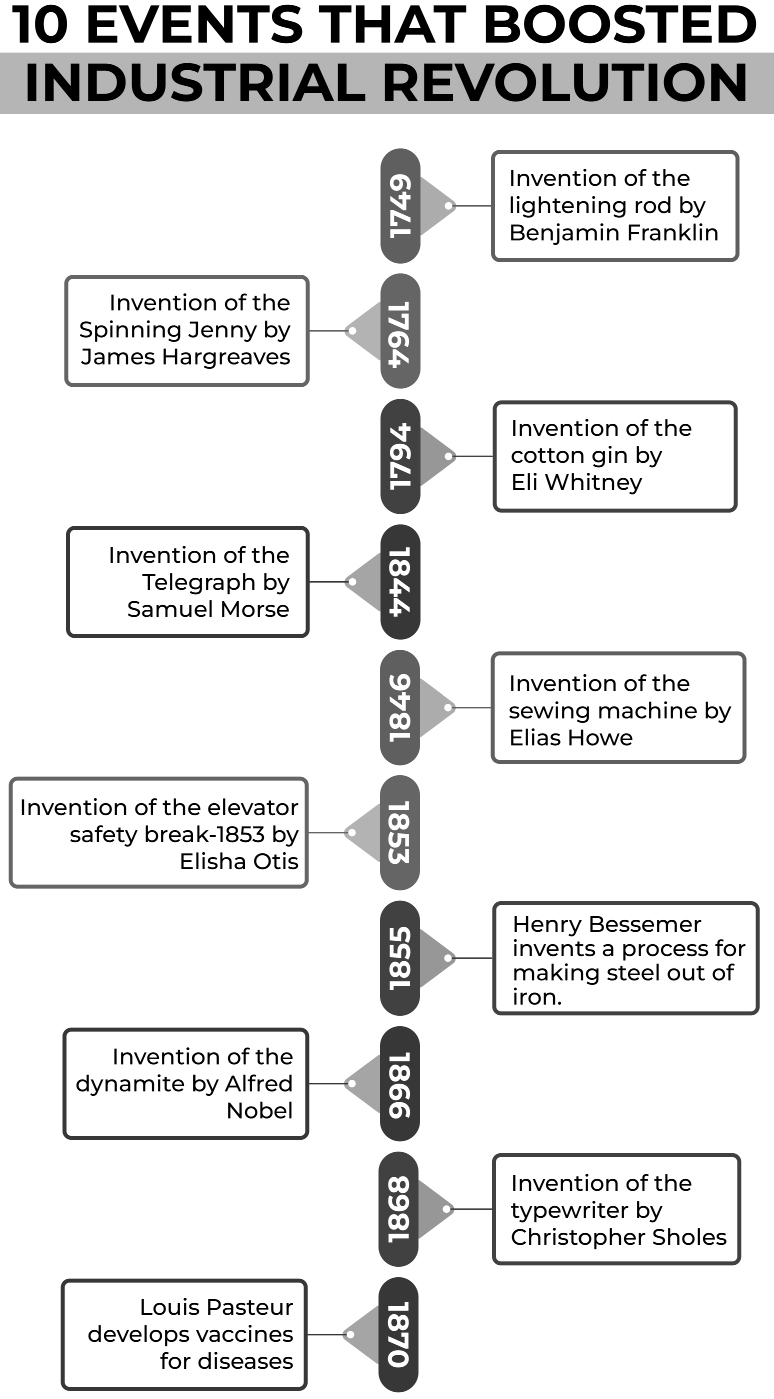
• In 1779, Samuel Crompton invented the “Spinning Mule,” while Edmond Cartwright developed the first water- powered loom. These innovations had a ripple effect, stimulating growth in other related industries, such as dyeing, bleaching, and printing.
• Richard Arkwright, known as “The Father of the Factory System,” revolutionized production by establishing the first factory designed specifically to house machinery. This new system introduced fixed working hours and a more stable form of employment, replacing the old system of hiring workers on a contract basis.
• Innovations
The Steam Engine:
• One of the most significant advancements of the Industrial Revolution was the invention and widespread use of steam power.
• For centuries, water had been the main source of mechanical energy, but it was limited by location, seasonal availability, and the flow rate of rivers.
• Steam power, on the other hand, generated high- temperature pressure that could drive a wide range of machinery. This made it the first energy source that was both reliable and cost-effective enough to power the manufacturing of machines themselves.
• Initially, steam engines were used primarily in mining. As the demand for coal and metals grew, steam power became essential for extracting resources from increasingly deeper mines.
Development of Steam Engine
• Flooding in mines was a significant issue during the early years of industrialization. To address this, Thomas Savery (1650-1715) invented a steam engine called the “Miner’s Friend” in 1698, designed specifically to drain water from mines. While innovative, these engines worked slowly, were only effective at shallow depths, and faced the problem of boiler explosions due to excessive pressure.
• In 1712, Thomas Newcomen (1663-1729) developed another steam engine, which, although an improvement, still had a major flaw: it lost energy because the condensing cylinder continuously cooled down, diminishing its efficiency.
• It was James Watt in 1764 who made a breakthrough by improving upon Newcomen’s design. Watt’s enhancements quadrupled the engine’s efficiency. He introduced a new chamber where cold water was sprayed to condense the steam, creating a vacuum that allowed the engine to operate much more effectively.
• This period also marked a significant transfer of technologies. For instance, Watt utilized John Wilkinson’s specialized drill, originally designed for making gun barrels, to bore the large cylinder required for his improved steam engine. This collaboration between different technologies was a pivotal moment in advancing industrial machinery.
Impact of Steam Engine: Revolutionizing Transport and Industry
The steam engine quickly replaced the earlier coal- powered locomotives, creating a surge in demand for railway lines. Its portability revolutionized various industries by eliminating the need for factories to be located along rivers or lakes. Now, industries could set up wherever they found it most beneficial.
After 1800, the steam engine continued to evolve, thanks to advances in lighter and stronger metals, more precise machine tools, and improved scientific understanding. This progress further boosted its efficiency and application across different sectors.
By 1840, British steam engines were responsible for generating over 70 percent of the total horsepower across Europe, highlighting the central role of steam power in industrialization. Together with coal and iron, the steam engine became a cornerstone of modern industry, laying the groundwork for the industrial landscape we recognize today.
Increased Demands for Coal
Working in coal mines was once considered so dangerous that it was believed only those with a "death wish" would take such jobs. Coal was transported through horizontal tunnels in baskets and then lifted to the surface via vertical shafts.
The extraction and movement of coal relied entirely on physical labor—provided by animals, men, women, and even children. Children were often preferred due to their small size, despite the perilous conditions.
As steam power became more widely used, the demand for coal increased significantly. This led to important improvements in mining, including better tunnel ventilation, more efficient coal transportation, the use of gunpowder to break through rock, and the introduction of safety lamps.
Despite these advancements, coal miners continued to face severe risks and health issues, particularly respiratory diseases such as lung conditions caused by prolonged exposure to coal dust.
Inventions in Iron Making
• In 1709, Abraham Darby revolutionized iron production by smelting pig iron with coke, replacing the traditional method that used charcoal derived from wood. This shift helped prevent the rapid depletion of England’s forests, which had been a growing concern.
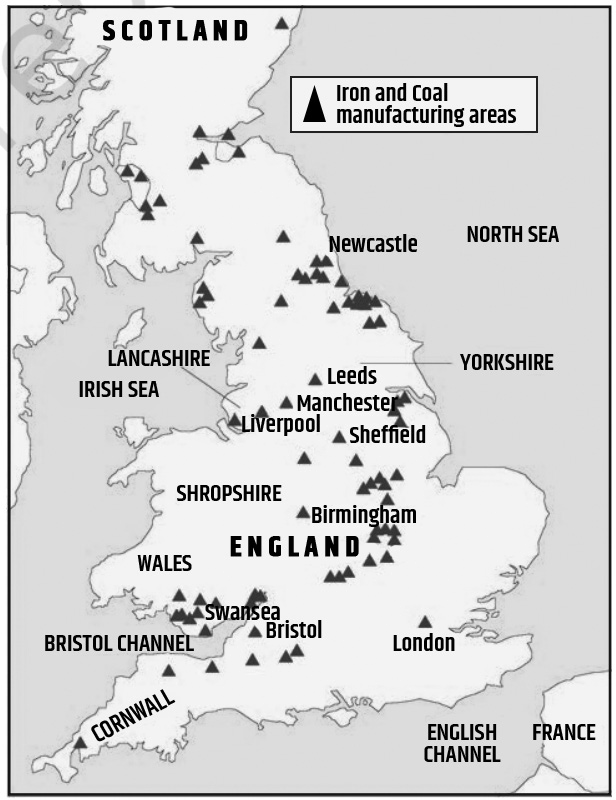
Fig: Iron and coal manufacturing areas
• Then, in 1784, Henry Cort, an ironmaster, developed a method for producing wrought iron, a less brittle form of iron. This innovation proved to be highly valuable in various industrial applications, further boosting the utility of iron in the industrial age.
• Around the same time, in 1774, John Wilkinson invented a drilling machine capable of creating holes with remarkable precision. His invention played a key role in improving the quality and accuracy of iron production. Between 1788 and 1806, iron production surged, with the metal finding new uses in farm machinery, hardware, shipbuilding, and more.
• One of the most iconic achievements during this period came in 1779, when the third Darby, Abraham’s descendant, built the world’s first iron bridge in Coal Brookdale. Spanning the River Severn, this bridge was a landmark in both engineering and the growing importance of iron in modern infrastructure.
• Wilkinson used cast iron for the first time to make water pipes.
• Means of Transportation and Communication
• The advancements in transportation and communicationplayed a crucial role in fuelling the Industrial Revolution. As industries grew, there was a clear need for a reliable system to transport raw materials, finished products, food, and people. In the early 1700s, significant improvements were made in bridge construction and road networks, which helped facilitate the movement of goods from factories to markets.
• In 1801, Richard Trevithick, an engineer from Cornwall, developed the “Puffing Devil,” a steam engine that could pull trucks around the mines. This early experiment laid the groundwork for future innovations in steam-powered transportation. Then, in 1814, George Stephenson built the first true steam locomotive, the “Blücher,” designed to run on railway tracks. This marked the beginning of a revolution in transport, as steam engines and railways soon began moving goods across the country, complementing the existing canal transport system.
• By the mid-19th century, steam-powered ships began to replace sailing vessels. The shift was further marked by the introduction of iron ships, which could traverse oceans more efficiently and securely.
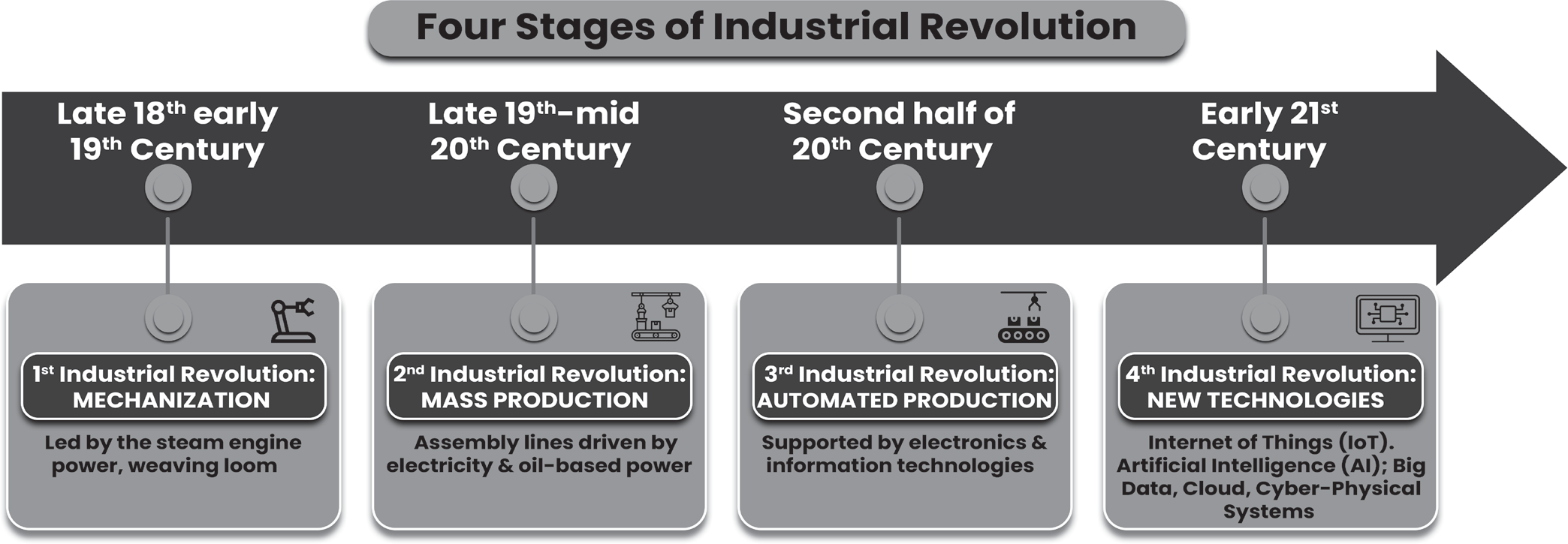
• While steam power drove the first phase of the Industrial Revolution, the second phase was defined by electricity. The development of faster transportation and communication technologies sped up business operations, facilitating quicker exchanges between military units, colonies, countries, and even ordinary people. The invention of the telegraph and telephone transformed global communication, allowing messages to be transmitted instantly, bridging vast distances and connecting people in ways never before possible
Impact of Industrial Revolution
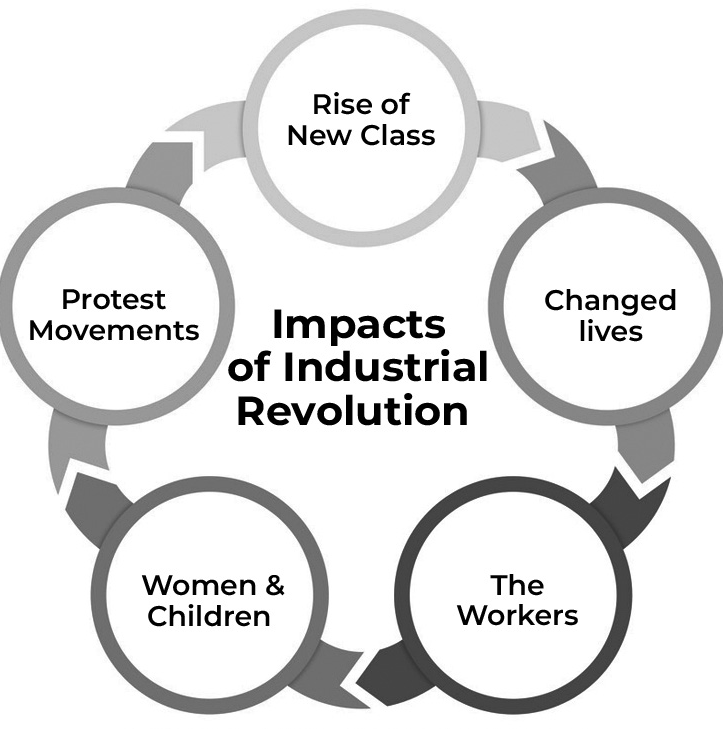
The term ‘Industrial Revolution’ was used by European scholars – Georges Michelet in France and Friedrich Engels in Germany. It was used for the first time in English by the philosopher and economist Arnold Toynbee (1852-83), to describe the changes that occurred in British industrial development between 1760 and 1820.
• Rise of New Class
Industrial production surged dramatically, leading to a significant drop in the cost of goods. Machines replaced manual labor, bringing an end to the domestic, home- based production system. At the same time, increased agricultural output helped lower food prices.
A new source of wealth emerged from factory and machinery ownership, giving rise to a new social class known as the capitalists. This group played a key role in shaping the modern banking system, channeling capital from regions with surplus income to areas where investment was needed most.
• Urbanization
Wealth increased significantly during this period— measured in goods, income, services, knowledge, and productivity. However, this economic progress came with a steep human cost, reflected in broken families, forced relocations, deteriorating urban environments, and harsh factory working conditions.
The number of English cities with populations over 50,000 grew from just two in 1750 to 29 by 1850. Yet this rapid urban expansion was not accompanied by adequate housing, sanitation, or access to clean water for the growing population.
New arrivals were often forced to live in overcrowded slums located in the congested centers of industrial towns, close to factories. In contrast, wealthier residents moved to suburban areas, where the air was cleaner and water more reliable.
• The Workers
A survey in 1842 revealed that the average lifespan of workers was lower than that of any other social group in cities.
Deaths were primarily caused by epidemics that sprang from the pollution of water, like cholera and typhoid, or of the air, for example - tuberculosis.
Women and Children
The Industrial Revolution brought significant changes to the roles of women and children in the workforce.
Factory work was a drastic shift from rural labor—it involved long, repetitive hours under strict supervision, with harsh punishments for mistakes or disobedience.
As machines became more widespread and required fewer operators, industrialists increasingly hired women and children. They were seen as less likely to protest poor working conditions and were willing to work for lower wages than men.
Women and children were employed in large numbers, particularly in the cotton textile mills of Lancashire and Yorkshire.
In coal mines, children were used to reach deep or narrow seams where adults couldn’t fit.
Factory owners viewed child labor as a form of early training for future factory work. Records from British factories show that nearly half of the workers began their employment before the age of ten, and 28 percent started when they were under 14.
• Protest Movements
• The early phase of industrialization coincided with the spread of revolutionary political ideals inspired by the French Revolution (1789–1794).
• The revolutionary slogans of liberty, equality, and fraternity demonstrated the power of collective mass action—not only in the creation of democratic institutions such as the French parliamentary assemblies of the 1790s but also in efforts to mitigate wartime suffering by regulating the prices of essential goods like bread.
• In England, growing discontent with the harsh conditions in factories led to a surge in political protests. Industrial workers increasingly demanded the right to vote and greater representation.
• As cities and factories became overcrowded with incoming laborers, workers expressed their anger through various forms of resistance, including widespread food and bread riots that erupted across the country from the 1790s onward.
• Another source of hardship was the enclosure movement, beginning in the 1770s, in which small farms were consolidated into larger estates controlled by powerful landlords. This process displaced many rural families, forcing them to seek employment in industrial centers.
• The Luddite movement (1811–1817), led by the influential figure General Ned Ludd, represented a distinct form of industrial protest. Contrary to the belief that it was simply a reactionary attack on machines, Luddism was driven by broader social and economic demands. The Luddites called for a minimum wage, regulation of women’s and children’s labor, job opportunities for those displaced by mechanization, and the legal right to form trade unions to voice their demands collectively.
• In August 1819, 80,000 people gathered peacefully at St Peter’s Fields in Manchester to claim democratic rights
– of political organization, of public meetings, and of the freedom of the press. They were suppressed brutally in what came to be known as the Peterloo Massacre and the rights they demanded were denied by the Six Acts, passed by Parliament the same year.
• Reforms through Laws
• In 1819, laws were passed to regulate child labour in factories, prohibiting the employment of children under the age of nine and limiting the working hours of those between nine and sixteen to twelve hours a day. However, these laws lacked effective enforcement mechanisms and were largely ineffective in bringing about change.
• It wasn’t until 1833, after widespread protests by workers across northern England, that the government took more concrete action. The new Factory Act restricted the employment of children under nine to silk factories only, set work-hour limits for older children, and introduced factory inspectors to ensure the law was followed.
• Despite these improvements, it took over three more decades of sustained pressure before the Ten Hours’ Bill was passed in 1847. This law was a significant victory, as it reduced the working hours for women and young workers, securing a ten-hour workday for male labourers as well.
• However, these labour reforms initially applied only to the textile industry and not to the mining sector. In response to growing concerns, the Mines and Collieries Act of 1842 banned children under ten and women from working underground. The Factory Act of 1847 also established limits, setting a ten-hour workday for women and children under eighteen in industrial settings.
• These laws marked important steps in the fight for better working conditions, but they were just the beginning of a larger movement to improve labour rights across various industries.
• Beginning of Colonialism:
The Industrial Revolution quickly spread to other parts of the world, driven by the discovery of new trade routes. This sparked a fierce competition among colonial powers, each eager to expand their empires in search of raw materials, new markets, and cheap labour. A race for colonies emerged, with England and France leading the charge, while countries like Italy, Germany, and others eventually joined in. As these imperial powers expanded their territories, they sought to dominate and exploit their colonies, disrupting traditional social, economic, and political systems. The consequences of this exploitation were severe, but it also sowed the seeds for resistance. Colonies, subjected to foreign rule, began to rise up and fight for their independence, setting the stage for conflicts that would shape the course of history in the years to come
Industrialization in Other Countries
USA
In the United States, the Industrial Revolution marked a significant shift in the economy, transitioning from manual and farm labour to a more industrialized workforce. This change, which began in the late 18th century and continued through the 19th century, was driven by key advancements in technology and manufacturing processes, which greatly boosted productivity and economic growth. The Industrial Revolution in the U.S. unfolded in two distinct phases. The First Industrial Revolution took place from the late 17th century into the first half of the 19th century, while the Second Industrial Revolution followed the Civil War and led to even greater advancements in industrialization. Several key industries played a central role in the U.S. Industrial Revolution:
• Textiles: The textile industry was the first to industrialize in the U.S. In the early 1800s, Samuel Slater established a water-powered textile mill in Pawtucket, Rhode Island, introducing British manufacturing technologies to America.
• Iron and Steel: The iron and steel industries were crucial to industrial growth. In the late 1800s, Andrew Carnegie established steel mills that helped make the U.S. the leading producer of steel in the world.
• Railroads: The railroad industry was vital in transforming the economy. Railroads allowed for the efficient transport of raw materials and finished goods, accelerating industrial production across the country.
• Oil: The oil industry also saw tremendous growth. In the late 1800s, Edwin Drake drilled the first successful oil well in Titusville, Pennsylvania, paving the way for the oil industry to supply kerosene, lubricants, and gasoline.
Several factors fueled the Industrial Revolution in the United States:
• Natural Resources: The U.S. had abundant natural resources like coal, iron ore, and timber, all of which were essential for industrial production.
• Transportation: Heavy investments in transportation infrastructure, such as railroads and canals, made it easier to move raw materials and finished goods across the country, supporting industrial growth.
• Technology: The U.S. both imported technologies from Europe and developed its own innovations, which drove efficiency and productivity in manufacturing.
• Government Support: Early government policies provided financial backing and other forms of support to industries, helping them grow and prosper.
• Labor: A large and diverse workforce, including many immigrants from Europe and Asia, provided the labour needed to fuel industrial growth.
Germany
• Industrialization in Germany began in the early 19th century and was relatively late compared to other European countries such as Britain and France. However, Germany’s industrialization was rapid and transformative, and by the late 19th century, Germany had become one of the most industrialized countries in the world.
• Regional character of industrialization: The Industrial Revolution did not unfold uniformly across all areas. Its development was shaped in part by existing local traditions and in part by favorable geographic and economic factors—such as proximity to trade routes, rivers, canals, raw material sources, or key markets. As a
result, industrial activity became heavily concentrated in specific regional hubs.
The Industrial Revolution in Germany was led by the development of the railroad system. In the 1830s and 1840s, Germany built a network of railroads that connected its major cities and industrial centers. This made it possible to transport raw materials and finished goods more efficiently, which boosted industrial production.
Other key industries that played a leading role in Germany’s industrialization included coal mining, iron and steel production, and machine building. Germany also became a leader in the development of new technologies, such as electricity and chemicals.
Russia
The Industrial Revolution in Russia started in the late 19th century and continued into the early 20th century. This era marked a period of rapid economic and technological transformation, shifting the country from a predominantly agrarian society to an industrialized nation.
Industrialization in Russia began much later than in other European countries, at a time when many features of industrial civilization had already become well established across Europe. Even before Russia’s industrialization, its commercial and social ties with Europe had started to influence its economy, leaving early marks of industrial change from the beginning of the 19th century. However, unlike in many Western countries, the main impetus for industrialization in Russia was political rather than economic.
• Factors driving industrialization:
• The need to catch up with Western industrial powers.
• The completion of the Trans-Siberian Railway, which opened up Siberia for settlement and resource exploitation.
• Increased foreign investment, particularly from France and Belgium.
• Government support and incentives for industrial development.
• Key developments:
• Heavy industry, such as coal, steel, and machinery, was prioritized.
• The development of a significant textile industry.
• The expansion of the railway network, which facilitated transportation and trade.
• The establishment of state-owned enterprises like the Russo-Baltic Wagon Factory and Putilov Steel Works.
• Social impact:
• The industrialization process led to significant urbanization, as people from rural areas moved to cities in search of work.
• This migration resulted in the growth of factory towns and the emergence of a working-class population.
• Working conditions in many factories were often harsh, and labor movements began to take shape, leading to strikes and demands for workers’ rights.
• Political implications:
• The industrialization process played a role in the lead- up to the Russian Revolution of 1917. The working class, disenchanted with the autocratic regime and poor living conditions, became a key driving force behind the revolution.
• Bolshevik role:
• After the Bolsheviks seized power in 1917, they pursued a policy of state-led industrialization known as “War Communism” and, later, the “New Economic Policy” (NEP).
• Under Joseph Stalin’s leadership in the 1920s and 1930s, the Soviet Union implemented a series of Five-Year Plans to rapidly industrialize the country, focusing on heavy industry and collectivization of agriculture.
• Achievements and challenges:
• Industrialization brought about significant economic growth and modernization, making the Soviet Union an industrial superpower.
• However, it came at the cost of social disruption, political repression, and human suffering, particularly during collectivization and the purges of the Stalin era. The Soviet Union's centrally planned economy allocated a significant portion of its resources to boosting industrial production and developing infrastructure, aiming to ensure its survival and establish itself as a global superpower.
Japan
After Commodore Matthew C. Perry issued the Convention of Kanagawa, forcing Japan to open the ports of Shimoda and Hakodate to American trade, the Japanese government recognized the urgent need for major reforms to resist Western influence. In response, the Tokugawa shogunate dismantled the feudal system and introduced military reforms to modernize the army. The government also laid the foundation for industrialization. During the 1870s, the Meiji government actively promoted technological and industrial advancement, transforming Japan into a powerful modern nation.
• Meiji Restoration:
• Industrialization in Japan gained momentum during the Meiji Restoration (1868-1912), a period of political and social reform.
The Meiji government initiated a series of far-reaching changes, including the abolition of the feudal system, modernization of the legal and educational systems, and the promotion of industrialization.
• Factors driving industrialization:
• Embracing Western ideas: The Meiji leaders sought to adopt Western technology, industry, and institutions.
• Foreign advisors: Japan invited foreign experts to help with industrial development and modernization.
• Infrastructure development: The government invested in building a modern infrastructure, including railways and a telegraph system.
• Encouraging entrepreneurship: The government encouraged private enterprise and entrepreneurship.
• Investment in education: Education was promoted to provide a skilled workforce and technological know-how.
• Key developments:
• Heavy industry: Japan focused on developing heavy industries such as steel, shipbuilding, and armaments.
• Textiles: The textile industry, including silk and cotton production, was a significant early industry.
• Railways and transportation: Japan expanded its railway network, making transportation more efficient.
• Modern banking and finance: The government established a modern banking system to facilitate capital accumulation for industrialization.
• Social impact:
• Industrialization led to significant urbanization as people migrated from rural areas to cities in search of work.
• A new urban middle class emerged, along with a growing industrial working class.
• Working conditions in some factories were harsh, leading to labor movements and strikes.
• Political implications:
• The Meiji government centralized power and modernized the political system to support industrialization.
• The military was modernized and used for territorial expansion, leading to Japan’s participation in World War I and later in World War II.
• Imperial expansion:
• As Japan industrialized, it sought to secure resources and markets through territorial expansion. This led to conflicts in East Asia, such as the First Sino-Japanese War (1894-1895) and the Russo-Japanese War (1904- 1905).
• Achievements and challenges:
• Japan rapidly caught up with and even surpassed many Western industrial powers in terms of economic and technological development By the early 20th century, Japan was recognized as a major global industrial and military player.
• However, industrialization also brought social and environmental challenges, as well as expansionist policies that eventually led to Japan’s involvement in World War II.
Industrialization in Japan was marked by a strong government-led effort to modernize the country, absorb and adapt foreign technologies, and establish the foundation for Japan’s emergence as a major economic and industrial player on the world stage.
Industrialization and Globalization
Globalization
Globalization refers to the process of increasing international integration resulting from the exchange of worldviews, products, ideas, and various cultural elements.
In 2000, the International Monetary Fund (IMF) outlined four key dimensions of globalization:
trade and transactions,
capital flows and investment,
migration and the movement of people, and
the spread of knowledge.
Additionally, global environmental challenges—such as climate change, transboundary air and water pollution, and overfishing—are closely connected to globalization. These globalizing trends both influence and are influenced by business practices, labor organization, economic systems, socio-cultural dynamics, and the natural environment.
Understanding Interlinkages of Globalization and Industrialization
It can be argued that the primary driving force behind globalization is the capitalist world economy, which was sparked by the Industrial Revolution. This system established global structures rooted in the capitalist mode of production, characterized by production, consumption, international trade, competition, and conflict among rival states.
Significant advancements in transportation and telecommunications—such as the invention of the telegraph and, later, the development of the Internet— have played a crucial role in accelerating globalization, deepening the interdependence of economic and cultural activities worldwide.
Industrialization and Colonialism: The Industrial Revolution dramatically expanded the variety of raw materials needed for production, shifting from traditional methods that used fewer inputs. This increased demand for diverse resources from different regions, making it
essential to control access to and secure routes for these materials. As a result, European powers competed fiercely to dominate colonial territories. With rising production, colonies evolved from mere suppliers of raw materials to becoming markets for finished industrial goods, fueling further colonial expansion.
• Industrialization and Nationalism: The link between the rise of capitalism and the formation of nation-states in Europe is crucial to understanding globalization. During the 17th and 18th centuries, as trade grew, it was accompanied by new scientific ideas, state-building, and wars. Gunpowder allowed central rulers to undermine local lords, while reforms broke traditional loyalties and promoted national unity. To fund these wars, rulers encouraged trade and agriculture, which in turn fostered economic growth. Capitalism and state-building fed off each other, as merchants, entrepreneurs, and rulers sought stability for profit and taxation, aligning their interests. This cooperation led to the formation of nation- states and the flourishing of capitalism.
• States began to protect their industries by implementing high tariffs, especially in newly industrialized countries, while Britain and other industrialized powers pushed to remove trade barriers. Colonial policies were also designed to benefit businesses by ensuring access to overseas markets.
• Free Trade and Globalization: The idea of free trade further contributed to globalization. Adam Smith, a key advocate, argued that the world’s resources could be used most efficiently through open international trade, where countries specialize in producing goods they can produce most efficiently. This division of labor created global interdependence. English scholars, in particular, supported this theory, as Britain was considered the most industrialized nation at the time.
• Interconnected Economic World: These developments laid the foundation for a global financial system, connecting markets more closely. The prices of raw materials and industrial goods began to be set in global markets, with financial hubs emerging in key cities worldwide. By the mid-20th century, the division of labor expanded beyond production to include financial services such as banking, credit, and insurance. While much of the heavy production shifted to developing countries, the early industrialized nations focused on financial services, further deepening global economic integration.
Industrialization enabled capitalism to establish a global market that increasingly integrates all regions of the world, whether developed or developing, into international economic exchanges. The current wave of globalization operates within the global market framework that was shaped by the Industrial Revolution.