Whatsapp 88106-52225 For Details
Get Free IAS Booklet
Get Free IAS Booklet
Socialism
Socialism is a system where the state owns and controls common property or the means of production. It can also refer to various social organization models in which the production and distribution of goods may be privately owned, collectively managed, or directed by a central government. In many cases, socialism involves significant government intervention and planning to regulate the economy.
While socialism isn’t always tied to communist or fascist regimes, its practical application often requires a strong central authority to enforce its principles and manage economic activities.
Types of Socialism
State Socialism
State socialism is the idea of state involvement in addressing the social inequalities that arise from capitalism, such as low wages and economic disparity. It promotes the vision of a welfare state and is centred around collectivism, where society as a whole works for the collective good. More than just an economic model, some scholars view state socialism as a moral and welfare-driven movement grounded in principles of justice and equality.
State socialists believe that to eliminate exploitation within the production system and support social welfare, the state must intervene in the economy. This includes using legislation to protect the interests of marginalized groups. Central to this approach is the nationalization of key industries, ensuring that production is distributed fairly among workers. The state, in this model, serves as a mechanism to promote equality, redistribute resources, and uplift disadvantaged sections of society.
Military Socialism
Military socialism refers to the collective goals of armed forces during times of war. In this system, a person’s income and social status are determined by their role within the military structure, rather than personal achievements or private ownership. The concept rejects individual ownership of production means, emphasizing that in wartime, personal goals are secondary to the collective purpose of the military. Soldiers typically live in communal camps, where they engage in shared activities that shape their daily lives, including their personal and family matters. This structure aims to foster unity and a sense of collective responsibility among the troops.
Communism
Communism is a broad ideology that seeks to create a society based on collective ownership of resources, eliminating social classes, money, and the state. It stands in stark opposition to capitalism and private ownership. Developed by Karl Marx and Friedrich Engels, communism advocates for the use of society’s resources by and for the benefit of society. While the term encompasses various leftist ideologies, it is most closely linked with Marx’s ideas, particularly those outlined in the 1848 Communist Manifesto. Marx argued that inequalities in society stem from the unequal distribution of wealth under capitalism. He envisioned a classless society where wealth was shared equally, aiming to eliminate exploitation and conflict by ensuring no one could rise above others out of greed.
Historical Background
The term communism originates from the French word communisme, which itself is derived from the Latin word communis, meaning “common” or “shared.” One of the earliest modern uses of the term appeared in a letter written around 1785 by Victor d’Hupay, who referred to himself as an auteur communiste (communist author). The first recorded use of the word communism in English is credited to John Goodwyn Barmby in 1840.
Communism gained prominence as a political doctrine through the work of Karl Marx, especially with the publication of The Communist Manifesto. Over time, Marxist theory was further developed and adapted by various thinkers, most notably Vladimir Lenin, the Soviet leader who introduced an authoritarian dimension to Marxist practice.
Spread of Communism
Communism, in its modern form, emerged from the socialist movement in 19th-century Europe, fuelled by the industrial revolution. As industrialization advanced, socialists began to criticize capitalism for deepening the divide between the ‘proletariat’—factory workers—and the ‘bourgeoisie,’ the wealthy class. Against this backdrop, Karl Marx’s Communist Manifesto gained widespread popularity. In 1917, the October Revolution in Russia, led by Vladimir Lenin and the Bolsheviks (later renamed the Russian Communist Party), marked the first successful communist revolution.
Lenin made significant modifications to Marxist theory and practice. In his 1902 book What Is to Be Done?, Lenin argued that revolution should be led by a small group of radicalized intellectuals, rather than a spontaneous uprising by the working class, as Marx had envisioned. He believed the peasantry could not be trusted to lead such a movement. This shift in thinking led to the rise of what became known as Marxism-Leninism, advocating for centralized, authoritarian control.
Though communism spread to many countries, most communist governments eventually collapsed, especially with the fall of the USSR. Today, only five countries still have communist governments: China, Vietnam, Laos, Cuba, and North Korea.
Communism and China
Mao Zedong’s Communist Party took control of China in 1949. Initially allied with the Soviet Union, tensions between the two escalated as Soviet leader Nikita Khrushchev sought peaceful coexistence with the West. Mao’s rule, much like Stalin’s, was marked by violence, political purges, and brutal control over the population. In an attempt to rapidly industrialize, Mao launched the Great Leap Forward between 1958 and 1962. The peasants were stripped of their lands and forced to work in steel mills built on their farmlands, producing subpar pig iron by melting scrap metal. With fewer workers available for farming, food shortages led to widespread famine, resulting in at least 15 million deaths. The Great Leap Forward proved to be a catastrophic failure. Meanwhile, Mao’s purges of political opponents led to the deaths of approximately 1.6 million more people before his death in 1976.
After Mao’s death, his successor, Deng Xiaoping, implemented a series of market-oriented reforms that continued under his successors. The normalization of diplomatic relations with the United States opened up new economic opportunities, helping to expand China’s market. Despite these changes, the Chinese Communist Party remains in absolute control, maintaining a system of state-run capitalism. Freedoms, especially of expression, are heavily restricted, elections are non-existent, and loyalty to the party is strictly enforced, with harsh consequences for dissent.
Inefficiencies of communism
Communism contains several inherent inefficiencies that have contributed to its failure in most cases. Firstly, it lacks incentives for individuals to generate profit or innovate, as private enterprise is discouraged or eliminated.
Secondly, centralized planning presents significant challenges. A top-down economic system demands vast, detailed planning and constant communication. Such systems are vulnerable to data inaccuracies, and economic figures are often manipulated to create the illusion of success.
Thirdly, the concentration of power in the hands of a few typically leads to corruption and inefficiency. Those in power often manipulate the system for personal gain, undermining fairness and effectiveness.
Today, Soviet-style communism is largely obsolete, surviving only in North Korea, which operates under a repressive regime. The Chinese model—rooted in Maoist communism— remains, but it has evolved into a form of state capitalism, which differs fundamentally from classical Marxist communism. In fact, true Marxist communism, as envisioned by Marx, has yet to be realized anywhere in the world.
Communism Vs Socialism Vs Capitalism
The distinction between communism and socialism has long been a subject of debate. Both ideologies seek to create a more equal society by eliminating class divisions. Karl Marx often used the terms interchangeably, but a clearer difference emerges when examining the stages of communism.
Socialism, in Marxist theory, represents a transitional phase in which the working class controls the government. During this stage, wages are still tied to the quality and quantity of work, and limited elements of capitalism—such as private
ownership—may still exist.
In contrast, Marx’s vision of pure communism is a stateless, classless society with no private property. Goods and services are produced and distributed based on the principle: “From each according to his ability, to each according to his needs.”
Capitalism, by contrast, emphasizes private ownership, individual wealth creation, and free-market competition.
The ideological clash between communism and capitalism gave rise to numerous conflicts and tensions. After Joseph Stalin rose to power in the Soviet Union, he launched an aggressive industrialization campaign, aiming to rapidly build the country’s economic and military strength. His ultimate goal was to protect Soviet interests and challenge capitalist powers, especially the United States. Stalin’s ambition to expand communism into capitalist regions like the U.S. played a key role in triggering the Cold War.
Conclusion
In conclusion, communism and socialism represent two prominent ideological currents that have profoundly influenced the course of modern history and continue to shape political and economic discourse worldwide. While both systems share a commitment to reducing socio- economic inequality and promoting collective ownership of resources, they differ significantly in their implementation and philosophical underpinnings.
Communism, as historically practiced, often involved authoritarian regimes and centrally planned economies, leading to both significant achievements and egregious human rights abuses. Socialism, on the other hand, offers a more diverse range of models, from democratic socialism in Scandinavia to mixed-market economies in many Western nations.
They have spurred debates about the role of the state, individual liberty, and economic justice, revealing both the potential and the limitations of these ideologies. As contemporary societies grapple with issues of wealth inequality, climate change, and social justice, the principles of communism and socialism continue to inform discussions about the balance between collective responsibility and individual rights in the pursuit of a more equitable and sustainable future.
Stages Of Revolution
• The Russian revolutionary movement began to take shape in the 19th century when some members of the aristocracy began to recognize the oppressive nature of the Tsarist regime and the deep injustices in Russian society. They were particularly moved by the harsh conditions faced by the peasantry.
• These aristocrats, along with the emerging middle class, formed the intelligentsia, a group that criticized the political system and called for societal transformation. They organized in secret societies and small political groups, unable to campaign openly due to strict censorship and the ban on political activity. Despite these constraints, they became dedicated revolutionaries who demanded a constitution, elections, and social change. Many women were also active in the revolutionary cause, and although they faced brutal punishment when arrested, the movement continued to grow.
• As workers and peasants began to find the courage to fight against the injustices in their lives, they also turned against the autocracy. Their collaboration with the revolutionaries further enriched the movement. By the early 20th century, the Russian revolutionary movement had grown into a mass-based movement, and the call for revolution became widespread.
• The first significant popular uprising against the autocracy occurred in 1905. Though it was ultimately suppressed, the event taught valuable lessons that would shape the 1917 revolution, which Lenin later referred to as a “dress rehearsal.” The key demands of the 1905 movement included a democratic republic, universal suffrage, land redistribution for peasants, and better wages and working conditions for labourers. The movement also called for women’s equality, the right to self-determination for various nationalities, and the abolition of capital punishment. This period saw the first general strike, and sections of the army and navy revolted, leading to the formation of Soviet councils representing workers. These councils would later play a central role in the 1917 revolution.
• The movement was temporarily suppressed but gained momentum again during World War I. The war had a profound impact on the lives of ordinary Russians, revealing the true nature of Tsarist policies. As the puppet cabinet failed to function and the weak Duma could not meet popular demands, discontent grew.
• By 1917, the majority of the Russian population was determined to overthrow the autocracy. The February Revolution began with food shortages and a demonstration of women who urged soldiers to support the people rather than the Tsar. The soldiers, weary of the war, sided with the protestors, and within days, calls for the autocracy’s downfall rang out across the country. Red flags dominated the streets of St. Petersburg, and soon the entire empire was swept up in the revolutionary fervor.
The Tsar was overthrown, and a Provisional Government was established. While workers, peasants, and the bourgeoisie played significant roles in this change, the Provisional Government, dominated by parties representing capitalist interests, failed to implement substantial reforms. The workers, soldiers, and peasants, along with the Bolshevik Party, continued their struggle, culminating in the October Revolution of 1917.
The Bolsheviks, who had been attuned to the aspirations of the people, promised to end the war, redistribute land to the peasants, give workers control over industry, and grant self-determination to nations. Their slogan, “Peace! Land! Bread! Democracy!” resonated with workers, peasants, and soldiers, leading to Bolshevik leadership in these mass organizations.
The October Revolution, which took place on November 7, 1917, was not merely a military coup but a popular movement with broad support. It marked the beginning of a new era for Russia and is celebrated on November 7th because Russia had adopted the international calendar after the revolution
Stages Of Revolution
• The Russian revolutionary movement began to take shape in the 19th century when some members of the aristocracy began to recognize the oppressive nature of the Tsarist regime and the deep injustices in Russian society. They were particularly moved by the harsh conditions faced by the peasantry.
• These aristocrats, along with the emerging middle class, formed the intelligentsia, a group that criticized the political system and called for societal transformation. They organized in secret societies and small political groups, unable to campaign openly due to strict censorship and the ban on political activity. Despite these constraints, they became dedicated revolutionaries who demanded a constitution, elections, and social change. Many women were also active in the revolutionary cause, and although they faced brutal punishment when arrested, the movement continued to grow.
• As workers and peasants began to find the courage to fight against the injustices in their lives, they also turned against the autocracy. Their collaboration with the revolutionaries further enriched the movement. By the early 20th century, the Russian revolutionary movement had grown into a mass-based movement, and the call for revolution became widespread.
• The first significant popular uprising against the autocracy occurred in 1905. Though it was ultimately suppressed, the event taught valuable lessons that would shape the 1917 revolution, which Lenin later referred to as a “dress rehearsal.” The key demands of the 1905 movement included a democratic republic, universal suffrage, land redistribution for peasants, and better wages and working conditions for labourers. The movement also called for women’s equality, the right to self-determination for various nationalities, and the abolition of capital punishment. This period saw the first general strike, and sections of the army and navy revolted, leading to the formation of Soviet councils representing workers. These councils would later play a central role in the 1917 revolution.
• The movement was temporarily suppressed but gained momentum again during World War I. The war had a profound impact on the lives of ordinary Russians, revealing the true nature of Tsarist policies. As the puppet cabinet failed to function and the weak Duma could not meet popular demands, discontent grew.
• By 1917, the majority of the Russian population was determined to overthrow the autocracy. The February Revolution began with food shortages and a demonstration of women who urged soldiers to support the people rather than the Tsar. The soldiers, weary of the war, sided with the protestors, and within days, calls for the autocracy’s downfall rang out across the country. Red flags dominated the streets of St. Petersburg, and soon the entire empire was swept up in the revolutionary fervor.
The Tsar was overthrown, and a Provisional Government was established. While workers, peasants, and the bourgeoisie played significant roles in this change, the Provisional Government, dominated by parties representing capitalist interests, failed to implement substantial reforms. The workers, soldiers, and peasants, along with the Bolshevik Party, continued their struggle, culminating in the October Revolution of 1917.
The Bolsheviks, who had been attuned to the aspirations of the people, promised to end the war, redistribute land to the peasants, give workers control over industry, and grant self-determination to nations. Their slogan, “Peace! Land! Bread! Democracy!” resonated with workers, peasants, and soldiers, leading to Bolshevik leadership in these mass organizations.
The October Revolution, which took place on November 7, 1917, was not merely a military coup but a popular movement with broad support. It marked the beginning of a new era for Russia and is celebrated on November 7th because Russia had adopted the international calendar after the revolution

Nature and Significance of Russian Revolution
• Economic Aspects
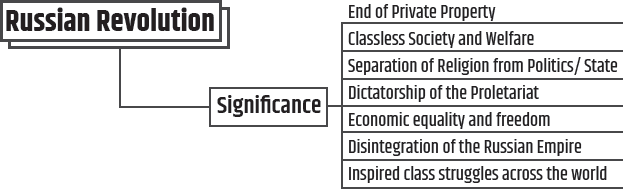
The Russian Revolution brought significant changes to the country’s economy, with the most notable being the end of private property and the transfer of ownership to the state. The abolition of private property meant that all sources of profit, such as factories, land, and banks, were now under state control. Individuals could no longer own these resources and exploit the labour of others to generate personal profit.
A major development that followed the Revolution was the establishment of workers’ control over industries. Workers were now able to oversee the production process through their representatives, ensuring that their rights were protected in the workplace and that the production process aligned with the needs of the broader society.
This shift led to the creation of a centralized economy, which was designed to prioritize the needs of the entire country, particularly the working class. The idea was to plan production and resource allocation in a way that would benefit the majority of the population, rather than private owners or capitalists.
In agriculture, the land was nationalized, meaning it became the property of the state. It was then redistributed to the peasants for hereditary use. However, they were not allowed to sell, mortgage, or use the land to exploit the labor of others for personal profit. The November 1917 land decree abolished landlordism and redistributed land to the peasantry, marking a significant change in the structure of Russian agriculture.
The collectivization of agriculture began in 1928, further advancing the social relations within rural communities. Through this process, the state pushed for collective farming as a way to increase agricultural productivity and transform the rural economy in line with socialist ideals.
• Social Aspects
By abolishing private ownership of the means of production, the Revolution aimed to eliminate the foundations of social inequality.
It established the groundwork for a classless society where individuals were compensated “according to their work.”
The Soviet state guaranteed various social benefits to all citizens, including free medical care, free and equal access to education, unemployment benefits,
and equal opportunities for cultural participation and advancement. These were enshrined as constitutional rights.
Gender equality was not only guaranteed by the constitution but was supported by material provisions to ensure its implementation.
Measures such as six months of maternity leave, workplace childcare facilities (crèches), and subsidized public canteens were introduced to support women’s full participation in public life.
These policies had a profound influence on capitalist societies, which felt compelled to introduce welfare measures in response to the socialist model. The concept of the welfare state in the West emerged largely as a reaction to the social benefits offered by the Russian Revolution, preventing Western workers from fully embracing socialism.
Another significant reform was the separation of religion from politics and the state. Religion was designated as a private matter.
Religious education was removed from schools, and religion was excluded from public affairs. However, religion itself was not abolished, and religious individuals were not persecuted, contrary to common belief.
• Political Aspects
The Russian Revolution politically led to the formation of a state centred around the working class, which was encapsulated in the idea of the “Dictatorship of the Proletariat.” This concept signified the dominance of the working class in the post-revolutionary political structure.
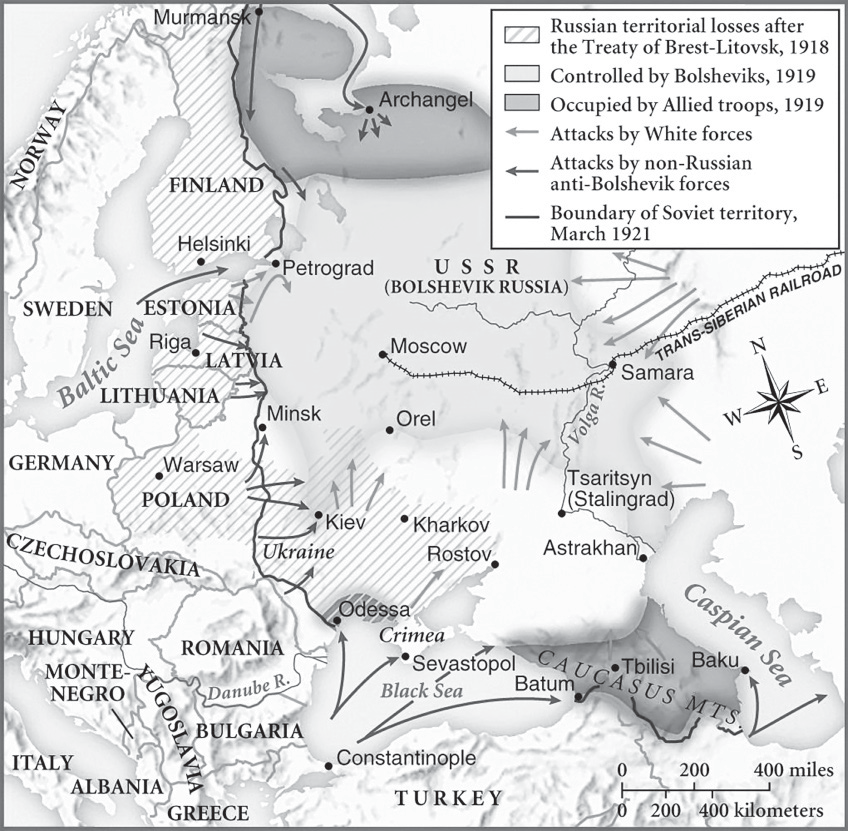
However, the Revolution faced immediate resistance from ten other nations that sided with the Russian aristocracy and bourgeoisie. These foreign powers aimed to suppress the revolution and maintain the old order. As a result, for a period, a political system led by the working class became essential to defend the revolution and its ideals.
This new state was notably more democratic compared to bourgeois states, as it gave power to the majority of people, who were the working class. This majority, once oppressed, now had the authority to dismantle the privileges held by the minority in pre-revolutionary Russia.
In this new system, the freedoms enjoyed by Soviet citizens extended beyond just political rights. They gained freedom from hunger, legal and social equality, and economic justice. The revolution expanded the very notion of freedom, ensuring that it reached not only legal and political domains but also the economic well-being of its people.
• International Aspects
The Russian Revolution marked a significant turning point in international relations. First, the Bolsheviks abolished all the secret treaties made by the previous Autocratic and Provisional Governments.
They believed that people have the right to know what their governments are doing and that citizens should be able to influence their country’s foreign policy through open debate and participation.
Additionally, the Bolsheviks issued a decree offering immediate peace without demands for territorial gains or reparations. They were the only political group worldwide to implement such a policy in practice.
They also renounced Russian claims to various territories in the Near and Far East that had been contested by previous governments.
Declaring their opposition to imperialism, the Bolsheviks supported national liberation movements against foreign domination.
Within the former Tsarist Empire, they acknowledged the right of all nationalities to self-determination, including the right to secede.
In regions where the landed aristocracy and bourgeoisie sought independence, but where workers and peasants wished to remain part of Soviet Russia, the Bolsheviks sided with the masses and worked alongside them to solidify the gains of the October Revolution.
The workers and peasants of most nationalities were with the Bolsheviks because they knew that the defeat of the Bolsheviks would mean the return of landlordism and capitalist exploitation.
Pre-Independence Era of Socialism in India
Socialism in India began to take shape during the freedom movement, much like in other parts of Asia. Its growth was strongly influenced by the global events of the First and Second World Wars, which created a unique social and political context in the country.
However, socialism didn’t have an easy start in India, facing resistance not only from British colonial powers but also from the shifting stances of the International Communist Party toward India’s struggle for independence. The complexities of these transitions made the initial phases of socialism’s growth challenging.
Indian nationalists were particularly drawn to Karl Marx’s radical ideas, which helped highlight the economic struggles caused by British exploitation. They sought to expose the injustices of colonial rule and emphasize the economic difficulties faced by their country as a result of British policies.
The influence of socialism peaked during the Gandhian era, especially during the Satyagraha movement. Gandhi’s philosophy of non-violence was central to his approach, but other leaders like Swami Dayanand also advocated for equality in Indian society. While many socialists in India focused on economic equality, figures like Bankim Chandra placed more emphasis on social equality.
Gandhi’s model of socialism was rooted in ethical values and social reform. He argued that Western democracy and communism did not offer true freedom for Indians, and thus his vision diverged from both.
The economic difficulties faced by Indians played a significant role in shaping the rise of socialism. These challenges contributed to the growth of an ideology that sought to address both social and economic inequalities, helping to cement socialism’s influence in India’s struggle for independence.
Post-Independence Era Socialism in India
The Indian model of socialism is not explicitly defined in the Constitution, but Article 43A, introduced by the 42nd Constitutional Amendment in 1976, suggests that socialism, as envisioned in the Preamble, includes worker participation in industry management and profit-sharing. In the landmark case of Nakara vs. Union of India (1982), the Supreme Court noted that Indian socialism is a blend of Marxism and Gandhism, with a heavier emphasis on Gandhian principles. However, after the economic reforms of 1991, which focused on Liberalization, Privatization, and Globalization, India has distanced itself from the idea of collective ownership of the means of production. Still, socialism continues to influence national debates.
Key aspects of Indian socialism include:
• Ensuring equal opportunities for all.
• Reducing inequalities through state laws and welfare schemes. The Indian Constitution includes provisions like Article 24, which bans child labor under the age of 14 in hazardous jobs, and the Minimum Wages Act of 1948, aimed at securing workers’ livelihoods.
• Preventing the concentration of wealth through state regulation and laws.
• Public control over crucial sectors of the economy, with a robust public sector in heavy industries and capital- intensive areas.
• Focusing on the development of heavy industries and mechanization.
• Efforts to redistribute land, such as the banning of Zamindari, and promoting cooperative farming where peasants voluntarily form cooperatives to farm collectively.
• Indian socialism is often referred to as Democratic Socialism, which aligns more closely with Social Democracy in Europe than with other forms of socialism.
• Indian socialism, as reflected in the Preamble, is inspired by the ideals of Liberty, Equality, and Fraternity, derived from the French Revolution.
Impact on The National Liberation Movement in India
The 1905 Revolution served as a significant source of inspiration for Indian leaders. The agitation against the Partition of Bengal, which took shape in the Swadeshi Movement, emerged soon after this period.
Although the impact of the October Revolution on the Indian National Movement was not immediate, its success gradually made Indian leaders realize that neither constitutional methods nor revolutionary violence alone could achieve their goals.
The Russian Revolution also played a key role in spreading socialist ideas throughout India. Many of the first Indian communists received their training in Soviet Russia.
Influenced by Marxism and their involvement in popular struggles, several Indian Congress members eventually broke away from the party, laying the groundwork for the Communist Movement in India. Two prominent leaders in this movement were A.K. Gopalan and E.M.S. Namboodiripad.
The growth of the Communist Movement added a new dimension to the Indian National Movement. The class struggle—the fight of workers against the Indian capitalist class—became an integral part of India’s quest for freedom.
During this period, socialism became a common term in the political discourse of Indian leaders. By the 1930s, the Indian National Movement had reached a stage where the bourgeois dominance was seriously challenged by the left. Student and writers’ organizations with leftist orientations also emerged.
The Indian National Movement became part of the global struggle against imperialism, led by the Soviet Union, a connection increasingly acknowledged by Indian leaders. Without the success of the Russian Revolution, which weakened imperialism worldwide, India’s fight against British colonial rule would have been far more difficult. It is no coincidence that the process of decolonization accelerated after the defeat of fascism and the capitalist crisis following World War II.
In India, movements such as the Royal Indian Navy (RIN) Mutiny, the Tebhaga movement, and the Telangana uprising (1946-48) played crucial roles in the country’s political independence. These were led by Indian Communists who saw themselves as part of the global
Conclusion
The Russian Revolution, encompassing the events of 1917, stands as one of the most consequential upheavals in modern history. It marked the end of centuries of imperial rule and the birth of the world’s first communist state. The dual revolutions in February and October 1917 brought about seismic shifts in political and societal structures, leading to the abdication of the Romanov monarchy and the rise of the Bolsheviks under Vladimir Lenin. The revolution promised to deliver social and economic justice to the masses but ultimately resulted in a brutal and authoritarian regime that caused immense suffering, exemplified by the Red Terror and the Russian Civil War. The Russian Revolution also catalyzed broader geopolitical changes, contributing to the emergence of the Soviet Union as a superpower and fueling ideological conflicts during the Cold War. It left a lasting imprint on the global political landscape and ignited debates about the feasibility and consequences of communism.