Which centre consists of more than 100 Buddha caves?
Correct Answer:
(C) Kanheri
The Kanheri caves constitute a group of rock-cut monuments that are located to the north of Borivali on the western outskirts of Mumbai. The Kanheri caves demonstrate Buddhist influence on the art and culture of India built during 1st century BC.
Ques: 2
Ellora cave temples are related to–
1. Hinduism
2. Buddhism
3. Jainism
Choose right answer from codes:
Correct Answer:
(D) 1, 2 and 3
Ellora caves, locally known as ‘Verul Leni’ is located 25 km away from Aurangabad in Maharashtra. In total, there are 4 caves. Among them, 1 to 12 belongs to Buddhist, caves 13 to 29 are devoted to Hindu and caves 30 to 34 belongs to Jain.
Ques: 3
Which of the following temples is an example of rock- cut architecture?
Correct Answer:
(C) Kailasa Temple, Ellora.
Kailasa temple of Ellora is an example of rock-cut architecture. Rashtrakuta ruler Krishna–I built this temple in Dravidian style.
Ques: 4
The rock-cut caves in western India are located in –
Correct Answer:
(A) Nasik, Ellora and Ajanta
The ancient rock-cut caves in western India are located at Nasik, Ellora and Ajanta. Total of 34 caves in Ellora are famous and related to Buddhist, Hindu and Jains. Nasik caves are also known as Pandavleni caves or Pondu Leni, representing Buddhists devotional practices.
Ques: 5
Which of the following places is famous for Buddhist Cave Temples?
Correct Answer:
(C) Ajanta
Ajanta is famous for Buddhist cave temples while Elephanta is famous for its Shaiva temples, Khajuraho is known for Shaiva, Vaishnava and Jain temples and Nalanda is famous as a Buddhist education centre.
Ques: 6
Which of the following temples is considered as a wonder of rock-cut architecture?
Correct Answer:
(C) Kailasa Temple, Ellora
Kailasa (cave 16 of Ellora) is a remarkable example of Dravidian architecture on account of its striking proportion, elaborate workmanship, architectural content and sculptural ornamentation of rock-cut architecture. The temple was built by Krishna I Rashtrakuta dynasty. It is designed to recall Mount Kailasa, the home of Lord Shiva.
Ques: 7
Which religion had Rashtrakuta protection?
Correct Answer:
(B) Jain
Rashtrakuta kings also patronize followers of the Shaiva, Vaishnava and Shakti faiths but they were inclined towards Jainism since many of the scholars who flourished in their courts and wrote in Sanskrit, Kannada and a few in Apabhramsha and Prakrit were Jains. King Amoghavarsha- I was the disciple of the Jain Acharya Jinasena the Author of Adipuran.
Ques: 8
Consider the following pairs:
How many of the pairs given above are correctly matched?
Correct Answer:
(B) Only two
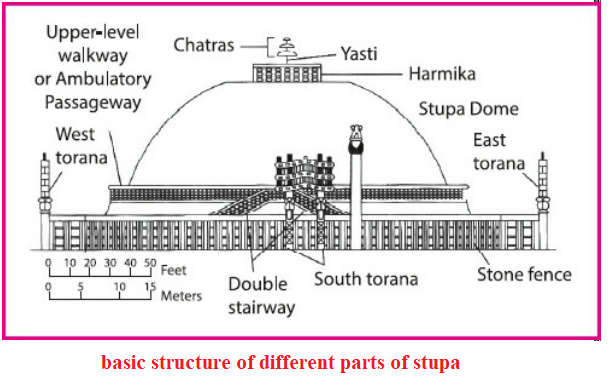
The Stupa is one of the most revered parts of Buddhism. Various parts of stupa signify something. The Great Stupa (also called Stupa no. 1) was originally built in the 3rd century BCE by the Mauryan emperor Ashoka and is believed to house ashes of the Buddha.
The simple structure was damaged at some point during the 2nd century BCE. It was later repaired and enlarged, and elements were added; it reached its final form in the 1st century BCE. The building is 120 feet (37 metres) wide and 54 feet (17 metres) high.
The central structure consists of a hemispherical dome (anda) on a base, with a relic chamber deep within.
The dome symbolizes, among other things, the dome of heaven enclosing the earth. Hence, pair 1 is correct.
It is surmounted by a squared railing (Harmika) that can be said to represent the world mountain. Hence, pair 2 is incorrect.
A central pillar (Yashti) symbolizes the cosmic axis and supports a triple umbrella structure (Chattra), which is held to represent the Three Jewels of Buddhism—the Buddha, the dharma (doctrine), and the sangha (community). Hence, pair 3 is incorrect and pair 4 is correct.
A circular terrace (Medhi), enclosed by a railing, surrounds the dome, on which the faithful are to circumambulate in a clockwise direction.
The entire structure is enclosed by a low wall (Vedika), which is punctuated at the four cardinal points by toranas (Ceremonial gateways).
The toranas of the Great Stupa are the crowning achievement of Sanchi sculpture. Each gateway is made up of two squared posts topped by capitals of sculptured animals or dwarfs, surmounted by three architraves.
All the elements are covered with relief sculptures depicting the events of the Buddha’s life, Jataka stories (about the Buddha’s previous lives), scenes of early Buddhism, and auspicious symbols.
The names of donors are also inscribed, the most notable one being the ivory workers of Vidisha.
Ques: 9
Sonagiri, the highest among 103 Jain temples, lies in the proximity of
Correct Answer:
(A) Datia
Sonagiri is located 15km away from Datia (MP). Sonagiri is a sacred place popular among Digambar Jain devotees and ascetic saints to practise for self-discipline, austerity and to attain Nirvana. There are 77 beautiful Jain temples with sky-high spires. Temple No. 57 is main among them which is related to Lord Chandraprabhu.