Water Conservation and Resources MCQs with Explanations
Practice MCQ Questions
Ques: 1
The 'World Water Day' is celebrated on:
Correct Answer:
(B) 22 March
World Water Day is an annual event celebrated on March 22. The day focuses attention on the importance of fresh water and advocates for the sustainable management of freshwater resources. The theme of World Water Day 2024 is 'Water for Peace'. When we cooperate on water, we create a positive ripple effect – fostering harmony, generating prosperity and building resilience to shared challenges.
Ques: 2
Who among the following environmentalists is known by the name of ‘Jal Purush’?
Correct Answer:
(B) Rajendra Singh
Rajendra Singh is a well-known water conservationist from Alwar district, Rajasthan also known as ‘waterman of India’. He won the Stockholm Water Prize, an award as in 2015. Previously he won the Ramon Magsaysay Award 2001 for his pioneering work in community-based efforts in water harvesting and water management.
Ques: 3
Which of the following leaf modifications occurs/occur in desert areas to inhibit water loss?
Hard and waxy leaves
Tiny leaves or no leaves
Thorns instead of leaves
Select the correct answer using the code given below :
Correct Answer:
(D)
All of these
Due to the scarcity of water in the desert, in some plants, leaves are modified to reduce water loss. Hard and waxy leaves help to minimise water loss through diffusion. Water loss is also prevented in the form of gummy substance in leaves minimising the surface area to volume ratio. Thorns have a high surface area but they help in water conservation. They also help in condensing moisture from the air which then drips to the ground and is absorbed by the roots.
Ques: 4
If the National Water Mission is properly and completely implemented, how will it impact the country?
Part of the water needs of urban areas will be met through recycling of waste-water.
The water requirements of coastal cities with inadequate alternative sources of water will be met by adopting appropriate technologies that allow the use of ocean water.
All the rivers of Himalayan origin will be linked to the rivers of peninsular India.
The expenses incurred by farmers for digging bore-wells and for installing motors and pump-sets to draw groundwater will be completely reimbursed by the Government.
Select the correct answer using codes given below :
Correct Answer:
(B) 1 and 2
The main objective of the National Water Mission is "conservation of water, minimizing wastage and ensuring its more equitable distribution both across and within States through integrated water resources development and management". National Water Mission is a part of the National Action Plan on Climate Change which was started on 30 June, 2008. The five identified goals of the mission are (i) Comprehensive water database in public domain and assessment of impact of climate change on water resource (ii) Promotion of citizen and state action for water conservation augmentation and preservation (iii) Focused Attention to vulnerable areas including over-exploited areas (iv) Increasing water use efficiency by 20% (v) Promotion of basin level integrated water resource management. Hence (b) is the correct answer.
Ques: 5
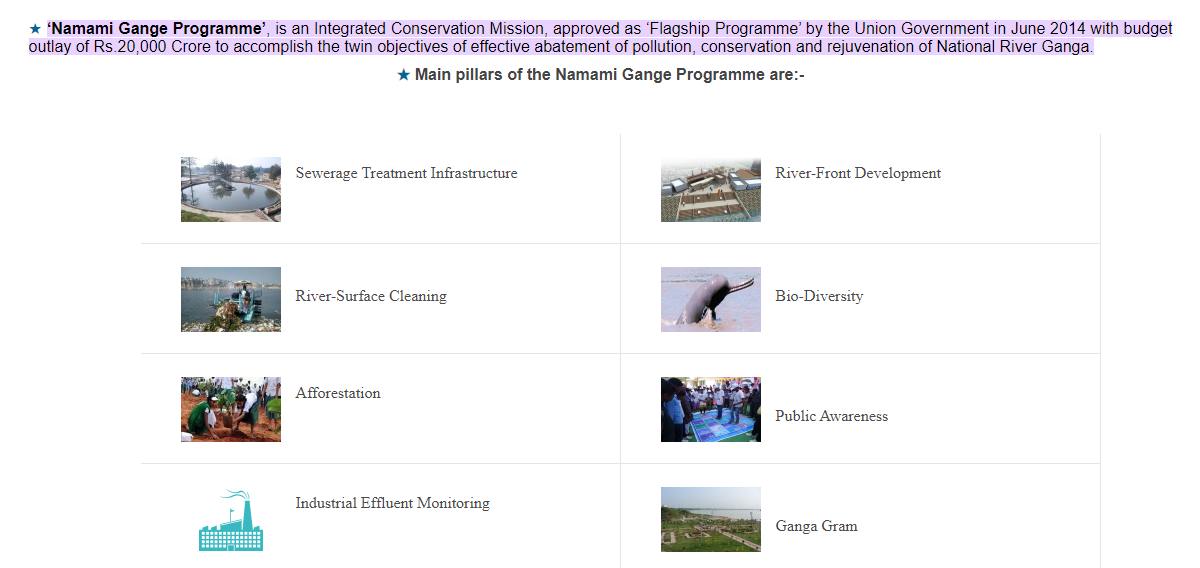
Which of the following are the key pillars of the Namami Gange Programme?
River-Front development.
Afforestation.
Sewerage treatment infrastructure.
Select the correct answer using codes given below:
Correct Answer:
(D)
1, 2 and 3
Ques: 6
Which one of the following is not a biotic resource?
Correct Answer:
(A) Freshwater
Biotic resources are obtained from the living and organic material such as forests and animals and the materials that can be obtained from them. Fossil fuels such as coal and petroleum are also included in this category because they are formed from decayed organic matter.