Article 2: Changing Political Landscape of India
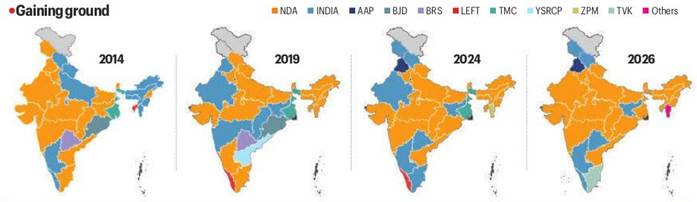
Why in News: With the Bharatiya Janata Party (BJP) securing a major electoral victory in West Bengal, the political map of India is undergoing significant changes, affecting federal dynamics and party dominance.
Key Details
- The Bharatiya Janata Party and its allies (NDA) are now in power in 22 states and Union Territories. This marks a steady expansion of political influence compared to previous years.
- The National Democratic Alliance (NDA) has increased its footprint from 16 states in 2014 to 22 in 2026. This reflects sustained electoral success and strategic alliances across regions.
- The opposition INDIA bloc is currently in power in around 6 states. This shows a relative decline in comparison to the ruling alliance’s expansion.
- Regional parties and other political groups now govern only a few states. This indicates increasing centralisation of political power among major alliances.
Indian Federal Structure
- Quasi-Federal Nature: India follows a quasi-federal system with a strong Centre. The Constitution provides more powers to the Union compared to states.
- Division of Powers: Powers are distributed through Union, State, and Concurrent Lists. This ensures functional autonomy while maintaining national unity.
- Role of States: States play a key role in governance, policy implementation, and regional representation. Political control over states directly impacts federal balance.
- Political Map Significance: Party dominance across states influences Centre-State relations. It also affects policy coordination and political stability.
Rise of BJP and NDA
- Expansion Since 2014: The BJP-led NDA has expanded significantly across India. It has moved beyond its earlier image of being a North India-centric party.
- State-Level Growth: BJP alone governs 14 states currently. This shows increasing independent electoral strength without reliance on allies.
- Alliance Strategy: Strategic alliances with regional parties have helped expand reach. These alliances are crucial in states where BJP has limited grassroots presence.
- Electoral Consolidation: Continuous victories have strengthened organisational capacity. This has enabled better election management and voter mobilisation.
Decline of Opposition and Regional Parties
- Reduced State Presence: Opposition alliances now govern fewer states compared to earlier years. This reduces their influence in national decision-making.
- Fragmentation Issues: Lack of unity among opposition parties weakens electoral performance. Differences in ideology and leadership create coordination challenges.
- Regional Party Decline: Many regional parties have lost their traditional strongholds. This reflects changing voter preferences and nationalisation of politics.
- Exception Cases: Some regional parties like AAP and ZPM continue to hold specific states. However, their influence remains geographically limited.
End of Communist Rule in India
- Historical Context: States like West Bengal, Kerala, and Tripura had long histories of communist governments. These states once formed the ideological base of Left politics in India.
- Recent Decline: The loss of Kerala marks the end of communist rule in India. This is the first time since 1977 that no state has a Left government.
- Changing Ideologies: Voters are shifting towards development-oriented and national narratives. This has reduced the appeal of traditional ideological politics.
- Political Significance: Marks a major ideological shift in India’s political landscape. It indicates weakening of Left influence in electoral politics.
Regional Political Developments
- West Bengal Shift: BJP’s victory ends long-standing dominance of regional forces like TMC.It represents a major breakthrough in Eastern India.
- Tamil Nadu Scenario: Emergence of new parties like TVK shows dynamic political competition. Regional politics continues to evolve with new leadership.
- Kerala Change: Congress-led UDF returning to power reflects cyclical electoral trends. It also indicates anti-incumbency against ruling governments.
- North-East Dynamics: NDA has strengthened its presence through alliances. This region has become strategically important in electoral politics.
Implications for Indian Democracy
- Centralisation of Power: Increasing dominance of one alliance may affect political balance. It raises concerns about reduced competitive federalism.
- Policy Uniformity: Greater alignment between Centre and states can improve policy implementation. It may lead to faster execution of national schemes.
- Opposition Role: A strong opposition is essential for democratic accountability. Decline of opposition may weaken checks and balances.
- Electoral Trends: Voter preferences are shifting towards national leadership and governance performance. This indicates transformation in democratic behaviour.
Way Forward
- Strengthening Federalism: Ensure balanced Centre-State relations. This is crucial for cooperative federal governance.
- Revitalising Opposition: Opposition parties need unity and clear policy alternatives. This will improve democratic competition.
- Encouraging Regional Voices: Regional diversity must be preserved in politics. It ensures inclusive representation across India.
- Focus on Governance: Political success should translate into effective governance. This will enhance public trust and democratic legitimacy.
Conclusion
India’s political map is witnessing a significant shift towards dominance by a single alliance. While this may improve governance efficiency, maintaining democratic balance and federal principles remains essential for long-term stability.
EXPECTED QUESTIONS FOR UPSC CSE
Prelims MCQ
Q. Which of the following best describes ‘cooperative federalism’ in India?
(a) Complete independence of states
(b) Strong Centre with no role of states
(c) Collaboration between Centre and States for governance
(d) Absence of division of powers
Answer: (c)
Descriptive Question
Q. “The changing political map of India reflects both the strengthening of national parties and challenges to federal balance.” Discuss. (250 words, 15 marks)