Editorial 2 : Hydrology of the Brahmaputra
Context
The question lies that could the Chinese dams can affect Brahmaputra flow in India.
The Brahmaputra
- The Brahmaputra, lifeline of Assam and Arunachal Pradesh, originates as Yarlung Tsangpo in Tibet and enters India near Gelling in Arunachal Pradesh.
- The river, which is called Siang in Arunachal, is joined by many tributaries in Assam as it flows down the plains before entering Bangladesh, where it is called Jamuna.
What interventions does China plan?
- India has been monitoring Chinese infrastructure interventions on the river.
- A major concern is the planned Medog (or Motuo) Hydropower Project, a massive dam in Medog County near the ‘Great Bend’ where the river makes a U-turn and plunges into a canyon before entering Arunachal Pradesh.
- According to reports, the planned 60,000-MW Medog project will be the world’s largest hydropower facility, with a generation capacity three times that of the Three Gorges Dam on the Yangtze, currently the world’s largest hydropower station.
- Concerns have also been raised over China’s massive, multi-decade South-North Water Diversion (SNWD) project, the Western Route of which apparently involves diverting water from the Yarlung Tsangpo to the country’s dry northern regions.
How much of the Brahmaputra’s water yield is generated in India?
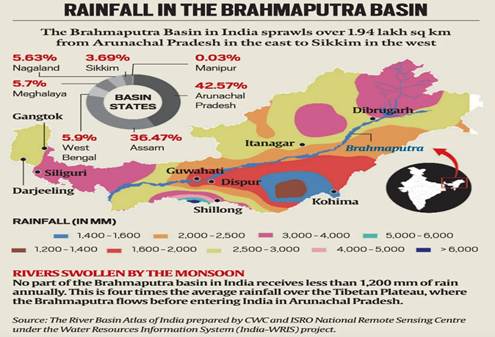
- Although the portion in India constitutes only 34.2% of the total basin area, it contributes to more than 80% of the Brahmaputra’s yield, making the Tibet Autonomous Region a minor contributor to the basin’s overall yield.
- This is because the Tibetan Plateau is a region of scanty rainfall, and by contrast, the southern part of the river basin in India receives 2,371 mm of rain on average every year.
- Also, the Brahmaputra receives a number of tributaries at both its northern and southern banks.
- The yield of the river system is increased significantly by the annual monsoon from June to September. Many of the Brahmaputra’s tributaries also receive considerable contributions from snowmelt, mostly in the Indian catchment area.
The upstream interventions and the flow
- Changes in the river’s flow patterns can impact hydropower projects planned on the Siang during the lean period and during peak power production.
- As a mitigation strategy, India could plan storage on rivers of the Brahmaputra system to absorb the variations in flows.
- The Upper Siang Project, for example, will not only generate power, its storage can also serve as a buffer against variations in flows
- Risks of flooding may also arise from intentional or unintentional operation of reservoirs in Tibet, as well as unforeseen events such as dam failure, landslides, or earthquakes.
- Upstream interventions have the potential to affect the river morphology, with consequences for riverine flora and fauna.
Using the water potential
- The Brahmaputra and its tributaries carry more than 30% of the country’s total water resources potential, and 41% of the total hydropower potential.
- The utilisation of hydropower potential in Arunachal Pradesh has been slow due to difficulties of land acquisition and concern over the submergence of forest lands, etc.
- The National Water Development Authority has proposed two links to connect the Brahmaputra and its tributaries to the Ganga basin with the aim of transferring surplus water to water-scarce regions.
- These are (i) the Manas-Sankosh-Teesta-Ganga Link, joining the Manas, a tributary of the Brahmaputra, to the Ganga via the Sankosh and Teesta;
- and (ii) the Jogighopa-Teesta-Farakka Link, joining the Brahmaputra at the planned Jogighopa Barrage to the Ganga at the Farakka Barrage.
Way forward
- It is important for India to assess the effects by conducting detailed multi-disciplinary scientific studies, and prepare an adaptive strategy.
- It needs to use diplomatic channels to actively seek detailed hydrological and project-related data to continuously assess the downstream impact of Chinese infrastructure interventions.
- India should also work to develop comprehensive data sharing protocols with China for advance warning and disaster preparedness.