Editorial 1 : Why Axiom-4 matters
Context
The travel of Indian astronaut Shubhanshu Shukla to the International Space Station (ISS) on the Axiom-4 mission on Wednesday marks the beginning of a new era in Indian space.
Moving into next gear
- With Shukla’s flight, we are moving into the next gear. This might still not be our own human spaceflight mission, which is supposed to happen very soon, but it is not as though we are just hitching a ride on someone else’s mission.
- The Axiom-4 mission is closely integrated with our own space plans, and will provide some critical inputs to the Gaganyaan mission and other missions to follow.
- When Rakesh Sharma went into space on a Russian mission in 1984, India’s space program was still in its very early stages.
- We also did not have a definitive plan or roadmap for the future: a human spaceflight was not on the horizon.
- Shukla’s flight will have practical uses as well. ISRO has, in the intervening years, emerged as one of the leading space agencies of the world with the ability to execute very complex missions. Human spaceflight is one of the few remaining frontiers that ISRO still has to conquer.
Gaganyaan ahead, importance of Shukla’s critical inputs
- Human spaceflight missions are extremely challenging, more so when you are doing it for the first time.
- They are maybe a couple of orders of magnitude more complex than uncrewed missions because of the safety protocols that have to be integrated.
- This is the challenge that ISRO faces with the Gaganyaan mission. And every bit of additional input that reduces the risk and increases the safety of the mission is invaluable.
- The spacecraft has to follow a complicated orbit to reach the ISS, which is a moving target in space. The pilot will be required to take a number of decisions, and initiate several processes, during the flight to the destination.
- Shukla will have an opportunity to see how the ISS functions and operates. ISRO’s next big project, after Gaganyaan, is to build its own space station.
Muscle behaviour to moong dal: Experiments for future projects
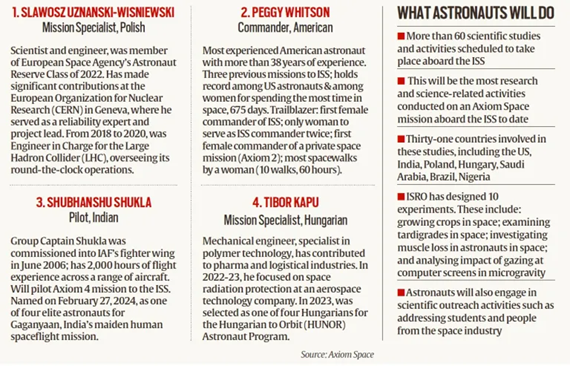
- The experiments that ISRO has designed for the Axiom-4 mission are very interesting. And again, they directly feed into ISRO’s own future needs and projects.
- This is the first opportunity for ISRO to carry out such customised experiments in space. Many are biology-related, and a few are technology experiments.
- The zero-gravity conditions in space offer a unique setting for studies that are extremely difficult to do on Earth.
- For example, one of ISRO’s experiments relates to the study of muscle behaviour. Muscle degradation can be because of natural causes; it can also be affected by a person’s weight.
- On Earth, it is very difficult to decouple these two causes because of gravity.
- Space’s zero-gravity environment gets rid of the weight factor and allows the study of changes in muscles purely due to natural reasons, which that can lead to breakthroughs in the understanding of human health.
- The experiments on sprouts, specifically on moong dal, on the micro-algae, and others are all very interesting, and tailored to Indian requirements.
- Participation in the Axiom-4 mission has given India an opportunity to carry out these experiments in space. These can be followed up with a new set of experiments on the Gaganyaan mission.
Boosting space economy and attracting new talent
- Shukla’s flight is the beginning of a series of steps that will lead up to the human Moon landing that ISRO has planned to undertake by 2040.
- Space is a costly endeavour, and the sector can benefit hugely from private-sector participation.
- It will also make the sector more vibrant, facilitate innovation, expedite technology development, and attract new, young talent. It can also boost economic growth.
Way forward
- Globally, the space market is worth about $500 billion, and is expected to double by the year 2030. India, despite being a major spacefaring nation, accounts for a just 2% share of this market. We have the ambition of increasing our share to at least 10% in the coming years.