Article 1: Emerging Price Pressures in India
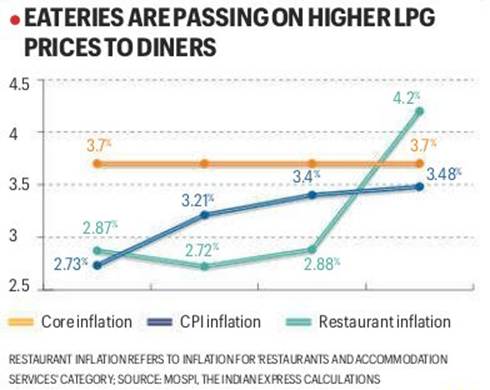
Why in News: India’s retail inflation rose marginally to 3.48% in April 2026, while core inflation remained unchanged at 3.7% for the fourth consecutive month, reflecting stable underlying demand despite global energy uncertainties linked to the West Asia conflict.
Key Details
- India’s headline retail inflation based on the Consumer Price Index (CPI) increased to 3.48% in April 2026 from 3.4% in March. This remains below the Reserve Bank of India target level of 4%, indicating overall price stability in the economy.
- The restaurant and accommodation services category recorded inflation of 4.2%, higher than the previous month. The rise was mainly due to increased commercial LPG prices and rising operational costs for eateries and hotels.
- Despite global crude oil volatility arising from the West Asia crisis, core inflation has remained stable at 3.7% for four straight months. This indicates that producers are still absorbing part of the increased input costs instead of fully passing them on to consumers.
- The RBI has projected CPI inflation at 4.6% for FY27, warning of upside risks from energy prices and possible El Niño conditions. This suggests inflationary pressures may intensify in the coming quarters if global and climatic risks persist.
Understanding Inflation
- Inflation refers to a sustained increase in the general price level of goods and services in an economy. It reduces the purchasing power of money and directly affects household consumption and savings.
- India primarily tracks retail inflation using the Consumer Price Index (CPI) prepared by the Ministry of Statistics and Programme Implementation (MOSPI). The CPI basket includes food, fuel, housing, clothing, transport, and services consumed by households.
- The RBI follows a Flexible Inflation Targeting (FIT) framework under which inflation is targeted at 4% ± 2%. This means inflation must remain within the tolerance band of 2% to 6%.
- Inflation can be caused by rising demand, supply-side disruptions, imported inflation, or higher production costs. External shocks such as oil price increases and geopolitical tensions often contribute to inflationary pressure.
Core Inflation and Its Significance
- Core inflation excludes volatile items such as food and fuel to measure underlying price trends in the economy. It is considered a more reliable indicator of long-term inflationary pressure and demand conditions.
- India’s core inflation remaining stable at 3.7% indicates moderate underlying demand despite global uncertainties. This suggests the economy is not currently witnessing broad-based runaway inflation.
- Stable core inflation also reflects that manufacturers in sectors such as plastics, pharmaceuticals, and personal care are absorbing input cost increases. This helps prevent sudden spikes in consumer prices and supports macroeconomic stability.
- Central banks closely monitor core inflation while deciding monetary policy measures such as repo rate changes. Persistent increases in core inflation may eventually trigger tighter monetary policy.
West Asia Conflict and Imported Inflation
- India imports nearly 85% of its crude oil requirements, making it highly vulnerable to global energy price fluctuations. Any disruption in West Asia directly impacts domestic fuel, transport, and manufacturing costs.
- Rising global crude prices increase logistics and production expenses across sectors. This often leads to imported inflation, where international price shocks raise domestic inflation levels.
- The government has attempted to shield consumers through calibrated fuel taxation and supply management measures. This has helped contain the broader inflationary impact despite external uncertainties.
- However, sustained geopolitical tensions can eventually increase inflationary pressures in sectors dependent on petroleum products. This remains a major concern for policymakers and the RBI.
Food Inflation and Rural Economy
- Rural inflation rose to 3.74%, reaching a 15-month high in April 2026. This indicates growing price pressure in essential goods and services consumed in rural areas.
- Food inflation remains a critical component because food carries the largest weight in India’s CPI basket. Changes in food prices directly affect household welfare, especially among lower-income groups.
- Possible El Niño conditions may weaken monsoon rainfall and disrupt agricultural production. This can reduce crop output and further increase food prices in coming months.
- Inflation in rural areas can also impact demand patterns, rural wages, and poverty levels. Hence, managing food inflation remains a key economic priority for the government.
Restaurant Inflation and Service Sector Costs
- The “restaurant and accommodation services” category recorded one of the sharpest price increases in April. This reflects rising input costs being gradually passed on to consumers.
- Higher commercial LPG prices have significantly increased operating expenses for eateries and hotels. Businesses are adjusting menu prices to maintain profitability amid rising fuel and logistics costs.
- Service sector inflation is important because it reflects broader consumption patterns in urban economies. Rising dining-out expenses indicate inflationary transmission beyond essential commodities.
- If service inflation persists, it can contribute to stickier inflation trends in the overall economy. This may complicate the RBI’s efforts to maintain price stability.
Monetary Policy and RBI’s Response
- The RBI’s Monetary Policy Committee (MPC) decides the repo rate to control inflation and support growth. The repo rate currently remains at 5.25%, reflecting a cautious “wait and watch” approach.
- If inflation rises persistently above target levels, the RBI may increase interest rates to reduce excess liquidity. Higher interest rates generally reduce borrowing and consumer demand, thereby controlling inflation.
- At present, inflation remains within the RBI’s tolerance band, reducing immediate pressure for aggressive tightening. However, the central bank continues to monitor risks from oil prices and weather-related disruptions.
- Economists expect the RBI to remain cautious during 2026 due to uncertainty regarding global energy markets and monsoon conditions. This highlights the balancing act between inflation control and economic growth.
GDP Data Revision and Statistical Significance
- The government has postponed release of Q4 and FY26 GDP data to improve data accuracy and coverage. This includes incorporating audited corporate results and updated government finance figures.
- GDP data is a key indicator of economic performance and influences policy decisions. Accurate data helps investors, policymakers, and institutions assess growth trends effectively.
- India’s statistical system is gradually moving towards improved transparency and methodological refinement. This enhances credibility and supports evidence-based policymaking.
- High-quality macroeconomic data is essential for maintaining investor confidence and economic stability. It also improves the effectiveness of fiscal and monetary policy interventions.
Challenges Before the Indian Economy
- Global geopolitical instability continues to create uncertainty in energy and commodity markets. This exposes India to inflationary shocks despite strong domestic fundamentals.
- Climate-related risks such as El Niño can affect agricultural production and food prices. Weather shocks increasingly influence inflation dynamics in developing economies like India.
- Balancing economic growth with inflation control remains a major policy challenge. Excessive tightening may slow growth, while loose policy can worsen inflation.
- Rising service sector costs and imported inflation may gradually spread across sectors. This requires careful coordination between fiscal and monetary authorities.
Way Forward
- India must strengthen energy security through diversification of crude oil imports and renewable energy expansion. This will reduce vulnerability to geopolitical disruptions and imported inflation.
- The government should improve agricultural resilience through irrigation, storage, and climate-adaptive farming practices. This can help stabilise food prices during adverse weather conditions.
- The RBI should continue data-driven monetary policy while closely monitoring core inflation trends. A calibrated approach can maintain macroeconomic stability without hurting growth.
- Enhancing supply chains, logistics efficiency, and domestic manufacturing capacity can reduce cost pressures. This will support long-term price stability and economic resilience.
Conclusion
India’s inflation remains relatively contained despite global energy shocks and geopolitical uncertainty. However, rising service costs, imported inflation, and climate risks indicate that inflationary pressures may gradually build in the coming months. Sustained policy coordination between the government and the RBI will be essential to preserve price stability while supporting economic growth.
EXPECTED QUESTIONS FOR UPSC CSE
Prelims MCQ
Q. With reference to inflation and monetary policy in India, consider the following statements:
- Core inflation excludes food and fuel prices while measuring underlying inflationary trends.
- The Reserve Bank of India follows a Flexible Inflation Targeting framework with a target of 4% ± 2%.
- Imported inflation in India is completely unrelated to crude oil price fluctuations.
How many of the above statements are correct?
(a) Only one
(b) Only two
(c) All three
(d) None
Answer: (b)
Descriptive Question
Q. “Persistent global geopolitical tensions and climate uncertainties are increasingly shaping India’s inflation dynamics.” Discuss the challenges posed by imported inflation and evaluate the role of monetary policy in maintaining macroeconomic stability in India. (250 words, 15 marks)