Article 1: India’s Agricultural Trade Resilience Amid Global Tariff Pressures
Why in News: Despite steep tariff hikes imposed by the United States under the administration of Donald Trump, India’s agricultural exports recorded positive growth in 2025–26, reflecting diversification of export markets and resilience in the farm sector.
Key Details
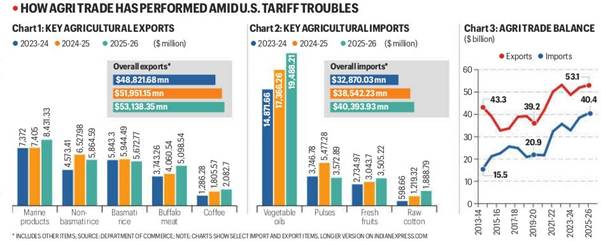
- India’s agricultural exports increased to $53.1 billion in 2025–26, registering a 2.3% year-on-year growth. This growth came despite disruptions in global trade and higher tariffs imposed by the United States on several Indian products.
- Agricultural exports performed better than overall merchandise exports, which grew only 0.9% during the same period. This highlights the relative resilience of India’s farm sector in an uncertain global economic environment.
- Products such as marine products, buffalo meat, and coffee achieved record export levels. The growth was largely driven by diversification towards Asian, Middle Eastern, and European markets.
- India’s agricultural trade surplus has narrowed over time due to rising imports of edible oils, pulses, and raw cotton. This reflects structural challenges in domestic agricultural productivity and self-sufficiency.
Agricultural Trade and India’s Economy
- Agricultural exports play an important role in generating foreign exchange and supporting rural livelihoods. They also help integrate Indian farmers with global value chains and international markets.
- India remains a net exporter of agricultural products, unlike many other merchandise sectors where trade deficits persist. This provides stability to the external sector and strengthens the country’s balance of payments position.
- The agricultural sector contributes significantly to employment, especially in rural areas. Higher exports can improve farm incomes and support inclusive economic growth.
- Agricultural trade is influenced by factors such as global demand, climate conditions, trade policies, and currency movements. Therefore, diversification and competitiveness are crucial for long-term sustainability.
Impact of US Tariffs on Indian Exports
- The US imposed tariffs ranging from 25% to 50% on several Indian exports before partially reducing them later. These measures affected sectors such as pharmaceuticals, textiles, leather, and some agricultural commodities.
- Exports of marine products, spices, basmati rice, and processed foods to the US witnessed declines. Higher tariffs reduced the competitiveness of Indian products in the American market.
- However, Indian exporters managed to reduce dependence on the US market through diversification. This strategy helped offset losses by expanding exports to alternative destinations.
- The episode demonstrates the vulnerability of export-oriented sectors to geopolitical and protectionist policies. It also underlines the importance of strengthening trade resilience through multiple markets.
Diversification of Export Markets
- India expanded exports of marine products to countries such as China, Vietnam, Japan, Belgium, and Thailand. This helped compensate for declining shipments to the United States.
- Buffalo meat exports rose sharply due to increasing demand from countries in West Asia and Southeast Asia. Major destinations included Vietnam, Egypt, Malaysia, UAE, and Saudi Arabia.
- Coffee exports crossed the $2 billion mark for the first time due to high global prices and supply shortages in Brazil and Vietnam. India’s robusta coffee gained demand in European and West Asian markets.
- The diversification strategy reflects the importance of reducing excessive dependence on any single export destination. It enhances economic resilience during periods of global trade uncertainty.
Marine Products: India’s Major Export Success
- Marine product exports touched a record $8.4 billion in 2025–26. This sector emerged as one of the strongest performers despite US tariff pressures.
- India’s seafood exports mainly include frozen shrimps and prawns. These products have high demand in East Asian and European markets.
- The sector supports millions of livelihoods, especially in coastal states such as Andhra Pradesh, Kerala, Gujarat, and Odisha. It is also important for foreign exchange earnings and food processing industries.
- Export diversification helped the sector absorb external shocks and maintain growth momentum. This demonstrates the effectiveness of market adaptation strategies.
Coffee Exports and Global Commodity Dynamics
- India’s coffee exports nearly tripled compared to 2020–21 levels. The rise was driven by lower global production and declining international stocks.
- Brazil and Vietnam, the world’s leading coffee producers, experienced weak harvests. This increased global demand for Indian coffee exports.
- India mainly exports robusta coffee, which is widely used in instant coffee and espresso blends. Key markets include Italy, Germany, Russia, UAE, and Belgium.
- The trend highlights how global commodity shortages can create export opportunities for India. It also demonstrates the importance of value addition in agricultural exports.
Rising Agricultural Imports and Structural Concerns
- India’s largest agricultural import item continues to be vegetable oils. Domestic production meets only around 40% of the country’s edible oil demand.
- Pulses imports remain significant because domestic production is insufficient to meet consumption requirements. This reflects challenges in productivity, irrigation, and crop diversification.
- Fresh fruit imports, especially almonds and walnuts from the US, have increased steadily. Rising incomes and changing dietary preferences are contributing to higher demand.
- India has also turned from a net exporter to a net importer of raw cotton. This is linked to stagnation in productivity and absence of new yield-enhancing technologies after Bt cotton.
Agricultural Trade Balance and Policy Concerns
- India’s agricultural trade surplus has narrowed from around $27 billion in 2013–14 to nearly $12.7 billion in 2025–26. Rising imports have grown faster than exports over the years.
- Although India continues to remain a surplus agricultural trader, the declining margin is a matter of concern. It indicates increasing dependence on imports for key commodities.
- The trend underscores the need to improve domestic productivity and competitiveness. Without reforms, import dependence may continue to rise in critical sectors.
- Strengthening agricultural exports while reducing avoidable imports is essential for long-term trade sustainability. This requires both technological and policy interventions.
Government Initiatives and Policy Measures
- The government promotes agricultural exports through the Agriculture Export Policy, 2018. The policy focuses on diversification, value addition, and integration with global markets.
- Schemes such as PM-KISAN, digital agriculture initiatives, and logistics reforms aim to strengthen farm productivity. Improved infrastructure can help reduce post-harvest losses and increase export competitiveness.
- India is also encouraging food processing and agri-value chains under the PM Formalisation of Micro Food Processing Enterprises (PM-FME) scheme. This supports small producers and enhances export potential.
- Trade agreements and market access negotiations are becoming increasingly important. India is focusing on balancing domestic interests with export expansion opportunities.
Way Forward
- Diversify Export Destinations: India should continue expanding into emerging markets across Africa, West Asia, and East Asia. This will reduce dependence on developed economies and improve trade resilience.
- Boost Domestic Productivity: Investment in irrigation, seeds, biotechnology, and research is essential. Higher productivity can reduce import dependence and improve competitiveness.
- Strengthen Value Addition: Processed agricultural products fetch higher export earnings than raw commodities. Expanding food processing industries can increase farmers’ incomes and exports.
- Improve Trade Infrastructure: Efficient logistics, cold chains, and port connectivity are necessary for global competitiveness. Reducing transaction costs will benefit both exporters and consumers.
Conclusion
India’s agricultural sector has shown resilience despite global tariff pressures and protectionist policies. Diversification of export markets, strong performance in marine products and coffee, and sustained demand for Indian farm products have supported export growth. However, rising imports of edible oils, pulses, and cotton highlight structural weaknesses that require urgent policy attention for ensuring long-term agricultural trade sustainability.
EXPECTED QUESTIONS FOR UPSC CSE
Prelims MCQ
Q. With reference to India’s agricultural trade, consider the following statements:
- India continues to remain a net exporter of agricultural products.
- Vegetable oils constitute one of the largest agricultural imports of India.
- India’s raw cotton exports currently exceed its imports.
How many of the above statements are correct?
(a) Only one
(b) Only two
(c) All three
(d) None
Answer: (b)
Descriptive Question
Q. “India’s agricultural exports have demonstrated resilience despite rising global protectionism and tariff barriers. However, structural weaknesses in domestic agriculture continue to increase import dependence.” Discuss. (150 words, 10 marks)