Article 2: Gender Economy Gap
Why in News: India’s female labour force participation is rising, but women remain severely underrepresented in leadership roles across sectors.
Key Details
- Female Labour Force Participation Rate (LFPR) increased from 33.9% (2022) to 40% (2025).
- Still below global average (49%) and countries like Vietnam (69%) and Brazil (53%).
- Women hold only 13% of top managerial and legislative roles (PLFS data).
- Women’s Reservation Act implementation delay highlights structural barriers in political representation.
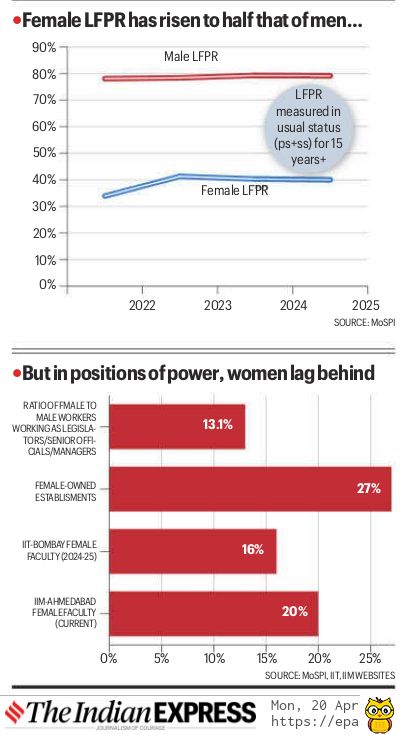
Female Labour Force Participation (FLFP)
- Rising but insufficient participation: India’s female LFPR reaching 40% in 2025 is a positive trend, yet it remains significantly lower than global standards, indicating underutilisation of human capital.
- Growth and development linkage: According to the World Bank, India needs ~8% sustained growth to become a developed economy by 2047, which is not feasible without higher female workforce participation.
- Demographic dividend utilisation: Women constitute nearly 48% of India’s population, and their economic inclusion is essential to fully realise the demographic dividend.
- Structural shift in employment: Increase in rural and self-employment has partly driven LFPR rise, but quality of jobs remains a concern, with many women engaged in informal and low-paying work.
Sectoral Employment & Labour Market Dynamics
- Role of labour-intensive industries: Sectors like textiles, food processing, and electronics can absorb more female workers, improving both employment and wages.
- Supply vs demand constraints: Studies show that increasing female labour supply without demand expansion may depress wages, highlighting the need for job creation.
- Informal sector dominance: A large proportion of women work in the informal economy, lacking job security, social protection, and fair wages.
- Urban-rural divide: Female participation is often higher in rural areas due to necessity-driven employment, whereas urban participation is constrained by social norms and safety concerns.
Glass Ceiling & Leadership Gap
- Low representation in top positions: Only 13 women per 100 men are in leadership roles (PLFS), indicating a sharp gender gap in decision-making spaces.
- Corporate leadership disparity: Despite mandatory board representation, 77% of companies have only 1–2 women directors, reflecting tokenism rather than meaningful inclusion.
- Critical mass theory: Research suggests at least 30% representation is needed for women to influence decision-making effectively.
- Academic leadership gap: Women constitute only ~14% faculty in IITs and around 20–30% in IIMs, showing underrepresentation in knowledge leadership.
Political Representation & Governance Impact
- Women’s Reservation Act delay: Implementation linked with delimitation has delayed benefits, affecting women’s legislative participation.
- Economic benefits of representation: A 2018 study found constituencies with women legislators experienced 1.8% higher economic growth annually.
- Policy prioritisation: Women leaders often focus more on health, education, and welfare, leading to inclusive development.
- Democratic deepening: Greater participation strengthens representative democracy and gender equality.
Barriers to Women’s Economic Empowerment
- Socio-cultural norms: Patriarchal attitudes, unpaid care work, and mobility restrictions limit women’s workforce participation.
- Skill and education gaps: Despite improvements, mismatch between education and employable skills restricts opportunities.
- Safety and infrastructure issues: Lack of safe transport, workplace security, and childcare facilities discourages workforce entry.
- Wage inequality: Gender wage gap persists, reducing incentives for women to join or remain in the workforce.
Government Initiatives & Policy Measures
- Skill development programmes: Initiatives like Skill India and women-focused training aim to enhance employability.
- Entrepreneurship promotion: Schemes like Stand-Up India encourage women-led enterprises, though ownership remains at ~27%.
- Corporate governance reforms: Mandatory women directors on boards aim to improve representation, though effectiveness remains limited.
- Labour reforms & social security: Policies focusing on maternity benefits, workplace safety, and flexible work are steps toward inclusion.
Way Forward
- Promote labour-intensive manufacturing to generate large-scale employment for women.
- Ensure quality jobs with fair wages, social security, and formalisation.
- Increase representation in leadership by targeting at least 30% participation.
- Invest in care economy (childcare, eldercare) to reduce unpaid work burden.
- Strengthen education-to-employment linkage with skill-oriented training.
- Fast-track Women’s Reservation Act implementation for political empowerment.
Conclusion
India’s progress in increasing female labour force participation is encouraging, but the persistent leadership gap reflects deep structural inequalities. For India to achieve inclusive growth and become a developed economy by 2047, it must move beyond participation to empowerment, representation, and leadership of women across all sectors.
EXPECTED QUESTIONS FOR UPSC CSE
Prelims MCQ
Q. Which of the following statements is correct regarding Female Labour Force Participation Rate (FLFPR) in India?
(a) It is higher than the global average
(b) It has remained stagnant in recent years
(c) It has increased but remains below global average
(d) It is higher than Vietnam
Answer: (c)
Descriptive Question
Q. Discuss the challenges and opportunities associated with increasing female labour force participation in India. (150 Words, 10 Marks)