Article 1: First Nationwide Survival Registry
Why in News: India’s first nationwide childhood cancer survivorship registry reports 94.5% five-year survival, while warning of significant long-term health risks.
Key Details
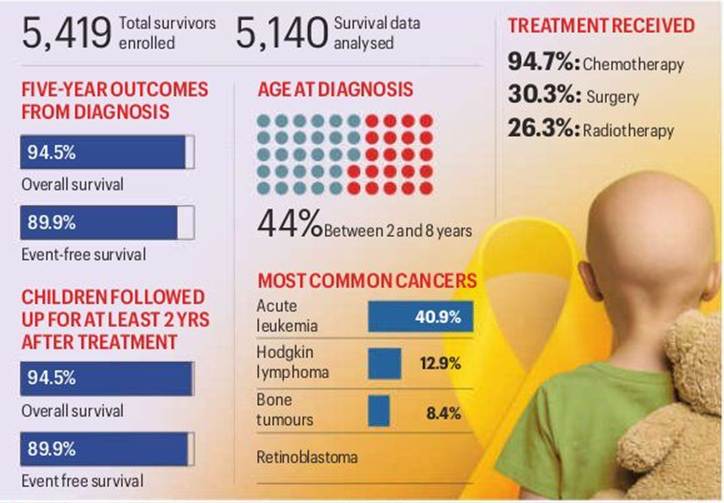
- India’s C2S (Childhood Cancer Survivorship) cohort tracked 5,419 survivors across 20 centres.
- The study reports 94.5% five-year overall survival and 89.9% event-free survival.
- The registry is coordinated by AIIMS New Delhi under the Indian Pediatric Hematology Oncology Group.
- Experts highlight rising survival but caution about late complications among survivors.
Childhood Cancer Burden in India
- Rising detection and survival: India reports nearly 50,000 new childhood cancer cases annually, with survival improving due to expanded oncology services and better treatment protocols.
- Common childhood cancers: Acute leukemia, Hodgkin lymphoma, bone tumours, and retinoblastoma are among the most frequently diagnosed cancers in children.
- Age vulnerability: The study shows 44% cases occur between ages 2–8, indicating the need for strong pediatric screening and early diagnosis systems.
- Socio-economic dimension: Many affected children come from lower-income families, highlighting inequities in access to early diagnosis and long-term care.
Indian Childhood Cancer Survivorship (C2S) Cohort
- First nationwide registry: The C2S cohort (2016–2024) is India’s first structured attempt to systematically track childhood cancer survivors across multiple centres.
- Large sample size: Out of 5,419 enrolled survivors, survival analysis was available for 5,140 children, improving statistical reliability.
- Treatment profile: Nearly 94.7% received chemotherapy, around 30% surgery, and 26.3% radiotherapy, reflecting multimodal cancer care.
- Follow-up mechanism: Survivors were monitored every 3 months (first two years) and every 6 months thereafter, ensuring longitudinal data.
Key Survival Outcomes
- High overall survival: Five-year overall survival stood at 94.5%, meaning nearly 95 out of 100 children survived five years post-diagnosis.
- Event-free survival: The 89.9% event-free survival indicates most children remained free from relapse or major complications.
- Improved outcomes with follow-up: Among children followed for at least two years, survival rose to 98.2%, showing benefits of structured monitoring.
- Global comparison context: These outcomes bring India closer to high-income country benchmarks, though disparities still persist.
Hidden Burden: Late Effects and Long-Term Risks
- Delayed health complications: International evidence suggests 33–50% of survivors may develop long-term complications months or years later.
- Common late effects: Survivors may face cardiac problems, endocrine disorders, cognitive difficulties, and psychological stress.
- Need for survivorship care: The study underscores the importance of multidisciplinary follow-up, including cardiology, endocrinology, and mental health services.
- Quality of life concerns: Issues related to growth, puberty, schooling, and emotional well-being require continuous monitoring beyond cancer cure.
Policy and Health System Implications
- Evidence for policy planning: The registry provides a denominator for designing national survivorship guidelines and long-term care frameworks.
- Strengthening pediatric oncology: Expansion of regional cancer centres and trained pediatric oncologists is essential for equitable outcomes.
- Integration with national programmes: Findings align with goals of Ayushman Bharat and National Programme for Prevention and Control of Cancer, Diabetes, Cardiovascular Diseases and Stroke (NPCDCS).
- Focus on LMIC leadership: India’s model can guide other low- and middle-income countries (LMICs) in building survivorship tracking systems.
Conclusion
India’s first nationwide childhood cancer survivorship registry marks a major step in evidence-based pediatric oncology. While survival rates are encouraging, the emerging burden of long-term complications calls for a shift from a “cure-centric” to a “care-continuum” approach. Strengthening survivorship clinics, integrating mental health and endocrine care, and ensuring equitable access will be crucial to securing not just survival but a healthy life for childhood cancer survivors.
EXPECTED QUESTIONS FOR UPSC CSE
Prelims MCQ
Q. The recently reported C2S cohort in India is related to:
(a) Maternal mortality tracking
(b) Childhood cancer survivorship
(c) Tuberculosis surveillance
(d) Rare disease registry
Answer: (b)
Descriptive Question
Q. Discuss the significance of survivorship registries in improving cancer outcomes in India. Highlight challenges in long-term care of childhood cancer survivors. (150 Words, 10 Marks)