Article 2: Delimitation in India
Why in News: Debate over delimitation post-2026 census has intensified due to concerns about value of vote, regional imbalance, and fiscal federalism in India.
Key Details
- Delimitation refers to fixing Lok Sabha seats, state-wise allocation, and constituency boundaries based on census data.
- India has frozen seat allocation since 1971 Census through constitutional amendments.
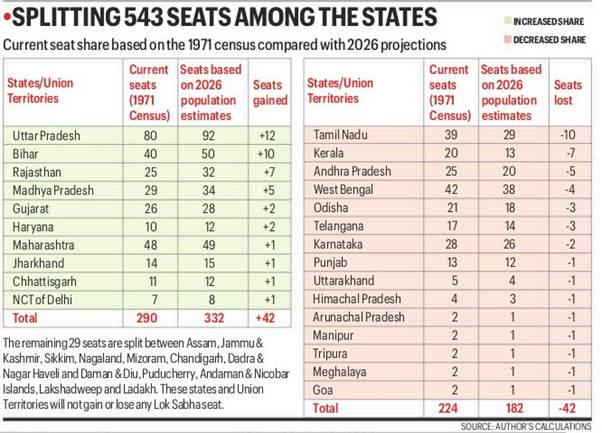
- Uneven population growth may lead to north gaining seats and south losing representation.
- Raises issues of “one person, one vote” vs fiscal and federal imbalance.
Delimitation: Concept & Constitutional Basis
- Meaning and Scope: Delimitation involves allocation of seats and redrawing of constituency boundaries to ensure equal representation. It is conducted by a Delimitation Commission, independent of executive interference.
- Constitutional Provisions: Article 81 ensures proportional representation of states in Lok Sabha, while Article 82 mandates delimitation after every census to maintain equality of representation.
- Principle of Equal Representation: The core idea is “one person, one vote, one value”, ensuring that each MP represents roughly equal population to maintain democratic fairness.
- Independent Mechanism: Delimitation Commission’s decisions are final and cannot be challenged in courts, ensuring neutrality and preventing political manipulation.
Historical Evolution of Delimitation in India
- Early Delimitation Exercises: Conducted after 1951, 1961, and 1971 censuses, ensuring periodic adjustment of representation in line with population changes.
- 42nd Constitutional Amendment (1976): During the Emergency, the government froze Lok Sabha seat allocation based on 1971 Census until 2001 to promote population control policies.
- 84th & 87th Amendments: The freeze was extended till 2026, though boundary readjustments were allowed (based on 2001 Census) without changing seat numbers.
- Current Situation: India still uses 1971-based seat allocation, despite population rising from ~55 crore to over 1.4 billion, leading to representational distortions.
Malapportionment & Value of Vote
- Unequal Representation: Due to freeze, states with higher population growth (e.g., Bihar, UP) are under-represented, while southern states are relatively over-represented.
- Example of Vote Inequality: An MP in Kerala represents ~17.5 lakh people, while in Bihar it exceeds ~30 lakh, meaning votes carry unequal weight.
- Concept of Malapportionment: It refers to mismatch between population share and seat share, violating the democratic principle of equal vote value.
- Democratic Implications: This weakens representative democracy, as citizens in populous states have less political voice per vote.
Regional Imbalance & Political Tensions
- North-South Divide: Northern states like Uttar Pradesh and Bihar may gain seats, while southern states like Tamil Nadu and Kerala may lose seats post-delimitation.
- Population vs Development Debate: Southern states argue they should not be penalised for successful population control policies and better governance outcomes.
- Federal Tensions: Delimitation could shift political power towards populous states, affecting coalition politics and policy priorities.
- Ethnic & Linguistic Concerns: Since states are reorganised on linguistic lines, seat redistribution impacts regional identity and political bargaining power.
Fiscal Federalism & Economic Dimension
- Revenue vs Representation Paradox: Richer states generate higher tax revenues but may lose political representation, creating a fiscal imbalance.
- Centralised Fiscal Structure: The Union controls a significant share of revenues, with only about 40–41% devolved to states (Finance Commission).
- Horizontal Distribution Issues: Allocation formulas consider population and income distance, often benefiting poorer states more.
- Political Economy Concern: Reduced representation may weaken richer states’ ability to influence fiscal decisions in Parliament.
Under-representation & Governance Challenges
- Large Constituency Size: Indian MPs represent 1.5–3 million people, far exceeding global standards, reducing effectiveness of representation.
- Accountability Issues: Larger constituencies make it difficult for MPs to engage with voters and address local issues effectively.
- Comparative Perspective: Many democracies have smaller constituencies, enabling better citizen-representative interaction.
- Administrative Burden: Overburdened MPs may struggle with legislative, executive oversight, and constituency responsibilities.
Delimitation vs Federal Models
- Indian Model: Both Lok Sabha and Rajya Sabha are influenced by population, unlike classical federal systems.
- US Model Example: The House is population-based, while the Senate gives equal representation to states, ensuring federal balance.
- Indian Challenge: Lack of equal representation in the Upper House may lead to dominance of populous states.
- Need for Balance: A stronger federal design is needed to reconcile population-based democracy with state equality.
Way Forward
- Revisit Fiscal Federalism: Greater financial autonomy to states is essential to balance representation and revenue generation.
- Expand Lok Sabha Seats: Increasing seats (e.g., proposals up to ~850) can reduce constituency size and improve representation.
- Reform Rajya Sabha: Strengthening its federal role can ensure state interests are protected irrespective of population.
- Balanced Delimitation Approach: A calibrated method combining population, development indicators, and federal equity is needed.
EXPECTED QUESTIONS FOR UPSC CSE
Prelims MCQ
Q. Which Constitutional Amendment froze Lok Sabha seat allocation based on 1971 Census?
(a) 44th
(b) 42nd
(c) 86th
(d) 73rd
Answer: (b)
Descriptive Question
Q. “Delimitation raises a conflict between equality of votes and equity among states.” Examine. (150 Words, 10 Marks)