Editorial 2 : A first— how a customised gene-editing tool was used to treat 9-month-old boy
Context
A nine-month-old boy, born with a rare genetic disorder, has become the first (known) person to successfully receive a custom gene-editing treatment.
A new version
- He suffered from CPS1 deficiency which causes toxic levels of ammonia to accumulate in his blood.
- To treat him, scientists and doctors from the University of Pennsylvania and the Children’s Hospital of Philadelphia developed a personalised treatment based on “base editing”, a new version of the decade-old CRISPR-Cas9 technology.
- Scientists say this technology can potentially treat thousands of uncommon genetic diseases. But there remain many roadblocks to its universal adoption.
What is CRISPR?
- Following infection by a virus, humans generate an “immune memory” in the form of antibodies. When they are infected by the same virus again, these antibodies quickly identify the pathogens and help neutralise them.
- CRISPR, short for “clustered regularly interspaced short palindromic repeats” is an immune system found in microbes such as bacteria which fights invading viruses.
- When a virus infects a bacterial cell, CRISPR too helps establish a memory but a genetic one, not in the form of antibodies like in humans.
- When a virus enters a bacterial cell, the bacterium takes a piece of the virus’s genome and inserts the DNA into its own genome. CRISPR then produces a new “guide” RNA with the help of the newly acquired DNA.
- During a future attack by the same virus, the guide RNA quickly recognises the virus DNA and attaches itself to it. Then, the guide RNA directs an enzyme (a type of protein) called Cas9 to act like “molecular scissors” to cut and eliminate the virus DNA.
How does CRISPR-Cas9 gene-editing work?
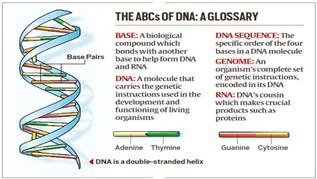
- CRISPR-Cas9 gene-editing works like a “cut-copy-paste” or “find-replace” tool for DNA. DNA is made up of four chemical bases—A, T, C, and G—which pair up to form the double-helix structure.
- To fix a faulty gene causing disease, scientists first identify the abnormal DNA sequence. They then create a guide RNA that matches this sequence and attach it to the Cas9 enzyme, which acts like molecular scissors.
- When introduced into the patient's cells, the guide RNA leads Cas9 to the faulty DNA, which is then cut at that exact spot (a double-strand break).
- To ensure the faulty part does not grow back, a correct DNA sequence is also supplied to patch the break.
- Newer techniques like base editing now allow precise single-letter changes in DNA without cutting both strands, making the process safer and more accurate.
How does base editing work?
- Base editing and CRISPR-Cas9 differ significantly in how they modify DNA.
- Unlike CRISPR-Cas9, base editing does not make a double-strand break. Rather, it enables targeted single-base conversions with the help of a Cas9 enzyme fused to a base-modifying enzyme.
- This allows scientists to fix mispairing of the bases by changing one specific base.
- In the older version of CRISPR, scientists were required to provide additional DNA from outside, which would be pasted at the site where the double-strand break takes place.
- In base editing, however, the system by itself can make a very precise change without the need for a foreign DNA to be inserted.
- As a result, base editing has fewer components and is compact, making it easier to package in delivery vehicles, which can take it to target cells,” he said.
Way forward
- To make base editing more commonplace, a coordinated effort is needed to reduce treatment costs, improve scalability, and streamline regulatory processes.
- Governments must simplify regulatory approvals and provide funding support to make such therapies more accessible, especially in countries with bureaucratic hurdles like India.
- Encouraging public-private partnerships, building local manufacturing capacity, and raising public awareness are also essential steps.
- With such reforms, base editing could eventually become a transformative and affordable solution for treating rare genetic disorders.