Article 2: Global Economic Impact
Why in News: The ongoing West Asia conflict involving the US, Israel, and Iran has disrupted global markets, impacting growth, inflation, and currencies, with significant implications for India.
Key Details
- The conflict has led to global market volatility affecting oil, gold, currency, and trade flows.
- The Indian rupee depreciated nearly 4% in a month, indicating external vulnerability.
- OECD Economic Outlook (2026) shows uneven impact across economies, with some gaining and others losing.
- India faces inflationary pressures and growth slowdown due to energy dependence.
Geopolitical Conflict & Global Economic Transmission
- Strategic Location – Strait of Hormuz: The conflict involves threats to the Strait of Hormuz, through which nearly 20% of global oil supply passes, making it a critical chokepoint affecting energy security.
- War-induced Uncertainty: Geopolitical tensions create uncertainty in global markets, leading to capital flight, supply disruptions, and volatility in commodities like oil and gold.
- Globalisation Linkages: In an interconnected economy, regional conflicts transmit globally through trade, finance, and energy channels, affecting both developed and developing nations.
- Historical Precedence: Similar patterns were observed during the Gulf War (1991) and Russia-Ukraine conflict (2022), where energy shocks triggered global inflation.
Impact on Global Growth
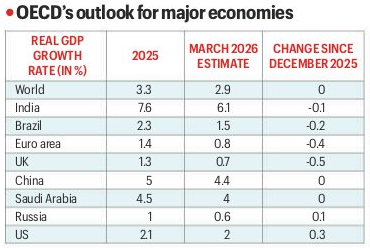
- Resilient but Uneven Growth: OECD estimates show global growth at around 2.9% (2026), appearing stable but masking divergent impacts across countries.
- Biggest Losers – Europe & UK: The Euro Area (-0.4%) and UK (-0.5%) face the sharpest slowdown due to high energy dependence and weak economic recovery.
- Unexpected Winners – USA: The US economy may gain +0.3 percentage points in growth, driven by domestic energy production and increased investments.
- Neutral/Resilient Economies: Countries like China and Russia show relative resilience due to strategic insulation and alternative trade arrangements.
Inflationary Pressures and Energy Shock
- Oil Price Transmission: Rising crude oil prices increase costs of transport, production, and logistics, leading to cost-push inflation globally.
- India’s Inflation Surge: India’s inflation is projected to rise from ~2% (2025) to 5.1% (2026), crossing the RBI’s 4% target, mainly due to imported inflation.
- Developed Economies Impact: The US, EU, Japan, and Korea may witness inflation increases of over 1 percentage point, affecting consumption and growth.
- Exception – Oil-rich Economies: Countries like Saudi Arabia are relatively insulated due to strong domestic oil production and export gains.
Currency Depreciation & Financial Markets
- Rupee Depreciation: The Indian rupee depreciated nearly 4% in a month (₹94.6/$), compared to its usual annual depreciation of 2–3%, indicating external shocks.
- Capital Outflows: Investors shift towards safer assets like US dollar and gold, leading to capital outflows from emerging markets like India.
- Exchange Rate as Economic Indicator: Currency depreciation reflects underlying weaknesses such as trade deficits, inflation, and capital volatility.
- Financial Market Volatility: Stock markets, bonds, and commodities experience fluctuations, reducing investor confidence and economic stability.
Sectoral Impact on Indian Economy
- Energy Dependence: India imports over 85% of its crude oil, making it highly vulnerable to global price shocks.
- Trade Balance Deterioration: Higher oil import bills widen the current account deficit (CAD), putting pressure on foreign exchange reserves.
- Agriculture & Industry Costs: Rising fuel and fertiliser prices increase input costs, affecting both agricultural productivity and industrial output.
- Export Opportunities: Some sectors like IT services, pharmaceuticals, and remittances may benefit from global disruptions and currency depreciation.
Winners and Losers: Comparative Analysis
- Winners – United States: Gains due to energy exports, technological investments, and domestic demand stimulation.
- Relative Beneficiaries – Russia & China: Benefit from strategic trade positioning and alternative economic networks, reducing dependency on Western systems.
- Losers – Energy-importing Nations: India, EU, and Japan face inflation, growth slowdown, and fiscal pressure due to high import dependency.
- Mixed Impact for India: While facing inflation and currency pressure, India retains long-term growth resilience (6.1% GDP growth).
Policy Response & Economic Resilience
- Monetary Policy Measures: The RBI may adopt interest rate adjustments and liquidity management to control inflation and stabilise the rupee.
- Energy Diversification: India is focusing on renewable energy, strategic petroleum reserves, and diversified import sources.
- Fiscal Management: Government may rationalise subsidies and manage fiscal deficit to cushion inflationary shocks.
- Structural Strengths: India’s large domestic market, digital economy, and reforms provide long-term economic resilience.
Conclusion
The West Asia conflict highlights the deep interlinkages between geopolitics and economics. For India, the challenge lies in balancing short-term shocks like inflation and currency depreciation with long-term growth prospects. Strengthening energy security, diversifying trade, and maintaining macroeconomic stability will be crucial. Ultimately, resilient policymaking and strategic autonomy will determine India’s position in an increasingly uncertain global order.
EXPECTED QUESTIONS FOR UPSC CSE
Prelims MCQ
Q. Which of the following best explains the term “imported inflation”?
(a) Inflation due to excess domestic demand
(b) Inflation caused by rising global prices of essential imports
(c) Inflation due to fiscal deficit
(d) Inflation due to monetary expansion
Answer: (b)
Descriptive Question
Q. Discuss the winners and losers of global economic conflicts and evaluate India’s preparedness to deal with such external shocks. (150 Words, 10 Marks)