Editorial 1 : How FTAs with US, EU, UK will impact India’s farm trade
Context
India’s agriculture exports are currently higher than its imports. But that trade surplus could shrink with rising imports, supply-demand mismatches, and pressures to cut tariffs and provide greater market access.
The trade story
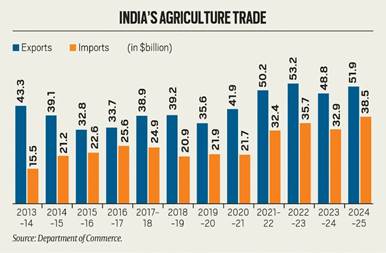
- India’s agriculture exports rose 6.4% to $51.9 billion in 2024-25, from $48.8 billion during the preceding fiscal year ended March 2024.
- A longer period trend reveals India’s agriculture exports declining between 2013-14 and 2019-20, before recovering and peaking in 2022-23.
- On the whole, the increase was from $43.3 billion in 2013-14 to $51.9 billion in 2024-25 or just over 20%.
- Imports, in contrast, have posted steadier expansion from $15.5 billion in 2013-14 to an all-time-high of $38.5 billion in 2024-25, working out to 148%.
- India’s agriculture trade surplus, too, has more than halved from $27.7 billion to $13.4 billion over this period.
- All this comes even as India is negotiating trade agreements with the United States and European Union, which are both seeking tariff reductions and greater market access for their agricultural products.
Export drivers
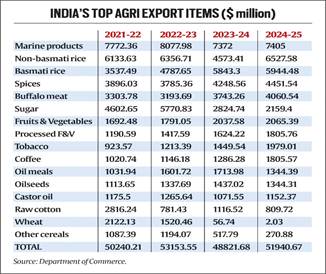
- The No. 1 export commodity, marine products, has registered a drop in 2022-23 in the following two fiscals.
- Marine exports from India are largely to the US (roughly 35% share), China (20%) and the EU (15%).
- Shipments to the US, predominantly frozen shrimps, now attract 17.7% duty. That includes the 10% baseline tariff imposed recently.
- There are no such worries with rice, where the value of both non-basmati and basmati shipments reached record levels in 2024-25.
- The bulk of India’s basmati goes to West Asia, while it is Africa for non-basmati grain.
- Rice apart, exports of spices, tobacco, coffee and fruits & vegetables (both fresh and processed) scaled new highs during the last fiscal.
- Coffee exports from India got a boost from global ending stocks for 2024-25 depleting to a 25-year low, on the back of drought in Brazil and dry weather followed by a typhoon in Vietnam.
- India mostly exports robusta beans and powder used in instant coffee and espresso blends.
- Poor crops in Brazil and Zimbabwe last year likewise benefitted Indian tobacco exporters.
- Spices are an interesting case, where both exports from and imports into India surged to record levels in 2024-25.
- India is a preeminent exporter of chilli, cumin, mint products, oleoresins, curry powder/paste and other non-traditional spices such as turmeric, coriander, fennel, ginger and garlic.
- On the other hand, it has become a net importer of the two traditional plantation spices, namely pepper and cardamom.
- The commodities whose exports have suffered on account of domestic supply shortfalls include wheat, sugar and cotton.
- India continues to export refined/white sugar. However, this is from processing imported raw sugar, the value of which has correspondingly gone up.
- Cotton is a sad story, where India’s exports had crossed $4.3 billion in 2011-12 and $3.7 billion in 2012-13.
- Exports have not only collapsed, but the country has turned into a net importer of the natural fibre.
- Buffalo meat exports surpassed $4 billion in 2024-25, but are still below the $4.4 billion and $4.8 billion levels touched in 2013-14 and 2014-15, respectively.
Import drivers
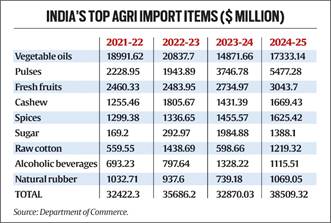
- Coming to imports, the big-ticket items remain vegetable oils and pulses.
- Low per-acre yields relative to rice and wheat, plus no equivalent system of minimum support price-based government procurement, have made it less viable for Indian farmers to ramp up production of oilseeds and pulses.
- The result is a soaring import bill. In vegetable oils, it’s only partly offset by exports of oilseeds (mainly groundnut and sesame) and the residual cake/meal after extraction of oil.
- Pulses imports were valued at $5.5 billion in 2024-25, pushing past the $5 billion mark for the first time.
But it isn’t just edible oil and pulses.
- Stagnant, if not falling, domestic production is also leading to rising imports of cotton and natural rubber.
- With no yield-raising technologies after genetically modified (GM) Bt hybrids, India’s cotton output has dipped between 2013-14 and 2024-25. Rubber production, too.
- This, even as domestic consumption has inched up from 10 lt to 15 lt during the past decade.
- The other significant agri import items are fruits (almonds, pistachios, walnuts, apples, dates, figs and raisins, among others), spices (basically pepper and cardamom) and alcoholic beverages.
Conclusion
With the signing of trade pacts with the US, EU and the United Kingdom, one can expect more imports of dry fruits, wines and spirits. Additionally, the Trump administration is likely to push for import duty cuts and easing non-tariff barriers on maize, soyabean and cotton. All this will ultimately reflect in India’s agricultural exports, imports and the surplus – whether that would further shrink remains to be seen.